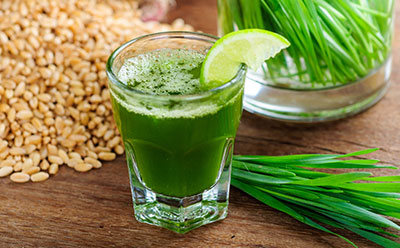





Wheatgrass Juice

Is the magical mystery juice all it's blended up to be?

Filed under Consumer Ripoffs, Fads

Skeptoid #06
November 09, 2006
Podcast transcript | Listen | Subscribe
Also available in Japanese
Bookmark and Share

The other day, I was getting a pineapple smoothie for lunch, when I happened to notice a poster extolling the virtues of wheatgrass juice. I didn't know too much about it, except that I've heard a lot of people talk about it as if it's the second coming. So out of curiosity, I began reading.

My friends, the English language does not contain adequate hyperbole to do justice to the tons of manure printed on this poster. If the average person can take even half of this poster seriously, then the ignorance and gullibility of the general public is much worse than even I would have ever guessed.

The poster was a list of claims, almost all of which centered around chlorophyll, of which it said wheatgrass juice is a rich source. Chlorophyll, as you know, is used by plants to synthesize proteins and sugars, using radiation from the sun to power a chemical reaction, converting carbon dioxide from the air and water from the ground into proteins and sugars, exhausting oxygen as a waste byproduct. Humans and other animals, not surprisingly, don't work this way. We get our proteins and sugars by eating food; our bodies have no special use for chlorophyll.

Now, I'm not saying that there's anything unhealthy or bad about wheatgrass juice. It's probably at least as healthy as just about any other plant that you could put in your juicer and blend into green syrup. I probably wouldn't rate wheatgrass as high on the nutrition scale as a proper vegetable, but I doubt very much that there's any harm in it. However, wheatgrass juice proponents don't merely claim that it's healthy. They've assembled the most outrageous list of vague medical conditions that it cures, and all sorts of types of wellness that it supposedly promotes. Since these claims are all entirely unsubstantiated, and sound far fetched to say the least, this is certainly a product you should approach skeptically. Let's take a look at some of these claims.

Wheat grass is high in oxygen like all green plants that contain chlorophyll, and the brain functions at an optimal level in a high-oxygen environment.

While it's true that if you cut off the oxygen supply to your brain, its function will be somewhat less than optimal, it's not true at all that chlorophyll is a good source of oxygen. I suggest you continue to rely on your lungs for that, which are probably better, since you don't have leaves. All types of chlorophyll have only trace amounts of oxygen. Chlorophyll is a carbohydrate, thus its makeup is overwhelmingly carbon and hydrogen. The molecule has as many as 127 hydrogen and carbon atoms, but only 5 or 6 atoms of oxygen, 4 of nitrogen, and one lonely magnesium atom. Incidentally, this also refutes another claim: that the high magnesium content of chlorophyll builds enzymes that restore your sex hormones. Interesting, given that enzymes are proteins made of amino acids, which contain no magnesium at all. I have no idea whether a single atom of magnesium restores sex hormones, whatever that means, but if so that's one hell of an atom. If you want magnesium, take a vitamin pill. If you want oxygen, take a breath. If you want sex hormones, get a girlfriend.

Wheatgrass juice has been proven to cleanse the lymph system, building the blood, restoring balance in the body, removing toxic metals from the cells, nourishing the liver and kidneys and restoring vitality.

The grammatical errors are from the poster, not from me. Let's take these one at a time. First, the claim that it's been "proven" to do any of these things. Notice that these claims are very vaguely worded: "restores balance", and "builds the blood". This is deliberate. If they tried to be specific, they would get into trouble with the FDA. If you make a claim that a product is intended to diagnose, mitigate, treat, cure, or prevent a specific disease, and your product has not been tested and is therefore unregulated, you're in violation of the law (21 U.S.C. 343(r)(6)). The wheatgrass people of course can't actually submit their product for testing against any particular diseases, because of course it would fail. So they are relegated to making only vague, untestable claims like it "builds the blood" and "restores balance".

As for whether the ingestion of wheatgrass will lower the levels of toxic metals in your cells, I wasn't able to find any research that supports this. However I did find research where living wheatgrass was found to be one of the grasses most susceptible to the absorption of zinc and cadmium from the soil through its root system, so it's more likely to be contaminated with these metals. If lowering your toxic metal levels is important to you, wheatgrass is the last thing you should put on your shopping list. And, of course, this is all founded on the assumption that you have toxic metal problems that need to be addressed. Before you seek out quack remedies for this unusual illness, first find out from a medical professional that this is indeed a problem you have, and don't go only on the assurance of a health food store owner who wants to sell you something. Probably the best thing you can do is stop chewing the lead paint off your windowsills.

It contains most of the vitamins and minerals needed for human maintenance, including the elusive B12.

Sounds compelling! But it sounded less compelling when I turned away from the poster, and looked at the store's own nutritional facts chart. The only vitamins present in a 2-ounce shot of wheatgrass juice are 15% of your daily allowance of Vitamin C, and 20% of iron. The rest of the vitamins and minerals, "elusive B12" included? Zeros, all the way down the board. The bottom line is that a shot of wheatgrass juice offers far less nutrition than a single Flintstones vitamin pill.

I would welcome a scientific test of wheatgrass juice. I challenge wheatgrass proponents to pick any supposed benefit of wheatgrass juice, and substantiate it in a real test. And by a test I don't mean a report from a hippie whose energy fields have been rejuvenated. I mean one of their claims that some sick people might actually believe and are avoiding important medical treatment as a result, such as the claim that wheatgrass juice will reduce high blood pressure. That's easy enough to test in a real, peer reviewed, double blind clinical trial. Take notice that the wheatgrass proponents have not done such a test, and there's probably a very good reason they've avoided it. Approach far fetched claims with skepticism, especially those that have not been, or cannot be, substantiated.

$2/mo $5/mo $10/mo One time

In the meantime, I'll continue to enjoy my pineapple and banana smoothies, no wheatgrass juice, bee pollen, or extract of ginseng needed.

Follow me on Twitter @BrianDunning.

Brian Dunning

© 2006 Skeptoid Media, Inc. Copyright information

References & Further Reading

Alberts, B., Bray, D., Johnson, A., Lewis, J., Raff, M., Roberts, K., Walter, P. Essential Cell Biology: An Introduction to the Molecular Biology of the Cell. New York: Garland Publishing, 1998. 12-13, 432-434.

Bidlack, W., Meslin, M. "Nutritional quackery: selling health misinformation." California Pharmacist. 1 Feb. 1989, Volume 36: 34-43.

Jarvis, W.T. "Wheatgrass Therapy." National Council Against Health Fraud Resource Documents. National Council Against Health Fraud, 15 Jan. 2001. Web. 9 Nov. 2006. <http://www.ncahf.org/articles/s-z/wheatgrass.html>

Lister, C. "Wheat Grass Nutritional Analyses." Crop & Food Research. The New Zealand Institute for Crop & Food Research Ltd, 12 Sep. 2002. Web. 9 Nov. 2006. <http://www.barleyleaf.co.nz/rightpages/WheatGrass.html>

Ross, Sharon. "Functional Foods: The Food and Drug Administration Perspective." The American Journal of Clinical Nutrition. 1 Jun. 2000, Volume 71, Number 6: 1735S-1738S.

Reference this article:
Dunning, B. "Wheatgrass Juice." Skeptoid Podcast. Skeptoid Media, Inc., 9 Nov 2006. Web. 20 Jun 2013. <http://skeptoid.com/episodes/4006>

Discuss!

10 most recent comments | Show all 380 comments

I ate celery the other day and it didn't heal my ailment - so I am very skeptical that celery even works ..

Ok, this is pretty much how skeptics always sound ..

The thing about natural foods/remedies, is that it's relatively hard to measure what exactly is going on ..

It's not like caffeine or ibruprofen where you can say, "Yup, that works!" just because you feel something happening, or can measure it on some retarded device some dumbass made.

The human body is much more complex than that - besides, chemists have ruined the world with all of their horseshit chemicals - like they know anything about health!

Anyway, I'd say wheatgrass actually does work for various ailments, and it kind of depends ..

For me, it's been a great way to easily add a few servings of veggies everyday - who actually chokes down 7 servings a day?!

Wheatgrass effortlessly changes your ph from acidic to alkaline - this is a VERY big deal ..

Wheatgrass is a highly concentrated green - so you only need a small amount to up your veggie intake - instead of choking down a huge pile of vegetables (although I still eat as many veggies as I can choke down).

Also, wheatgrass varies - the stronger stuff is called "Wheatgrass Juice" - the term 'juice' means it's much more concentrated, and more likely to help you.

Better brands, like Brightcore's Sweet Wheat, will have little to no toxins ..

The way this author talks, you'd think you could just kill him and replace w/carbon or something.

John, Anytown
March 08, 2013 2:05am

I am a student at the University of Toronto specializing in Developmental Biology and Animal Physiology and every time I hear this Wheatgrass nonsense my head explodes.

Grass, of any species, is primarily made of cellulose. As natural omnivores our digestive system does not produce the enzymes required to break down this molecule.

The difficult process of breaking down cellulose is the reason why cows and other cud chewers need four stomaches and take 80 hours to completely digest the grass they eat.

If you need to eat greens, eat vegetables. If you want more energy from plant food, eat fruit.

Caity, Toronto,ON
March 23, 2013 10:39am

It appears John likes the almost science words..Its called pseudoscience John

Mud, Pho s Brewery NSW, Oz
March 27, 2013 8:57am

Wheatgrass Juice does not contain cellulose. No one is talking about eating grass. Animals can not only survive on a diet of grass, but can thrive on grass alone. It is a complete food, which can be utilizied by humans by juicing it.

It works wonders for many, personally I love it! Works much better than coffee for a pick me up. No jitters and no crash

Paul Drufva, Old Saybrook
March 28, 2013 6:14am

"Wheatgrass effortlessly changes your ph from acidic to alkaline - this is a VERY big deal .."
You can't, and shouldn't, change the pH of your body. Doing so would kill you. Just saying.

Øyvind, Sogndal
April 17, 2013 8:20am

@John, Anytown
"I ate celery the other day and it didn't heal my ailment - so I am very skeptical that celery even works ..

Ok, this is pretty much how skeptics always sound .."

No, that's generally how believers sound: 'When I tried wheatgrass juice, I felt better, so it must work.'

"The human body is much more complex than that..."
Indeed it is, which is why we have controlled tests and trials, the kind that wheatgrass juice has yet to pass.

"...besides, chemists have ruined the world with all of their horseshit chemicals - like they know anything about health!"

Even if chemists ruined the world, does that show that wheatgrass does what you claim? Even if chemists ruined the world, does that mean they know nothing about health? Even if they nothing about health, does that prove show wheatgrass' efficacy? It's like one big non-sequitur sandwich.

"Anyway, I'd say wheatgrass actually does work for various ailments..."
Based on what? Personal experience, the thing you (rightfully) derided earlier? Or are there studies that back you up?

"Wheatgrass effortlessly changes your ph from acidic to alkaline - this is a VERY big deal ."

Do you know what happens when you change your body's pH from it's natural state? It tries to change it right back, because if it doesn't, things go very wrong, very quickly. Yep, a VERY big deal indeed. Wheatgrass has no significant effect on body pH, and if it did, it would be unhealthy, to say the least. It would beike drinking bleach.

Yabeen Sees, Tooleedoo
April 17, 2013 10:18am

If its science people want to prove anything dont worry there will be enough eveidence IF the profits are high enough to go after....if you look at ALL..ALL! claims of pills potions, exercise machnines, personal trainers. and endless foods and systems that claim weight loss then these are INFINITE. This Billion dollar industry that claims weight lose works and yet hide behind a simple "scientific" wording that pops up in small letters as "the" scientifically proven quote "this can only help as part of a calorie controlled diet" (which of course even if all skeptics wanted to loose weight would not know how to do by not understanding calorie intake on a weekly daily basis)
So its all about profit the reason there are no tests and will never be a test is because how much money can be made selling fresh wheatgrass (forget the dried rubbish) at $15 a tray and $2 a shot with 8 serevings per tray!! and there no allowance for cost for labour

There is more money selling skeptic books as an author than there is selling wheatgrass for profit even if some whacky billionaire could prove a wheatgrass test on oxygenating the blood or explaining the slight buzz you get from it that you do not get from spinach (juice??) yet 4 times the buzz you get of an addictive expresso shot.
vernon montgomery
24hrgym swindon

vernon montgomery, swindon wilts UK
April 22, 2013 5:07am

Congrats Brian on making an article that still pissing off hippies nearly 7 years later.

Chris, Westford, MA
April 25, 2013 1:02pm

True, who knows if it really works or not? BUT...I will say that it always amazes me the efforts people will go to, in order to try and ridicule people from trying to be healthy as though its some sort of harmful substance or antisocial lifestyle choice.
Seems to moi that 'ye olde fast food and beer consuming folk' feel better once they have everyone else fat as fools along side 'em....entertaining article all the same, but I can't say I've ever heard of anyone 'die by wheatgrass', or even developing chronic diseases from 'passive wheatgrassing' ;)

Pepper Pops, Wheatgrass Valley
May 29, 2013 12:27pm

I stopped into my local health food store today to get a fresh green juice, I had been reading a little about wheatgrass and asked about it, of course they could add a 2oz shot of it to my juice for $6.99 but I was told I couldn't run wheatgrass through my juicer, I had to buy a special juicer that they conveniently could sell me for $249.00, I'll stick to vegetables

treeman, jax, fl
June 01, 2013 3:47pm

Make a comment about this episode of Skeptoid (please try to keep it brief & to the point). Anyone can post:

Your Name:
City/Location:
Comment:
characters left. Discuss the issues - personal attacks against other commenters, posts containing advertisements or links to commercial services, nonsense, and other useless posts will be deleted.
Answer 7 + 1 =

You can also discuss this episode in the Skeptoid Forum, hosted by the James Randi Educational Foundation, or join the Skeptalk email discussion list.

What's the most important thing about Skeptoid?

Support Skeptoid
 
Skeptoid host, Brian Dunning
Skeptoid is hosted
and produced by
Brian Dunning


Newest
Who Is the Grinning Man?
Skeptoid #367, Jun 18 2013
Read | Listen (12:51)
 
The Sedona Energy Vortex
Skeptoid #366, Jun 11 2013
Read | Listen (12:32)
 
The Black Knight Satellite
Skeptoid #365, Jun 4 2013
Read | Listen (14:19)
 
Listener Feedback: Conspiracies
Skeptoid #364, May 28 2013
Read | Listen (12:56)
 
All About Graphology
Skeptoid #363, May 21 2013
Read | Listen (12:42)
 
Newest
#1 -
8 Spooky Places, and Why They're Like That
Read | Listen
#2 -
Skinwalkers
Read | Listen
#3 -
The Suicide Dogs of Overtoun Bridge
Read | Listen
#4 -
Student Questions: Food Woo and Iron Man at the Airport
Read | Listen
#5 -
Negative Calorie Food Myths
Read | Listen
#6 -
Listener Feedback: That Darned Science
Read | Listen
#7 -
The Loch Ness Monster
Read | Listen
#8 -
Secrets of the Stradivarius
Read | Listen

Recent Comments...

[Valid RSS]

  Skeptoid PodcastSkeptoid on Facebook   Skeptoid on Twitter   Brian Dunning on Google+   Skeptoid RSS

Members Portal
beta


"Are We Alone?"
inFact with Brian Dunning


Support Skeptoid
Join today and become
a part of this.