 |
      
|
 |
SkinwalkersSkeptoid Podcast
#321 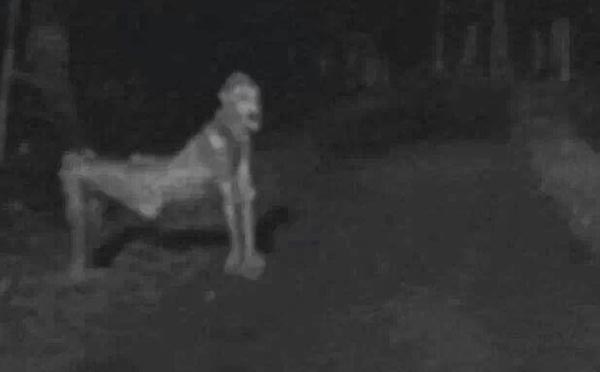 From the plains of the American West comes a story with a history as long as that of the Native Americans themselves: the skinwalkers. Witches, a class of outcast criminals who practiced black magic, were said to have the ability to shapeshift into any animal they chose. Such people were called skinwalkers, and if one was suspected, it was legal to kill them on sight. Skinwalkers would take the hide of a wolf or coyote, put it on, and were said to physically transform into that animal. They would appear slightly too large, disproportionate, and have red glowing eyes. They left oversized animal footprints. When in human form, skinwalkers used various spells and potions to sicken and kill those around them. And as animals, they were fierce, vicious, and bloodthirsty. Hardly any creature in the folklore of the Native Americans was as feared as the skinwalker. Some version of the American skinwalker is found in most Native American cultures, but it's the Navajo that is most prevalent. But shapeshifting humans are common in the mythology of almost every culture worldwide. In fact we can even trace the shapeshifting witches along the human civilizations that first entered the Americas via the Bering Strait from Asia, beginning with the Wendigo of the northern tribes. The Navajo tradition comes down from the Anasazi, an umbrella term for the prehistoric Native American tribes, and we can follow the stories south from there as humanity gradually filled the continent. From the Aztec Nagual (NOW-all) in what is today Mexico, the Olmec Were-jaguar, the Maya Huay Chivo and Wayob, all the way down to the Chilean and Argentinian Chonchon, the shapeshifting witch or sorceror is a staple of cultural folklore. The list of transforming beings from Europe, Asia, and Africa (from folklore alone, even omitting fiction) would fill an encyclopedia. Most stories of the Navajo skinwalker today carry a modern touch, such as the various ways skinwalkers could and could not be killed with bullets. This may be simply because it wasn't until European culture began to mix with the Native Americans, and introduced things like guns and horses, that the stories were translated into English. Stories of the skinwalkers are usually about strange half-human looking creatures chasing cars and terrorizing the innocent on foot. Here's a sampling:
Skinwalker tradition holds that if one is shot but only wounded, the wound will still be there when it transforms back into human shape. It's also said that to be killed, a skinwalker in animal form must be shot through the neck. This goes back to the way an animal skin is worn ceremonially, with the animal's head on top of the person's head, and its skin draped over the person's back. Shooting the skinwalker in the neck thus pierces the head of the human inside; any other shot merely creates a harmless wound. Perhaps the best known facet of the skinwalker lore is the so-called Skinwalker Ranch in Utah. To understand Skinwalker Ranch, you have to know Robert Bigelow, the wealthy hotel entrepreneur who owns the Budget Suites of America hotel chain. Today he's best known as the founder of Bigelow Aerospace, a private space ventures company that wants to expand into orbiting space hotels. Bigelow Aerospace is very serious: they actually launched two modules, Genesis I and Genesis II, in 2006 and 2007, that remain in orbit as of this date. But in 1995, Bigelow himself was more interested in spending his vast fortune on paranormal research. There was a 480-acre ranch owned by the Sherman family in Utah's largely barren Uintah County which was popularly believed to have a long history of unusual UFO sightings, cattle mutilations, strange creatures, and other assorted colorful tales. Its story was brought to the popular consciousness by journalist and Coast to Coast AM co-host George Knapp, the same guy who introduced fellow Las Vegas resident Bob Lazar to the world. Bob Lazar was a hoaxster who, for a time, convinced a lot of UFOlogists that he had been an engineer working for the military at Area 51, reverse engineering alien spacecraft. So Knapp was the perfect man to publicize the Sherman ranch under his nickname for it, UFO Ranch. Knapp published a few articles in local Utah papers and in Knapp's own weekly column in Las Vegas, telling about the UFOs said to fly around the ranch. Knapp's publicity caught the attention of Robert Bigelow, who purchased the ranch in 1995 and then hired molecular biologist Colm Kelleher to head up his science team, which included a handful of PhDs in various disciplines. Bigelow called his enterprise the National Institute for Discovery Science. For the better part of a decade, Bigelow and Kelleher's group set up shop on the ranch and, with an assortment of paranormal researchers and working scientists who had interests in the paranormal, made observations. They called it Skinwalker Ranch. With a small portable building as a command post, they kept the ranch manned 24 hours a day to record any phenomena with remote cameras, and Knapp reported on any sightings they collected. They never found anything Kelleher would describe as physical evidence of anything, in fact the only real phenomena anyone ever experienced there were occasional cattle mutilations and floating lights. From my read of Knapp's reporting, none of it sounded outside the realm of normal cattle carcass predation and the various types of ghost lights we've discussed here on Skeptoid. Skinwalker Ranch seemed to have little or nothing to do with skinwalkers. Knapp and Kelleher eventually published all of this in a book called Hunt for the Skinwalker, which, paradoxically, was mostly about hunting UFOs on the ranch instead. The explanation for the name Skinwalker Ranch came from their friend, UFOlogist Junior Hicks, who told that the ranch was "in the path of the skinwalker" according to, as he said, a curse that the Navajo once placed on the Utes. I was not able to find any historical basis for this suggestion. More likely, the name Skinwalker Ranch was chosen in recognition of the popularity of author Tony Hillerman's 1986 novel Skinwalkers, which is said to have been a pretty decent read, and had a classic juxtaposition of Navajo mysticism with modern detective science. It was probably this novel's success that suggested to Bigelow and Knapp that capitalizing on the scary-sounding word "skinwalker" would be a good marketing choice for their ranch and nonfiction book. Others have thought so too. At least three movies have since been made, either based on Hillerman's novel or leveraging its same theme of Navajo werewolves. But other than anecdotal stories like those given earlier and the plentiful cultural mythology, there's never been any evidence that real skinwalkers have ever been anything more than unnamed, unknown Native Americans who donned animal hides and fancied themselves witches. But believers in the legend — at least, believers outside of the Native American culture — have worked hard to suggest that shapeshifting witches might be real. In paranormal literature about Skinwalker Ranch, much is often made of the fact that the Sherman family lasted only 30 months on the property before leaving, ostensibly due to all the paranormal activity. The Shermans themselves have never given this as the explanation: True, they'd lived there only 30 months, but then Robert Bigelow knocked on their door with his enormous checkbook, and bought it from them. Their stay was short because Bigelow bought them out, not because they were driven away by UFOs or monstrous creatures. Some have also pointed to clinical lycanthropy, a bona fide psychological condition, as a legitimate basis for the authenticity of skinwalkers. It turns out that the psychiatric literature is indeed sprinkled with cases where patients held delusional beliefs that they were animals, which is what lycanthropy is. These cases give us two interesting clues that may help us to understand the skinwalker phenomenon, and the larger worldwide idea of shapeshifters in general. First, it turns out that such cases are generally found in patients who believe it to be a punishment for some sinful act. While the good news today is that the symptom of lyncanthropic delusion is usually easily reversible with psychiatric treatment, the interesting part is that the patient believes it to be associated with evil. Navajo witches who become skinwalkers are said to be unscrupulous and motivated by selfishness. Such a person, who may be distraught with guilt over some sinful act, might fall into clinical depression, and these cases have usually been major depressive disorders with psychotic features. Second, a 2012 literature survey of many such cases found that the specific animal, by which the patient believed himself to be demonically possessed, varied by culture. In each culture, an animal associated with evil was usually the subject of the delusion. Wolves have been mankind's most feared predator throughout Europe and North America, so it's not at all surprising that sufferers of clinical lycanthropy would manifest as werewolves in Europe and as skinwalkers in North America. The idea of clinical lycanthropy does appear to tick all the boxes, making it a viable candidate to explain how and why the legend of the skinwalkers exists. Perhaps in an episode lost to history, some Navajo tortured by guilt and depression believed himself possessed by a wolf spirit as punishment for his sins. Perhaps he acted out the role, and perhaps the story was told and retold, and medicine was developed to contextualize the concept of the skinwalker. It could well be that the Navajo skinwalker is the result of well-meaning shamen codifying their belief into an official explanation and response plan: This is what a skinwalker is, this is what should be done about them if one appears. This is pure speculation, of course, but the information we have suggests that some such circumstances probably have taken place in many cultures. And thus we can easily imagine how the actions of many disturbed individuals, over the centuries, could result in the prescientific belief (and a resulting deep cultural tradition) that skinwalkers are real, that they do indeed physically transform, and that they can indeed be found witching their incantations and charms over a fire.
Cite this article:
©2024 Skeptoid Media, Inc. All Rights Reserved. |