 |
 |
  
|
 |
The Loch Ness MonsterThe world's most famous cryptid is said to swim in Scotland's most famous loch. Skeptoid Podcast #318 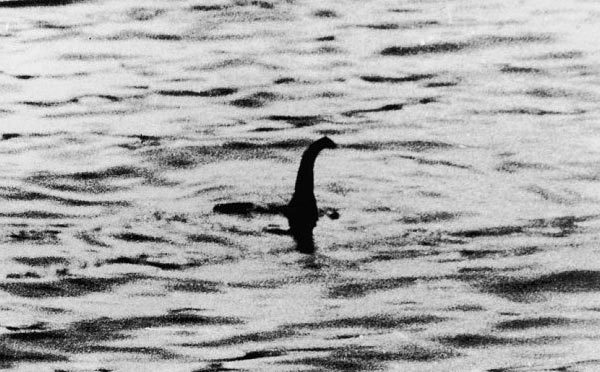 by Brian Dunning Today we're going to plunge into the deep, dark, cold waters of Loch Ness, by volume the largest lake in Scotland. The world's most famous cryptid is said to live here, cruising about the black depths, and occasionally poking its head up to alarm passersby. The Loch Ness Monster, dubbed Nessie, is said to have been plaguing the loch since the sixth century when St. Columba commanded it to cease an attack on one of his followers. Since 1933, various photographs and films have been presented, said to depict a distant and hazy Nessie. Is Nessie a real animal, or does her value lie elsewhere? There are three basic possibilities to explain the sightings at Loch Ness. The first is that an unknown species of megafauna actually does live in the lake and is responsible for at least some of the sightings. The second is that deliberate hoaxes are responsible, and we already know for a fact that this explains at least a few of the sightings. The third possibility, which probably explains most sightings even if either of the other two possibilities are true, is honest misinterpretations of ordinary or unknown objects or phenomena. So the major question that stands is whether any good evidence exists that is not explainable as #2 or #3. Does an unknown megafauna lurk beneath the surface? Loch Ness is home to many species of animals. There are many fish, mainly salmon, trout, eel, char, and sturgeon, plus at least a dozen less common varieties. Otters live in the loch, and seals occasionally make the trip up the river from the North Sea, sometimes in small groups of up to five, and have been photographed in Loch Ness many times. There's even at least one confirmed photograph of a dolphin in the loch in the 1930s. The loch is a bit of a biological desert. In most lakes, growth of phytoplankton is limited by available nutrients. Loch Ness is unusual in that its phytoplankton growth is limited instead by light. Nutrients such as phosphorus are available, but the water is so dark and opaque that photosynthesis is next to zero, strictly limiting the phytoplankton population. The reason for this murkiness is peat, the decayed vegetation that makes up much of the surrounding soil. Like any lake, Loch Ness has all sorts of natural features which are going to look strange to observers. Boat wakes and converging waves create the appearance of a line of humps moving along. Birds and fish break the surface while feeding. Wind reefs create lines that appear to be the wake of a moving object. For every eyewitness report that might be of Nessie, we have to sort through fifty eyewitness reports that were actually of Mother Nature trying to trick us into thinking we were seeing Nessie. Evidence for Nessie's existence is entirely anecdotal, meaning it consists of stories, photographs, and films that are not testable. We have no remains or reproducible sightings. The value of anecdotal evidence is to suggest directions for research, and so for nearly a century, researchers both amateur and professional have been following up on these leads hoping to find proof. So far all we've accumulated are more stories and more dubious photographs. There are really only three photographs that unambiguously show a monster-like animal. Photos are one of the most exciting pieces of evidence, and they're the ones that stay in our memories the longest. The first of these is perhaps one of the most widely published photographs in the world, and it's the one you've probably seen yourself: the slightly blurry 1934 black-and-white image of a plesiosaur-style neck and head stretching up out of the loch's waters. Dubbed the "surgeon's photo" since photographer Lt. Col. Robert Wilson was a doctor, this has been the keynote icon for Nessie for most of a century. Attempts by skeptics to assign it an alternate explanation, such as the head and neck of a deer swimming across the loch, fell pretty flat; it's clearly not a deer. The only thing suspicious about the photo was the size of the creature compared to the natural wavelets in the water around it. It seemed quite small, about sock-puppet sized. And so it was not surprising — though undoubtedly disappointing — when, sixty years after the photo was taken, one of the conspirators revealed the facts. A man named Marmaduke Wetherell had once gained himself a bit of Nessie notoriety by taking a hippo-foot umbrella stand and stamping some fake Nessie footprints into the mud with it. He was not pleased with the way the Daily Mail newspaper treated him in the aftermath, and so he decided to get a bit of revenge, perhaps figuring that two wrongs made a right. Wetherell engaged the services of his stepson, Christian Spurling, to build Nessie for him. Spurling purchased a toy submarine about 35cm long (just over a foot) and soldered a lead keel to it for stability. He then spent a total of eight days crafting the head and neck out of wood filler putty. They took the contraption down to the loch, and Wetherell's son Ian snapped the photograph. They engaged their friend Col. Wilson to be the front man, contrived a story for him to tell about how he came to see and photograph the beast, and then the picture was duly provided to the newspapers. This exposé was broken to the press in March of 1994 by Loch Ness zoologist David Martin and his friend, London art teacher and Nessie enthusiast Alastair Boyd. Martin had seen a 1975 newspaper article in which Ian Wetherell detailed his role in the hoax, an article which, for some reason, had failed to attract much attention. Boyd and Martin tracked down the last of the surviving conspirators, Christian Spurling, who was 93 years old, close to death, and happy to talk about his submarine. Spurling died in September of 1993, then Boyd and Martin wrote and published Nessie: The Surgeon's Photograph Exposed. The second unambiguous photo, taken in the early 1970s by attorney and Nessie researcher Robert Rines, is a deepwater black-and-white closeup of a diamond-shaped fin protruding from a large body, called the "flipper photo". Although widely published and very distinct, the flipper photo turns out to have a discouraging history. It was, basically, a painting. Rines said it was merely "enhanced", but a comparison with the original (widely available on the Internet) shows that the actual subject was completely indistinct, to the point that it's not even clear if there was anything there or not. In dark Loch Ness, if anything was close enough to the camera to be visible, it would be close enough to make out. The third popular photo also came from the Rines underwater expeditions, and shows what appears to be an extremely grainy, though relatively distinct, full view of a plesiosaur-like creature arcing through the water, complete with long neck and short stumpy legs. The obvious problem with this picture is that to fit into the frame, a plesiosaur would have to be far enough from the camera that it would be completely invisible — which in murky Loch Ness requires only about a meter. It turns out that this requisite nearness to the camera explains the photo's nickname, the "treestump photo". During Operation Deepscan, a 1987 effort to comprehensively sonar map the loch, sponsored by sonar manufacturer Lowrance for publicity, Rines' exact same tree stump was rediscovered... still in the same position, and still showing the miniature plesiosaur (assuming a bit of imagination). That plesiosaur hypothesis is one that's been among the most popular for some time, but as cool as that would be, it's not very likely. First, Loch Ness did not exist until the glaciers that cut it receded about 10,000 years ago. By then, plesiosaurs had been extinct for 65,000,000 years, but even if a relict population had survived in the oceans, there was never a time when they could have swam into the loch. Elasmosaurus, the long-necked plesiosaur most often depicted in artist renderings of Nessie, had a long but very stiff neck. It was incapable of bending in the swanlike S-shape usually drawn. It couldn't bend up at all, eliminating it as a candidate for the surgeon's photo. Moreover, a neutrally buoyant animal is never able to lift so much mass out of the water without strongly driving upward, the way a dolphin's able to jump. The animal in the surgeon's photo seemed to be perfectly stable despite a hundred kilograms of meat lifted high above the surface. Nothing about it at all can be considered consistent with Elasmosaurus or any other plesiosaur. Whether a plesiosaur or any other type of air-breathing animal, Nessie manages to stay hidden implausibly well. Plesiosaurs probably needed to come up for air at least once an hour. A breeding population necessary for minimal genetic diversity would require at least 100 individuals. This means that there should be a minimum of several thousand heads popping up per day for air. Given that there are so few sightings, in light of the number of eyes watching the loch every day, the possibility that any air-breathing yet unseen animals are in the loch becomes vanishingly small. Let's take a closer look at that ancient tale of St. Columba commanding the monster to go away. This story appears in the second of three books about St. Columba written by the seventh century abbot St. Adomnán of Iona. This series is considered one of the most important of all surviving texts from ancient Scotland. The second book is all about various miracles said to have been performed by St. Columba. If the book is to be taken literally, St. Columba regularly raised his hand and caused the instant deaths of numerous wild beasts, men who had spurned him, wicked men, and other enemies. He controlled the weather, he had the powers of transmutation and telekinesis, and performed countless miraculous healings. One of the beasts he faced was said to be in the River Ness (not in Loch Ness as usually reported). It was a great roaring monster with a huge mouth. The tale has, essentially, nothing whatsoever in common with modern Nessie sightings, and is not even from Loch Ness. Considering the wild, theatrical nature of Adomnán's books and their evident fictional or allegorical genre, it's hard to give this specific chapter any special treatment as being a factual historical account. The Loch Ness Monster is one of the few mysteries that captures and stimulates the imagination. It did for me, and it helped prompt a lifelong desire for learning. What glides in the darkness beneath the wind-speckled surface of Loch Ness is not so much a monster as a dream. It's the promise of mystique and of revelation. It's the temptation of solving a puzzle that has eluded so many, of the discovery of a prize that no one has yet captured, of seeing what nobody has seen. Nessie embodies the drive that powers all science and research. Long may she swim.
Cite this article:
©2025 Skeptoid Media, Inc. All Rights Reserved. |