




Finding Amelia Earhart

Popular modern reports claim Amelia Earhart made it to an island and survived for a time. Might that be true?

Filed under Ancient Mysteries, Conspiracies, Urban Legends

Skeptoid #295
January 31, 2012
Podcast transcript | Listen | Subscribe
Bookmark and Share

Amelia Earhart
Amelia Earhart, Fred Noonan,
and the Lockheed Electra, 1937
(Public domain photo)

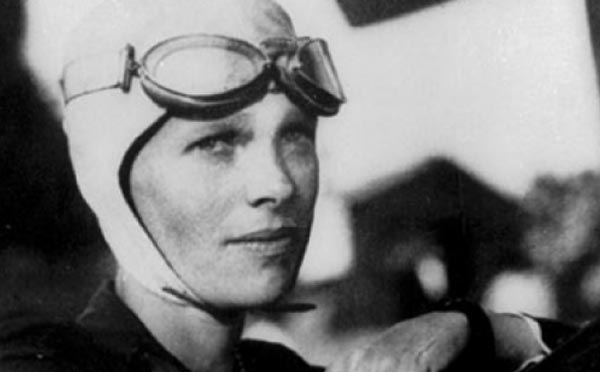
Today we're going to point the skeptical eye at some of the rumors surrounding one of the twentieth century's great mysteries: The disappearance of pioneering woman aviator Amelia Earhart, when her airplane disappeared over the Pacific Ocean on her famous 1937 flight around the world. Conventional wisdom says that she simply ran out of fuel and ditched into the ocean, but stories have persisted for decades that she might have made it safely to an island, perhaps even survived for some time. Here and there, various artifacts have been found: A shoe, a zipper, a scrap of aluminum. There are even some crazy stories: that she made it back to the United States and lived out her life under an assumed name, or that she was captured by the Japanese and executed as a spy. Let's take a look to see if any of these alternate explanations can withstand scrutiny.

Amelia Earhart and her navigator, the highly experienced and esteemed Fred Noonan, were on the third-to-last leg of their circumnavigating flight in her Lockheed Electra 10E, a 1200 horsepower, state-of-the-art twin engine aircraft. They took off from Lae in Papua New Guinea on July 2, 1937, headed for a remote refueling stop in the South Pacific, a tiny island called Howland. From there they would continue to Honolulu for a final refueling before completing the journey in Oakland, California.

And as everyone knows, they never made it to Howland. A US Coast Guard cutter, the Itasca, was on station at Howland transmitting a radio direction-finding signal, and made sporadic voice contact. Most historians agree that a half-hour time zone difference disrupted both parties' attempts to establish two-way voice communication, and a photograph of the Electra taking off from Lae appears to show that a belly antenna (of unconfirmed purpose) may not have been in place. And to top it off, it turns out that Howland's position was misplaced on Earhart's chart by about five nautical miles, but which would still have kept it within visual range. Whatever role these problems may have played, if any, is unknown; but Earhart's final radio transmission to the Itasca said they were in the immediate vicinity of Howland. And ever since then, the best analysis is that they ran out of fuel, ditched in the Pacific Ocean, and perished.

But one group of historic aviation enthusiasts called TIGHAR (The International Group for Historic Aircraft Recovery) has been tirelessly promoting their hypothesis that Earhart and Noonan flew not to Howland, but by mistake to an island 650 km to the southeast, now called Nikumaroro but then called Gardner, where they crashed and survived for a time as castaways. TIGHAR's hypothesis and claimed discoveries saturate virtually all television and print reports of Earhart for the past decade, but these media outlets almost never mention that TIGHAR's is a fringe theory supported by poor evidence and that has almost no serious support from mainstream historians or archaeologists.

Here's the problem with TIGHAR's findings. Even though they meticulously document and preserve every artifact, they exhaustively research each one to find matches with real objects from the 1930s, and they look exactly like what such an expedition should look like, their overall methodology is fundamentally, fatally unscientific. It's unscientific in that it's done completely backwards. TIGHAR begins with the assumption that Amelia Earhart crashed, camped out, and died on Nikumaroro. They take everything they find — every anomaly in a photograph or in a story, every piece of bone or manmade artifact found on the island — and try to match it to their assumption, rather than trying to objectively assess its origin.

Nikumaroro, this tiny island where TIGHAR has recovered its artifacts, is in Kiribati, a nation of 100,000 people spread over millions of square kilometers of the South Pacific. People leaving artifacts come and go all the time. For example, pearl divers. Fleets of pearl boats have plied these waters since the 1800s. Every island and reef in the South Pacific has been visited countless times by pearl boats, who anchored, made camp on shore, and spent a few weeks free diving for oysters. Their exploits and histories have been published in dozens of books, such as Roy Miner's 1941 volume Pearl Divers, and the many colorful tales in Frank Coffee's 1920 book Forty Years on the Pacific. TIGHAR found evidence of campfires and fish bones on Nikumaroro and concluded "Amelia Earhart" who is not known to have visited the island; but I found no attempt made by them to exclude the pearl divers who are known to have camped there, and to have done so countless times over more than a century. TIGHAR appears to be dedicated to proving the least likely explanation for the artifacts.

They found an object identified as the heel of a woman's shoe. Many pearl divers were women, and they came from Fiji, the Philippines, and New Zealand, where shoes were not unknown in the 1930s. Could the shoe have come from the 1929 wreck of the steamship SS Norwich City that killed 11 of its 35 crew on Nikumaroro? Could it have belonged to one of the sixteen women who settled on the island in 1939 as part of a British colony? Could the shoe have even floated to the island from anywhere else? I find no reason to exclude the women who lived on or visited the island as possible owners of the shoe, or any reason to suggest Amelia Earhart was the most likely owner.

The found the remains of a buckknife. Is Amelia Earhart really more likely to have brought a buckknife to Nikumaroro than pearl divers, the British settlers, the operators of an 1892 coconut plantation, or the 25 crew of a 1944 Coast Guard station?

At its height, Nikumaroro had a population of about 100 people. Half a dozen smaller populations had come and gone over the prior century, and throughout it all, pearl divers camped ashore. Would you expect such an island to be pristine, or would you expect random debris from not just the 1930s but other periods as well? Without exception, every one of the artifacts recovered by TIGHAR should be expected to have been found there whether or not Amelia Earhart had ever even lived.

This even extends to a partial human skeleton that was found on the island in 1940 during its British colonial occupation. At the time, the young officer who found it, Gerald Gallagher, shipped the bones to Dr. David Hoodless, principal of the Central Medical School of the South Pacific on Fiji. Hoodless studied the bones and reported them to be "definitely" male, judging by the pelvis; and from an individual about 5 foot 5 1/2 inches tall, of European heritage and not a Pacific Islander. No clothes or hair were found, and the bones were severely weatherbeaten and in poor condition.

Near the skeleton, Gallagher also found a small wooden box with dovetailed joints, that he determined to be a sextant box. It was delivered to Harold Gatty, founder of Air Pacific, and a good friend of Fred Noonan and familiar with his navigation habits; for example, that he often carried an old-school sextant with him on flights in addition to modern equipment, just to double-check things the way a good navigator should. Regarding Gatty's own expertise, Charles Lindbergh had described him as the "prince of navigators". Another British officer in the area cabled Gatty's findings back to Gallagher:

Mr. Gatty thinks that the box is an English one of some age and judges that it was used latterly merely as a receptacle. He does not consider that it could in any circumstance have been a sextant box used in modern trans-Pacific aviation.

After studying all these results in light of his original speculation that they may have been related to Earhart, Gallagher wrote:

It does look as if the skeleton was that of some unfortunate native castaway and the sextant box and other curious articles found nearby the remains are quite possibly a few of his precious possessions which he managed to save.

Neither the bones nor the sextant box still exist today, but TIGHAR has made their own analysis of them, based on reading these original reports. As expected, TIGHAR has concluded that the skeleton was consistent with that of Amelia Earhart, and that the sextant box was consistent with one Fred Noonan may have used. Essentially, TIGHAR took the original first-hand expert analyses, and rejected and re-interpreted them to support their desired conclusion.

From a navigational perspective, the fundamental assumption of TIGHAR's theory is almost inconceivable. Fred Noonan was one of aviation's top experts in using the latest navigational techniques and equipment, including the then-new E-6B flight computer, which (among other things) corrects for the effects of wind on speed and course. Nikumaroro is a full five and one half degrees of latitude south of Howland. That's a massive, massive error; it's simply not plausible that Noonan could have been that far wrong. Earhart was no slouch of a navigator either. Could they have made such an error without either of them catching it?

Moreover, the bearing from Papua New Guinea to Howland is about 79° true. To Nikumaroro, it's 89° true. Nikumaroro was about 4272 km away, only slightly farther than Howland, which was 4160 km. The Electra's maximum's range did allow them to make it to either island, but only if they flew an absolutely direct course. The TIGHAR hypothesis suggests that they made their entire flight at a full 10° off course, without catching it, while following their compass and homing in on the Itasca's direction-finding signal, and were as much as five degrees of latitude too far south. Even for 1937, this size of an error strains credibility. Either the E-6B or the sextant would have caught either of these errors easily.

Howland Island, the intended destination, is basically just a flat coral sand cay in the middle of nowhere, about two and a half kilometers long and less than a kilometer wide. It's uninhabited and has no trees, and no structures other than an automated lighthouse beacon. It's about as featureless and bleak as a desert island can be. But in 1937, there was a tiny temporary population there. Hawaii's Kamehameha School for Boys had set up a camp where students would spend a few months learning about the plants and animals there. It was called Itascatown, named after the Itasca that supplied it and handled all the transportation of students.

$2/mo $5/mo $10/mo One time

Three unpaved runways were bulldozed in anticipation of Earhart's landing, but since she never arrived, they ended up having never been used at all. The Japanese bombed them during World War II and they were never repaired.

But back on that day in 1937, the airstrips were ready, the Itasca sat on station off the coast of Howland, and drums of fuel had been sent ashore to refuel Earhart's plane. Coast Guardsmen and teenagers from the Kamehameha School stood watching the skies. They watched and waited, the time for Earhart's arrival came and went, and still they watched. The skies remained quiet. Eventually it became clear that there would be no landing that day, and word gradually spread that the Itasca had lost contact and the plane was now well past the point at which its fuel would have run out.

Following the bearings of Earhart's final radio transmission, just northwest of Howland, the search ships combed the ocean for a week. The aircraft carrier USS Lexington, the battleship Colorado, the Itasca, and even a few Japanese ships scoured the ocean's surface, tiny gray dots on an unimaginably vast shimmering blue curtain. But well hidden, deep in the peaceful darkness thousands of fathoms below them, rested what remains aviation's most enduring legend.

Further information is in this followup blog post.

Follow me on Twitter @BrianDunning.

Brian Dunning

© 2012 Skeptoid Media, Inc. Copyright information

References & Further Reading

Coffee, F. Forty Years on the Pacific. New York: Oceanic Publishing Company, 1920.

Editors. "Sextant Box Found on Nikumaroro." Earhart Project Wiki. TIGHAR, 25 Jan. 2010. Web. 27 Jan. 2012. <http://tighar.org/wiki/Sextant_box_found_on_Nikumaroro>

Goldstein, D., Dillon, K. Amelia: The Centennial Biography of an Aviation Pioneer. Washington, D.C.: Brassey's, 1997. 245-254.

Leff, D. Uncle Sam's Pacific Islets. Stanford University: Stanford University Press, 1940. 47-50.

Lorenzi, R. "Amelia Earhart Clue Found in Clumps." Discovery News. Discovery Communications LLC, 2 Mar. 2011. Web. 27 Jan. 2012. <http://news.discovery.com/history/amelia-earhart-clumps-island-castaway-clues-110302.html>

Miner, R. Pearl Divers. New York: American Museum of Natural History, 1941.

Strippel, R. "Researching Amelia: A Detailed Summary for the Serious Researcher into the Disappearance of Amelia Earhart." Air Classics. 1 Oct. 1995, Volume 31, Number 11: 20.

USCG. "What was the Coast Guard’s role in the search for Amelia Earhart?" Coast Guard History. United States Coast Guard, 10 Oct. 2012. Web. 15 Nov. 2012. <http://www.uscg.mil/history/faqs/earhart.asp>

Reference this article:
Dunning, B. "Finding Amelia Earhart." Skeptoid Podcast. Skeptoid Media, Inc., 31 Jan 2012. Web. 18 May 2013. <http://skeptoid.com/episodes/4295>

Discuss!

10 most recent comments | Show all 70 comments

Dave how do you know no one takes you seriously ?

No psychic stuff or spirit guides ever used by me in locating the wreckage of the missing flight.

Remote viewing is not involved here, rather direct, i.e. DIRECT viewing, that is, for only those who have "eyes" to see.

I wonder if I have to provide "evident" in a sensationalistic manner to convince the gullible, or only present the truth as I know it, as to the location of the missing Electra and content ?

Tighar, et al, do not want to face the truth and have someone else locate AE flight, seemingly fearing loss of face, or to injure their ego, after decades of search and research, all of which ended up in failure. In other word, they cannot handle success, or unwilling to face it.

A couple of years ago, I stumbled upon numerous efforts in search of the Electra, and with me being unemployed, with a lot of time on hand,I went to work on the project, reviewed their work, placed it under the "microscope",if you will, and discovered that their analysis is sort of an insult to one's intelligence. And I was vocal about that. Their response is like how could you possibly find the missing craft in a ten thousand square miles of ocean by analysis alone.

I provide no evidence whatsoever, I only know the exact location of the Electra and content where it resides right this very moment.

Any questions ? Have a great day. Kevin.

Kevin, Los Angeles, CA
October 31, 2012 1:11am

++++++++++++++++++++++++++++++++++
++++++++++++++++++++++++++++++++++
Kevin, Los Angeles, CA
October 31, 2012 1:11am
++++++++++++++++++++++++++++++++++
++++++++++++++++++++++++++++++++++

You present no evidence, you merely try and cast an illusion in the minds of readers and yet you speak of insults to others intelligence?

Explain how you know the condition of the two bodies.

izzy, St Charles IL
November 24, 2012 12:55am

Send the man in......Dr Robert Ballard! The man who found the Titanic.

Tighr is WAY of course and looking in the wrong place!

Phil, Scotland
December 03, 2012 5:46pm

Tighar, needs to explain the Bevington photo game that was played, as they used any means to get the funding for the great and expensive trip to explore off the island for the Earhart Lockheed Electra

There was no basis for the claims referenced at their press conference, like the experts at the State Department said, the object on the photo was the landing gear of a Lockheed Electra.

This was impossible to do even with the final photo copy made after the Tighar trip to the UK, to get a very high resolution copy, well after the PR shots with Hillary

Therefore the State Department could not have possibly come any such conclusion with a 600 dpi version of the original photo that was 1.73" by 1.28"
The Bevington 600 DPI photo has little to no detail in relation to the object

It really makes one wonder about how this public display with Hillary and others that day, could have happened

Dave, Minnepolis
December 31, 2012 4:09pm

@ Dave, Minnepolis

Was that photo really only 1.73" by 1.28", I assume you mean the target area, of course?

Right near the edge of the photo too, an area known for not giving truly accurate information, it's not like the swimming bigfoot is in perfect focus right in front of the camera.

Even today any photo is viewed sceptically if produced as evidence, because we have seen time and again people seeing things that are not there. I can remember a bird in Canada being photographed and the photographer wanted $Can30,000 because they believed it was an alien spaceship, due to blur and a misunderstanding of perspective.

Regarding the podcast, I would just like to know what happened, why did Mr Noonan fail to get to Howland, so near yet so far, it seems, even if the aircraft is ever found, wherever it rests, I doubt we'll ever know why.

Sceptical Steve, Good old UK
January 23, 2013 1:50pm

Aircraft & crew have never been on Nikumaroro , TIGHAR´s nonsense "hypothesis" is commercial. On the back side of a large size match box easily , you can calculate that the island was beyond the ferry range from the Howland region , and TIGHAR´s inner circle knows this .

h.a.c.van asten, Schagerbrug , Netherlands
January 30, 2013 2:20am

1. I have always believed they ditched not on the reef at Nikomaruru, but perhaps on some unidentified reef, shoal, outcropping within 100-150 miles of Howland. Why?

2.The last message from AE purportedly says "reef". It makes no mention of "land", "Island", or "ship" (Norwich City). Even on the reef (unless seriously injured), FN could have shot a fix for a quick transmission. Not done. We will never know the reason why.

3. I would also guess that, when within 500 miles of Howland, FN would have been fine tuning his Fixes and confirming their location. You know-the start of the Final Approach. No transmitted record of this.

4. Fred Noonan was an excellent Navigator, but there was at least one error he made in accompanyment with AE on this flight.
On the fourth leg of this "Round The World" attempt, on the hop from new Orleans to Miami, FN was off by a little less than 3 miles from Miami. The distance involves varies depending upon the source: TIGHAR: 450 miles. Most other sources: 586 miles. I do not know if they are statute, nautical, whatever. However, even off by, say 1.5 miles over the state of Florida seems to be rather major.

5. Tied to #4, on the Lae to Howland leg, they were in the air 20 hours. Think of fatigue, the desire to doze, cramps, noise, smell of lubricants, etc. If each of the five annoyances I mention here are taken into consideration, say, at the 15 hour mark, their efficiency has been drained dramatically. 2556 miles.....

WILSON, HONOLULU
April 17, 2013 12:11pm

If Mr Noonan was taking more than one fix over the whole 4th leg journey, the error is a little larger than expected, but not over the whole distance with one or no fixes. Just depends how many and when he took them. There again, a relatively short distance over land, maybe he just chilled out!!

The units used are irrelevant, as long as they are the same, then the percentage error is relevant. Taking it as 3 miles over 450, the same error over the 2556 to Howland is just 17 miles, and for sure he would have been taking more fixes to get there, safely. I've read that celestial navigators accept an error of up 10% since last fix.

Having said that, the earlier Hawaii flight did have some loop radio fixes, and possibly had the expert Mr Mantz in the copilot seat taking the readings as he 'educated' AE along the way.

All FN had was heavenly bodies on that ill-fated night, no radio loop fixes at all. I've looked at the celestial fixes that were available for the last flight, seems some good sightings possible, so maybe he had very poor weather and just couldn't get his sights? Be kind of like sat-nav without satellites.

Fatigue could've played a part, we know Earhart was ill before departure, and a telegram mentioned 'personnel problems', did she mean her, FN or both? As you say the fumes would be pretty bad, especially if unwell, and the cockpit was a very noisy place too.

It was certainly going to be a long hard day, whatever the physical condition of the crew.

Ross Farley, in the Illuminati's lair
April 19, 2013 2:57pm

I will never understand why AE and FN did not plan a multi-stop flight to Howland versus a 20 plus hour killer.

Ruminate on this:
Lae to New Caledonia
New Caledonia to Fiji
Fiji to American Samoa
American Samoa to French Polynesia
French Polynesia to Howland.

Now, I do not know with any certainty the presence of airfields at each of the locations. However, they did bulldoze three coral strips on Howland for AE and FN. I would presume they could have accomplished the same at the other locations. Nothing exquisite-just a basic landing strip laid out in accordance with the direction of two Civil and Aeronautical Engineers. G.P. Putnam certainly had he dough.

QUESTION #1: How many hours did AE have in her Logbook up to the time she took off at Lae?

Question#2: Is there any record of her treatment for Dysentery: Physician, Actual Treatment, Medications (if any) and Extant Medical Records???

HAVE A GREAT DAY !!!!

WILSON, HONOLULU
April 23, 2013 5:43pm

While it's possible there were some airports in the places named, it's very unlikely. In 1937, aviation was still pretty primitive and uncommon. Lae was unique in that it was one of the very first places where aviation was established in the South Pacific, and this was exclusively a result of the need for aviation support into the gold fields at Bulolo. As such it had an airport big enough for AE's plane, and it there was fuel available. It's unlikely the same existed in the other places. As far as creating, ad-hoc, the required airports, that ignores the logistics and expense required. Howland was easy (comparatively); it was relatively close to Hawaii; the US Coast Guard, had already been operating to there from Hawaii as a part of a colonization effort; there was an airport established prior to AE's flight, it was pretty well suited to use as an airport, as it was low, flat treeless coral and sand. Making runways was a fairly simple matter of smoothing the ground out enough to land on. The other places named are volcanic islands with substantial mountains, not smooth, flat, treeless expanses of coral and sand. It's one thing to get support and cooperation from the US government to do a little runway improvement on an island a few days sailing from Hawaii which was US territory and the US, for political reasons, was already occupying and building runways. Going farther, to places outside US territory, not as well suited to airfields is something else.

Andrew, Dubai
May 04, 2013 11:38pm

Make a comment about this episode of Skeptoid (please try to keep it brief & to the point). Anyone can post:

Your Name:
City/Location:
Comment:
characters left. Discuss the issues - personal attacks against other commenters, posts containing advertisements or links to commercial services, nonsense, and other useless posts will be deleted.
Answer 1 + 9 =

You can also discuss this episode in the Skeptoid Forum, hosted by the James Randi Educational Foundation, or join the Skeptalk email discussion list.

What's the most important thing about Skeptoid?

Support Skeptoid
 
Skeptoid host, Brian Dunning
Skeptoid is hosted
and produced by
Brian Dunning


Newest
Polybius: Video Game of Death
Skeptoid #362, May 14 2013
Read | Listen (11:27)
 
The 16 Personalities of Sybil
Skeptoid #361, May 7 2013
Read | Listen (11:50)
 
Lincoln Kennedy Myths
Skeptoid #360, Apr 30 2013
Read | Listen (11:07)
 
Cupping for the Cure
Skeptoid #359, Apr 23 2013
Read | Listen (10:38)
 
Listener Feedback: Aliens and UFOs
Skeptoid #358, Apr 16 2013
Read | Listen (10:02)
 
Newest
#1 -
8 Spooky Places, and Why They're Like That
Read | Listen
#2 -
Skinwalkers
Read | Listen
#3 -
The Suicide Dogs of Overtoun Bridge
Read | Listen
#4 -
Student Questions: Food Woo and Iron Man at the Airport
Read | Listen
#5 -
Negative Calorie Food Myths
Read | Listen
#6 -
Listener Feedback: That Darned Science
Read | Listen
#7 -
The Loch Ness Monster
Read | Listen
#8 -
Area 51 Facts and Fiction
Read | Listen

Recent Comments...

[Valid RSS]

  Skeptoid PodcastSkeptoid on Facebook   Skeptoid on Twitter   Brian Dunning on Google+   Skeptoid RSS  


"New Age Energy"
inFact with Brian Dunning


Support Skeptoid
Join today and become
a part of this.