 |
 |
  
|
 |
Is Barefoot Better?Some advocate that going barefoot is better for the health and strength of your feet. Skeptoid Podcast #185 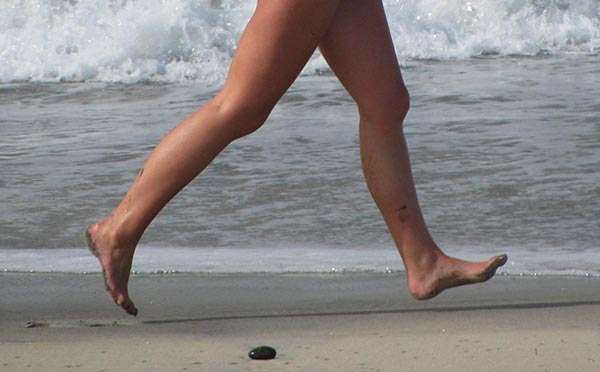 by Brian Dunning Today we're going to let our dreadlocks down and take a rational, science-based perspective on a trend that seems, at face value, like just another nonsense hippie claim from the "anything natural is good, anything modern is immoral" crowd: The idea that we'd all be better off being barefoot. Whether you run marathons or give boardroom presentations, barefoot advocates claim that barefoot, the way we evolved to walk and run, relieves and prevents orthopedic injuries. I'll freely confess that the first time I heard this claim I scoffed, it bears so many of the red flags of pseudoscience. These red flags include the implication of a medical/industrial conspiracy to keep us injured by selling us expensive shoes and orthopedic treatments, and of course the ever-present all-natural fallacy. But what grabbed my attention was that I also noted that products like expensive running shoes also sport a major red flag that I'm keenly aware of. Until extremely recently in the history of our species, nobody had expensive running shoes, or even any shoes at all, and we did just fine. I'm reminded of how I always smirk when I see new parents paying double for special baby apple juice in the supermarket: Even today, most babies in the world are lucky to get a twig and a dirt clod to eat each day, yet they grow up fine. Do I, the product of millions of years of evolution creating a bipedal animal optimized for walking and running barefoot on the savannah, really need a $100 pair of super-duper running shoes to make my feet work properly? My default answer for such questions, based on evolution, is "probably not". So I believe this barefoot question does deserve a really close look. Logically, the argument in favor of going barefoot — both for everyday locomotion and for athletes — is a compelling one. It is a fact that that's how our feet evolved to work. Record setting runners like Zola Budd and Abebe Bikila have proven that barefooters are perfectly capable of competing at the highest levels of the sport, no shoes needed. A friend of mine visited Africa and brought back pictures of the feet of some guy who never wore shoes his whole life. They didn't much look like human feet, more like great big thick gray leather pads. He could probably walk on any kind of surface at any temperature without the slightest inconvenience. And forget worrying about arch support; he had no discernible arches. If you don't mind looking like a hobbit, his way of life might not be so bad. Go anywhere, anytime, with no concerns and no stability problems. After all, that's exactly how the overwhelming majority of Homo sapiens have lived their entire lives, throughout our entire 500,000 year history, and how some do still today. There are quite a few websites advocating the barefoot way of life (like Barefooters.org and RunningBarefoot.org). Most of the benefits they tout have to do with freedom, comfort, and the carefree lifestyle. But they also cite some health benefits. One 1949 study published in The Journal of the National Association of Chiropodists found that bare feet avoid most risks of foot fungus. Over 100 Chinese rickshaw coolies were interviewed, all of whom trotted all day every day on hard pavement pulling a rickshaw with bare feet, and aside from some temporary pain and swelling when they began their careers, none reported any foot problems. The study concluded "Shoes are not necessary for healthy feet and are the cause of most foot troubles," though it does appear that this conclusion is probably premature, based on this data alone. Ill-fitting and restrictive footgear was claimed to be particularly at fault, but since modern Nikes are not best described as "ill-fitting and restrictive", it may be hard to translate the 1949 conclusion to today's runners. The principal medical claim put forward by the barefoot proponents is that wearing shoes weakens the muscles in your foot, through disuse. While this sounds like it should be obviously true, it does not appear to have been thoroughly studied or proven. And there's a good argument that the opposite might be true. When you wear a shoe with a sole of average thickness, around 22mm, the lateral leverage angle on your ankle is significantly increased, which, logically, should make it more prone to injury; and requires greater strength in the muscles and tendons that stabilize the ankle to compensate. A search of the literature reveals that most researchers complain of a lack of good studies comparing injury incidence between barefoot runners and shod runners, so it's premature to make any kind of authoritative statement that either barefoot running, or running shoes, help prevent injuries. If you hear this claim made by either side, that claim is not yet supported by a good body of research. But what has been established pretty clearly is that running barefoot keeps you more up on your toes, closer to the stride of animals, while shoes let you strike harder with your heel. This means (and nobody really disputes this) that shoes make you run in an unnatural way; or at least with a stride that's notably different from that which our ancestors evolved. This heel-to-toe stride encouraged by shoes does appear to be correlated with pronation, but the link is not necessarily causal. It's easy to imagine how constant landing on the heel could cause cumulative stretching of the ligaments and eventually roll the foot inward toward the arch. However, whether this cause exists or not, it's not clear that such pronation is a problem. There doesn't seem to be any proven correlation between pronation and injury incidence. But the claim that feet are weakened by frequent shoe wearing are everywhere, and are easily believed, since it sounds so logical. In response, shoe manufacturers have been quietly entering the arena, making less shoelike shoes. The Vibram FiveFingers is basically a glove for your foot, providing little more than a thin sole to protect you from sharp objects. Vibram says "Stimulating the muscles in your feet and lower legs will not only make you stronger and healthier, it improves your balance, agility and proprioception." The Vivo Barefoot is slightly more conventional looking but has no rigid structure and only a thin puncture-proof sole. The benefits Vivo claims for going barefoot is that it "Strengthens the muscles in your feet; realigns your natural posture; feeling the ground stimulates sensory perception; and flexes your feet as nature designed." All of these claims, I think, have to be regarded as marketing messages. They are not the result of proven research. They sound satisfyingly logical, and some of them may well be true; but at this point, we don't know that they are. Yes, we did evolve wearing bare feet, but that doesn't necessarily mean it's the best thing to do. That evolution has made us into bipeds that walk and run barefoot across the savannah is not a perfect argument that we're well adapted to do so. There are many examples in nature of creatures who evolved detrimental traits. The giraffe's laryngeal nerve runs all the way down its neck into its chest, loops around its aorta, then runs all the way back up to its larynx; making it absurdly long and prone to many types of failure. The Irish elk developed antlers so large that the energy required to grow them exceeded the available food sources and the species became extinct. The mating ritual of the Kakapo flightless parrot is more likely to attract a predator than a mate. The retinas in all vertebrate eyeballs are inside-out, creating an unnecessary blind spot. The list goes on forever. The point is that evolution does not create perfectly adapted creatures; it creates adequate creatures. The human body too is full of evolved points of failure, and we've learned to fix many of them. If shoes do indeed improve our ability to walk, they would be just one of many examples where we've used medical science to improve our bodies' inherent weaknesses. Our appendix doesn't seem to serve much purpose except to potentially kill us, so we've developed the appendectomy. Wisdom teeth try to force too many teeth into too small of a jaw, so we routinely remove them. Nearly everyone has bad eyes, so we correct our vision. Orthopedically, our knees' lateral retinaculum exacerbates many knee problems, so some modern knee surgeries include a routine severing of this structure. There is other anatomical evidence that the human transition to bipedality is not a very complete one. Walking upright has left human females with a pelvis that, relative to other primates, doesn't allow much room for the birth canal. This makes giving birth more dangerous for humans than it is for the great apes who knuckle walk. And then there's this strange foot we have. While nearly every other animal on the planet walks on its fingers and toes, we lay one additional segment down and walk on our ankles, and even crawl on our wrists as babies. Trading one joint for extra surface area was fine for gripping tree branches, but it makes little sense for walking on flat ground. Among other things, it leaves us with one fewer joint to absorb twists, making us more prone to ankle and knee injuries. So is there a clear, science-based verdict on the barefoot issue? From my research, I conclude that the jury is out; but any benefit that may be found by either wearing shoes or going barefoot is likely to be small, and to differ widely among different people, based on their habits and their anatomy. The most interesting revelation, for me, was that barefoot running does indeed appear to be a perfectly viable option for both athletes and casual joggers. The only real risk is puncture injury, which you can solve by either developing feet like that African guy, or by getting some of those barefoot-wannabe shoes. Once you get past some initial pain and swelling, similar to what the rickshaw coolies went through, you're probably no more or less likely to develop any significant injuries than if you were to wear shoes. Zola Budd, by the way, is long retired but still runs tens miles per day in her native South Africa. But things have changed for her. "I no longer run barefoot," she told the UK Guardian in 2005. "As I got older I had injuries to my hamstring. I found that wearing shoes gives me more support and protection from injuries." But hers is only one data point, and is anecdotal. We just need a few thousand controlled data points before science can make such a declaration.
Cite this article:
©2025 Skeptoid Media, Inc. All Rights Reserved. |