 |
 |
  
|
 |
The Lucifer ProjectSome believe that NASA is trying to turn Saturn or Jupiter into a small sun. Skeptoid Podcast #143 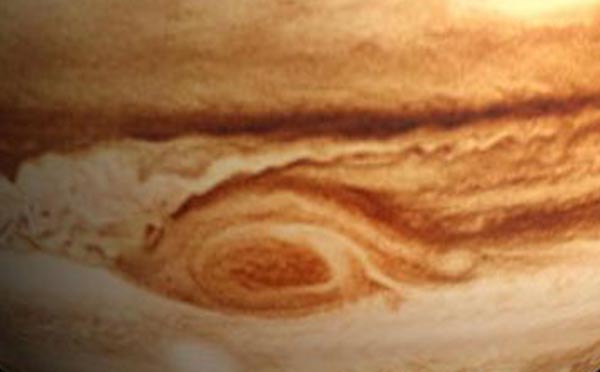 by Brian Dunning One of the most dramatic events in Arthur C. Clarke's 2001: A Space Odyssey series of books happens in the second installment, 2010: Odyssey Two. The strange alien monolith orbiting Jupiter somehow replicates itself billions of times, apparently using matter from Jupiter itself, condensing the gas giant down into a smaller, denser, hotter mass until it suddenly achieves sustained nuclear fusion. Thus, Jupiter fulfills the destiny denied it by nature as what some astronomers have termed a "failed star". This new star brings life to its constellation of Earth-like moons, becoming a solar system within a solar system, and is named Lucifer by the people of Earth, who henceforth have two suns in the sky. For the LUCIFER Telescope conspiracy theory, see episode #729.
Most of us consider this the stuff of science fiction; there are too many physical reasons why it couldn't actually happen, a few of which are raised by Clarke's characters as they witness the event incredulously. However, a number of conspiracy theorists (most of the variety who still believe in the Face on Mars) believe that this is not only possible, but that it is an actual project in the works at NASA. And, moreover, that what they term "The Lucifer Project" has already been attempted. Details vary, the most significant of which is the confusion over whether Lucifer would involve Jupiter or Saturn. The Space Odyssey movies and books all use Jupiter, except for the original book, which was based on an early version of Clarke and Kubrick's screenplay that used Saturn (Saturn's rings later proved too great of a special effects challenge). Many of the modern conspiracy theories bring the story back around to Saturn as well, but really for all practical purposes we're talking about "a gas giant", think of either Saturn or Jupiter, whichever you please. Doesn't make much difference as far as reality is concerned. The main element of these deep-space NASA missions that fuels the conspiracy is the RTGs, or radioisotope thermoelectric generators, that power space probes such as Cassini, Galileo, Voyager, and others. Past Mars there's not enough sunlight to provide the power a spacecraft needs, and so these RTGs are the only option we have. We've mentioned them before on Skeptoid: Russia has used similar generators to power about 150 lighthouses along its extremely remote northern coast. Heat from a radioactive element, usually plutonium-238, goes through a thermocouple, which is a material that produces a direct electrical current when heat is applied to it. RTGs have no moving parts and are extremely simple and reliable. Believers in the Lucifer Project conjecture that such a payload of radioactive material would act like an atomic bomb in the high-pressure depths of a gas giant, and they suppose that this would somehow ignite the entire planet, turning the whole thing into a small star. This would act as a sun for its moons, turning them into habitable worlds. Saturn's moon Titan is usually cited, the claim being that NASA plans to turn it into a human colony for some unknown nefarious purpose. In 2003, the Galileo spacecraft's mission was ended by deliberately crashing it into Jupiter, in order to absolutely avoid any possibility of contaminating Jupiter's moons with bacteria from Earth. A guy named Jacco van der Worp, now an advocate for the 2012 apocalypse, went on the Coast to Coast AM radio program and claimed that such a collision would cause the plutonium in the RTGs to immediately implode, triggering an atomic explosion. Recall our old friend Richard Hoagland, the space conspiracy theorist who believes that many of the features found on Mars are ruins of ancient civilizations, and that NASA is covering it up. He heard of van der Worp's idea and ate it up, claiming that a mysterious black spot that appeared briefly on Jupiter's surface a month later was evidence of this explosion. Hoagland asserts that Galileo would have broken up in Jupiter's atmosphere, and that it would have taken one month for the plutonium capsules to fall through Jupiter's increasingly dense atmosphere until such a pressure was reached that the capsules would implode. Hoagland concludes that the protection of Jupiter's moons from contamination was just a cover story for NASA's attempted creation of Lucifer. The Cassini orbiter at Saturn is scheduled to terminate in 2012, however NASA has not yet decided whether to crash it into a smaller moon (where RTG contamination is not a problem) or to leave it in a high parking orbit. Saturn's rings make an approach for a Galileo-style crash into the gas giant too difficult. There are a number of differences between an RTG and an atomic or thermonuclear warhead. The grade of plutonium is one difference. The RTG uses reactor grade plutonium, while a weapon uses weapon-grade plutonium. The difference is that weapon grade contains less than 7% Pu-240. Reactor grade has more. Not only does this make a chain reaction more difficult to sustain, it also makes the material more radioactive and more difficult to work with and store. In 1977, the United States declassified a 1962 underground nuclear test at the Nevada test site in which non-weapon grade plutonium was used. Although the explosive yield was quite low, the test proved that the plutonium grade alone doesn't disprove the Lucifer conjecture. But the main reason that an RTG could not explode like a weapon is its structure. Each of Cassini's three RTGs contains 72 marshmallow-sized pellets of plutonium, each weighing about 150 grams, and each separately enclosed in iridium inside a shock-proof graphite impact shell. Four of each of these are enclosed within one of 18 separate General Purpose Heat Shell modules, each with its own separate heat shield and impact shell. Should any kind of crash or problem happen, including breaking up during a re-entry, these impact shells separate from each other and scatter. Conversely, in order to detonate Pu-238, you need a single critical mass of solid plutonium weighing at least 10 kg. This critical mass has to be imploded with a simultaneous explosion from all sides, applying sudden pressure precisely from all angles at the same exact instant. Obviously this couldn't happen with an RTG design. Although each RTG does theoretically have enough plutonium to make up a critical mass, there isn't any way that it could all be brought together into the right shape. An implosion triggered atomic device needs to have its critical mass in a very specific configuration. Any type of pressure or crash event has already sent all the separate impact shells scattering about space, and each is far too small to ever achieve critical mass and implode. No way, no how, physics simply do not make it possible for a chunk of less than critical mass to initiate a chain reaction, no matter what environment it's put in. Proponents of the NASA conspiracy state that the high pressure of the deep atmosphere inside a gas giant will provide the implosion pressure, but they do not offer a solution for the critical mass problem. I searched and searched, and the best document I could find by conspiracy theorists, by an anonymous author, admits that the pellets are 150 grams but states that plutonium-238 requires only 200 grams to reach critical mass. This is simply wrong, but even if it were true, 150 is still less than 200. However the author seems to simply ignore this, skips over it, and says that a 600 kiloton explosion would result. So let's grant that an RTG could somehow result in a 600 kiloton atomic explosion on a gas giant. This is only a tiny fraction of the firepower of some of the thermonuclear tests done on Earth, the largest being the Soviet Union's 1961 Tsar Bomba shot with a yield of 50 megatons. That didn't turn the Earth into a small sun, it was a barely visible pinprick on our gigantic planet. So why would this far, far smaller explosion have such a drastic effect on a gas giant? Well, like our sun, the gas giants are composed largely of hydrogen and helium. In the intensely confined pressure inside an atomic explosion, fusion happens among these elements and causes the runaway thermonuclear chain reaction. In a nuclear explosion on Earth, this chain reaction quickly runs out, because of a lack of pressure and fuel. But inside the sun, there is tremendous fuel available and tremendous pressure from the sun's powerful, crushing gravity. This is called gravitational confinement, and it's the reason the sun's nuclear reaction is ongoing. Stars that are less massive than the sun have less gravity. Beyond a certain limit, they have inadequate gravitational confinement. These are called brown dwarfs. Because of their density and gravity, all brown dwarfs happen to be about the same physical size as Jupiter. However their mass ranges from 1 to about 90 Jupiter masses. Above this limit, they would have adequate gravitational confinement and could sustain fusion. But inside this range, at which Jupiter is at the extreme lowest end, they don't and can't. Some astronomers don't make a clear distinction between what constitutes a gas giant and what constitutes a brown dwarf, but one feature they share is mass that's way too low for sustaining fusion. An atomic or even thermonuclear explosion inside Jupiter would fizzle out the same way it does on Earth. Saturn, with less than a third of Jupiter's mass, is even farther from achieving gravitational confinement. Even Arthur C. Clarke didn't pretend that his fiction was plausible. At Lucifer's ignition, one of Clarke's Russian scientists, Vasili, said:
And like Vasili, we've only touched upon a couple of the problems, but certainly among the most intractable for those who believe that our tiny little space probes are the harbingers of planetary death and new solar systems. Enjoy your science fiction stories and enjoy the science coming back through Cassini's telemetry, but please don't confuse the two. Saturn and Jupiter are here to stay.
Cite this article:
©2025 Skeptoid Media, Inc. All Rights Reserved. |