 |
 |
  
|
 |
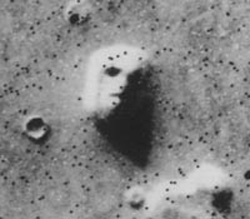
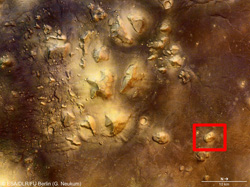
The Face on Mars RevealedSkeptoid Podcast #97 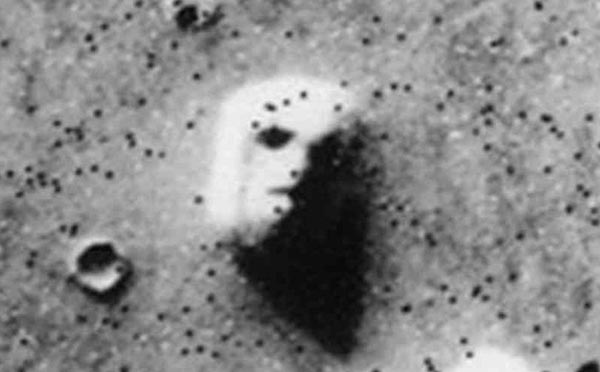 by Brian Dunning Imagine yourself in a NASA control room, late at night. The coffee's cold and, outside, the rain drums steadily against the window. You start to drowse off in your chair, when suddenly the teletype jumps to life with a loud mechanical bang. You're startled, but annoyed; and as it starts hammering out its latest data, you try to go back to sleep. You've heard this all before and seen a million badly printed images. But then, as it finishes printing the second page, your eye catches that long sheet of perforated printer paper folding into a pile on the floor, and you see something unbelievable. There, in yet another series of photographs from Mars, is a distinct human face. It was 1976, and Viking I was sending its latest images. Among a number of similar hillocks and mesas in a region of Mars called Cydonia Mensae, one feature stood out. It was a clear rendering of a human face! NASA engineers loved it; they passed it around, put it out for publication, and had all sorts of fun with it. But what they hadn't anticipated was that some in the public thought it was actually an artificially carved human face, despite the accompanying explanation that it was just a hill that happened to have this funny resemblance to a face when the light was at a certain angle. One of it most important distinguishing features, a nostril, was only one of many black dots that actually represent missing data in the image. Before long, to the dismay of astronomers worldwide, there was a firmly established pop-culture belief that there was a real gigantic human face on Mars, carved in perfect detail by aliens.
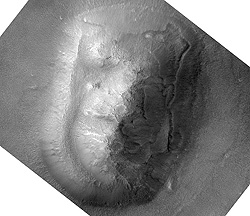
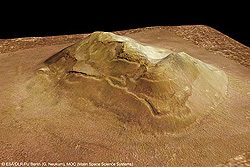
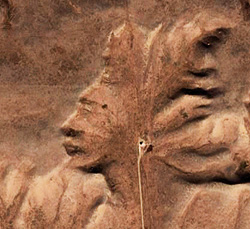
As the decades wore on, better cameras took better images, finally culminating in the 2001 image taken by the Mars Global Surveyor, with a super high resolution of about six feet per pixel. As you can see on the Skeptoid.com web page, the Cydonia "face" turns out to be merely an unremarkable hill, with plenty of natural random variations on its surface, and no longer looks anything remotely like a face or any other kind of carving. However you can see the general contours that made up the facial features in the original image. While those black dots of missing data in the original image gave the illusion of sharp focus, the image is now shown to have been extremely blurry. Although a two-dimensional view of the hill does have the appearance of some symmetry, the improved image shows that it's nowhere near as symmetric as it appeared to be in the original blurry image. The popular belief in an artificial sculpture would probably have never emerged if not for the writings of conspiracy theorist Richard Hoagland. Hoagland saw the original image, immediately concluded that an artificial carving was the only reasonable explanation, and wrote the book Monuments of Mars claiming that the Cydonia face is only one of many artificial structures on Mars, including pyramids and whole cities. He claims that NASA has exhaustive photographic evidence of all such structures, but that they cover them up and suppress them to avoid the mass panic that would inevitably ensue should Hoagland's claims be proven. Other claims of Hoagland's include taking credit for designing the plaque that was on Pioneer 10, which was done by Carl Sagan and which Hoagland had nothing to do with; that he first conceived the idea of subsurface oceans on Europa in a 1980 article, even though scientists including Isaac Asimov had been proposing this throughout the 1970's; and that a concept involving trans-dimensional energy that he calls "hyperdimensional physics" is correct and that every educated and professional scientist is wrong about the nature of the universe. Since he has positioned himself as the leading public advocate for NASA's evil coverups and the "truth" about Martian civilization, I recommend that you at least read through the Wikipedia entry about Richard Hoagland to see just how disconnected this guy really is. And then, you might want to reconsider your sources if you take seriously any claims that Hoagland has promoted. Of course, this ad-hominem attack against Hoagland personally says nothing directly about the validity of his claim that the face is an artificial structure, so I'll refer you to the high resolution photos on the Skeptoid.com website to make up your mind about that for yourself. Geological features that happen to look like faces, people, or other objects are not rare. In Alberta Canada, there's a figure called the Badlands Guardian that, when viewed from the air, looks astonishingly like a Native American wearing a full headdress and listening to an iPod. In fact, it looks way more like a person than the Cydonia face ever did on its best day. Why hasn't Richard Hoagland claimed that somebody carved the Badlands Guardian? That would be a lot more plausible. He probably doesn't make that claim because it would be testable and easily falsified. But the Badlands Guardian is only one example. The Old Man of the Mountain in New Hampshire looked just like the profile of a man jutting out from a cliff until it collapsed in 2003. North Carolina has a giant head sitting on a cliffside ledge called the Devil's Head. Sundance, Wyoming is home to the Old Man of the Park, and the Absaroka Range in Montana features an amazingly lifelike face called the Sleeping Giant near Livingston. Pictures of all of these are posted on the Skeptoid.com website. But, these are all newcomers. From the day the first protohuman looked into the sky, we have marveled at the Man in the Moon, the largest facelike structure known. Although some of these features are pretty astonishingly realistic, they don't even have to be. Your brain will still say "Face", even if it's as indistinct as the Cydonia face. This is a perceptual phenomenon called pareidolia, which is the tendency for the brain to see order in randomness. The famous Rorschach inkblot test is based on pareidolia. Pareidolia causes cryptozoologists to see crouched Bigfoots in forest photographs. It causes us to see a face made of headlights and grills on the front of a train or a truck, or the face of the Virgin Mary on a piece of toast. Pareidolia means that any two dots and a line, like those on the Cydonia face, will shout "eyes and mouth" to a human brain. Carl Sagan proposed that brains are hardwired to see faces. Without the phenomenon of pareidolia, no drawing less than a Rembrandt masterpiece would be recognizable as a face. But let's even set pareidolia aside, and just look at the original blurry photograph of the Cydonia face. The face is about one square kilometer. The entire surface of Mars is about 150 million square kilometers. Thus, if we postulate that the Cydonia face is about a one-in-a-million oddity, probability dictates that somewhere on the surface of Mars, some 150 one-kilometer areas bear some equally improbable likeness. How many fist-sized rocks are there in a square kilometer of Martian surface? A million, maybe? If one in a million fist sized rocks bears some resemblance to J. Edgar Hoover, we should expect to find 150 million fist-sized rocks on the surface on Mars that look like J. Edgar Hoover. By the sheer weight of large numbers, it's a virtual certainty that the surface of Mars has natural structures that look like human faces, elephants, and Ferraris, when viewed from certain angles. By the same law, you'll also find these things on Venus, Titan, Pluto, and Halley's Comet. So let's collect all of our evidence about the Cydonia face:
So, are the conspiracy theorists right, that an artificial sculpture is the most likely explanation for the Cydonia face? Well, I have to conclude that the evidence for that is pretty thin. A much better alternate explanation is available: That it is a simple natural structure, which when viewed with the details blurred out and with right lighting conditions, can look like a face, much like countless natural structures on Earth. What do you think?
Cite this article:
©2025 Skeptoid Media, Inc. All Rights Reserved. |