 |
      
|
 |
The Oak Island Money PitThis mysterious treasure pit on a Nova Scotia island has a fascinating natural explanation. Skeptoid Podcast #129 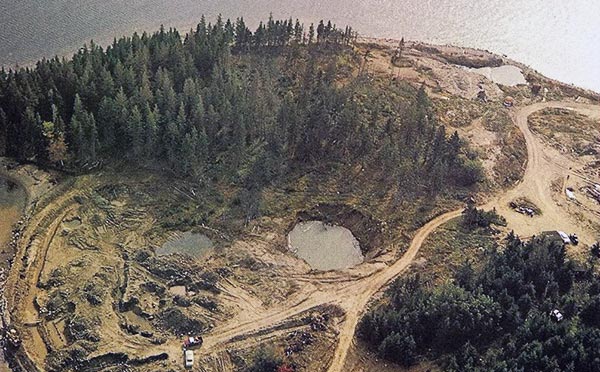 by Brian Dunning It began as every boy's dream adventure, like a chapter from Tom Sawyer. It was the year 1795 when young Daniel McGinnis, a lad of 16, rowed to Oak Island in Nova Scotia on a journey of exploration. On the eastern end of the wooded island he found something out of place: an old wooden tackle block suspended from a heavy branch, and on the ground below, a sunken depression. It didn't take young Daniel long to bring in heavy equipment, in the persons of two friends armed with shovels and the knowledge of old stories that the pirate Captain Kidd may have buried treasure on this part of the coast. Two feet down they struck a layer of flagstones, and all the way down they found pick marks on the walls of the shaft. The three boys dug for days, and just when they were about to give up, they came to a solid platform of logs. There was nothing under the logs, but it fired the boys up: There was no longer any question of whether something had been buried here. Over the coming weeks they finally reached 30 feet — that's incredible for three teenagers — and along the way found two more log platforms. By then the difficulty and frustration won, and they gave up. But the local newspapers had made the pit something of a phenomenon. A few random people came and tried to dig further, and around 1803 a mining group called the Onslow Company took over the island and made the first really serious effort. They found more regularly spaced log platforms, a few of which they found to have been apparently sealed using coconut fiber and putty. Their most important find was a stone tablet at 90 feet, inscribed with weird symbols, translated to mean "40 feet below, two millions pounds lie buried." Encouraged, they continued their dig, but got no further: Just below the tablet they struck a side tunnel, open to the sea, which immediately flooded the pit. It was a booby trap. To make a very long story short, many companies and investor groups have taken over the island and launched major digging efforts, costing millions of dollars and the lives of six men killed in various accidents. An auger sent down the hole in 1849 past the flood tunnel went through what was said to be a sheet of iron, more oak, "broken bits of metal", and brought up three links of gold chain and a 1-centimeter scrap of parchment reading "vi" or "ri". Flooding and collapses marred many mining efforts over the decades. In 1965 a causeway was built to the island to deliver a great 70-ton digging crane which excavated the Money Pit to a depth of 134 feet and a width of 100 feet. In 1971, workers sunk a steel caisson all the way down, finally striking bedrock at 235 feet. They lowered a video camera down into a cavern at the bottom of the shaft, but whether it shows nothing interesting or a spectacular pirate's cave seems to depend on whose account you read. After more than 200 years of excavation, that entire part of Oak Island is now a wasteland of tailings and abandoned gear, and the location of the original Money Pit is no longer known. What might have been buried at the Money Pit? Theories abound beyond the popular local notion of Captain Kidd. Other pirates said to have buried loot in the region include Henry Morgan and Edward Teach, as well as Sir Francis Drake and Sir Francis Bacon. Some suggest the Vikings. An interesting nomination is that of the British Army protecting payroll during the American Revolution, whose Corps of Royal Engineers were about the only folks at that time with the ability to construct such a system, with subterranean flood tunnels leading to the sea. I've long been curious about a couple of elements from the Oak Island story. First, the coconut fiber. Coconuts are not found in Nova Scotia, nor anywhere in the vicinity. The closest place coconuts were found in the 18th century was Bermuda, about 835 miles due south of Oak Island. You might think this supports the pirate theory, since pirates certainly frequented Bermuda and the Caribbean. Some accounts of Oak Island have said that coconut fibers were found in large quantities buried beneath the beach, though this has never been evidenced. A 1970 analysis by the National Research Council of Canada did identify three of four samples submitted as being coconut fiber. Radiocarbon dating found that the coconut came from approximately the year 1200 — three centuries before the first European explorers visited the region, and two centuries after the only known Viking settlement more than 600 miles away. How would 300 year old coconuts get buried 50 feet underground when there was nobody around to do it, in a booby-trapped shaft that nobody had the technology to dig? It's really those flood tunnels that put the Money Pit over the top of anything you could expect pirates or anyone else to be responsible for, especially during a century when no Europeans were within thousands of miles. Divers would have needed weeks or months to cut subterranean tunnels from the bay nearby to the 90-foot level of the Money Pit. Or would they? The geology of Oak Island and its surrounding area gives us some more clues. The region is primarily limestone and anhydrite, the conditions in which natural caves are usually formed. In 1878, a farmer was plowing Oak Island just 120 yards away from the Money Pit when suddenly her oxen actually broke through the ground, into a 12 foot deep sinkhole above a small natural limestone cavern. 75 years later, just across the bay, workers digging a well encountered a layer of flagstone at two feet, and as they dug to a depth of 85 feet, they encountered occasional layers of spruce and oak logs. Excitement raged that a second Money Pit had been found, but experts concluded that it was merely a natural sinkhole. Over the centuries sinkholes occasionally open up, trees fall in, and storms fill them with debris like logs or coconuts traveling the ocean currents. These events, coupled with the underground cavern at the bottom of the Money Pit discovered in 1971 and the discoveries of numerous additional sinkholes in the surrounding area, tell us that Oak Island is naturally honeycombed with subterranean limestone caverns and tunnels. The geological fact is that no Corps of Royal Engineers is needed to explain how a tunnel open to the sea would flood a 90 foot deep shaft on Oak Island, booby trap style. Obviously the story has plenty of elements not thoroughly explained by the theory that the Money Pit was simply a natural sinkhole consistent with others in the area. One such element is the stone tablet. There's a link to a drawing of it made by investigator Joe Nickell in the online transcript of this episode. No photographs exist of the stone, nor any documentation of where it might ever have physically been. The transcribed markings are in a simple substitution cipher using symbols borrowed from common Freemasonry, and they do indeed decode as "Forty feet below, two million pounds lie buried", in plain English. The stone tablet made its appearance in the Onslow Company's records, coincidentally, about the same time they were running out of money and their pit flooded. Most researchers have concluded that the stone tablet was probably a hoax by the Onslow Company to attract additional investment to continue their operation. The same can be said of the other two significant artifacts, the links of gold chain and the parchment. Accompanying his map, Joe Nickell said "The artifacts are not properly documented archaeologically, and most would appear to derive from historical activity on the island or from subsequent excavation or hoaxing by workmen." And as with so many other subjects, the older the account you read, the less specific and impressive the details. The contemporary newspaper accounts of Daniel McGinnis and his two friends make no mention of a tackle block or of regularly spaced log platforms, only that logs were found in the pit, and that the tree branch showed evidence of a block and tackle having been used. Armed with proper skepticism and the willingness to look deeper than the modern sensationalized retellings, the Money Pit's intrigue and enchantment begin to fade. I was probably no more than eight or nine when I first read about young Daniel McGinnis and his treasure tree, and at that very moment, Oak Island became a permanent part of me, as it has so many others. Oak Island's history is a patchwork of individual romances and adventures, a tapestry made from the reveries of skeptics and believers alike. Whether building causeways and sinking caissons, analyzing old newspapers, swinging a pick in the glare of a lantern, or even listening to a podcast about the mystery, all of us share the same ambition. No matter if we seek treasure or truth, we all long for the chance to turn just a few thrusts of the shovel, and we care not what we find.
Cite this article:
©2024 Skeptoid Media, Inc. All Rights Reserved. |