What You Didn't Know about the Stanford Prison Experiment
 The Stanford Prison Experiment, said to have proven that evil environments produce evil behavior, was completely unscientific and unreliable.
Skeptoid Podcast #102
Filed under General Science  
 by Brian Dunning
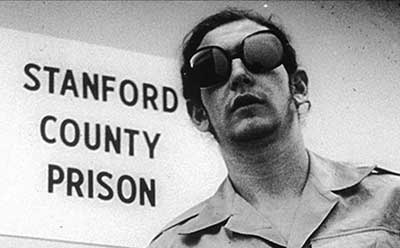
May 27, 2008 It was 1971 when the prisoner, emotionally drained, sleep deprived, chained, and dehumanized in his rough muslin smock was thrown into a tiny dark closet by the cruel guard nicknamed John Wayne, to endure solitary confinement without food or bathroom privileges. You might think this scene was from Hanoi in Vietnam, or at best a military prison in the United States. You'd be close. This brutal activity was funded by the United States Navy, which was interested in learning more about the psychological mechanisms in a prison environment. It took place at Stanford University in California, and the prisoner had done nothing wrong other than to volunteer for a research project. This was the infamous Stanford Prison Experiment, conducted by professor of psychology Dr. Philip Zimbardo.
Philip Zimbardo grew up in what he describes as a "South Bronx ghetto", and as a boy watched his close friends engage in acts of violence, abuse drugs, and wind up in jail. He grew fascinated by the question of why good people do bad things, and became convinced from a very young age that bad environments tend to poison the people placed into them. Put a good person into an evil situation, and that person will become evil. He later wrote:
To investigate this I created an experiment. We took women students at New York University and made them anonymous. We put them in hoods, put them in the dark, took away their names, gave them numbers, and put them in small groups. And sure enough, within half an hour those sweet women were giving painful electric shocks to other women within an experimental setting... Any situation that makes you anonymous and gives permission for aggression will bring out the beast in most people. That was the start of my interest in showing how easy it is to get good people to do things they say they would never do.
From his body of work, it is easy to conclude that he was actively interested in justifying a preconceived notion: That good people will become evil if you put them into an evil environment. About a decade after getting his Ph.D. in psychology from Yale, Zimbardo went to Stanford University, where he got tenure and then set about planning the experiment that was to define his career.
24 students were recruited for a two-week experiment for which they would each receive $15 per day. They were randomly assigned to be either prison guards or inmates. The prisoners were surprised to be picked up unexpectedly at their homes by real Palo Alto police officers. They were roughly hustled to their new home, stripped, deloused, and put into rough muslin smocks with no underwear. Zimbardo described it:
The question there was, what happens when you put good people in an evil place? We put good, ordinary college students in a very realistic, prison-like setting in the basement of the psychology department at Stanford. We dehumanized the prisoners, gave them numbers, and took away their identity. We also deindividuated the guards, calling them Mr. Correctional Officer, putting them in khaki uniforms, and giving them silver reflecting sunglasses like in the movie Cool Hand Luke. Essentially, we translated the anonymity of Lord of the Flies into a setting where we could observe exactly what happened from moment to moment.
The results have become legendary. Some of the guards seemed to relish their newfound authority a little too much, becoming sadistic, and working extra hours just for fun. The torment they put on the prisoners was real. Some began showing physical manifestations of stress and psychological trauma, to the point that one third of them had to be removed from the experiment early. In fact, it got so bad that Zimbardo decided to end the experiment after only six days, less than half the planned duration.
Zimbardo's conclusion was clear. Good, ordinary college students willingly became sadistic tormentors, simply because they were given the permission, the means, and the expectation of doing so. The Stanford Prison Experiment, and this well-publicized result, became a permanent fixture in the popular conception of psychology.
The problem is that a lot of the psychology community disagrees with his findings. Some found that any results were rendered meaningless by insufficient controls. Some have problems with his analysis of the results, reaching a different conclusion based on the same data. Some found the sample population invalidated by selection biases, or the size of the sample inadequate for statistically useful results. Some found methodological flaws that tainted the participants' behavior. Let's look at some of these criticisms in closer detail.
- First, the issue of selection bias. Selection bias is where you choose your subjects in such a way that they are not truly representative of the general population. In this case, Zimbardo advertised to students to participate in an experiment about "prison life". Clearly, a large segment of the general population would be repulsed by such a concept, and you've got to have questions about anyone attracted to that idea. Thus, all applicants to the Stanford Prison Experiment were preselected for comfort with the idea of "prison life".
- Most of the Stanford guards did not exhibit any cruel or unusual behavior, often being friendly and doing favors for the prisoners. The most notorious guard, nicknamed John Wayne, explained that he was simply trying to emulate Strother Martin's character from Cool Hand Luke. Other analysts have found it difficult to support Zimbardo's conclusions, since the allegedly poisonous environment did not affect most participants, and the most notorious participant explained that his motivation came from a completely different source.
- Zimbardo himself was also criticized for actively participating in the experiment as one of the characters. He was the prison superintendent. Although he may have restrained himself from having any influence on the experiment, the fact that he put himself in the position of ultimate active authority over the guards' behavior calls this into question. Many designers of such experiments would summarily throw out such a study based on this alone.
- Some researchers have also questioned why Zimbardo neglected the effect of individual personalities, instead generally attributing all behavior to the prison environment. How did John Wayne's behavior as a guard compare to his behavior outside the experiment? Was he generally a friendly guy, or might he already have been a royal jerk? We don't know, so there was insufficient data to conclude that his behavior was changed by the experiment.
- The statistical validity of the sample of participants, 24 male Stanford students of about the same age, has been called into question as being too small and restrictive to be generally applicable to the population at large.
- I have one other issue with Zimbardo's results that I didn't find anyone else raising, and it goes back to my 15-point checklist in Skeptoid #37, How to Spot Pseudoscience. Zimbardo has dedicated much of his career to the promotion of the idea that bad environments drive bad behavior. I tend to be cautious of claims coming from sources dedicated to promoting them. The scientific method starts with a null hypothesis, not with a preconceived notion to justify; and that process invariably produces data that do not support the conclusion, and theories tend to change over time as a result. By my analysis, Zimbardo appears to be cherrypicking his results to justify the same conclusion that he has been promoting throughout his career. This doesn't make him wrong, it just gives me cause for skepticism.
- Finally, It's worth mentioning that by today's standards, the Stanford Prison Experiment was unethical and could never be performed in the United States. However, this point is not relevant to the validity of the results, and in any event, it was perfectly legal at the time.
Dr. Zimbardo and the Stanford Experiment came into the news again in 2004, following the Abu Ghraib prison scandal in Iraq. American prison guards were accused of cruelty to Iraqi prisoners — the great Naked Human Pyramidgate scandal. A number of soldiers and senior officers were court martialed and imprisoned or demoted. The prosecutors claimed that "a few bad apples" were responsible. The defense disagreed, and called in Dr. Zimbardo as an expert witness to testify that it was the environment that was responsible, not the individuals. "You can't be a sweet cucumber in a vinegar barrel," he famously said. The court disagreed, finding (rightly, as many would say) that individuals must be held accountable for their own actions, and the few bad apples went to jail. Dr. Zimbardo then wrote the book The Lucifer Effect, drawing further parallels between his prison experiment and the Abu Ghraib scandal.
Psychology is complicated, and there will probably never be a perfect theory explaining all human behavior; so people should never assign too much significance to the results of any given experiment like the Stanford Prison Experiment. And, when an experiment receives a large amount of scholarly criticism from mainstream science, as this one did, you have very good reason to look past its portrayal in the popular media and, instead, be skeptical.

By Brian Dunning
Please contact us with any corrections or feedback.
Cite this article:
Dunning, B. (2008, May 27) What You Didn't Know about the Stanford Prison Experiment. Skeptoid Media. https://skeptoid.com/episodes/4102
References & Further Reading Brannigan, A. The Rise and Fall of Social Psychology: The Use and Misuse of the Experimental Method. New York: Aldine de Gruyter, 2004. 37-39.
Brockman, John. "You can't be a sweet cucumber in a vinegar barrel: A talk with Philip Zimbardo." Edge: The Third Culture. Edge Foundation, Inc., 19 Jan. 2005. Web. 24 Apr. 2008. <http://www.edge.org/3rd_culture/zimbardo05/zimbardo05_index.html>
Carnahan T., McFarland S. "Revisiting the Stanford prison experiment: Could participant self-selection have led to the cruelty?" Personality and social psychology bulletin. 1 May 2007, Volume 33, Number 5: 603-614.
Haney, C., Banks, C., Zimbardo, P. "Interpersonal dynamics in a simulated prison." International Journal of Criminology & Penology. 1 Feb. 1973, Volume 1, Number 1: 69-97.
Reicher, S., Haslam, S. A. "Rethinking the psychology of tyranny: The BBC prison study." British Journal of Social Psychology. 1 Mar. 2006, Volume 45, Number 1: 1-40.
Zimbardo, P. The Lucifer Effect: Understanding How Good People Turn Evil. New York: Random House, 2008.
©2025 Skeptoid Media, Inc. All Rights Reserved. Rights and reuse information
|
|


Shop: Apparel, books, closeouts
Now Trending...
 Tartaria and the Mud Flood  Vaccines: Success Story of the Century  The Scole Experiment  The Siberian Hell Sounds  Email Myths  Chemtrails: Real or Not?  The Red Haired Giants of Lovelock Cave  Illuminating Our Lady of Zeitoun
|