 |
 |
  
|
 |
Super Sized Fast Food PhobiaSkeptoid Podcast #88 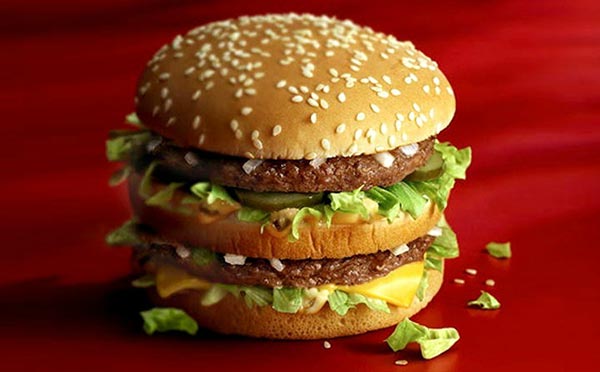 by Brian Dunning Join me for a cheeseburger and a Coke as we put our feet up, get grease all over ourselves, and examine the deeply-rooted pop culture belief that fast food is bad for you. And here's a thing of honey-mustard sauce to drink for dessert. The questionable nutritional value of fast food, and of McDonald's in particular, came under its closest scrutiny when documentary filmmaker Morgan Spurlock released Super Size Me in 2004. The movie documented his own experience living exclusively on McDonald's food for 30 days. He averaged 5,000 calories a day, and when you consider that a Big Mac contains only 510 calories, you know that he was really packing it in. He super-sized every meal that was offered. Most dramatic was Spurlock's reported health problems. Not only did he gain 13% of his body weight, he also developed liver problems, depression and other psychological effects, and sexual dysfunction. Super Size Me also contained a large amount of editorial content about how McDonald's deliberately forces cheap, unhealthy food onto an unsuspecting public for profit. Super Size Me was the most popular documentary of the year, and was nominated for an academy award. Its claims were generally accepted without critique by nearly everyone who watched it or even just heard about it. But this result was virtually guaranteed by Spurlock's choice of subject matter. McDonald's is probably the world's easiest target. It's always popular to be anticorporate; it's always popular to bash fast foods, and audiences are generally well predisposed to welcome any information that supports these concepts. Spurlock's results were only presented in his movie. No actual data was published or subjected to any scrutiny or peer review. We have only his verbal statements to go on, plus the lines delivered onscreen by the doctor and nutritionist who performed in his movie. This is a Hollywood entertainment, it's not valid scientific data. However, for the sake of argument, my inclination is to give Spurlock the benefit of the doubt and accept his claims as valid, and accept the movie dialog as actual opinions of unbiased health professionals. From the perspective of responsible empiricism, that's a stretch, but I'm willing to do it. The problem is that Spurlock's results are highly deviant from other research on the same subject. You see, Morgan Spurlock is not the only person to have ever tested fast-food-only diets, or even McDonald's-only diets. After his movie came out, many people repeated his experiment themselves, including a number of scientific institutions that applied controls and conducted the research in a scientific manner. At least three other documentary movies were made, Bowling for Morgan, Portion Size Me, and Me and Mickey D, in which the filmmakers lived exclusively on McDonald's food for 30 days but (unlike Spurlock) did not force themselves to overeat when they were not hungry. All filmmakers lost weight during the period and suffered no ill effects; and the subjects in Portion Size Me, which was scientifically controlled, also had improved cholesterol. Most famously, Swedish scientist Fredrik Nyström conducted an experiment with eighteen students; only he upped the ante — considerably. Rather than Spurlock's 5,000 calories per day, Nyström's subjects were required to consume a measured 6,000 calories per day. The food was controlled to ensure that most of the calories were from saturated fats. The subjects were not allowed to exercise during the 30 days, also unlike Spurlock, who made sure that he walked a normal distance every day. Considering these differences, Nyström's subjects should have been considerably worse off than Spurlock was, but they weren't. They did all gain 5-15% extra body weight, and complained of feeling tired; but none suffered any other negative effects. There were no mysterious psychological problems, no strange conditions that baffled the doctors. Nyström and his medical staff noted no dangerous changes at all. After his experiment, Nyström was asked his opinion of Spurlock's extreme reaction, especially his liver problems. Having never examined Spurlock, Nyström could only guess, but among two of his perfectly reasonable hypotheses were that Spurlock may have had pre-existing undiagnosed liver problems; or that his normally vegetarian diet may have rendered his liver poorly prepared to suddenly deal with a diet high in carbohydrates and saturated fat, a problem that anyone eating a normal diet would not experience. Any cynic can also easily propose a third possibility, that Spurlock was simply trying to make as dramatic, engaging, and commercial a movie as he could, which is the goal of every filmmaker. Public relations required McDonald's to respond to Super Size Me, and their response was fairly low key. They basically just agreed that it's best to eat a balanced diet, and stated that any actual ill effects experienced by Spurlock were more the result of force-feeding himself 5,000 calories a day for a month, than they were indicative of anything bad about McDonald's food. Way too much of any food is going to be bad for you. That response suggests the next thing to look at. Is McDonald's food, and other fast food in general, actually bad for you? Dr. Dean Edell once took a call on his radio show from a woman whose teenage daughter ate a fast food hamburger every day. The woman was worried that her daughter would develop malnutrition. Quite the contrary, said Dr. Edell: She might gain weight if she ate a lot of them, but malnutrition is that last thing she should worry about. A hamburger is actually quite a balanced meal, rich with just about every nutrient. Add a slice of cheese and it even contains all four food groups. Fast food hamburgers are excellent sources of protein, calcium, and iron. McDonald's hamburgers are not even as grossly calorific as most people probably think. Their biggest burger, the Double Quarter Pounder with Cheese, contains 740 calories. Three of those a day, which is more than anyone reasonably eats, still amounts to a good, healthy, slim 2,200 calorie diet for an adult. The real offenders on fast food menus are not the hamburgers at all, but the drinks; especially the milkshakes. Where Spurlock gained his weight was from the milkshakes. McDonald's 32-ounce Chocolate Triple Thick Shake packs 1,160 calories. Personally, I can't even imagine drinking a 32-ounce shake! A more common size, the 16-ounce, is 580 calories, or slightly more than a Big Mac. McDonald's biggest breakfast will also get you: The large Deluxe Breakfast delivers 1,140 calories. This may sound like a lot, but in fact it's not really much more than any average balanced breakfast. By now you're saying "OK fine, McDonald's food may not be as high in calories as people think, but the real reason it's bad is that it's chock-full of trans-fats, sodium, saturated fats, and cholesterol." That would be bad indeed. The United States and Canada both use a system called the Dietary Reference Intake to establish ideal levels of nutrients. These four compounds listed have an ideal level of "as low as possible", except sodium. Ideally you should take 1500mg of sodium each day, and you should not take in more than 2300mg. McDonald's poster child of evil, the Big Mac, delivers 1040mg of sodium, about 2/3 of your daily ideal. Not a problem by itself, but don't eat three of them. The Big Mac delivers 10g of saturated fat, which is 10g more than you want; but realistically it's virtually impossible to get zero. The Center for Disease Control and the World Health Organization recommend that you keep your saturated fat intake under 7% of your daily caloric intake, and the Big Mac fulfills half of that. So, in short, two Big Macs a day maxes out your recommended safe levels of saturated fat. The Big Mac's 75mg of cholesterol represents 1/4 of the CDC and World Health Organization's daily recommended maximum. I'm not going to eat four of them a day, so that's not a problem. Finally, the scariest mugshot on the CDC's Ten Most Wanted poster: trans-fats. Beginning in 2003 with some high-profile class action lawsuits filed against major food producers, the fast food restaurant chains have all pledged to switch to cooking oils free of trans-fats. Some have completed this, others, including McDonald's, are still completing the switch. But although it's possible to eliminate the addition of trans-fats to fried foods, some foods, like meat and some vegetables, contain naturally occurring trans-fat. 2-5% of the fat in livestock is trans-fat. Whether you order a Big Mac or barbecue your own organic filet mignon, you're getting trans-fat. McDonald's doesn't add it, and your neighborhood butcher has no way of reducing it. A big Mac (or any comparable meat of the same quantity) contains 1.5g of trans-fat, which is more than you want, but only about 8% of the daily amount the World Health Organization says you really, really need to keep it under. Eight percent — the Big Mac is hardly the monster it's made out to be. So eat up, and I'll see you at the drive-thru. Correction: An earlier version of this incorrectly said the Nyström study had seven subjects. Eighteen is correct.
Cite this article:
©2025 Skeptoid Media, Inc. All Rights Reserved. |