 |
      
|
 |
Star JellyJellylike blobs have been reported to fall from the sky during meteor showers. Aliens? No, science. Skeptoid Podcast
#299 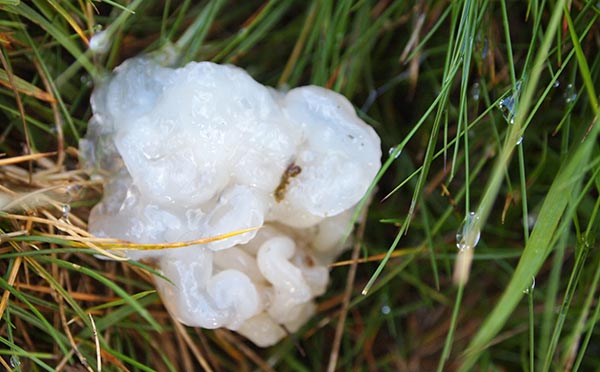 Cumbria, 2011; Washington, 1994; Massachusetts, 1983; Pennsylvania, 1950; in fact, virtually everywhere on the planet, nearly every year, going back as far as written histories go — star jelly has been reported falling from the skies. It's also been called star rot or fallen star in a variety of languages, and old texts have referred to it as "a fatty substance emitted from the Earth" and "a mucilaginous substance lying upon the earth". Star jelly is sticky, slimy goo, in puddles or patches, that's said to fall from the skies, usually associated with meteor storms or with shooting stars. It often doesn't last long, drying up and blowing away before it can be properly analyzed. Star jelly's correlation with falling stars is not universally observed, but many meteors fall without being noticed. One fairly rational Earthly explanation that's been suggested is that star jelly could be chemical waste dumped from the toilets of airliners flying overhead. In more recent years, even conspiracy theorists have gotten in on star jelly, postulating that it is residue from government chemtrail spraying operations. In some cases, witnesses have even reported widespread sickness in towns where the jelly has been found, prompting some to speculate that it may contain some sort of alien virus, thus making it an example of panspermia. Biologists and other scientists, however, have a wide assortment of less spectacular explanations for the goo. Five minutes on Google reveals that samples, when examined, usually turn out to be some sort of biological growth. But sometimes they don't; it's equally easy to find examples where either no such testing was done, or where a microscopic test found no familiar cells. One thing that's certain is that there is no single substance that accounts for all the many blobs found. Photographs and descriptions are all over the map. Different colors, different textures, different parts of the world. We have to abandon the idea that there is one explanation for star jelly. The various blobs found probably represent many different things. Many star jelly blobs are probably slime molds. Slime molds are strange organisms, neither fungus nor bacteria, that reproduce via spores. They live in dead plant matter, feeding on the microorganisms found there. The life cycle of slime molds begins as a single cell, which reproduces quite quickly, moving visibly, and can range in size from smaller than a coin to over a meter. During this growth phase, they are wet and slimy, and called a plasmodium. They look a great deal like many star jelly photographs, ranging in color from clear to white to yellow to pink to red. In fact, one common species of slime mold, Enteridium lycoperdon, is called caca de luna in Mexico, basically "Moon poop". Later in the life cycle, the plasmodium dries up, hardens, splits opens, and releases brown spores, each of which blows away to begin the life cycle anew. Another highly probably candidate for a lot of star jelly findings is a genus of cyanobacteria (commonly but incorrectly referred to as blue-green algae) called Nostoc, of which there are many species. Nostocs live all over the world as tiny, barely visible colonies of bacteria; but when they get wet, for example in a rainstorm, they swell up to great size and become great gooey lumps or puddles, ranging from clear to yellow to green. Some species are collected and eaten throughout Asia and Central and South America. Notably, Nostoc's common names include star jelly and fallen star. There's also a type of slime bacteria called myxobacteria, which travel in packs of cells and actively move through soil. In starvation conditions, intercellular communications prompt the slime bacteria to group together into what's called a fruiting body which can then emerge from the soil. However these jellylike fruiting bodies are tiny, perhaps a millimeter or two in size, and are not a good explanation for most star jellies. Some fungi look superficially like a few of the star jellies reported, such as Phlebiopsis gigantea. Although this and other fungi can often appear and grow quite quickly, and can do so simultaneously scattered over a wide area, many star jelly enthusiasts point out that fungi are neither jellylike nor sticky. Fungi are generally dry, with a consistency more like bread than like slime. However many fungi do secrete a smelly slime, generally thought to attract flies that help spread the spores. One whole group of mushroom are in fact called slime caps. But after comparing many photographs of slime-producing fungi with star jelly specimens, I find it very hard to accept that one could be mistaken for the other. But there is another interesting candidate, once thought to be related to fungi but now considered to be separate. Bryozoa are a whole phylum of creatures many people have never heard of. There are about 4,000 species, and they exist in colonies of interdependent individuals. We call such colony-dependent individuals zooids. Most of these zooids are tiny but not microscopic, about a half a millimeter long, and they secrete exoskeletons. In some species, this is relatively solid, giving the colony a coral-like or plant-like appearance; in others, this is gelatinous, turning the whole colony into a wet, sticky blob of non-living gel with a living surface of zooids. Byrozoan blobs live in the water, some in salt, some in fresh; and attach themselves to underwater objects. Some species move up to several centimeters a day. The largest colonies have been observed to be a meter across. One such blob famously surfaced in a lake in Newport News, VA in 2010, prompting all sorts of speculation from people who had no idea what the heck it might possibly be. Other racier natural substances include unfertilized frog spawn or even deer sperm, both of which do appear clumped on the ground in nature and look very similar to a lot of the photos of star jelly found on the Internet. As surprising and unlikely as they may sound, it's more than likely that at least some of the many sightings throughout history were these simple substances. The suggestion that some star jelly is actually human waste dumped from airplane toilets is a poor fit. First of all, airplanes don't now (and never have) discharged toilet waste by dumping it in mid-air; however, it is possible for their systems to leak. On the few occasions when this has happened, the blue liquid forms ice on the fuselage which can break off and fall, usually when the plane is descending into warmer air before landing. There have been about a half dozen reported cases in the past few decades of such chunks actually damaging roofs. But these ice chunks are not gelatinous, and their blue color is not a good match for many of the reports of star jelly. The anecdotal reports of mass illness striking residents after falls of star jelly also fail to stand up to scrutiny. It's fine to say that lots of people in town got sick, and we can even grant that they did; but what were they sick with? What ties the sickness to the star jelly? Virtually every town has some virus being passed around at any given time; and no matter what event happens, it's almost always possible to correlate it with a current breakout of some sickness. It certainly is possible to connect an epidemic with a cause, and so far, this has not been done in a single star jelly case. It's been pure anecdotal speculation; there's never once been a diagnosis of a pathogen tied to star jelly. Especially given that someone in any town is always sick, there has not yet been any compelling science-based reason to conclude that star jelly produces ill effects. Perhaps the most important weak assumption about star jelly is its origin: having fallen from the sky. News reports almost always state the substance rained out of the sky, and indeed, most people talking to the reporters honestly believe that it did. Most of them are probably assuming it, but others have a firmer conviction. They saw the ground with no star jelly, then maybe regular rain fell or maybe nothing fell, and then they observed the star jelly. No other apparent explanation was possible, so the notion of its having fallen is often taken for granted as an observation. But the fact is that there is no testable, non-anecdotal evidence that any star jelly has ever fallen from the sky. Exactly as we found when Skeptoid studied the stories of frogs and fish raining out of the sky, the observation of falling seems so obvious that eyewitnesses firmly believe that it happened and tend to report it, whether they actually saw it or not. Verbal reports have included fish flipping about in rain gutters on rooftops, despite no corroborating evidence. So it is not at all surprising — in fact it's expected — that some star jelly witnesses will report actually having seen it fall from the sky. Maybe it did, but science does not allow us to assume that all verbal reports precisely and inerrantly describe what actually took place. We have to rely on what we can test and what we can know; and so far, star jelly is not known to fall from the sky at all. But what about DNA testing, shouldn't that tell us for sure whether star jelly is an Earthly organism or something else? There's a good reason that DNA tests are rarely done on star jelly. Unlike their television portrayal, DNA tests — especially in past years when famous star jelly events have happened — have been prohibitively expensive and involved. Star jelly would have to be taken to a university equipped to do such testing, and would require lots of time and money. Who is supposed to pay for that? Volunteers stepping forth with their checkbooks open have been few. Star jelly cases have rarely excited the interest of scientists sufficiently to get them to front the costs from their own pockets, simply because there are so many possible common and unremarkable explanations. My summation on star jelly is that it's a mistake to consider it a single phenomenon. Every case of some jellylike slime found on the ground is unique, and should be treated as such. There are so many possibilities; every given case, on visual and tactile data alone, offers at least two or three possibilities from Earth's own taxonomic kingdoms. Is any star jelly actually from the stars? Maybe some of it is, but it would be the exception not the rule; and has yet to be supported with evidence.
Cite this article:
©2024 Skeptoid Media, Inc. All Rights Reserved. |