 |
 |
  
|
 |
Decrypting the Mormon Book of AbrahamMormon Prophet Joseph Smith allegedly translated the adventures of Abraham in Egypt. Skeptoid Podcast #168 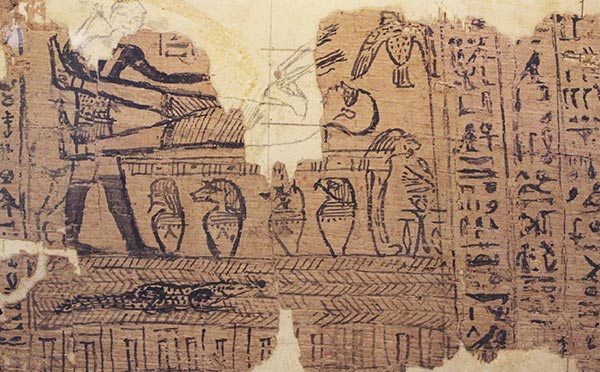 by Brian Dunning Today we're going to point our skeptical eye at one of the supposedly ancient scriptures of the Mormon Church, the Book of Abraham. In 1835 the Church came into possession of some Egyptian papyri, said to have been translated with divine guidance by their prophet, Joseph Smith. Smith reported that the papyri were "the writings of Abraham while he was in Egypt, called the Book of Abraham, written by his own hand, upon papyrus." In the book, Jehovah reveals to Abraham the nature of the universe and the order of all things, in a personal conversation, including knowledge of the planet Kolob, which is close to where God lives. Sometime in the early 1800's, an antiquities dealer named Antonio Lebolo returned from Egypt with eleven mummies and other artifacts, including papyri, from the region around Thebes. Upon his death, the collection was sold at auction, and ended up in an exhibition that traveled the United States, which sold the artifacts off as it went. In 1835 this exhibition reached Kirtland, Ohio, the headquarters of the Latter-Day Saints. The exhibition's proprietor at the time was a Michael Chandler, who was well aware that the church had been founded upon Joseph Smith's claimed translation of gold plates written in Egyptian, which became the Book of Mormon. Chandler gave Joseph Smith a viewing of the collection, which by that time had been reduced to four mummies and a few rolls of papyri containing hieroglyphics, and Smith gave Chandler a cursory translation of some of the papyri. Shortly thereafter, two church elders, Joseph Coe and Simeon Andrews, purchased the entire collection from Chandler for $2,400, about $60,000 in today's dollars. Smith then took the papyri into seclusion to translate them. At his side were Oliver Cowdery and William Phelps who transcribed. The product of their labors is the Book of Abraham. It's not very long; five short chapters, less than six thousand words. The book includes three Egyptian-looking illustrations done by Reuben Hedlock, a professional engraver who copied them from the actual papyri. The Book of Abraham, with its illustrations, is now included in the Pearl of Great Price, one of the Mormon church's five books of scripture. Upon Joseph Smith's assassination in 1844, the artifacts were passed to his mother, and then to his widow, who sold them to a collector by the name of Abel Combs. Combs broke up the collection, and about half the artifacts went to the Wood Museum in Chicago, where they were subsequently lost in the Great Chicago Fire of 1871. The whereabouts of Joseph Smith's papyri remained a mystery for nearly a century, until a scholar named Dr. Aziz Atiya from the University of Utah happened upon them in the New York Metropolitan Museum of Art's archives in 1966, recognizing them by one of the illustrations that he knew from the Pearl of Great Price. Upon investigation, it was discovered that the Metropolitan had purchased them in 1908 from the daughter of Abel Combs' housekeeper, including an affidavit from Smith's widow. All of Smith's original papyri had been fragmentary, and these ten pieces probably made up some one-third to one-half of his original collection. The Church bought the papyri from the Metropolitan and brought them back to the Salt Lake City headquarters, where one additional fragment was discovered in the Church's own archives; bringing the total count of Joseph Smith's original papyri that survive today to eleven. Having the original documents available made it possible for Egyptologists to examine and properly translate them, to see whether they do indeed match what Smith, Cowdery, and Phelps came up with. If they were indeed divinely inspired with translating abilities, you'd think that would be the case. Let's find out. This is a good time to introduce Thomas Stuart Ferguson, an attorney, amateur archaeologist, author, and Latter Day Saint. Ferguson's lifelong passion was finding archaeological evidence from Mesoamerica that confirmed the Book of Mormon stories. His book One Fold and One Shepherd is considered one of the seminal works on the subject. It was Ferguson who first approached Brigham Young University and persuaded them to create a Department of Archaeology. He founded the New World Archaeological Foundation to bankroll expeditions to Mesoamerica, and even got the Church itself to become a major sponsor of his work. So imagine Ferguson's excitement at the opportunity to provide a real live black-and-white proof of Joseph Smith's divine inspiration, and an actual historical document, thousands of years old, telling the Book of Mormon stories. Ferguson obtained photographs of the eleven papyrus fragments and sent them to Klaus Baer, a professor of Egyptology at the University of Chicago, and to an unaccredited amateur, D.J. Nelson. He also sent copies to a pair of Egyptologists at U.C. Berkeley, Professor Henry Lutz and Leonard H. Lesko, but provided no information about their origin or anything that might link them to the Book of Abraham. All four men quickly came back with the exact same proper identification of the documents. They were examples of what's called a hypocephalus, meaning "below the head". This is a round papyrus or other inscribed object placed under the head of a deceased person for burial. No two are the same. They are inscribed with a traditional funerary text, often from The Book of the Dead, and this particular one was The Breathing Permit of Hor. The papyri were merely unremarkable burial trappings, quite likely from Antonio Lebolo's original mummies. They had nothing remotely to do with Abraham, the planet Kolob, or anything else found in Joseph Smith's translation. Moreover, numerous Egyptologists since have examined the widely published photographs, and identified in detail everything found in the illustrations. Again, Smith's own callouts and identifications bear no resemblance to the actual contents. Ferguson said "I must conclude that Joseph Smith had not the remotest skill in things Egyptian-hieroglyphics." The Church has defended Smith's claim against the findings of academia. Hugh Nibley, a late professor of Mormon scripture at Brigham Young University, was the Church's primary apologist for many years. Nibley's main defense was that the papyrus fragments recovered from the Metropolitan did not happen to be the same ones in which Smith found the Book of Abraham, and thus the different translations; after all, perhaps as much as two-thirds of the original papyri have never been recovered. Ferguson scoffed at this suggestion, pointing out that all three of Reuben Hedlock's illustrations exactly match those in the existing papyri. Smith, Cowdery, and Phelps had also written the Egyptian Alphabet & Grammar, purportedly a guide for understanding the heiroglyphs in the documents they translated, which has remained in the Church's possession. It makes clear references to the heiroglyphs and their positions on the pages, unambiguously referring to the existing papyri. They are clear, additional evidence that the existing papyri are the ones claimed to contain the Book of Abraham. Nibley dismissed the Egyptian Alphabet & Grammar as "of no practical value whatever and never employed in any translation." I have to agree with Nibley here: They certainly do not seem to be of any practical value, but that says nothing about the finding that they do reference the existing papyri. The papyri have been dated to the first century BC, about 1500 years after Abraham is claimed to have lived, which makes it difficult to reconcile Smith's statement that they were written by Abraham's own hand. Hugh Nibley came to the Church's rescue again, stating that it's common to refer to a book as having been written by someone without literally meaning that that exact volume was created by a pen held in that person's own hand. The Church itself goes even farther, stating that "Joseph Smith never claimed that the papyri were autographic (written by Abraham himself)", implying that there's still a loophole for Smith's claims to be true. But this is a tenuous position to which to cling. Joseph Smith's introduction to the Book of Abraham reads:
Joseph Smith also showed a papyrus to Charles Adams, the son of John Quincy Adams, who reported that Smith told him:
Beyond any reasonable doubt, Joseph Smith maintained that his papyri were literally written by Abraham's own hand, and that they told Abraham's story. Both are, beyond any reasonable doubt, untrue. It's not possible to get inside the heads of Joseph Smith, Oliver Cowdery, and William Phelps, so we can't really know what their honest intentions were. The most cynical analysis concludes that the Book of Abraham's authorship was a fully deliberate fraud, where all three men knowingly conspired to contrive a Bible-style book to add to their doctrine, claiming the papyri as the source when they well knew that it probably had nothing to do with the story they invented. A more charitable version of events has Smith honestly believing he was divinely inspired to translate the papyri, reeling off the tale as it came to him, with Cowdery and Phelps sincere in their faith and transcribing Smith to the best of their ability. Maybe Smith alone knew he couldn't read the papyri and was making up the story, and hoaxed Cowdery and Phelps. All we can say for sure is that its source is absolutely not what the Church claims it is. The Church says that the significance of the Book of Abraham is that it is "evidence of the inspired calling of the Prophet Joseph Smith." I can find no rational argument that supports this. It is merely evidence that the talents of Smith, Cowdery, and Phelps, combined with any divine inspiration any of them may have had, were insufficient to translate a document that is a trivial task for any knowledgeable Egyptologist. Honest Mormons should have grave concerns over the Church's continued promotion of a claim proven to be false. It's time for Mormons with intellectual integrity to demand the Book of Abraham be reclassified as not of any divine inspiration, and its authorship properly assigned to Smith, Cowdery, and Phelps, with whatever status the Church likes that does not endorse the bogus translation.
Cite this article:
©2025 Skeptoid Media, Inc. All Rights Reserved. |