




Blood for Oil

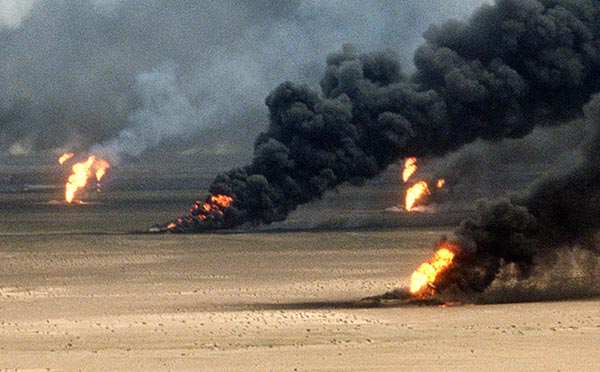
Is the war in the Middle East really being waged for oil?

Filed under Conspiracies

Skeptoid #32
March 12, 2007
Podcast transcript | Listen | Subscribe
Bookmark and Share

The War on Terror and anti-American sentiment in the Middle East has raised our gasoline prices to an all-time high. Or has it?

Everyone knows that most of our oil comes from the Middle East, which is why we're so heavily dependent upon them for our energy. And when they don't like us, for example when we bomb them, they jack up our prices to hit us where it really hurts. Or so I've always heard. But is any of that really true?

More than a third of our petroleum, about 37% of our total usage, is produced domestically by our own oil companies. I'm not sure why people seem to forget about those guys, ExxonMobil and Chevron and all of them; you may resent them but they are the principal source of our non-foreign-dependent energy. So this means that only a bit less than two thirds of our petroleum is imported. That still means most of our petroleum comes from OPEC, right? Wrong. Most of our petroleum imports come from non-OPEC countries; 56% of it, in fact. Of that 56%, the majority is from Canada and Mexico, who are about as far removed from the Middle East as can be. The rest of it is from other random places like Angola, Russia, the Virgin Islands, and Brazil, all of whom are friends of ours. So exactly where is all this leverage from anti-US exporters coming from?

Petroleum Imports
Almost none of US petroleum comes from hostile Middle East nations - less than 1%

You probably assume that it comes from the OPEC countries, who provide the remaining 32% of our petroleum. Well, here's the next monkey wrench. Of that 32%, almost none comes from hostile Middle East countries. The biggest supplier is Saudi Arabia, a relatively Westernized country that's our biggest ally in the region. Number 2 is Venezuela (in more ways than one); their president may be headed for a rubber room but they're hardly a Middle Eastern terrorist nation. Number 3 is Nigeria, and I'll bet you didn't know that they had an industry other than sending emails promising millions. Number 4 is Algeria, and what's left comes from Iraq, which isn't allowed to hate us any more now that we occupy them. In fact, less than 1% of our petroleum comes from hostile Middle East countries.

No blood for oil, say the anti-war protesters. I'm against the war too, but I'm interested to hear that particular claim defended. Yes, the United States does launch some pretty unpopular military actions in this world, but not against anyone who provides any significant part of our oil. No blood for oil. Looks great on an anti-war protest sign. Sounds great on 60 Minutes. But what's it based on? I don't know.

So I don't understand. Since none of our oil supply is dependent on these Middle Eastern countries we're always fighting with, how come that fighting affects our gas prices? Sounds like a smoking gun to me. Clearly, we wouldn't be fighting them if we weren't getting some oil out of it somewhere, say the conspiracy theorists. Maybe the Saudis are behind it. Maybe attacking Iraq is a way to please Saudi Arabia. Well, if it is, the fighting sure didn't improve our gas prices much. From what I can see, we've gained nothing by attacking Iraq. We certainly haven't won any free oil or earned any favoritism discounts. So why do the conspiracy theorists draw this connection? I don't know. None of it makes any sense to me.

Yet, something has driven up the gas prices. Whose word do we accept unconditionally: the government's, or that of the anti-US conspiracy theorists? Maybe a liberal dose of skepticism is due. Maybe all of these people are speaking with an agenda, rather than with responsible critical analysis.

An advertisement in the New Yorker magazine costs a lot more than an advertisement in People Magazine, despite the fact that People Magazine reaches many more readers. A Porsche Turbo costs almost twice what a Porsche Carrera costs, even though they're 98% identical. A Rolex contains the same parts as a Timex but costs a hundred times as much. Has the world gone mad? When did prices suddenly jump off the sanity wagon? Since when do companies charge a penny more for their products than their production cost?

Prices are driven by markets. Markets are driven by human beings. Human beings are driven by emotions. Emotions, like fear, explode when we get into a war. When we get into a war in an oil-producing region, petroleum markets in those regions go insane. Stockholders get nervous. Traders freak out. Prices climb the tree like mad to escape the tsunami. Everyone between you and the guy who connects the hose to the well in Yemen becomes terrified, and oil becomes the most prized commodity on the planet. It's simple, it's obvious, it's organic, and it's Economics 101. It's not blood for oil and it's not a Halliburton conspiracy. It's a fact of world economics, and the tidal force of the world economy is the strongest superpower on Earth: greater than Dick Cheney, greater than Osama bin Laden, greater than anti-war protesters. The US administration wishes it could control oil prices like this.

I'm well aware that this little outburst of mine is not going to change the mind of anyone who believes that the war in the middle east is all about oil. I know that plenty of listeners are going to find fault with my research and point out that we did in fact get seven barrels of oil from a hostile country ten years ago. I know that many listeners are going to drag out the tired old adage that if Iraq produced pencils instead of oil, the Gulf War would never have happened. I know that many listeners are going to point out that regardless of short-term price hikes, it's essential for the US long-term energy strategy to have a strong military presence in the Middle East. I know I can't change your mind. What I can do is to encourage you to be skeptical for a moment. What I can do is to encourage you to look up, on your own, where our oil actually comes from. When you see how little of it comes from the Middle East, and especially how almost none of it comes from the hostile parts of the Middle East, I hope that you will at least re-examine the blood for oil claim. Is that small percentage of oil truly more important than virtually everything else about our country, to the point where we'd infuriate everyone in the world, plus most of our own people, to wage a war? I'm not a politician and I don't claim to know what the war is really about, but when I look at the oil question skeptically, it just doesn't emerge as a logical cause. I'm not claiming to have the answers and I'm not even claiming to be right, but I am claiming to have thought about it more, and personally done more independent research into the sources of our petroleum, than most people who simply parrot the blood for oil slogan because it's a great sound bite and because it's an easy and trendy way to be anti-Bush. I'll give you a great starting point for your own research, an article by the engineering editor of Road & Track, and you'll find the link for it in the online transcript of this episode.

I fully expect this episode to be among the least popular, and the most criticized. It's always more popular to be skeptical of the government, than to be skeptical of those who doubt the government. So go ahead, I'm all through talking now; bring it on.

You should follow me on twitter here.

Brian Dunning
Brian Dunning

© 2007 Skeptoid Media, Inc. Copyright information

References & Further Reading

Bromley, S. "The United States and the Control of World Oil." Government and Opposition. 15 Mar. 2005, Volume 40, Issue 2: 225-255.

Chaudhuri, A. Emotion and Reason in Consumer Behavior. Oxford: Butterworth-Heinemann (Elsevier), 2006.

Flynn, S.M. Economics for Dummies. Hoboken: For Dummies (Wiley), 2005.

Maugeri, L. The Age of Oil: The Mythology, History, and Future of the World's Most Controversial Resource. Westport: Praeger Publishers, 2006.

Reynolds, A. "Oil prices: cause and effect." TownHall.com. Salem Web Network, 23 Jun. 2005. Web. 8 Nov. 2009. <http://townhall.com/columnists/AlanReynolds/2005/06/23/oil_prices_cause_and_effect>

Shalizi, Z. "Energy and emissions : local and global effects of the rise of China and India." Research Working Papers of the World Bank. 1 Apr. 2007, N/A: 1-52.

Shermer, M. The Mind of the Market: How Biology and Psychology Shape Our Economic Lives. New York: Holt Paperbacks, 2008.

Reference this article:
Dunning, Brian. "Blood for Oil." Skeptoid Podcast. Skeptoid Media, Inc., 12 Mar 2007. Web. 2 Sep 2010. <http://skeptoid.com/episodes/4032>

Discuss!

5 most recent comments | Show all 88 comments

Remember, you should always read with skepticism the comments of anyone too lame to put their real name & city.

Speaking of cherry picking, did you read this part?

"I'm not a politician and I don't claim to know what the war is really about, but when I look at the oil question skeptically, it just doesn't emerge as a logical cause. I'm not claiming to have the answers and I'm not even claiming to be right, but I am claiming to have thought about it more, and personally done more independent research into the sources of our petroleum, than most people who simply parrot the blood for oil slogan because it's a great sound bite and because it's an easy and trendy way to be anti-Bush."

He wants people to think.

The scholarly work I've read seems to indicate that the Bush administration drank their own Kool-aid as it were. They really thought they were doing those Kurds a favor, that the world would look at the 'amazing success' that Iraq would quickly become, and love the US all the more for it. Their 'faith' is one of the main reasons I extremely disliked the Bush administration.

I do echo the criticism that just because WE don't get oil from hostile countries doesn't mean trying to 'stabilize' the middle east wouldn't be a way to drop oil prices (as other consumers wouldn't be competing as much for the oil from the places we get ours). I go one further. Just because it is an illogical reason doesn't mean that it couldn't be the reason. People do act irrationally after all.

Brian was addressing the POPULAR claim and assumptions, which happens to be an easy target.

Brandon, Falconer
August 22, 2010 7:23pm

My point Adam was that you claimed that using the term "conspiracy theory" was a character assassination, when the term is apt to describe the popular view.

And your post did accuse Brian cherry picking weaker targets to dismiss out of hand, before youyourself appeared to dismiss them a few lines later.

Tom H, Kent, UK
August 22, 2010 10:15pm

Before anyone jumps on my throat, I just realised I made a mistake: the Shah was not helped into power by the US in Iraq during the 60s, it was in Iran during the 50s; though as an historical antecedent is still valid, since it was also related to controlling Iran’s oil (issue that the US is also currently looking to resolve again).
---
Come on Brandon, that final disclaimer was simply what you call an “Appeal to Lack of Authority”; you either know what you’re talking about or you don’t. And I have no doubt that Brian has looked into it more than most people (since most people’s reading is limited to their Cornflakes box), but by no means that justifies, and much less validates, the analysis.
---
The character assassination or “ad hominem attack” was not calling them “conspiracy theorists” Tom, but saying that conspiracy theorists are “anti-US”. It’s obvious that Brain was attempting an appeal to patriotism to gain support for his argument; simply telling you that if you believe the conspiracy theorists, then you are anti-American. This fallacy is very common and widely used by skeptics, who often know so little about what’s going to the point of ignoring that most of these people, whether it is for good or bad, are driven by an extreme nationalist and patriotic sentiment. And apart from “poisoning the well”, the statement is also a “non-sequitur”, since patriotism is independent of any administration, and therefore of government.

Am I using your logical fallacies right? :)

Adam Freeman, Springfield
August 23, 2010 5:24am

Hey Adam, not saying you are wrong but I dont seem to have read the same spin into Brians podcast as you have. Addressing the nonsequiter argument, I'm not convinced it accused protesters of being unpatriotic, just partisan politics, being Anti Bush, not Anti American.
It is hardly a non~sequiter when the statement is that certain groups are claiming that the war was fought over oil (and such images are abundant), and the argument is a lack of facts to back this up.

Taking a world wide view (of protestersat G8 for example); The protestors were indeed anti-US because in the rest of the world the US was seen as the driving force of the invasion.

Any appeal to partiotism you believe was imparted was not the crux of the argument. The facts and figures you disagree with were the crux of the argument. Brian does however make reference to the Ant-Bush lobby. As you pointed out yourself this is a partisan statement not an anti-patriotic statement.

Again, I'm not arguing if you are rightor wrong, just trying to clarify some of your issues.

Tom H, Kent, UK
August 26, 2010 4:14am

Yes, I can agree with you in from that point of view, but I think we are interpreting the argument in different ways. This is the statements I was referring to:

"Whose word do we accept unconditionally: the government's, or that of the anti-US conspiracy theorists?"

I don't think Brian was referring to protesters (those who protest against the war), he specifically named the conspiracy theorists (those who come up with the claims against the government) as anti-US. And there’s also the appeal to patriotism: you either believe Brian and your government, and therefore you are patriot; or you believe the conspiracy theorists, and therefore you are an anti-US like them. Which I believe is a non-sequitur, because patriotism is independent of government (you can love your country and hate the government, and vice-versa); it’s unrelated.

I also think we are interpreting the "war for oil" argument in different ways. I don't disagree with Brian’s figures, but with the claims he chose to analyze. He assumed, and base his whole argument, on the idea that protesters claim that the US’ intention was to lower the prices and/or gain an extra supply of oil, while I’m proposing more likely alternative motives unrelated to prices or supply; like gaining control and influence over oil producing countries, the west having control of oil as a resource, or granting the exploitation of Iraq’s oil by western companies.

Adam Freeman, Springfield
August 26, 2010 4:14pm

Make a comment about this episode of Skeptoid (please try to keep it brief & to the point). Anyone can post:

Your Name:
City/Location:
Comment:
characters left. Discuss the issues - personal attacks, posts containing advertisements or links to commercial services, nonsense, and other useless posts will be deleted.
Answer 5 + 3 =

You can also discuss this episode in the Skeptoid Forum, hosted by the James Randi Educational Foundation.

Join the Skeptalk email discussion list.

What's the most important thing about Skeptoid?

Support Skeptoid
Support Skeptoid
 
Skeptoid host, Brian Dunning
Skeptoid is hosted and produced
by Brian Dunning


Newest
The Myers-Briggs Personality Test
Skeptoid #221, Aug 31 2010
Read | Listen (13:10)
 
Yonaguni Monument: The Japanese Atlantis
Skeptoid #220, Aug 24 2010
Read | Listen (11:53)
 
Stalin's Human-Ape Hybrids
Skeptoid #219, Aug 17 2010
Read | Listen (13:14)
 
The Astronauts and the Aliens
Skeptoid #218, Aug 10 2010
Read | Listen (12:53)
 
Some New Logical Fallacies
Skeptoid #217, Aug 3 2010
Read | Listen (12:08)
 
Newest
#1 -
How to Debate a Young Earth Creationist
Read | Listen
#2 -
The Real Philadelphia Experiment
Read | Listen
#3 -
Medical Myths in Movies and Culture
Read | Listen
#4 -
MonaVie and Other "Superfruit" Juices
Read | Listen
#5 -
Religion as a Moral Center
Read | Listen
#6 -
HAARP Myths
Read | Listen
#7 -
Apocalypse 2012
Read | Listen
#8 -
The Detoxification Myth
Read | Listen

Recent Comments...

[Valid RSS]

ZIP Code Database

Skeptoid Podcast Skeptoid on Facebook   Skeptoid on Twitter


"The Philadelphia Experiment"
inFact with Brian Dunning

Skeptoid is not responsible for the content of the ads below. Often they are great illustrations of what this episode is examining critically, so feel free to take a look.