




Ganzfeld Experiments

The true history of the experiment that is said to present the strongest evidence yet for telepathic abilities.

Filed under Paranormal

Skeptoid #348
February 05, 2013
Podcast transcript | Listen | Subscribe
Bookmark and Share

Today we're going to enter a quiet, darkened room, sit comfortably, and prepare to receive psychic imagery, in what's often claimed to be the most convincing evidence for the reality of psi — psychic abilities. The idea of being able to transmit thoughts from one person to another is so compelling that there's never been a shortage of researchers hoping to find a way to develop it. We all wish we could have such a superpower, so we all want this to be true. Today's subject is ganzfeld experiments. Ganzfeld is German for "whole field", referring to its method of replacing the whole of your field of perception. Let's take a close look and see what it is, how it works, and — most importantly — whether it does indeed promise to be proof of psi.

A ganzfeld state is a bit different from sensory deprivation, as made famous in the movie Altered States. In sensory deprivation, the idea is to remove all stimuli, audio, visual, thermal, and tactile. Ideally the subject is placed in an isolation tank, a coffin-like device in which you float in a dense saline solution, the temperature is a constant, comfortable ambient temperature, and it's completely dark and quiet. You see, hear, and feel nothing. Sensory deprivation has often been used recreationally, both with and without hallucinogenic drugs, for its ability to make the imagination seem surprisingly real, given the lack of competing stimuli.

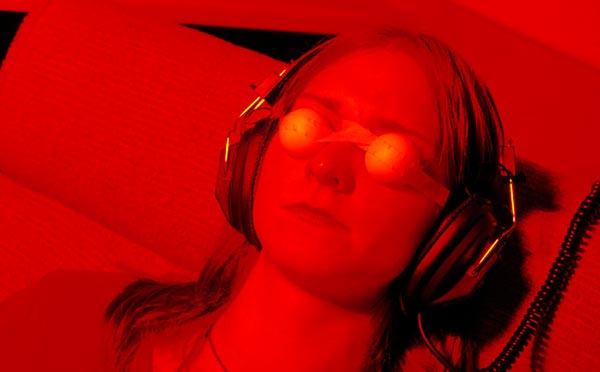
However, in ganzfeld, the idea is to instead provide homogenous stimuli. The subject, called the "receiver", sits comfortably in a recliner, wearing headphones playing gentle white noise. The room is bathed in red light and the receiver wears translucent cups over the eyes, so all they see is a uniform, featureless red. They are relaxed and cozy. That's the physical setting of the experiment. Two other people are involved: an experimenter and a "sender". The sender, in an isolated room where they cannot be seen or heard by the receiver, concentrates for 30 minutes on a "target", which is some object or video clip or something. Throughout the 30 minutes, the receiver is supposed to verbally recite what they see or imagine. The experimenter, who is also supposed to be isolated from both the sender and the receiver, records what the receiver says, and usually keeps notes about what they describe.

At the end of the 30 minutes, the receiver is shown the actual target upon which the sender was focusing, presented alongside with three other control objects. The receiver guesses which of the four most closely resembles their impressions during the ganzfeld session. Pure chance predicts a 25% hit rate. But ganzfeld experiments became famous within the parapsychology community because experimenters consistently found a significantly higher hit rate; closer to 35%.

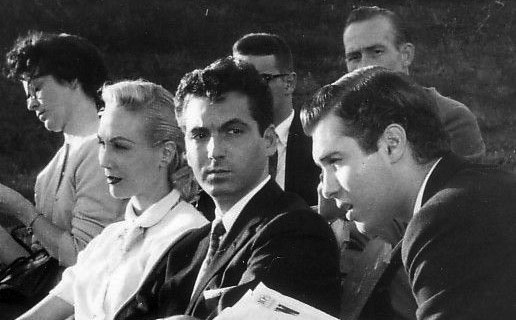
The history of ganzfeld experimentation is essentially the history of a particular battle between skeptics and believers; a cordial battle, but a battle nevertheless. Beginning in the 1970s, the leading proponent was American parapsychologist Charles Honorton, a staunch believer in psychic abilities, who was dedicated to finding a reliable scientific method of establishing the reality of psi. Honorton's idea was that whatever psi abilities many people may have is lost in the sea of constant stimuli that we're all receiving all day long. We see, we hear, we touch, we think, to such a degree that if we did receive a psychic impression we'd never recognize it as such. So by placing subjects into a ganzfeld state, it's thought that the signal-to-noise ratio would be increased, by shutting off all that noise, and subjects might be more likely to recognize a psychic transmission.

Across the line of battle was Ray Hyman, at the time a professor of psychology at Harvard. In the 1980s he came across Honorton's body of work, said to be the best evidence yet for psi. Hyman studied it carefully, and came away unconvinced. In his assessment, the positive results so flaunted by the parapsychologists was due to methodological error. In 1985, Hyman published an article in the Journal of Parapsychology called "The Ganzfeld Psi Experiment: A Critical Appraisal".

Unimpressed right back, Honorton published — in that very same issue of the journal — "Meta-Analysis of Psi Ganzfeld Research: A Response to Hyman". Clearly, there was a difference of opinion.

Before we look at what happened next, let's hear out both Honorton and Hyman to see exactly what was right or wrong with the research. Most of this involved what are called meta analyses, which is when you combine the results of multiple studies with the goal of getting a better idea of what the whole body of research in a field has concluded. Meta analyses are tricky animals, because studies can be conducted in so many different ways, and are often of greatly varying quality. All sorts of statistical methods can be employed (rightly or wrongly) to try and account for and control these differences. It's not surprising — in fact it's to be expected — that researchers can come up with greatly differing findings doing meta analyses on the same set of studies.

Hyman brought a considerable amount of skepticism to the table, so I was expecting his article to find all sorts of problems with Honorton's work, which covered 42 studies in which 55% showed positive evidence of psi. Hyman did report problems, however his own corrected analysis found not the random chance result of 25%, but a still-significant 30%, which, in itself, appears to still represent pretty amazing evidence that Honorton's receiving subjects were in fact receiving some kind of impressions from the senders. However, not so fast. The criticisms that Hyman found were inadequate randomization; sensory leakage (meaning that in some cases, the receivers could actually hear what was going on in the sender's room next door; in others, it was possible for things like the sender's fingerprints to be visible on the target object for the receiver to see); and inappropriate statistical analysis.

Mainly, Hyman felt that Honorton's work suffered from a type of statistical complication called multiple testing. In a nutshell, multiple testing is when you take more and more variables into account between two groups; sooner or later you're going to find more and more differences between them. These variables included the different ways that researchers had categorized the senders and receivers, cross referencing them to the results. They found that subjects were more likely to have positive results if they had been educated in a creative field; if they already had a strong belief in psychic powers; if they were extroverted; and if the experiment was conducted in a warm and welcoming atmosphere. Hyman believed that the positive results reported by Honorton were due, at least in part, to multiple testing effects that inappropriately considered these types of variables. Hyman also found that the "file drawer effect" came into play, which is when studies are abandoned when they end up not showing any interesting results. Thus, the body of published work was inappropriately skewed to include those results which showed a positive result, which is going to happen sometimes simply due to random variances. Hyman figured that, working backwards and accounting for the degrees to which various weaknesses were present in each of the studies, the actual size of the effect was zero. His closing line was:

It is concluded that this data base is too weak to support any assertions about the existence of psi.

Honorton's reply in the journal was in kind. He acknowledged all of these potential weaknesses, but explained how he had accounted for them, and still insisted that the results supported the existence of psi. This whole discussion got about as deep into statistics as anyone might reasonably (or unreasonably) want to go; but the net result is that the men had a disagreement on the analysis of the existing body of work. So now let's look at what happened next.

It was quite refreshing, and something that I wish I've seen more often. Honorton and Hyman got together and collaborated on a new article, hoping to find an analysis they could agree on. It was published in the same journal in 1986, entitled "A Joint Communique: The Psi Ganzfeld Controversy". Essentially, Honorton and Hyman agreed on the methodological weaknesses and on ways to fix them, but were not able to come to a consensus on the proper analysis of the existing studies. They concluded:

We continue to differ over the degree to which the effect constitutes evidence for psi, but we agree that the final verdict awaits the outcome of future experiments conducted by a broader range of investigators and according to more stringent standards.

The result of this collaboration was a process called the autoganzfeld study. This was a computer controlled version of the ganzfeld experiment, where randomization and the other methodological weaknesses identified by Hyman and others were eliminated. In expressing his satisfaction with the potential of the autoganzfeld process, Hyman wrote:

Honorton's experiments have produced intriguing results. [If] independent laboratories can produce similar results with the same relationships and with the same attention to rigorous methodology, then parapsychology may indeed have finally captured its elusive quarry.

So with replication as the goal, many researchers at many locations took up the torch and began performing autoganzfeld tests. Publications continued to be produced, many of them continuing to find positive — if small — results. It was this decade and a half of replication efforts that led to the next major publication on ganzfeld experiments. Honorton and his collaborator, Daryl Bem, published this time in a more mainstream journal, Psychological Bulletin, in 1994 (after Honorton's death). Their conclusion was optimistic, but measured:

The autoganzfeld studies by themselves cannot satisfy the requirement that replications be conducted by a "broader range of investigators." Accordingly, we hope that the findings reported here will be sufficiently provocative to prompt others to try replicating the psi ganzfeld effect.

$2/mo $5/mo $10/mo One time

Their article failed to convince. In 1999 the Bulletin published a thorough critique of Honorton and Bem's paper. Its authors were experimental psychologists Richard Wiseman and Julie Milton, and it focused on the failure of the popularly reported positive results to be replicated by independent researchers. After a deep discussion of all the problems found with Honorton's body of work, Wiseman and Milton concluded:

The new ganzfeld studies show a near-zero effect size and a statistically nonsignificant overall cumulation... The autoganzfeld results have not been replicated by a "broader range of researchers." The ganzfeld paradigm cannot at present be seen as constituting strong evidence for psychic functioning.

With the death of Charles Honorton in 1992, interest in ganzfeld has declined somewhat, though psi researchers such as Dean Radin have continued to support it. The best lesson to be learned from ganzfeld experimentation is not so much that the technique has failed as evidence for psi, but rather that it is indeed possible for skeptics and believers to work together in a productive, positive, and collaborative way to find the truth. Hyman and Honorton showed us that the mainstream and the fringe need not always be squared off with an us-vs.-them mentality, and reminded us that the best researchers, whether they're right or wrong, embrace their critics and work with them to improve the state of our knowledge.

Follow me on Twitter @BrianDunning.

Brian Dunning

© 2013 Skeptoid Media, Inc. Copyright information

References & Further Reading

Bem, D. Encyclopedia of the Paranormal. Buffalo: Prometheus Books, 1996. 291-296.

Frazier, K. "Improving Human Performance: What about Parapsychology?" Skeptical Inquirer. 1 Jul. 1988, Volume 13, Number 1: 34-45.

Honorton, C. "Meta-Analysis of Psi Ganzfeld Research: A Response to Hyman." Journal of Parapsychology. 1 Sep. 1985, Volume 49: 51-91.

Hyman, R. "The Ganzfeld Psi Experiment: A Critical Appraisal." Journal of Parapsychology. 1 Sep. 1985, Volume 49: 3-49.

Hyman, R., Honorton, C. "A Joint Communique: The Psi Ganzfeld Controversy." Journal of Parapsychology. 1 Jan. 1986, Volume 50: 351-364.

Lilienfeld, S. "New Analyses Raise Doubts about Replicability of ESP Findings." Skeptical Inquirer. 1 Nov. 1999, Volume 23, Number 6: 9, 12.

Milton, J., Wiseman, R. "Does Psi Exist? Lack of Replication of an Anomalous Process at Information Transfer." Psychological Bulletin. 1 Jan. 1999, Volume 125, Number 4: 387-391.

Reference this article:
Dunning, B. "Ganzfeld Experiments." Skeptoid Podcast. Skeptoid Media, Inc., 5 Feb 2013. Web. 25 May 2013. <http://skeptoid.com/episodes/4348>

Discuss!

10 most recent comments | Show all 27 comments

For good reason Freke1.

Mud, At (actually Pho's gulag) virtually missing point, NSW, OZ,
February 09, 2013 2:08am

I enjoyed reading this article, but the conclusion that

"The best lesson to be learned from ganzfeld experimentation is not so much that the technique has failed as evidence for psi, but rather that it is indeed possible for skeptics and believers to work together in a productive, positive, and collaborative way to find the truth."

Seems unjustified by the contents of the rest of the article where many studies found (shaky) evidence of psi. It seems the best conclusion from the article is that there is some evidence but it is reasonably in doubt.

Petrov, New Jersey
February 09, 2013 7:46pm

Depends on how you read it Petrov..

Skeptics have an "its possible attitude" than can be stretched to any garbage is possible.

I'll happily place myself amongst the more stoic of the skeptic community..

Getting together with the psi and alien mob to have them exhibit they havent moved past 60's and 70's sci fi is gratifying.

Smug? certainly...

We have many woosy contributors that you may enjoy Petrov..

Mud, Sin City, Oz
February 13, 2013 10:48pm

Mr. Dunning,

I noticed that you stopped your article at the 1999 Milton-Wiseman meta-analysis. However, that presents a very incomplete picture of the ganzfeld literature.

The MW meta-analysis was harshly critiqued by Storm and Ertel (and other parapsychologists in the Journal of Parapsychology) at the time of its publication, and Storm and Ertel also came out with their own meta-analysis in 2001 (showing an extremely significant effect).
Bem/Palmer/Broughton also did a meta-analysis in 2001 showing an extremely significant effect.

Then, in 2010, Storm/Tressoldi/Di Risio, using conservative methods for calculating overall effect size and overall z-score, did an even more updated meta-analysis and again found an extremely significant overall effect. And in 2011, Tressoldi did a meta-analysis using random and fixed-effects models (which are the state of the art in meta-analysis methods) and again confirmed the Storm et al. findings in 2010.

Were you not aware of these subsequent studies? If you were, may I ask why you left them out?

Max, South Carolina
February 14, 2013 11:57am

Following on what Max from South Carolina said: In your episode, they seem to have given up too soon.

Abby, Austin
February 15, 2013 12:16pm

I would like to disagree with those who believe using statistical evidence is inherently dodgy.

Parapsychologists are no doubt well aware that many hits between participant choices and targets will occur by chance. That is surely the very reason they compare their results to the hit rates that chance alone would suggest.

Yes, they use statistics to try to demonstrate a real effect. This is good practice, and an eveyday method accepted in the field of orthodox psychology - from which skeptics such as French, Alcock and Hyman are to be found.

None of this proves the parapsychologists case. However, it does show some criticisms are unfair.

I'm not sure I think the Ganzfeld proves psi, but procedures like the auto-ganzfeld suggests researchers are trying to conduct good research with impressive methodology.

It may come to be accepted that that the Ganzfeld work contains subtle flaws, or that long term analyses of the database will show a return to chance scoring.

Nevertheless, it seems to me that there is worth in continuing the research. It would be interesting to see a large scale replication attempt supervised by a respected critic and a proponent (e.g. Hyman/French and Bem).

Robert, Manchester
February 24, 2013 10:37am

"the receiver is shown the actual target upon which the sender was focusing, presented alongside with three other control objects."

Shown by whom? Was this a double blind test or is there a possibility the presenter's body language provided subconscious clues?

"consistently found a significantly higher hit rate; closer to 35%."

10% increase over how many trials? Certainly withing the margin of error for under a thousand attempts.

Robert Struble, San Diego
March 03, 2013 3:58pm

If conducted according to proper procedure - the researcher who may help the subject make a choice does NOT know the identity of the real image. You're quite right to be concerned about the methodological weakness that would be present if this blinding were not followed

With conflicting meta-analyses and arguments it seems hard to decide what the final conclusion should be. I would argue that the modern research is far from shoddy, and deserves serious scrutiny.

Before the Ganzfeld work, researchers had investigated the idea of ESP in dreams. What I found quite surprising is the review of such research in a recent book called Anomalistic Psychology by Holt et. al. ...

Holt et al. basically claim that no serious criticism of the dream telepathy studies appears to have been validated - and yet critics have now had decades to find fault. The research does seem to offer genuine support for psi.

I know readers may disagree with Holt et. al.'s claim, but I find it fascinating that Holt et. al. are a group of four authors including the respected skeptic Christopher French.

All this seems to support the view that even skeptics may accept some parapsychological claims do represent serious evidence for some form of anomaly. (Skeptic Ray Hyman has himself noted how some critics simply grab the worst research to present the case for psi in a bad light.)

Does all this stuff prove psi? Maybe not, but it does show that not all paranormal research can be viewed as obvious nonsense.

Robert, Manchester
March 07, 2013 7:06pm

I heard of psi in the sixties.

It hasnt gotten any better in the 48 years since.

I heard of mobile phones in the early seventies and on Batman in the late sixties.

No-one expects psi to be as good as a mobile phone and to date psi still hasnt risen above the "I wish" list.

You can now get a phone that is unnoticable and talk and receive without even handling it.

That part of psi is not only superceded but pointless after all this time.

The skeptic may say "yeah its possible" and also say "why bother when there is going to be technology that will be indistinguishable from your fantasy/fallacy?".

Mud, Pho\\\'s Brewery NSW, Oz
March 17, 2013 11:38pm

I would expect that IF we had a psychic ability in our mind, that first of all, we are like infants in its use since we have no belief or system of developing that side of ourselves in modern society(school, library etc.). Second of all I would expect it not to be a "communication" with words or even "thoughts" as we know them and thus even harder to identify and grasp IF it would be so.
And if it is so that you have to practice this form of communication to "hear" it, how could you possibly expect a studie on everyday people to show results. It's like asking a baby what 2+2 is, and then saying it will never be able to do math because it can't solve the problem.
I would love for this to get researched and analyzed properly, but I also believe there are so many variables we can't even think of, yet.

Adrian, Sweden
April 23, 2013 6:03am

Make a comment about this episode of Skeptoid (please try to keep it brief & to the point). Anyone can post:

Your Name:
City/Location:
Comment:
characters left. Discuss the issues - personal attacks against other commenters, posts containing advertisements or links to commercial services, nonsense, and other useless posts will be deleted.
Answer 8 + 1 =

You can also discuss this episode in the Skeptoid Forum, hosted by the James Randi Educational Foundation, or join the Skeptalk email discussion list.

What's the most important thing about Skeptoid?

Support Skeptoid
 
Skeptoid host, Brian Dunning
Skeptoid is hosted
and produced by
Brian Dunning


Newest
All About Graphology
Skeptoid #363, May 21 2013
Read | Listen (12:42)
 
Polybius: Video Game of Death
Skeptoid #362, May 14 2013
Read | Listen (11:27)
 
The 16 Personalities of Sybil
Skeptoid #361, May 7 2013
Read | Listen (11:50)
 
Lincoln Kennedy Myths
Skeptoid #360, Apr 30 2013
Read | Listen (11:07)
 
Cupping for the Cure
Skeptoid #359, Apr 23 2013
Read | Listen (10:38)
 
Newest
#1 -
8 Spooky Places, and Why They're Like That
Read | Listen
#2 -
Skinwalkers
Read | Listen
#3 -
The Suicide Dogs of Overtoun Bridge
Read | Listen
#4 -
Student Questions: Food Woo and Iron Man at the Airport
Read | Listen
#5 -
Negative Calorie Food Myths
Read | Listen
#6 -
Listener Feedback: That Darned Science
Read | Listen
#7 -
The Loch Ness Monster
Read | Listen
#8 -
Area 51 Facts and Fiction
Read | Listen

Recent Comments...

[Valid RSS]

  Skeptoid PodcastSkeptoid on Facebook   Skeptoid on Twitter   Brian Dunning on Google+   Skeptoid RSS  


"Are We Alone?"
inFact with Brian Dunning


Support Skeptoid
Join today and become
a part of this.