 |
      
|
 |
The Secret of Plum IslandThis secret government lab was said to create genetic mutants. Here's what they actually did. Skeptoid Podcast
#257 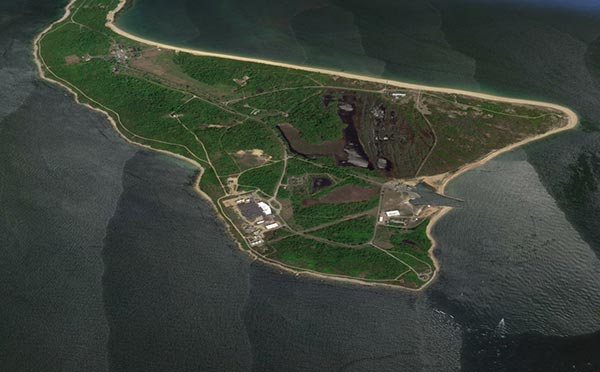 The very name of the place conjures up images from H.G. Wells or Dean Koontz, like strange hybrid creatures creeping through the island's greenery at night. Popular urban legends tell of carcasses of freakish unknown beasts washing ashore on nearby beaches. And the armed guards pacing the secure facility seem to confirm just about any nefarious rumor you might hear about Plum Island, a government research facility off the shore of New York that intrigues monster hunters, conspiracy theorists, and the merely curious alike. When the corpse of the strange-looking "Montauk Monster" washed ashore in Montauk, NY in 2008, the media's first speculation was that it could have been a genetic experiment that somehow escaped from Plum Island. More recently, conspiracy theory promoter Jesse Ventura hyped up Plum Island on his television show as some kind of secret biological weapons research lab, that's not only illegally producing biological weapons, but that also poses an imminent threat to the region should any of these pathogenic compounds be released accidentally. Plum Island seems to have all we need to warrant a close examination with our skeptical eye. What do they actually do at Plum Island, and are there really strange mutant creatures being produced there? Plum Island's association with the United States government goes all the way back to the 18th century, when General George Washington recognized its strategic importance. The island is located squarely in the narrow mouth of Long Island Sound, which contains most of New York state's important harbors. It's home to the Plum Gut Lighthouse and Fort Terry, constructed in 1897, and used through World War I as an artillery base to protect New York from invading ships. Geographically the island is unimpressive; largely flat, a few low dunes and bluffs, a well wooded strip of island less than 5 kilometers long, and about 840 acres. After World War II, Plum Island's handy combination of safe isolation from shore plus convenient access made it attractive to the US Army Chemical Corps, which planned and began construction of a facility there. However, those plans were ultimately canceled before construction was complete, and the new buildings were taken over in 1954 by the United States Department of Agriculture to study foot and mouth disease, at what became the Plum Island Animal Disease Center. Foot and mouth disease is a highly contagious viral infection that can spread very quickly throughout animal populations. Hooved animals are mainly affected, most often cattle, but other animals can spread it as well. It's rarely fatal, but since it renders entire populations of livestock unsuitable for meat or milk production, it can rapidly pose a huge threat to the economy and food supply of a whole region or even a nation. Epidemics continue worldwide to this day, most recently in Bulgaria, Japan, Korea, and the United Kingdom, requiring the destruction of millions of pigs and cattle. So with foot and mouth disease being a very real and imminent danger to the security of the United States, the USDA had good reason to set up the Plum Island facility. The work focused on developing vaccines and treatments for the disease, but since it could also be used as a biological weapon against the economy of an enemy nation, Plum Island researchers looked into this as well for a time. But in 1969, President Nixon stopped all non-defensive research into biological weapons, and shortly thereafter, the US ratified the Geneva Protocol and the Biological Weapons Convention, which outlawed biological warfare. Plum Island continued its work developing defenses against the disease. And not just foot and mouth disease, but others as well. African swine fever, vesicular stomatitis, rinderpest (aka cattle plague) and other diseases also represent clear and present threats to food production, and the scientists who work at Plum Island (mostly microbiologists) are attacking these diseases too. Life inside is a bit like something out of science fiction. The entire facility is negatively pressurized, so that air flows in and never out, thus keeping any airborne germs from escaping. The center of the facility, where the live animals are kept, is at even lower pressure, keeping air flowing away from the scientists to protect them. Entering requires changing into autoclave-sterilized garments, and leaving requires a full body scrubdown with disinfectant through an airlock. Since 9/11, security at Plum Island has been under increased scrutiny, as one theoretical threat would be for an enemy force to steal pathogens and infect our livestock population. So in 2003, the Department of Homeland Security took over administration of the island, while the Department of Agriculture still does the research. A somewhat infamous Government Accounting Office report released later that same year outlined many flaws in the security that needed to be addressed, producing a long list of recommendations, all of which have since been implemented. Plans are now in place that guard against the increased threats that Homeland Security perceives. In the end, Plum Island may fall victim to more mundane forces. It's currently preparing to reduce staff in the face of government budget cuts; and the island has in fact been listed for sale since 2010, due to a 2008 decision by the Department of Homeland Security to move it to a more secure location in Kansas. According to the Department of Agriculture, technology is now sufficiently advanced that the study of foot and mouth disease can now be safely continued on the mainland, so little reason remains to continue the research on an inconvenient, outdated island facility. Moreover, the safeguards at Plum Island have proven themselves inadequate in the past. Twice in 2004, foot and mouth disease was accidentally released inside the biocontainment area. In separate incidents, two head of cattle and four pigs were found to be infected even though they shouldn't have been. Both incidents took place inside the innermost, negatively pressurized animal pen areas, and so posed no outside threat. However, many years before, in 1978, animals kept in outdoor pens on Plum Island were found to have been infected with foot and mouth disease, and this was what prompted the current practice of keeping all research animals inside the biocontainment area. There was also much fallout from a highly publicized strike in 2002, when maintenance workers employed by a private contractor on the island went on strike. It was the first time a strike had ever occurred against a secure government laboratory, and since Plum Island's safety cannot be maintained without maintenance work, the strikers were quickly fired and replacement workers were hastily brought in. Questions were rightly raised about the training and security clearances of the replacement workers, so this underscored yet another vulernability at the facility. This too was addressed by the Homeland Security recommendations in 2003. The claims of secret research or clandestine development of biological weapons are a bit naive. Much of the scientific staff consists of visiting scientists from other nations and quite a few from Yale University and the University of Connecticut. All of them even put their contact information on Plum Island's website. Conspiracy theorists are free to contact anyone currently or formerly employed at Plum Island and will probably find an enthusiastic researcher eager to discuss his work. Evidence of secrecy or coverups has simply never surfaced, and would be pretty hard to hide in such an open environment. There's nothing classified or secret about any of the research done at Plum Island. But urban legends continue to propagate. One author, Michael Carroll, wrote a 2004 book called Lab 257: The Disturbing Story of the Government's Secret Plum Island Germ Laboratory in which he asserts, among other things, that Plum Island created Lyme disease, and even caused a 1975 outbreak of it. Carroll also suggested that other outbreaks on the mainland were caused by Plum Island, including Dutch duck plague in 1967 and West Nile virus in 1999. Although his many fanciful claims (supported only by his own speculation) are not taken seriously by people who know better, the general public generally doesn't; and when the only publicized information about a place is created by people like Jesse Ventura and books like this, it should surprise no one that the rumors persist. So how do we know that they're just rumors? We don't always, but we can get a pretty good idea. The publications from the scientists who work there and at the associated universities paint a clear enough picture of what does happen at Plum Island, but that's not proof that other nefarious activities don't also happen in secret. Many times, conspiracy theorists have accused me of being a paid disinformation agent for the government. Try proving that I'm not. You can see what I do with my time; you can interview my family and friends; but that won't prove that I don't have a secret room and carve out secret blocks of time when nobody's around. You also can't prove that I am a disinformation agent. I'm not (I don't even know if there's any such thing), so obviously no evidence exists that I am. Those charges are based purely upon speculation. Similarly, claims about secret genetically designed creatures coming from Plum Island are based purely upon conjecture drawn from the air. We do know from history that their research included the development of biological weapons prior to 1969, but no evidence exists that it has continued; and there's never been anything to suggest that they ever genetically created monstrous hybrid animal species, nor any reason for them to do so. You can speculate all day, and say that this sounds plausible or that it would justify distrust of the government, but it doesn't make it so. Just to give one example, Jesse Ventura's main source for his TV show about Plum Island was Kenneth King, author of Germs Gone Wild, and a former writing teacher and attorney who has no more inside knowledge about Plum Island than you or I. His book points out that accidents, such as those that happened at Plum Island in 2002, frequently occur at such labs throughout the country and all over the world. Of course this is true, but this is an entirely different question than whether Plum Island is secretly and illegally developing clandestine bioweapons. This was just the best that Jesse could do, and his technique of raising alarm about something that appears relevant, or suggesting guilt by association, is a common one among conspiracy theorists who have no valid evidence. Next time you enjoy a steak or a pork chop, thank the Department of Agriculture for keeping foot and mouth disease in check. And, by the way, the Montauk Monster was just a raccoon.
Cite this article:
©2024 Skeptoid Media, Inc. All Rights Reserved. |