




The North American Union

Are the United States, Canada, and Mexico planning to merge into a single huge police state?

Filed under Conspiracies, Urban Legends

Skeptoid #210
June 15, 2010
Podcast transcript | Listen | Subscribe
Bookmark and Share

Today we're going to put on our cheap suits, stick earpieces in, and join the legions of multinational Secret Service agents flowing out among the populace of Canada, the United States, and Mexico; as the borders disappear and we round up a unified population into forced socialism under martial law in our gigantic new pancontinental police state. Some believers say this takeover is actually already underway; others reckon the plans are still being laid, but few believers doubt that it's in the works. The ultimate goal, according to the rumors, is for the few elite in the new government to enjoy unprecedented power, control, and profit over a new supermassive megastate, at the expense of half a billion workers forced into socialized labor. This new police megastate will be called the North American Union, or NAU.

One common theme in the conspiracy rumor is that anytime something bad happens for real, it's generally viewed by the believers as a deliberate attack by the American government upon its own people, as part of this active, ongoing process. 9/11 is the most obvious example; the conspiracy community believes nearly absolutely that 9/11 was perpetrated by the government, in part as an excuse to increase domestic control in preparation for the NAU takeover. When Hurricane Katrina killed over 1,800 people in 2005, some in the conspiracy community took it as an actual practice exercise by FEMA to round up thousands of young men and execute them in the swamp. Even the 2010 explosion of the oil rig Deepwater Horizon and subsequent oil spill was described by some as a deliberate attack, with the dual goals of damaging the local economies and reaping huge profits for the government insiders through stock manipulation.

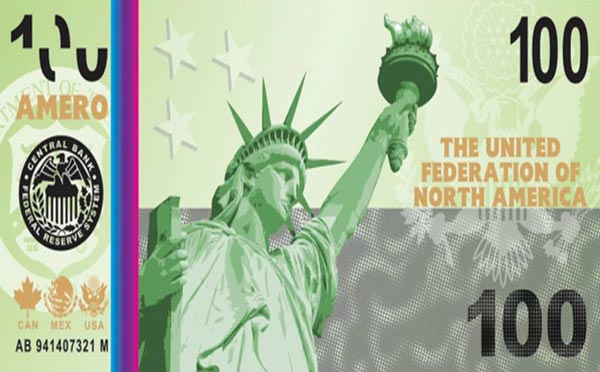
One piece of evidence the believers claim proves that the NAU takeover is underway is a new monetary unit to replace the dollar, called the amero (obviously patterned after the euro used in the European Union). It should be stressed at this point that all known examples of actual amero bills or coins have been proven to be hoaxes; there is no such thing (so far as we know) as actual amero currency. But conspiracy theorists can be well excused for suspecting that an amero is in the works. After all, the euro certainly became a reality in Europe; therefore the amero might well happen here, so they reason.

However, comparisons between the amero and the euro, or the North American Union and the European Union, do not hold much water. The euro was first planned as a solution to a number of problems unique to Europe, where there were many small countries who necessarily had to do large amounts of business among one another; but with all their own separately fluctuating currencies, there were all sorts of problems. Foreign investment was unnecessarily complicated and troublesome, exchange was inefficient and costly, interest rates were unpredictable, and various inflation rates made every transaction a shot in the dark. When the euro was introduced, participating countries had to meet certain requirements of stability. Since its introduction, studies have found that it was tremendously successful in addressing the problems. As of 2006, the European Central Bank estimated that the euro increased trade among member nations by 5-10%, and later estimates show that this trend has only continued to improve.

North American countries, by contrast, do not have anywhere near the currency-related problems that Europe faced before the euro. We simply don't have an unmanageable number of international transactions suffering from fluctuating exchange rates and expensive conversions. Mexico suffered these problems historically, but when the North American Free Trade Agreement (NAFTA) was signed in 1994, it had a rocky start, but followed by a hugely stabilizing effect on Mexico's economy and ever since, their problems have been largely mitigated. Arguably, NAFTA has addressed many of the issues for North Americans that Europeans solved with the euro. We just had those problems on a far smaller scale, and so our fix was correspondingly less drastic.

But that doesn't mean nobody's ever proposed an amero. There's been talk of it for a long time, mainly from a small number of Canadian economists. Quebec is one faction in North America that would actually benefit from an amero, and Mexico is probably the other. But since the United States and the majority of Canada would not, the amero is unlikely to ever proceed beyond the ruminations of these few authors.

In the real world, the introduction of an amero would probably have real benefits for a few, but none for the majority. Historically, the amero's proponents have been Quebec and Mexico. Quebec's perspective is an interesting one. They have a certain degree of French-Canadian nationalism, and being part of Canada and tied to its currency rubs this nationalism the wrong way. If they shared an amero with everyone else in North America, it would make them less dependent on Canada economically and freer to trade directly with the United States. Former Mexican President Vicente Fox expressed his desire for an amero openly, on multiple occasions, as a natural followup to NAFTA. Such economic unions often confer more benefit upon those at the bottom of the food chain that those at the top. Mexico would benefit from increased stability, while Canada and the United States would lose control of their own inflation and interest rates.

Canadian professor of economics Herb Grubel wrote a 1999 paper for the Canadian think tank The Fraser Institute called The Case for the Amero, but in it he admitted that his arguments were probably less important to the governments of Canada and the United States than the need to maintain control over their own monetary independence. The other most significant proponent has been Dr. Robert Pastor, professor of political science and former national security advisor under President Jimmy Carter. In his 2001 book Toward a North American Community, he pointed out the benefits of an amero for Latin America, but failed to convince very many people that it had any benefits for the United States. He did admit in the book that an amero was unlikely to happen, and has said that he absolutely does not support a North American Union.

So with academic and economic expertise in agreement that neither a North American Union nor even an amero make much sense, what support remains? Well, unfortunately, it's really just of the conspiracy theory variety, drawing its evidence from misinterpretations and exaggerations of actual events.

One such actual event feeding the conspiracy theory is a group formed by businessmen and academics from Canada, the United States, and Mexico called the Independent Task Force on North America. It's sponsored by nonprofit think tanks from all three nations. Created in 2004 in a post-9/11, post-NAFTA world, it advocates closer economic and security cooperation among the three nations, generally all good ideas. They do not advocate either an amero or a North American Union, all of their reports are freely available, and there's no secrecy attached to anything they do. Nevertheless, some conspiracy theorists consider their existence to be proof that the North American Union is already happening.

A similar, but more official, group was called the Security and Prosperity Partnership of North America, formed in 2005 by Vicente Fox, George W. Bush, and Paul Martin, who met for dialog for essentially these same purposes, and was active through 2009. It included no treaties or agreements. The US web site for the SPP says in its "Myth vs. Fact" section:

...The SPP [seeks] to make the United States, Canada and Mexico open to legitimate trade and closed to terrorism and crime. It does not change our courts or legislative processes and respects the sovereignty of the United States, Mexico, and Canada. The SPP in no way, shape or form considers the creation of a European Union-like structure or a common currency.

But nevertheless, you can say this up and down and standing on your head; the diehard conspiracy theorists dismiss such a statement as just another part of the coverup. Notably, in June of 2006, CNN anchor Lou Dobbs described the SPP, on the air, as an agreement (which it wasn't) to actually form the North American Union without the consent of Congress (which it didn't).

...The Bush administration is pushing ahead with a plan to create a North American Union with Canada and Mexico. You haven't heard about that? Well, that's because Congress hasn't been consulted, nor the American people.

Dobbs is not the only one. Believers all across the Internet say "Hey, it happened in Europe; it can happen here in North America." The European Union is indeed a reality, so by that example, it's plausible that a North American Union could happen as well, right? The European Union is actually not a real-world precedent for what the North American Union is believed to be. The EU is primarily an economic union. All the member nations in the EU are still sovereign nations, holding their own independent elections and issuing their own passports, and no European citizens are being forced into labor camps or executed by the millions. Conversely, the claims about the North American Union have the United States, Canada, and Mexico merged into a single police state characterized by brutality and forced socialism.

$2/mo $5/mo $10/mo One time

The former Soviet Union would be a closer precedent, but still not a very good one. It was a police state characterized by brutality and forced socialism, but there are two very important points to heed. First, the Soviet Union was the result of a popular uprising by the people, the Russian Revolution; it was not a secret takeover by hidden Illuminati intent on deceiving the masses. The Bolsheviks were a majority party, and there was nothing secret about them. Second, the Soviet Union didn't last, and remains a dramatic example of why such a union is a bad idea for everyone; not just for the people, but for everyone hoping to benefit from it.

Like all conspiracy theories that claim to predict future events, the North American Union requires reliance on supposition and irrational dismissal of evidence. Anyone who thinks the United States is likely to give up its sovereignty has, shall I say politely, "lost a few tiles on re-entry." Ask healthy questions and maintain a healthy skepticism; but if you catch yourself departing a little too far afield, take it as a red flag and point your skeptical eye at yourself as well.

Follow me on Twitter @BrianDunning.

Brian Dunning

© 2010 Skeptoid Media, Inc. Copyright information

References & Further Reading

Baldwin, R. "The Euro's Trade Effects." European Central Bank Working Paper Series. 1 Mar. 2006, Number 594: 48.

Chintrakarn, P. "Estimating the Euro Effects on Trade with Propensity Score Matching." Review of International Economics. 1 Feb. 2008, Volume 16, Issue 1: 186-198.

Dobbs, L. "Lou Dobbs Tonight (Transcript)." Cable News Network. Time Warner, 21 Jun. 2006. Web. 8 Jun. 2010. <http://transcripts.cnn.com/TRANSCRIPTS/0606/21/ldt.01.html>

Grubel, H. "The Case for the Amero." Fraser Institute Critical Issues Bulletin. 1 Jan. 1999, 1999 Edition.

Pastor, R. Toward a North American Community: Lessons from the Old World for the New. Washington, DC: Institute for International Economics, 2001.

SPP. "SPP Myths vs Facts." Security and Prosperity Partnership Of North America. US Department of Commerce, 21 Aug. 2006. Web. 9 Jun. 2010. <http://www.spp.gov/myths_vs_facts.asp>

Reference this article:
Dunning, B. "The North American Union." Skeptoid Podcast. Skeptoid Media, Inc., 15 Jun 2010. Web. 18 May 2013. <http://skeptoid.com/episodes/4210>

Discuss!

10 most recent comments | Show all 87 comments

While the conspiracy/police state aspects of the NAU may not be true, the desire and movement to create the NAU is real. Wikileaks just released cables confirming this without a doubt.

The issue comes into play that we would drag Canada down, and Mexico would drag us down economically.

Also, wars will not stop because of unity between the three countries. The drug war will continue, and may expand even more which is worrying. Not to mention rampant out of control corporatism and capitalism which has damaged much of the world.

Those in power want the NAU, and they say it would be good for us. I however am skeptical, because rarely what they want is good for us.

The US routinely destroys countries and leaves nations in the hands of despots (The Shah, Pinochet) supports dictators (Saddam, etc.) all for economic benefit.

So will the NAU hurt us or help us?

Nate, Massachusetts
June 11, 2011 7:07am

Hello! I love your pod-cast and i think like you on 99% of the topics but in this episode i found that you did an error then it came to the benefits of the Euro. I live in Sweden there i was born so i have seen the effect of the Euro on the economy. Right now in Europe the country's that have gone over to the Euro is in a terrible state Economically Greece is in need of several billion dollars worth of aid in order to keep the country from becoming bankrupt. And the rest of the country´s are in similar situations with a higher percentage of unemployment then those who haven't switch currency. It is true that the entire continent is in an economical crisis but my point is that While the EU is a good thing that has done a big service to the trade market the Euro has done more harm than good. I would like to hear your perspective on this issue and keep up the good work. You're doing a civil-service.

Niklas Lundquist, Stockholm
July 29, 2011 8:30am

Its pretty hard to keep diverse economies under one umbrella.

for something to be exchangable, the economies that exchange that idea be it coin, standard (my gig) or commodity value, the participants have to be on the same page as far as I know.

Politics seems to have come into play. World wide we have had some very bizarre politicking and frankly, its easy to vote for some things, especially if the vote offer benefits you (the voter). What else a government does good or bad, you generally do not vote for.

I'd like to hear our luminary have a skeptoid on political scams and economic disasters with good old Mike Schermer himself co hosting.

Frankly, the political and national point scoring over economic disasters is disgraceful and only fosters further conspiracy. Whether it be one economic zone or internationally, its always another country that gets pilloried where the citizens are just going about their day to day lives.

Alan Greenspan appearing all over Oz TV of late just adds to the bemusement

Henk v, sin city NSW, Oz
August 09, 2011 10:19am

If they did introduce a Common North American Currency it would make more sense just to change change Canada and Mexico to the US dollar.The US dollar is now the official currency of Panama, El Salvador and Ecuador,a few British and Dutch territories as well as being pegged to 23 currencies. That is not to mention black market use all across the globe.

Patrick Healy, Cork Ireland
November 21, 2011 7:08pm

I doubt that other countries would willingly take on the US debt by joining into a common currency.
At least the public would not like it. Of course, the public have very little say in our "democracies" anyway.

The US is a shade short of bankruptcy as we speak at this date, and the only things that are keeping its spending spree propped up is the US dollar's status as the world reserve currency, its continued borrowing, and the Federal Reserve's determination to keep on printing money, a disaster waiting to happen.

Already China and India apparently are paying for oil from Iran with their own currencies, and there is a call from some countries to end the greenback's status as the world reserve currency.

Not IF, but WHEN that happens, countries all over the world will flood the US with an UNKNOWN quantity of US dollars as they divest themselves of US dollars from their reserves.
This will cause massive inflation, already made worse by the Fed Res printing, and ten of millions of Americans are going to be plunged into poverty. The allied countries such as NZ that followed the American corporate economic model will follow.

As far as the "success" of the euro, take a look at the increasing number of countries in the European union requiring bailouts as we speak. Spain, Greece, Portugal, Ireland, etc.
Where is the success story there ?
Italy seems next on the list, if it isn't already.

Our bankers and corporates have a lot to answer for.

Macky, Auckland
October 03, 2012 11:09pm

I dont agree with any of Macky's post.

As far as I can see the worlds economic advantage lies in its ability to invest in a currency/economy for profit.

At present, if you looked at the pound or euro you would wonder about US and antipodean economies. Are we doing that well or more likely are they doing that badly.

Still, currency investment shift had bizarre consequences. Ive seen the lebanese pound and the japanese yen crucified 40 years ago (both commodity currencies) and now, the pressure on "good economies" that "export" or have a relativity rating (ie, AA+, AAA are targets for currency investmet.

Its not a bane, its how the ball rolls.

Sure, the euro is under pressure but its no conspiracy. Its just other countries investing in a wild manner in a wild global economy.

I wouldnt be bitching about countries splashing about with equity when the very same countries had disatrous employment and participation rates 40 years ago.

What I hate is hearing comments about greece or Italy having high unemployment or monstrous retirement subsidies 40 years ago as if they were new today.

Sure, there have been monstrous economic avoidance schemes growing in the euro zone. They were there at the start, they are there now, its only political duck speak to sway economic reform to say "classes dont pay tax and people to retire older" after an entire decadal laxity to pacify voters has been to do exactly that.

Brian may say the same about the US economy

Mud, At virtually missing point, NSW, OZ,
December 17, 2012 10:22pm

I don't see what there is to disagree on in my first three paragraphs of my last post.

They are well-known facts.

My fourth paragraph could be construed as mere speculation.

As to the euro, the spectacle of more well-off countries like Germany (who if they had any sense, should get out of the union) virtually bailing out Greece etc is just manipulation of funds by a commission comprising many unelected members.
Unelected power-brokers, in fact, who are telling euro-member countries when to have elections and when not to.

The money-laundering and subsequent repressive laws that have sprung from the implementation of a common currency where countries' borders are no longer relevant, have had serious consequences, according to my Dutch-speaking friend in Antwerpen.

He should know. He is currently celebrating the successful defence of money-laundering charges brought against him by an overly bureaucratic Belgian system, as we speak.

Macky, Auckland
December 27, 2012 4:48pm

These arent well known facts, these are just unresearched speculations on why currencies are pinned to currencies, floated or a common currency.

There are numerous processes a government or economy can adopt.

As it turns out, germany is not only a stakeholder and a driver for the euro, its stuck with it. Its the same as their energy policy they are again reviewing. They are stuck with the surrounding nuclear energy policies and draw on that nuclear energy.

Can we have a bit better research when it comes to mackinations?

Mud, At virtually missing point, NSW, OZ,
January 07, 2013 8:02pm

I didn't have to research the American debt figure too far. It's on so many sites that one could hardly miss it.

Unless of course you expect authenticity of the US debt figure to be confirmed by years of research and posted in some sort of financial/science journal.

I think it's fairly well-known that the US dollar is the world reserve currency, by and large. That has some bearing on the overall picture of world finance I'm sure, except of course some South Pacific island where sea-shells may still be the local tender.

"There are numerous processes a government or economy can adopt."

For sure. They can keep on printing more and more US dollars, as I'm assured that is happening as we speak, by several more websites.
Of course, I'm not there on the spot so I have to take their word for it.
Maybe they are lying, and it's all a US govt comspiracy to instil a feeling of doom among the population.

But I shouldn't really speculate, I guess. We're getting too much into muddy waters.

Macky, Auckland
January 09, 2013 12:19pm

An North American Union is not going to happen. Too many people would have to agree on at least one subject for it to happen. And, as Macky has noted (as have others) China might have something to say about it. -- Or not, depends on if they can stop laughing soon enough.

The truth is that it's not quite the same situation as the EU. And the EU has caused problems as well, in dealing with fellow countries that have gotten themselves into financial trouble. I don't see this as being a concern.

We can't even agree on a tax code.

HistoryTalking, The Real World
January 22, 2013 4:58pm

Make a comment about this episode of Skeptoid (please try to keep it brief & to the point). Anyone can post:

Your Name:
City/Location:
Comment:
characters left. Discuss the issues - personal attacks against other commenters, posts containing advertisements or links to commercial services, nonsense, and other useless posts will be deleted.
Answer 3 + 4 =

You can also discuss this episode in the Skeptoid Forum, hosted by the James Randi Educational Foundation, or join the Skeptalk email discussion list.

What's the most important thing about Skeptoid?

Support Skeptoid
 
Skeptoid host, Brian Dunning
Skeptoid is hosted
and produced by
Brian Dunning


Newest
Polybius: Video Game of Death
Skeptoid #362, May 14 2013
Read | Listen (11:27)
 
The 16 Personalities of Sybil
Skeptoid #361, May 7 2013
Read | Listen (11:50)
 
Lincoln Kennedy Myths
Skeptoid #360, Apr 30 2013
Read | Listen (11:07)
 
Cupping for the Cure
Skeptoid #359, Apr 23 2013
Read | Listen (10:38)
 
Listener Feedback: Aliens and UFOs
Skeptoid #358, Apr 16 2013
Read | Listen (10:02)
 
Newest
#1 -
8 Spooky Places, and Why They're Like That
Read | Listen
#2 -
Skinwalkers
Read | Listen
#3 -
The Suicide Dogs of Overtoun Bridge
Read | Listen
#4 -
Student Questions: Food Woo and Iron Man at the Airport
Read | Listen
#5 -
Negative Calorie Food Myths
Read | Listen
#6 -
Listener Feedback: That Darned Science
Read | Listen
#7 -
The Loch Ness Monster
Read | Listen
#8 -
Area 51 Facts and Fiction
Read | Listen

Recent Comments...

[Valid RSS]

  Skeptoid PodcastSkeptoid on Facebook   Skeptoid on Twitter   Brian Dunning on Google+   Skeptoid RSS  


"Logical Fallacies 1"
inFact with Brian Dunning


Support Skeptoid
Join today and become
a part of this.