 |
 |
  
|
 |
The Devil Walked in DevonThis 100-mile track of footprints in 1855 probably was not laid by the devil. Skeptoid Podcast #31 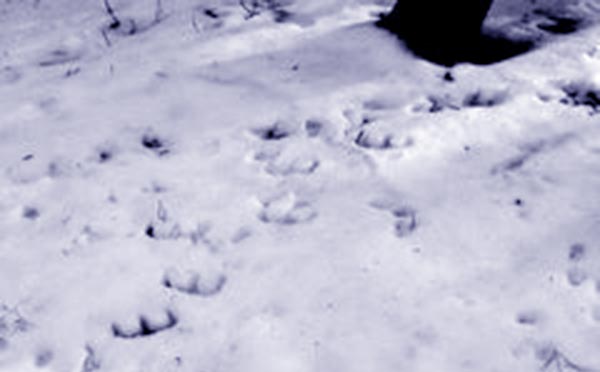 by Brian Dunning Snow fell all through the wee hours of February 8, 1855, in Southern Devon, a county in south western England. When the sun rose at last, villagers throughout the county awoke to find a set of strange footprints stretching over 100 miles throughout the county. But it wasn't the length of the track or its sudden appearance that caused the most alarm. It was that the track at one point went right through a 14-foot-high wall, leaving untouched fresh snow on top of the wall. Elsewhere, the track went through a haystack, emerging on the other side. It was also found to enter a 4-inch drainpipe, and continue out the other end. In some places the track stopped inexplicably, only to reappear elsewhere. Most significantly, the track was found to have crossed a two mile stretch of river, picking right up again on the other side as if the maker of the footprints had walked on water. Theories and explanations abounded, until some clergymen suggested that perhaps the devil was on the prowl. From that moment on, the devil was said to have walked in Devon. When people hear this story they generally imagine horseshoe-sized cloven hoof prints. However, this was not the case. All reports are that the footprints were between one and a half and two inches in size, and only eight inches apart. If this was the devil, he must have been more petite than he's usually depicted, and up on ballet pointe the whole way. No photographs exist but there are some detailed drawings of what the footprints looked like: basically, horseshoes. Now you've seen snow before, and you can imagine what a one and a half inch long footprint would look like in several inches of new fallen snow. Would it really be detailed enough to get a clear horseshoe drawing? Of course not. One suggested explanation was a field mouse, which does hop (often when there is snow that it can't easily walk through), and which does leave footprints in a V pattern. Each hind foot is long and narrow, and when they hop, their heels are together. A V is not so dissimilar from a horseshoe that the possibility cannot be discounted, given how indistinct the footprints would be in soft new snow. Some accounts describe it as a heavy snowfall, and others say it was a light snowfall. Now, it does get quite cold in Devon county and they definitely do get snow, but it's seldom more than a few inches and it certainly doesn't last all winter. This episode was in February, so a heavy snowfall is reasonable, though heavy is a relative term. Several inches is probably a good estimate. A single snowstorm is not likely to cover more than 100 miles, but we don't really have enough information about the preceding days to know whether there might have already been enough coverage over the area in question. Among the possible culprits nominated by the witnesses were some kangaroos known to have escaped from a private owner, a Mr. Fische. Although the track sounds too small for kangaroos, the size and age of Mr. Fische's kangaroos was not published, so possibly they were quite young, or they may have even been a smaller species, like one of the smaller species of wallaby, some of which are no larger than small rabbits when full grown. This explanation does have one strong piece of evidence in its favor: the fact that kangaroo tracks were almost certainly unfamiliar to residents of England in 1855. Given that this was a rural area, and snowfall was frequent, tracks of commonplace animals would have been easily recognized. Whether Mr. Fische recovered his kangaroos is not known. The element of this story that does it the least credit is the claim that this track stretched for over a hundred miles. In 1855 the means didn't really exist in Devon to travel a hundred miles in a single day to verify the length of this track, especially when the way is obstructed by two mile stretches of water. Devon is quite rural: farmlands, brooks, forests, hills; and must be teeming with small wildlife. Small rodents would have been running around everywhere, leaving tracks that would be pretty hard to tell apart from the description of the devil's footprints. For a group of investigators to follow one set of tracks to the river, leave their task long enough to find a bridge or a boat, cross, resume the search and spend enough time as it would take to find a set of mouse-sized footprints two miles away from where they were last seen, and all of this while plenty of other mouse-sized forest creatures are hopping around through the snow leaving tracks, and yet be certain that they found the one and only set of devil footprints, strains credibility. A prominent biologist named Richard Owen declared the tracks to be those of a badger, perhaps distorted by freeze-thaw action. Other nominations included raccoons, rats, swans, and otters. And, of course, the most famous nomination: that of the devil himself. What of these feats of moving through walls and haystacks, walking on water, and moving through drainpipes? I find it hard to give these much weight. These are purely anecdotal, unsubstantiated, uncorroborated verbal reports during a media circus when phrases like "the devil walked in Devon" were being tossed around. Give me something concrete to talk about, and we can look for explanations. But if you must accept these at face value, I submit that most of the animals we've nominated are perfectly capable of fitting inside a four inch drainpipe, and often do enter such structures for security or while foraging. I've already dismissed the river crossing to my satisfaction. And as far as materializing through walls and haystacks, I don't have enough information to speculate. Was there sheltered ground around the base of the wall? Was the wall breached near its end? But mainly, is there really any reason to believe that this happened? So who did walk in Devon that night? In the presence of so many possible and reasonable culprits, and in the extreme unlikelihood that this was indeed one single set of prints, I find little reason to turn to supernatural explanations. Commonplace events are frequently blown out of proportion, and everyday objects are just as frequently regarded as supernatural oddities. In my opinion, which I think is well supported with other examples in recent history, the devil's walk through Devon was the 1855 version of the Virgin Mary appearing in the bark of a tree or in bathtub stains. People see what they want to see and they think what they want to think, even when they're looking no farther than their own grilled-cheese sandwich skillet.
Cite this article:
©2025 Skeptoid Media, Inc. All Rights Reserved. |