




Living Stones of Death Valley

An examination of the mysterious stones that move by themselves across the desert floor.

Skeptoid #21
January 15, 2007
Podcast transcript | Listen | Subscribe
Bookmark and Share

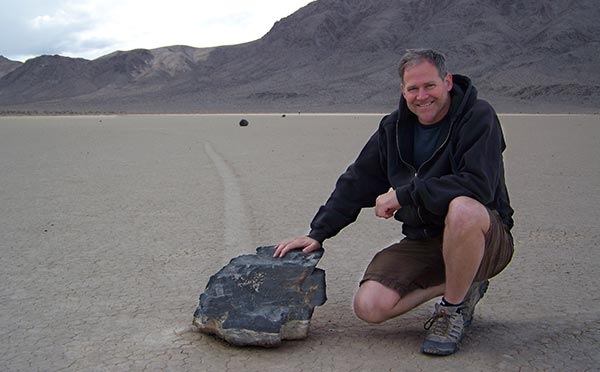
If you're familiar with the American Southwest or even if you're a fan of the paranormal, you've heard of the mysterious stones that move across the surface of a dry lakebed in Death Valley called Racetrack Playa. Hundreds and hundreds of rocks, scattered about the surface of this several square mile mudflat, have left trails behind them where they've moved across the surface. Nobody has ever seen one move, despite many studies. I came as close as anyone could.

Proposed explanations run the gamut from natural to paranormal to alien. Strange magnetic forces, psychic energy, alien spacecraft, teenage pranksters, and even transdimensional vortices have all been proposed. The leading scientific hypothesis is that the rocks are moved by high winds, on rare occasions when the playa is wet enough to be extremely slippery, and conditions are just right. I've always had trouble with this explanation. I used to play in mud flats as a kid, and when a rock is glued onto that surface it's pretty damn hard to move. The rocks at Racetrack Playa are quite streamlined, and it's hard to imagine any wind strong enough to break their bond with the surface and shove them along deep enough to leave those trails. The real cause of the moving rocks, it turns out, carries a lot more punch than wind, and requires conditions that are not oddball and that are easily observable.

In the early spring of 2002, I made one of my many trips to Racetrack Playa with two friends, Dan Bocek and John Countryman. The surrounding mountains were still covered with snow, and the playa itself was firm but had a large lake covering about a fifth of its surface, perhaps an inch or two deep at its edges, concentrated at the playa's south end where it's lowest. We ventured out, armed with cameras, shortly before sunrise. The temperature was just above freezing. The wind, from the south, was quite stiff and very cold. When we reached the lake, we found to our great surprise that the entire lake was moving with the wind, at a speed we estimated at about one half of a mile per hour. The sun was on the lake by now and we could see a few very thin ice sheets that were now dissolving back into water. This whole procession was washing past many of the famous rocks. It's easy to imagine that if it were only few degrees colder when we were there — as it probably had been a couple of hours earlier — the whole surface would be great sheets of thin ice. Solid ice, moving with the surface of the lake and with the inertia of a whole surrounding ice sheet, would have no trouble pushing a rock along the slick muddy floor. Certainly a lot more horsepower than wind alone, as has been proposed. The wind was gusty and moved around some, and since the surface is not perfectly flat and with rocks and various obstructions, the water didn't flow straight; rather it swapped around as it moved generally forward. Ice sheets driven by the water would move in the same way, accounting for the turns and curves found in many of the rock trails.

But don't take my word for any of this. I told you we had cameras, and I captured the event on video. Go to skeptoid.com and click on videos, and you'll see "Living Stones of Death Valley." It's well worth two minutes of your time.

That nobody has ever seen the rocks move is easy to believe. When there's water on the surface of the playa, you're not allowed to go out there — and indeed, you probably wouldn't want to. Thus there's nobody around when the ice sheets drag the rocks.

We missed the actual event, probably by a couple of weeks, so we didn't get the first real video of a moving rock. No doubt someone soon will. But we did see and document all the forces at play, and I think our explanation is far more plausible than any previous hypotheses.

Brian Dunning
Brian Dunning

References
© 2009 Skeptoid.com

Discuss!

5 most recent comments | Show all 13 comments

Remember, you should always read with skepticism the comments of anyone too lame to put their real name & city.

I have seen a few articles on this in the past few days and there seems to be typical for one of the comments to claim the moon as the culprit. I think this comes from a very widespread misunderstanding of how tides come about. The Skeptics Guide's blog had an interesting read about tides by Bob Novella http://www.theskepticsguide.org/sgublog/?p=62

The moon's gravity is simply not strong enough to effect the rocks, desert soil, water, or ice.

Coleman Mulkerin, Sayre, PA
April 16, 2008 8:33pm

looks like you need to get over to mentalfloss.com and try and recruit some listeners...
http://www.mentalfloss.com/blogs/archives/4559

Joe, Maryland
April 22, 2008 10:03pm

Hi Brian,
I am pretty sure you are right about those stones. I have some very large living stones on my property here in Maine. When we first got our lake property I noticed that there were a number of large rocks in the lake shallows (up to several hundred pounds) that sat at the shoreside end of self-made trenches in the gravel (up to a foot deep). I jokingly called them living stones because I had also recently seen one of those TV mystery shows. However, even then I knew the cause because in this case it was obvious. All lakes in Maine freeze with up to several feet of ice. We are on the north shore which receives a bit more sun and melts out first in early spring. When ice break-up begins it is common to have floating rafts up to a half-mile square and it only takes a little breeze to create substantial force on those rafts, dragging any rocks attached on their underside for a ride. The prevailing wind direction in this region is from the south. I also suspect that freezing and expansion of the ice in winter could also contribute a net force toward shore where the thinner ice tends to buckle. The force to moves these rocks has to be far greater than anything required to move those pebbles in Death Valley, but ice is easily up to the task. No one in Maine leaves their steel or aluminum dock in the water over winter or they would end up with a heap of tin foil. Now if I can just keep the hippy crystal worshippers (the living stoned) from migrating to my place.

Mike K, Maine
July 15, 2008 4:45pm

I wonder if the clay surface of the dry lake bed contains the mineral called Kaolin? Kaolinite is a clay.It is a soft, earthy, usually white mineral (dioctahedral phyllosilicate clay), produced by the chemical weathering of aluminium silicate minerals like feldspar. In many parts of the world, it is colored pink-orange-red by iron oxide, giving it a distinct rust hue.It is widely used as a replacement for talc.It is also used as a lubricant.It is what gives glossy paper it slick shiny appearance.
If kaolinite is leeching out of the clay when it is wet or submerged with water the surface would become very slick!

Tim, California
August 02, 2008 10:03pm

Football sized rocks? Thats a very small rock.

Ive seen wind move things..like entire houses..and when water is involved it just makes it that much more easy.

Hurricane survivor, New Orleans
April 24, 2009 11:44am

Make a comment about this episode of Skeptoid (please try to keep it brief & to the point). Anyone can post:

Your Name:
City/Location:
Comment:
characters left. Discuss the issues - personal attacks, advertisements, and other useless posts will be deleted. TO POST A URL, PLEASE USE A URL SHORTENING SERVICE LIKE TINYURL.COM.
Answer 5 + 4 =

You can also discuss this episode in the Skeptoid Forum, hosted by the James Randi Educational Foundation.

Join the Skeptalk email discussion list.

What's the most important thing about Skeptoid?

Support Skeptoid for just 99¢ per download
 
Skeptoid host, Brian Dunning
Skeptoid is written and produced
by Brian Dunning


Newest
Sarah Palin Is Not Stupid
Skeptoid #160, Jun 30 2009
Read | Listen (10:26)
 
The Mothman Cometh
Skeptoid #159, Jun 23 2009
Read | Listen (11:15)
 
Student Questions: Swine Flu and Depleted Uranium
Skeptoid #158, Jun 16 2009
Read | Listen (13:07)
 
High Fructose Corn Syrup: Toxic or Tame?
Skeptoid #157, Jun 9 2009
Read | Listen (12:32)
 
Falling into Mel's Hole
Skeptoid #156, Jun 2 2009
Read | Listen (11:03)
 
Newest
#1 -
How to Argue with a Creationist
Read | Listen
#2 -
The Detoxification Myth
Read | Listen
#3 -
Apocalypse 2012
Read | Listen
#4 -
Religion as a Moral Center
Read | Listen
#5 -
An Evolution Primer for Creationists
Read | Listen
#6 -
New Age Energy
Read | Listen
#7 -
World Trade Center 7: The Lies Come Crashing Down
Read | Listen
#8 -
The Devil Walked in Devon
Read | Listen

Recent Comments...

Creative Commons License
This work is licensed under a Creative Commons Attribution-Noncommercial-No Derivative Works 3.0 United States License.

[Valid RSS]

ZIP Code Database

Skeptoid Podcast Skeptoid Podcast   Skeptoid on Facebook   Skeptoid on MySpace   Skeptoid on Twitter

Skeptoid is not responsible for the content of the ads below. Supporters help reduce the need for them.