




The Sargasso Sea and the Pacific Garbage Patch
We cast our skeptical eye upon two vast hazards to navigation said to lurk in the centers of the two great oceans.
Filed under Environment
| Skeptoid #132 December 16, 2008 Podcast transcript | Listen | Subscribe |
|
Today we're going to sail the oceans blue, through the wind and spray, at least until we become mired in two remote wastelands said to be the bane of mariners: The Sargasso Sea in the middle of the Atlantic, and its companion on the other side of the globe, the Pacific Trash Vortex. Both areas are encircled by swirling ocean currents, and are said to collect their debris in the center. Both are the subject of tall tales. Both are ripe for skeptical inquiry.
The Sargasso Sea
Let's start in the Atlantic. The Sargasso Sea is actually a named sea, and it's the only one in the world with no shorelines, being completely enclosed within the North Atlantic Ocean. It's a 2,000,000 square mile oblong oval stretching across the Atlantic, centered on about 30°N latitude, bounded by major clockwise ocean currents. It's best known in stories for being a dense mat of solid seaweed, a tangled mass that no ship can penetrate. You hear tell of ancient mariners finding abandoned wrecks trapped, or starving crews who tried to walk out. Most famously, Christopher Columbus wrote about the Sargasso Sea in his log. Upon encountering the seaweed, he thought he must be near land, but when no land appeared after days of sailing his crew almost mutineed. Jules Verne's Nautilus visited the Sargasso in his novel 20,000 Leagues Under the Sea:
Such was the region the Nautilus was now visiting, a perfect meadow, a close carpet of seaweed, fucus, and tropical berries, so thick and so compact that the stem of a vessel could hardly tear its way through it. And Captain Nemo, not wishing to entangle his screw in this herbaceous mass, kept some yards beneath the surface of the waves. The name Sargasso comes from the Spanish word "sargazzo" which signifies kelp. This kelp, or berry-plant, is the principal formation of this immense bank... Above us floated products of all kinds, heaped up among these brownish plants; trunks of trees torn from the Andes or the Rocky Mountains, and floated by the Amazon or the Mississippi; numerous wrecks, remains of keels, or ships' bottoms, side-planks stove in, and so weighted with shells and barnacles that they could not again rise to the surface.
In 1910, the steamer Michael Sars took a party of scientists out to study the Sargasso Sea for three months, and their report was among the first that debunked these legends. They found the patches of seaweed to be small and sparse, rarely larger than a doormat, and in no way a hazard to navigation. They also found the waters of the Sargasso Sea to be warmer, clearer, bluer, and with less oxygen than the surrounding Atlantic. For this reason they declared the Sargasso Sea to be a type of desert, largely bereft of sealife.
This notion was challenged in 2007 when research published in the journal Science found that phytoplankton blooms were the reason for the decreased oxygen. The rotation of the huge eddy draws up salty, nutrient rich water from the ocean floor, enriching the sunlit upper layers of water, and kick-starting an unusually active ecosystem. Thus the Sargasso "desert" is actually quite the opposite, and the relative proliferation of sargassum seaweed is due to nutrient rich growing conditions, not vortex suction action.
What of the tall tales of ships becoming trapped, and stranded sailors dying? It so happens that the Sargasso Sea is a convergence of several conditions, not just the nutrients from the deep, but also weather conditions at its latitude. 30-35° latitude, both North and South, is the location of the subtropical ridge between the trade winds. Conditions here are variable winds and low precipitation. Sailors call it the doldrums. Sailing vessels entering the Sargasso Sea are virtually certain to come to a grinding halt in a dead calm. Throw in some strange seaweed and we have all the ingredients for a nautical epic.
The Pacific Garbage Patch
But if we spin the globe and look at the center of the North Pacific Ocean, we see a phenomenon that is due to vortex suction — the Pacific Trash Vortex, also called the Pacific Garbage Patch. One guy emailed me that he'd looked for it on Google Earth; he'd heard there was a giant island of solid floating garbage twice the size of Texas in the middle of the Pacific Ocean.
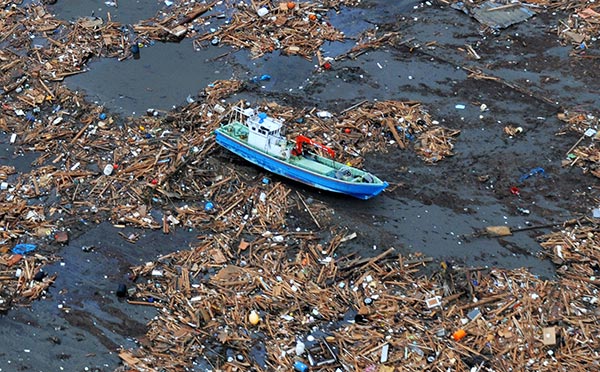
The North Pacific Gyre is a clockwise rotation of ocean currents in the North Pacific. Wind and currents combine to drive floating matter toward its center. You might have heard of the Pacific Garbage Patch before, and are probably just now wondering why you've never seen any photographs of a giant island of trash. In fact, Hawaii is right in the center of the Gyre, and if there were a Pacific Garbage Patch, Hawaii would be in its exact center. The answer is simple: No such floating island of trash exists. Despite the fact that there is a huge amount of plastic waste in the Pacific Ocean, and despite the fact that the Gyre does drive it all toward the center, there is no floating island. How do we corroborate these two seemingly mutually exclusive facts?
One proposed explanation, put forward in a map created by Greenpeace, shows the garbage patch as two separate patches on either side of Hawaii, both well clear of it; thus nobody ever sees them. The map also gets East and West reversed, and is dramatically wrong in its depiction of ocean currents, splitting the North Pacific into two counterrotating swirls, instead of one big one like it actually is. So let's set aside Greenpeace's claim for the moment, and go back to the origin of the story.
In 1988, Robert Day, David Shaw, and Steven Ignell submitted a report to NOAA (National Oceanic and Atmospheric Administration) detailing the results of four years of sample collection and analysis of plastic fragments found floating in the Pacific Ocean. They found concentrations highest in the North Pacific Gyre. The authors cited wind and currents as the primary force driving the higher concentrations to the center of the Gyre. Concentrations of what? Number one, monofilament fishing line fragments; and number two, something called neuston plastic. Neuston plastic refers to particles that have been broken down to a small size and are now floating just at or below the surface of the water. Most plastic floating in the open ocean degrades quite quickly, due primarily to ultraviolet radiation. It becomes brittle and crumbles. When it reaches microscopic size, it competes with phytoplankton as a food source for zooplankton, and enters the food chain. That's not good for anyone. The authors used 203 sample stations, each about 450 square meters in size. 52.2% of these contained plastic fragments.
Got that? Only half of NOAA's football-field sized sample areas, in the center of the densest part of the Pacific "Garbage Patch", contain even detectable levels of microscopic plastic. Unacceptable to be sure; but hardly a solid island.
The reason is that getting to the center of the Gyre takes more than enough time for plastic to break down. Oceanographer and sailor Charles Moore estimates that garbage from Asia takes about one year to reach the Gyre, and about five years from the United States. Moore is largely responsible for bringing the issue into the public eye. Upon his return voyage from the 1997 Transpac ocean race from California to Hawaii, he wrote:
There were shampoo caps and soap bottles and plastic bags and fishing floats as far as I could see. Here I was in the middle of the ocean, and there was nowhere I could go to avoid the plastic.
Although Moore is doing important work, some of his more overly dramatic descriptions like this one have helped to launch the popular belief in Texas sized garbage patches. Bringing attention to the issue is good; presenting an overdramatized representation of the facts to do so, not so much.
Now, I'm not here to defend the dumping of trash at sea, which is the default criticism I'm going to receive for pointing out that there is no Texas-sized island of trash surrounding Hawaii. I remember once while sailing from Newport Beach to Cabo San Lucas, about 100 miles offshore we crossed the path of a cruise ship that had passed in the night. It actually left a visible path: mainly an oil slick, dotted with party balloons, plastic cups, and other junk. Very nice. I also remember the first time I saw a garbage scow being towed out to sea, loaded with an acre of trash, to be dumped. I grabbed a marine chart and saw there was actually a marked area offshore designated for such dumping. I couldn't believe it. So while I do have opinions on the subject, on Skeptoid we focus on the truth of the stories about huge islands of trash floating in the middle of the Pacific. And the truth is there isn't one.
You should follow me on twitter here.
© 2008 Skeptoid Media, Inc. Copyright information
References & Further Reading
Berlofff, Pavel S. et. al. "Material Transport in Oceanic Gyres." Journal of Physical Oceanography. 10 Jun. 2001, Volume 32: 764-796.
Kubota, M. "A Mechanism for the Accumulation of Floating Marine Debris North of Hawaii." Journal of Physical Oceanography. 1 May 1994, Volume 24, Issue 5: Pages 1059–1064.
LiveScience Staff. "Mystery of the Sargasso Sea Solved." LiveScience. Tech Media Network, 22 May 2007. Web. 11 Jan. 2010. <http://www.livescience.com/strangenews/070522_sargasso_sea.html>
McGillicuddy, D.J. Jr and A. R. Robinson. "Eddy-induced Nutrient Supply and New Production in the Sargasso Sea." Deep Sea Research Part I: Oceanographic Research Papers. 1 Aug. 1997, Volume 44, Issue 8: Pages 1427-1450.
NOAA. "Great Pacific Garbage Patch." NOAA Marine Debris Program. NOAA, 1 Sep. 2009. Web. 11 Jan. 2010. <http://marinedebris.noaa.gov/info/pdf/patch.pdf>
Reference this article:
Dunning, Brian.
"The Sargasso Sea and the Pacific Garbage Patch." Skeptoid Podcast. Skeptoid Media, Inc.,
16 Dec 2008. Web.
6 Sep 2010. <http://skeptoid.com/episodes/4132>
Discuss!
Remember, you should always read with skepticism the comments of anyone too lame to put their real name & city.
Environmental activist are full of hyperbole and speculation. They're losing their case by over-stating the problems. If they continue to do this they will be moving their agenda backwards, not forward. Its like the boy crying wolf.
Patrick, Portland, OR
December 17, 2008 8:58am
I've never heard of any of this, thanks for the information!
Adam D. Jones, Dallas, TX
December 17, 2008 11:38am
Good podcast Brian! www.vbs.tv did a short documentary on the subject, and that is where I first heard of it. Since then I've heard a lot about the Texas size garbage island in the Pacific. It is good to apply critical thinking skills to environmental issues. Many environmentalist have a bad reputation with blowing up the facts and exaggerating the issues. By doing so others will not take them serious. One does not have to say there is an island of trash to explain the environmental impact. Some may think Brian has shot down the issues of garbage in the oceans, but I feel he has given it more validity. If more people tackled environmental issue like Brian does, with facts and critical thinking, I think the environmental movement could be much farther along today.
Keep up the good work and thank you for bringing such important issues like this to our attention! Your buck a show will be coming soon, I promise.
Dan Smukalla, Waterford, WI
December 18, 2008 2:43am
I love this guys work. I heard of this on NPR a while ago. It is incredible how irresponsible the press can be.
Keep up the great work.
Bob Wisner, Sarasota, FL
December 20, 2008 4:29pm
I read about it in the book "the world without us." I fine it sad that this will be one of the legacies of humanity that will survive until the end.
Joseph Furguson, Brawley, Ca
December 20, 2008 9:24pm
Good work Brian. Well researched, well argued.
Jerry York, Jacksonville Florida
December 30, 2008 3:53pm
The Pacific Trash Vortex is apparently growing:
The current (1/3/09) issue of The Economist prominently features "A 16-PAGE SPECIAL REPORT ON THE SEA" on its cover, and in the article "A sea of troubles" on page 9, it asserts "Another change is the appearance of a mass of discarded plastic that swirls round in two clots in the Pacific, each as large as the United States." Surely something this large would be visible from orbit? I did not, however, find any such pictures in the 16 page report (which, to be fair, is well written and worth reading, the occasional fact checking slip notwithstanding).
John Everett, Great Falls, VA
January 03, 2009 5:22am
THIS CRAP IS BORING, I AM MAKING THIS COMMENT WHEN I DIDN'T READ THE PASSAGE YET, it might be helpful it depends
Shadow the hedgehog, florida
January 09, 2009 7:42am
Good for you, Shadow.Your mind is open to new possibilities.
Marius vanderLubbe, Nullabour Plain, Australia
January 09, 2009 2:21pm
Dear Brian,
The British TV quiz QI recently included a question on the Pacific Trash Vortex which, if I recall correctly, claimed it was "the size of Texas". I thought it was odd that they used a diagram rather than a photo on screen and even odder that I couldn't subsequently find a photo of the thing on-line.
All this came back to me when I heard your recent podcast on the subject, and I posted a link to the QI message board (http://www.qi.com/talk/viewtopic.php?t=14295&start=0&sid=2036bcae1bbc07fa7ff6a50c44f8265f). It's produced no terribly interesting responses yet - although it is interesting to see how much people WANT to believe highly dramatic and overblown claims.
I thought you might be interested to know the discussion's going on over there and perhaps use the opportunity to nab a few more listeners!
Paul Slade, London, England
January 11, 2009 6:01am
Well, Patrick, hyperbole and speculation seem to be the squeak in the wheel that gets greased most often. So at least the enviros are sqeaking loudly. Othersiwe, we'd all still be dumping mine waste into our rivers. Wait, have we stopped doing that?
Sir Francis Drake, Plutonia, Uranus
January 15, 2009 12:34pm
I can't stop thinking about this episode... mainly because it's probably the most tenuous episode of my favorite podcast that I have yet heard.
This episode pains me because you are splitting hairs. There *are* photos of the pacific trash vortex and it's not hard to find them. Yes, there is no "floating island that is poses a hazard to navigation", but this episode comes across as blind denial of an actual, documented phenomenon. Most of the trash is sub-surface, but according to the photos and documentation, it is there and it is floating at the surface.
I almost went away from this podcast secure in the knowledge that the Pacific Garbage Patch doesn't exist. Thankfully I did my own research so I won't look like a fool if it comes up in polite conversation.
Steven Wood, Stamford, CT
February 04, 2009 9:14am
Steven,
I think Brian makes it clear enough that there is trash accumulation. Quotes from the article above:
"In 1988... ...report to NOAA... ...results of four years of sample collection... ...found concentrations highest in the North Pacific Gyre... ...That's not good for anyone... ...Unacceptable to be sure; but hardly a solid island."
You are treating this as a Black or White issue when (as is often the case) it's firmly gray.
It is evident from the reputable sources that there is not solid mass sufficient to impede shipping within any of the ocean gyres and that is the "Urban Legend" that Brian is refuting. There is an accumulation of trash. It is visible and it is nasty, but the density according to wikipedia is about "at 3.34 pieces with a mean mass of 5.1 milligrams per square meter." So, I wouldn't want to swim in it, but we are talking about a mass of less than the medicine in a single Extra Strength Tylenol for each square meter of ocean.
Rick Smathers, Raleigh, NC
February 17, 2009 5:10pm
Some wacky guy is talking about this in a TED Talk now:
http://www.ted.com/index.php/talks/capt_charles_moore_on_the_seas_of_plastic.html
John, Atlanta, Georgia
February 24, 2009 8:25pm
In this TED talk, he doesn't even mention the Pacific Garbage Patch. But the information on the TED site and other material on Mr. Charles Moore suggest that he is not wholly credible in that matter.
Anyway, I think his actions only raise awareness of the trash problem, which is a good thing (as Brian said in the podcast as well).
Sebastian Ullherr, Munich, Germany
February 24, 2009 10:50pm
Scientific American now has a podcast and article about "The Great Garbage Patch". http://www.sciam.com/podcast/episode.cfm?id=the-great-garbage-patch-09-02-26
I was under the impression that they were solid sources. They cite Charles Moore as their source as well.
Ron Campbell, Chicago
February 26, 2009 11:01am
Actually Steven Wood, there do not seem to be any actual images of the pacific trash vortex. Can you post some links? I find many graphical representations (i.e, cartoons) and articles about the subject with many horrible images of crazy dumpsites of garbage and plastic but none of the actual alleged pacific trash vortex. No doubt the dumping of plastic is bad, but I think someone with vested interest is inaccurately describing the situation
nygrump, nyc
March 02, 2009 9:38am
There is a real problem. It is that small sea animals are eating the small broken down plastic particles instead of real food and their diet is deficient which leads to problems up the food chain. I'm glad that this podcast mentioned this problem. Ultimately, I think the environmental groups are going to lose support once their hyperbole is eventually exposed.
Aran Johnson, Oakland, CA
March 14, 2009 12:07am
So the idea that Brian Dunning is getting across here is what? I'm a little confused.
Is he saying that there is no such thing as a garbage gyre at all? I have heard this discussed from various scientifically credible sources, including the SGU, Scientific American, and Science Friday-NPR that is does exist.
Or is he saying that an actual physical island of garbage doesn't exist? I don't think anyone ever said that there is a thick layer of trash the size of Texas floating out there on the surface.
Most of it is broken down and below the surface from what I have learned, and not an actual "Patch" or "island", it's just a name.
David Barnas, N. Tonawanda NY
April 15, 2009 8:35pm
As I see it, a garbage patch would be a good thing compared to diffuse garbage, as it could be much easier to capture. Too bad if it isn't true.
Regarding decay rates -- I've been to a number of remote pacific islands, and often they are heavily littered with more solid plastics. I've found the famous green Chinese frogs (they have a rather Buddha-like disposition) and other plastic animal toys that were swept off a container ship in the early 90's: these clearly take more than a few years to disintegrate.
But yes, you would think a great garbage patch would be visible from satellite.
Ridahoan, North America
April 23, 2009 1:08pm
i can't believe how casual and blase everyone is about a catastrophe happening on OUR planet. what a shame that we have lost control over the oceans of the world. I remember watching a clip on the tube showing a russian ship dumping toxic liquids encased in steel drums right into the ocean. then 60 minutes did the one on India's shipyards polluting their ocean like it is a garbage dump. it's not fair to everything living in the ocean. i hate people...
r. janov, mendocino, calfornia
April 23, 2009 6:37pm
I just read an article at Huffington Post about this. It seems to be getting some more attention thanks to the recent Earth Day and an Oprah episode. Well as a listener I remembered the Skeptoid episode and I came to the site to refresh my memory. Followed as Brian commonly suggests, with some research. Indeed there is as Brian said, a collection of broken down plastic floating the Pacific. And, it is an environmental problem as stated in the episode. But, near the end you mention trash dumping and oil slick trailing a ship. Yes tragic indeed. But what does this have to do with with the Pacific trash? It's all waste in our water, it's all bad. Why divert the reader/listener from the subject? So I have to question, Brian, what was the goal of your episode? You didn't contradict any of the reliable information on the subject. And, some might argue neuston plastic is still trash. Yet you imply drawing attention to the subject is unnecessary. Why?
Brian B, Leesburg, VA
April 24, 2009 2:56pm
If Brians commentary on this isnt interesting enough already, here is some discussion on the same thing from DIGG.com
http://digg.com/environment/The_Great_Pacific_Garbage_Patch_is_twice_the_size_of_France
AndrewR, Houston,TX
April 24, 2009 3:01pm
This just in! The elusive mass of plastic trash the size of Texas was briefly spotted by a group of eco-tourists at Loch Ness in Scotland. How the Texas sized mass of plastic got in Loch Ness remains a mystery, but Nessie advocates are worried what effect this Texas sized mass of plastic debris might have on Nessie's habitat. Clean up crews were organized, but were puzzled when the Texas sized mass of plastic simply "disappeard," according to eye witnesses. "I guess it went with Nessie," said one concerned volunteer. Sadly, no one has seen Nessie since the Texas sized mass of plastic was first spotted - leaving some activists to fear the worst. Greenpeace and PITA are currently organizing a candlelight vigil.
TimK, Atlanta, GA
April 24, 2009 8:47pm
The Times covered this a couple of days ago:
http://www.timesonline.co.uk/tol/news/environment/article6206867.ece
http://www.timesonline.co.uk/tol/comment/leading_article/article6207231.ece
DigitalGoldfish, London
May 06, 2009 3:02am
Listening to Science Friday on NPR, there was a discussion of the Great Pacific Garbage Patch, a large area of trash 3x the size of Texas. So, I was baffled by Skeptoid saying it didn't exist. But the operative word here seems to be "island." Is skeptoid maintaining that some people think that this "island" is solid enough that people could walk around on it? I never heard anyone claim that it was a solid mat of garbage, but there certainly seems to be a concentration of garbage in certain oceans. The dismissal by Skeptoid lacks clarity: Mr. Dunning, how do you define the garbage patch which you dismiss, while a seemingly reputable NPR program like Science Friday is discussing the phenomenon? And what do you think of flotsametrics.com? Maybe there isn't an island of trash around Hawaii, but plenty of trash is washing up on Hawaiiam beaches.
Carol Mathews, Redwood City, CA
May 06, 2009 8:58pm
http://scienceblogs.com/deepseanews/05RubbishGraphic_15022a.jpg
nunhes, Vigo
May 18, 2009 12:59pm
Brian,
Normally you do a really good job with your shows, however I'm not sure about this one. CNN.com has a story about it here: http://www.cnn.com/2009/TECH/science/06/08/ocean.trash.report/index.html, and NPR had a Ocean expert on recently (within the past 3 months) talking about trash areas bigger than the state of Texas, and that there are several around the world. How do you explain these reputable sources being wrong?
midwestatheist@yahoo.com
Midwest Atheist, La Crosse, WI
June 09, 2009 3:12pm
Interesting point. I too after hearing about this island pictured it as quite a visible mass but upon further reading found one of the problems with seeing this (from a satellite) is the very nature of plastics transparency.
I have however seen video (sadly can not remember where HuffPo? I think) where oceanographers set off for the garbage patch and arrive at it 5 days later and are rather surprised at how much is there. It wasn't like the boat got stuck going through it, it didn't, but the boat was surrounded as far as the eye could see in all directions by floating rubbish.
Cheers
Sandy
Sandy Sullivan, Orange Park
June 13, 2009 7:34am
Even if not a proper "island of garbage", a massive concentration of garbage floating on the sea should be visible from a satellite, right? I mean, on Google Maps you can see details like single people or camels in the desert, so even a garbage patch at the size of, say, Washington D.C. should be easily visible.
Checking Google Maps for a few hours, there's no garbage patch.
Is Greenpeace selling invisible catastrophes again?
Wash Echte, Berlin
June 15, 2009 5:53am
Brian,
Thanks for providing a well-reasoned analysis of the facts regarding ocean pollution.
I was incredulous upon hearing about a "floating styrofoam island twice the size of Texas." I searched dozens of articles looking for some evidence, only to be frustrated by those repeating the same misinformation, hyperbole and unbelievable assertions.
Indeed, oceanic pollution is a huge problem, but spreading the myth of this island does a huge disservice to cleaning up our oceans.
Credible news sources? There's no such thing these days, especially when it comes to scientific analysis and investigation. Your story is credible because it exposes the mythmakers with facts.
Brian, Texas
June 23, 2009 12:49pm
Are you people reading the same Internet that I am, claiming that "nobody is saying there is a garbage island twice the size of Texas" in the ocean?
That's exactly what hundreds, and probably thousands, of websites -- including the Greenpeace website -- are claiming. No, they don't actually say people can walk on it, but they do repeatedly describe it as a physical island twice the size of Texas.
In short, they are deliberately implying that it is a solid island twice the size of Texas.
And, therefore, they are using unacceptable hyperbole, exaggeration, and downright falsehood, since they give a statement that there is an "island" of trash twice the size of Texas, and say NOTHING about it being diffuse.
They're not helping their cause any by lying, giving overblown, alarmist, and frankly pathetic figures pulled out of thin air.
Yes, there's trash in the oceans. But their attempt at scare tactics is simply risible. They are so frantic to make their point that they've lost their grip on reality.
I applaud this website for popping the overblown bubble of this urban legend.
Rhian, Port Wing WI
June 23, 2009 9:17pm
I'm not defending Greenpeace's hyperbole regarding oceansic islands of plastic but you didn't think to hard about their map supposedly having East and West reversed. As a professional geographer, it is quite clear to me that these labels refer to the hemispheres they are in, and not their relative locations on the map.
Facts not Fear, Kansas City, MO
June 27, 2009 7:33pm
I recently read the book (I believe it is the same guy who was interviewed on Science Friday) about the science of ocean currents, and the use of floating objects to track them:
http://www.amazon.com/Flotsametrics-Floating-World-Obsession-Revolutionized/dp/0061558419/
It is basically an autobiography, but he does explain about the floating debris. Some of it is ground up and gets smaller, which is why it is difficult to photograph (the stuff mostly floats at or just below the surface). It is still an issue of animals ingesting the plastic.
There is also some interesting, and not quite to much information, on what happens to human remains in the ocean. The author is the one who investigated the shoes with feet in them that washed up on Vancouver Island.
This is his website:
http://beachcombersalert.org/
HCN, Wacky Washington Way out West
July 04, 2009 5:43pm
Maybe you should hitch a ride on a ship and go out and see for yourself if its there or not...
Corinne, Chilliwack, British Columbia
July 04, 2009 8:48pm
Darn it! Another urban legend, or at least exaggeration! Exposed! Does anyone know what happened to the garbage barge from New York, I believe, that nobody would let dump the trash? Word in Haiti is it got dumped there. Is that true?
Rick, Pekin, Illinois
July 12, 2009 9:13pm
Of course it isn't an island. Who said it was? Not Greenpeace, certainly, unless you care to quote the portion of their website that says that? They describe it as a 'soup' in the link provided, and I'd say that's fairly accurate; there's more plastic in the damn gyre than there is anything else at all aside from the fucking water!
Are you saying that the concentrations of plastic are not unusually high in the gyre? You said 'unacceptable', but that's pretty fucking 'DUH'. You might want to mention the actual concentration levels and tonnage, both of which are appalling.
Kevin R Brown, Calgary, AB
July 29, 2009 8:40pm
I recently attended a talk given by oceanographer Curtis Ebbesmeyer, the one interviewed on "Science Friday." he talked about the Great Pacific Garbage Patch and how he used various types of flotsam to track and study ocean currents and gyres. he showed many startling photographs, the most interesting of which showed a beach on Hawaii's Big Island called "Junk Beach." This beach was literally so covered i plastic, that it has now replaced the sand. Mr. Ebbesmeyer told the audience of how trash from all over the pacific wound up in the North Pacific Gyre and washed up on this beach. His stories and photographs very clearly point to the Great Pacific Garbage Patch being very real, and a very serious problem.
Sam Knox, Snohomish, Washington
August 03, 2009 1:25am
You state, "...neuston plastic. Neuston plastic refers to particles that have been broken down to microscopic size. Most plastic floating in the open ocean degrades quite quickly, due primarily to ultraviolet radiation. It becomes brittle and crumbles. When it reaches microscopic size, it competes with phytoplankton as a food source for zooplankton, and enters the food chain. That's not good for anyone...."
A quick check in a dictionary will tell you that "neuston" does not mean "broken down to microscopic size". It just means "at or just below the surface of water". In other words plastic floating at or just below the surface.
The North Pacific garbage patch is real please do not belittle the problem and mislead people.
Ash, New York City
August 03, 2009 8:48pm
This is why humankind deserves to be culled. Especially the author of this article. Humankind will pay for years of viral destruction on this earth and I hope its a gruesome and horrid end.
Zoot, G-town
August 04, 2009 7:28am
Zoot, are promoting genocide over this issue? I would rather work on fixing our environmental understandings.
Bryan Dunning does not deserve to die for investigate journalism - he should be applauded. I don't always agree with him but asking that he be killed is childish; talk like that might make you a big hit with the kids at 4Chan, but real thinkers visit this site.
Adam D. Jones, Dallas, TX
August 04, 2009 10:00am
As Brian says: "Remember, you should always read with skepticism the comments of anyone too lame to put their real name & city"
Sorry Zoot, you are laaame. Any actual comments on the issues at hand will be welcomed by all I'm sure. The "Pacific Trash Vortex" is the least of humanity's worries.
Sam J Leonard, United Kingdom
August 04, 2009 4:22pm
Well, the Great Pacific Garbage Patch story is back in the news. Two ships are heading out full of "researchers".
See the front page of today's San Jose Mercury News. also at "
www.mercurynews.com/news/ci_12985637?nclick_check=1
Bob Johnson, San Jose, California
August 04, 2009 11:06pm
This story won't seem to go away, on National Geographic and CNN as well, meaning it has to be true, right?
http://www.cnn.com/2009/TECH/science/08/04/pacific.garbage.patch/index.html
So far, I still see no proof in these articles that hasn't been revealed already, but if there are two ships heading out to research it, maybe we get an answer one way or the other.
Ron Campbell, DeKalb, IL
August 05, 2009 3:47am
Brian is a human, he can be wrong. Remember to always be skeptical, even of Skeptics.
Trampus, Salem, OR
August 05, 2009 10:00pm
The reason the Greenpeace map has East and West "wrong", is because if you look on a world map you will see that the eastern garbage patch is on the eastern side of it, and the wester patch on the western side of it.
Benjamin, Copenhagen, Denmark
August 18, 2009 3:56pm
Looks like they've found it.
http://www.sciencedaily.com/releases/2009/08/090827180747.htm
Edward B, London, UK
August 28, 2009 8:02am
The latest:
http://tinyurl.com/l4xy98
Stephon, Silver Spring, MD
August 28, 2009 9:07pm
More on the garbage patch:
http://www.straightdope.com/columns/read/2893/why-dont-we-ever-see-pictures-of-the-floating-island-of-garbage
Peter, Toronto, Ontario
September 04, 2009 6:38am
Brian,
I agree the garbage patch isn't a walkable island the size of Texas, but it IS an issue that has the world concerned.
Project Kaisei was started this last summer by the University of San Francisco and other sponsors to find a solution to this issue.
The trash isn't just countries dumping into the oceans, but storms and tsunamis carry waste out to sea.
Erica
Erica, Toronto
September 20, 2009 9:08pm
Hey Brian (and All),
I once asked a local police department how they keep track of when crimes are committed during the extra hour of a time change. If you set your clocks back to 1:00a at 2:00a then you have two 1:00a - 1:59a. I was told that I had asked an interesting question that they didn't have a good answer for. If someone committed a crime at say 1:35a, they wouldn't know if it was in the first or second occurrence of that hour. They can tell, due to their numbering system if a crime occurred before or after another crime. I wonder if this has ever been used to throw out a case due to lack of knowing when a crime was actually committed. I found this interesting and wondered how others keep track of this issue.
Keep up the great work.
Dave
David Charney, Chicago, IL
September 25, 2009 1:37pm
I'm curious as to why Brian doesn't respond to any of the messages here, especially the ones refuting this post and parts of it. Clearly there is a man-made concentration of plastic and other rubbish in the Pacific Gyre, obviously you can't walk on it. Certainly, some are over blowing the issue with hyperbole. But that doesn't make the issue an urban legend for goodness sakes. Please be skeptical of this skeptic and refuse to be lulled back to sleep by his attempts to diminish the issue with his skepticism.
Perry, Portland Oregon
September 26, 2009 10:03am
I am guessing Brian doesn't respond as there are quite a few messages and he doesn't have time but you can listen to a few of his listen feedback podcasts.
To answer you there are no masses of rubbish at sea it is simply impossible for rubbish to not be degraded by the ocean currents.
There are many issues with rubbish and dumping and if you go to any beach you will see it washing up but saying there is somekind of large mass in middle of the ocean is not factual and calls you whole argument into doubt.
Claire, Melbourne, Australia
September 28, 2009 6:15pm
My stepson's class recently covered this and I have been encouraging to think more skeptically about it (the impression his class got was of an almost physical island). Which is easy enough given that most websites that cover it seem to use pictures of large items of household waste to illustrate it. One even claimed that most of the waste washing up on Japan's beaches originates there.
After seeing no sign of it on Google Earth, we looked at Wikipedia, which seems to accept it mostly uncritically and does try to explain the fact that it is not visible by claiming it is mostly small particles beneath the surface. Here my physics fails me, but I would have thought that at high enough densities, the difference in refractive index between the plastics and the surrounding water would make the patch visible anyway.
G. Shelley, Ann Arbor, MI, USA
October 12, 2009 6:21am
While I'm a big fan of Brian Dunning, I'm a little disappointed in this report. Yes, there is hyperbole concerning the garbage patch, but it doesn't address the principle issue here - that chemicals are being released into the ocean with some concentration and reentering the food supply.
It is this point that concerns me about the garbage patch. The plastic breaks down and... Then what?
It is my opinion that we should be researching this seriously, especially as consumer economies in the region, especially ones that have bad environmental records like China, grow exponentially in the coming years. It is right to be skeptical in the face of overblown nonsense, but the real issue requires more intense scrutiny to protect the environment and the food supply.
Peace
Patrick
Patrick Lewis, Washington, DC
October 14, 2009 6:44pm
"The reason is that getting to the center of the Gyre takes more than enough time for plastic to break down."
This is true. Plastic breaks down within a year of hitting water. However, what plastic breaks down to is (among other things) styrene trimer and bisphenol A. What's more, these compounds sink, so you can't see any discoloration on Google Maps. So basically, the water isn't polluted with chunks of plastic (or at least not for long); instead, it's polluted with poisonous chemicals, and it's not just the surface, but it also affects creatures living deeper down in the sea.
Lukas, Europe
October 22, 2009 12:27pm
OK, I don't know if the plastic congregation is there in the pacific or not but the following photographic documentary says more than a 1000 words about the state of the oceans.
http://www.chrisjordan.com/current_set2.php?id=11
Cheers, Jens.
Jens, Linköping
October 23, 2009 6:59am
This weeks episode of 'The Hungry Beast' (the best show on Australian Television IMHO) ran a short story on the Pacific Garbage Patch.
The eposide will be available shortly by vodcast at www.abc.net.au/hungrybeast
They basically showed a bunch of photos of birds that had eaten rubbish. Not exactly proof, but have a look and see what you think.
Rob, Adelaide, Australia
November 11, 2009 3:01am
I, too, went looking for pictures of the great Pacific Garbage Patch. I thought something the size of Texas should show quite dramatically on satellite pictures or air photos. Nothing. I saw pics of garbage near land with the usual notation "this is what the Pacific Garbage Patch looks like," but nothing that is identified as the actual Garbage Patch.
I call baloney on the whole thing.
As for the pictures of birds eating garbage, how in heaven's name is that supposed to even support the existence of the PGP? Yes, we pollute the oceans; that is not in contention. But do you people have to make up stuff, e.g. PGP, just to make your point? Did these birds eat the garbage in the PGP then flew thousands of miles to die on our shores? Or meadows, as in one of the pictures linked here.
True believers just astound me.
Anna, California
November 11, 2009 5:34pm
<i>...So basically, the water isn't polluted with chunks of plastic (or at least not for long); instead, it's polluted with poisonous chemicals, and it's not just the surface, but it also affects creatures living deeper down in the sea.
Lukas, Europe
October 22, 2009 12:27pm</i>
So, Lukas, how poisonous are these highly diluted chemicals?
Are they any more serious than other poisonous chemicals in the ocean?
Should we stop manufacturing plastic (and everything else) to end this fish holocaust?
mockmook, Wash, DC
November 11, 2009 6:51pm
Come on, Jens. I've been on Midway Island. There is no stand of trees on Midway such as the last but one photo depicts. There was barely enough room for the runway and most of the rest of it is sand.
Is this one of those times when it doesn't matter what lie you tell because your intent is pure?
Mike S, St Louis
November 11, 2009 8:35pm
So the great Pacific vortex gobbles up plastic...and spits out human body parts...?
http://www.azcentral.com/offbeat/articles/0305MysteryFeet0305.html
Frank B, Columbus, Ohio
November 12, 2009 5:40am
This is the first exposure I had to the trash gyre - a video called "Toxic: Garbage Island" that I watch on www.vbs.tv I encourage anyone to watch it too, I found it quite disturbing.
Imo, we should be replacing plastic with glass when possible. Extra weight in shipping and other issues would certainly arise, but I'm not a fan of throwaway plastic bottles.
Emmer, Columbus, OH
November 12, 2009 6:06am
I'm not much for the likes of GreenPeace and their ilk, but your passage about the garbage scow dumping trash in the ocean made my eyes bug out in disbelief. At the Chesapeake bay, I've seen tons of garbage floating in the water, and I've seen those floating collector boats with the conveyor belts trying to scoop it up. The thought of it being collected, squashed together, put on a ship, then just dumped back in the water is just a step beyond parody.
If plastics can break down into microscopic particles under UV, perhaps there's a better way of dealing with such, as well as the other trash. Especially if we can use something with said particles that we couldn't with a whole, if empty, bottle of shampoo. If we can't do anything with them... perhaps someone ought to do a lot more research on ways to change it into a can-do attitude.
Anon, MD
November 12, 2009 8:55am
The map was not created by Greenpeace, but by The Independent. "INDEPENDENT GRAPHICS" is written next to it in bold uppercase letters on this page:
http://tinyurl.com/indie-trash
"Source: Greenpeace" probably just means that it is based on data provided by Greenpeace.
Christopher Sahnwaldt, Berlin, Germany
November 19, 2009 11:42am
Not sure of the exact date but there was a Diane Reem show in which one of the guests was a biologist (or student, sorry) said that she was on an expedition to take samples of the pacific garbage patch. She did say that garbage patch isn't correct since most of the debris is confetti size or smaller.
Robert Mcbride, Columbia, MD
November 24, 2009 10:31am
In reading over the posts, it seems that the debate is over the solidity of the island. I don't think anyone, other than those who are using the straw man fallacy, maintain that this is a solid mass, visible from a satellite photo. Plastics break down into smaller particles; I don't think they become liquid chemicals, as one contributor maintained. Instead they become small enough to be ingested by sea life, harming and killing them. The concentrations seem to be increasing.
Midway consists of two islands, Laysan and Sand Islands. There are many plants there, most of which are introduced, and many of them are trees. Cassuarina or Ironwood was commonly planted as a windbreak, produces many small seeds which in turn propagate wildly. So, why would anyone maintain that Midway is "just sand"?
And yes, Brian Dunning should revisit this issue after gathering more information, and at least define his terms. This episode is one big reason why I no longer listed to Skeptoid.
Carol M., Redwood City, CA
November 25, 2009 10:24am
"The map also gets East and West reversed." I for one believe that 'eastern' in this context means Asian, and 'western' refers to North-America.
Stijn, Antwerp, Belgium
November 26, 2009 11:36pm
@Stijn: they probably mean
"east" as in east from Greenwich.
"west" as in west from Greenwich.
EGKW, Ostend, Belgium
November 27, 2009 12:07am
As an oceanographer I can say that your description of the Sargasso Sea is erroneous. The Sargasso sea is in the middle of he North Atlantic subtropical gyre - analogous to the North Pacific subtropical gyre where the garbage patch is found. The Sargasso sea is an area of convergence and downwelling - not upwelling. It is considered "a desert" because of the low nutrient levels and relatively low net productivity.
As to the garbage patch, most of the plastic there is in small, particles, not easily sampled with a net.
Cromwell, At Sea
November 27, 2009 6:20am
"The map also gets East and West reversed." I for one believe that 'eastern' in this context means Asian, and 'western' refers to North-America."
What does this have to do with getting them reversed?
Gene Callahan, Brooklyn
December 06, 2009 1:02pm
@Gene
If you look at the map, the Eastern GP is on the left (near Japan) and the Western GP is on the right (near the US).
Scott Schmeelke, Schenectady, NY
January 07, 2010 11:02am
Brian,
Have you seen this? IF this is to be believed, then what are your revised thoughts, if any?
http://www.cnn.com/2010/WORLD/americas/02/16/vbs.toxic.garbage.island/index.html?hpt=C1
Frank, Texas
February 17, 2010 9:47am
@Frank and Brian,
VBS are the same people who claimed to have been offered Soviet nuclear warheads for sale, amongst other weirdness. Basically I take them as pure entertainment most of the way.
The footage looks like a coastal area, once more.
But if this is fiction, what is it doing on CNN?
Till, Europe
February 17, 2010 10:57am
Till,
Thanks for the insight. I actually didn't know anything about these people. As for what it's doing on CNN? I dunno. Can we trust a news outlet to report accurately. Bwhaha!
Frank, Texas
February 17, 2010 11:22am
The Garbadge patch it much worse than an island it is the composition of sea turned to sledge of liquid plastic. It is more disgusting than a garbage dump or anything you can comprehend. Try swimming in it and you'll see what a pile of goop we are leaving for future generations to drink.
Ed, Canada
February 17, 2010 7:47pm
When I heard about that garbage patch, I really wanted to see it! I looked it up on Google Earth. I wondered why there were no images. Thanks for this episode.
Abby, Austin, TX
February 17, 2010 9:41pm
Abby,
Just because you can't see it on a satellite photo, doesn't mean it's not there. If you watch that VBS video for a few minutes you'll see that even from the deck of the boat, the water looks nice and clean. However, when they put their net in the water, all sorts of crap got caught. Much of it was clear plastic so of course it wouldn't be seen in a photo. That said, I don't know that the VBS boat was where they said they were, but I was pretty convinced that a) they were at sea, and b) that sea water had a lot of debris just below the surface of the water.
In my opinion, Brian kind of blew it on this one by understating the possible magnitude of the problem.
Frank, Austin, TX
February 18, 2010 8:19am
What some of you complainers fail to grasp from Brian's podcast on the Patch is not whether the gyer is a real place with a heavier concentration of plastic or not, but rather to what extent it really exists as claimed. When I first heard about it, I also got the impression that this was a giant ISLAND made up of trash floating about at sea so dense that you could practically walk on it. The truth, as Mr Dunning explains in detail, is far more subtle and less sensational. Though the trash does exist in a detectable quantity greater than other areas of the surrounding sea, it is NOT, by any stretch of the imagination, an island of garbage you can walk on or even see from space. Simply put, it is an area with a heavier concentration of debris, floating plastic and other garbage... mostly microscopic in nature which is caught up in the gyre's particular current system.
The question was never about debunking the fact that man-made trash is a danger to our oceans and eco-system or not... or claiming that there isn't a Gyer in the North Pacific. It was to expose the untrue myths about the Garbage patch as it has been promoted to be and to learn what it IS rather than what it is NOT.
Sam, Miami, FL
February 18, 2010 10:50am
Sam,
I totally get what Brian is saying and not saying. However, the tone of the podcast as well as the accompanying video podcast suggest that the whole thing is a hoax. He's never clear enough in saying that while there are exaggerations out there, there IS in fact a concentration of plastic in the ocean. He gets to it in pieces, but the cohesiveness is not there.
Frank, Austin, TX
February 19, 2010 6:26am
Hi Frank.
I have listened to the podcast in question twice now and I honestly cannot detect this "tone" where it suggests "... that the whole thing is a hoax" as you describe. All the information pertaining to its existence was presented. Reading the transcript above, you will once again see that the factual information is there. It speaks about the microscopic nature of the debris and the report filed In 1988 by Robert Day, David Shaw, and Steven Ignell to the NOAA. There is a whole paragraph on this. Additionally, the segway from the Sargasso Sea to the North Pacific Vortex clearly states that it DOES exist. If you read it and listen to it again, it starts off as such: "But if we spin the globe and look at the center of the North Pacific Ocean, we see a phenomenon that IS due to vortex suction — the Pacific Trash Vortex...." Brian is very clear that what is NOT true is the exaggerated claims that have been spread about the gyre, which I already described previously.
Your tone argument just doesn't seem to hold up here. Your perception of tone, I would suggest, is merely that, a perception. It's not based on fact here. Perceptions can be anything for anyone. Perceptions can very well be influenced by pre-conceived notions about the author's intent. I'm not saying you have this pre-conceived notion of the author's intent. Rather, I am suggesting this could be a factor and something to step back and analyze. Have a great one.
Sam, Miami, FL
February 19, 2010 9:17am
Sam,
When I said "tone" I was actually referring to the inferred tone of the written podcast--I have not actually listened to it in quite some time. I absolutely agree with you that Brian acknowledges some of the facts that there is plastic in a concentrated area in the Pacific. However, there are 2 sentences in particular that don't belong:
1) "The answer is simple: No such floating island of trash exists."
2) "...we focus on the truth of the stories about huge islands of trash floating in the middle of the Pacific. And the truth is there isn't one."
These statements are simply too extreme and they violate what Brian so often and correctly criticizes, which is that overstating a case destroys the credibility of the argument.
I think statements like "while the images of a literal islands of trash are wildly exaggerated, there does exist a super-concentrated area of trash in the Pacific," would be much more appropriate.
Frank, Austin, TX
February 21, 2010 9:21am
Except there isn't a super-concentrated area of trash in the Pacific. You have patches of existing micro-plastic in the Pacific, which is bad enough on it's own. You don't need to lie and call it 'A super-concentrated area'. It isn't.
And the statements you label 1 and 2 are absolutely true. How does that make them extreme? Extremely true?
Brandon, Falconer NY
February 21, 2010 12:49pm
Saw this today on the News.com.au web site.
http://www.news.com.au/world/scientists-find-giant-plastic-rubbish-dump-floating-in-the-atlantic/story-e6frfkyi-1225834562266
SCIENTISTS have discovered a giant rubbish tip made up of plastic bottles, bottletops and toothbrushes floating in the Atlantic Ocean.
The discarded plastic, which lies north of the Caribbean, is known to harm seabirds and marine life.
Sea Education Association's Dr Karen Lavender Law said that the problem in the Atlantic had been "largely ignored".
Researchers told the paper that the dump has 200,000 pieces of debris per square kilometre but it was impossible to measure the exact size of the patch as much of it floats beneath the surface.
Mike P, Melbourne, Australia
February 25, 2010 3:24pm
I don't think that Greenpeace map mixes up east and west. People usually refer to Japan and east asia as "the east" and north america as "the west." XKCD has an informative comic: http://xkcd.com/503/
Geoff, Mountain View, CA
March 02, 2010 10:13pm
Have been pummeled on a previous topic, global warming, for not going with the "consensus" and daring question "real science", I'm going to have to say that the consensus of the scientists, news media and most everyone else does seem to be that this garbage patch is real. University research supports it. So I think we have go with the "consensus" and believe that there is a patch and Brian is just in denial on this one.
Sheri Kimbrough, Wyoming
March 19, 2010 5:58am
You call Charles Moore's description of shampoo caps and soap bottles, etc. "an overly dramatic description." Why? He's describing what he actually saw. Are you saying he's lying? Why should we believe you?
Jeff, Dover, NH
March 27, 2010 7:26pm
Fifteen months without any followup by Brian about his factual and logical errors is a good indicator of the value he places upon his credibility. His poorly-researched, ill-informed screed has served only to feed the denialism of the trolls.
Moe Badderman, fabulous Las Vegas
March 30, 2010 6:06pm
Its not an "island" of trash, and Charles moore, nor any of the other oceanographers said it was an "island" of trash, it is two zones where garbage has accumulated (ie higher concentration).
HAWAII is in the middle of the two patches, and it is close to the sout western edge of the eastern garbage patch, and it CAN BE SEEN that ALL of the Hawaiian islands are recieving constant flow of solid waste being washed up.
I think the author of this article is trying to cover a few things up themselves, clearly the East West was just a mix-up, all the other literature referring to the two patches give it correctly.
But from what ive observed, the skeptics to this are the ones who may have first heard about it as being an actual solid island of garbage, which even i believe is absurd. BUT, it is not absurd, and completely correct, that there is a high level of garbage, mainly plastics swirling around within the eastern garbage patch caused by a subtropical high pressure system, and the western patch AND also a zone called the subtropical convergence zone, north of Hawaii.
I am studying this for a uni project so i have access to actual PUBLISHED RESEARCH PAPERS, not sill media releases from newspapers trying to exagerate the details about the Great pacific Garbage Patch. Please get your information from RELIABLE SOURCES, and then you will discover that there is PLENTY of evidence that this is indeed a real issue.
Bamboozled.
Dave, Aus
May 01, 2010 12:02am
Since we're being skeptical:
"I grabbed a marine chart and saw there was actually a marked area offshore designated for such dumping."
How old is the chart? You're implying that the US government is currently allowing and regulating oceanic garbage dumping, and I think you should have to back that up.
Sick of Amateur Skepticism, San Diego, CA
May 17, 2010 3:10pm
He never said that there is no garbage, just that there are no "Islands" of it. I was a professional commercial fisherman in the Pacific for many many years. I know its not empirical evidence but I have seen that there is a lot of junk floating around out there. It sucks. But there are no "islands", its mostly crap like Charles Moore said, shampoo caps and plastic bags floating around. The bags and the fishing lines are the worst because the turtles seem to eat the bags and wildlife gets tangled in the lines. So before bashing the article read what he is actually saying: There is a lot of trash out there, it gets broken down and ends up in the food chain (this is bad), but there are no "islands" of garbage surrounding Hawaii. That does not equal "No trash, no problem".
Cheers.
Colin, Okazaki, Japan
May 20, 2010 12:42am
Have you actually been there? Why should we believe you over Charles Moore, who is actually out ON the ocean instead of surfing the web looking for info.
Sandy, Los Angeles, CA
May 28, 2010 9:53am
Please, people. Look at a map. We call the place where the Arctic is the north (you roll your eyes up to the top of the map); and the place where the the Antarctic is the south (you roll your eyes down to look in that direction). To look to the west, you roll your eyes to the left; to look toward the east, you roll your eyes to the right. It's the same all over the world; it's like that on every map & globe. Practice with the U.S. - California is in the west and New York is in the east. So, looking at the Pacific Ocean, remembering North is up, East is to right, South is down, and West is to left, you'll see the Japanese patch is the western patch and the other patch is the eastern patch.
Asia is called the East (capitalized) as a holdover from European writing and discussion. Asia is to the east of Europe, as the Atlantic Ocean is to the west of them.
Wendy Arsenault, Capitola CA
June 02, 2010 6:03pm
Do most of you comment without reading and understanding the articles? He said there is "no island of trash" and that is correct. He is not denying the existence of trash and other pollutants.
If you want to get out of your boat in the middle of the gyre and see if you can walk on garbage feel free, but you better be good at swimming.
Being a left or right wing idiot doesn't solve the issue of too many pollutants in the water. We need people that are working on real solutions. Not creating more problems like Greenpeace does.
FYI - a solution keeps the standard of living of the population while helping the Earth at the same time. Most of us don't want to move into a commune and smear cow poop all over ourselves. We like the modern world.
mike, detroit,mi
June 02, 2010 8:33pm
If you look up the series "the tropic of cancer" there is an episode in which the presenter visits Hawahee and walks on a plastic granule beach that is growing each year.
Ed, Stockton UK
June 08, 2010 3:13pm
There's either an "island of trash" (or more than one), or there isn't. We don't have to rely on hearsay evidence - from Moore or anyone else.
If the thing is that big, it'll show up on satellite photos (like the oil in the Gulf).
No photos, no "islands". It's as simple as that.
ZZMike, Santa Ana, CA
June 14, 2010 11:33pm
There does appear to be a trash problem, including the plastic beach mentioned in the Tropic of Cancer show. But the island of plastic has been proven to be a myth time and again. The best I could find were environmentalists concerned that an island may form. The microscopic plastic particles are seen as a more pressing concern, exactly because it doesnt have a big scary image like the island that can be summoned.
Tom H, Kent, UK
August 21, 2010 10:57am
Make a comment about this episode of Skeptoid (please try to keep it brief & to the point). Anyone can post:
You can also discuss this episode in the Skeptoid Forum, hosted by the James Randi Educational Foundation.
Join the Skeptalk email discussion list.
What's the most important thing about Skeptoid?


There is a giant vortex of trash. I saw documentary about "plastic people"- us on TV. Particles might be small, but it is toxic place to be.
jim, usa
December 16, 2008 1:28pm