




The Incorruptibles

We turn our skeptical eye on claims of incorruptibility - bodies that do not decay after death.

Filed under Religion

Skeptoid #126
November 04, 2008
Podcast transcript | Listen | Subscribe
Bookmark and Share

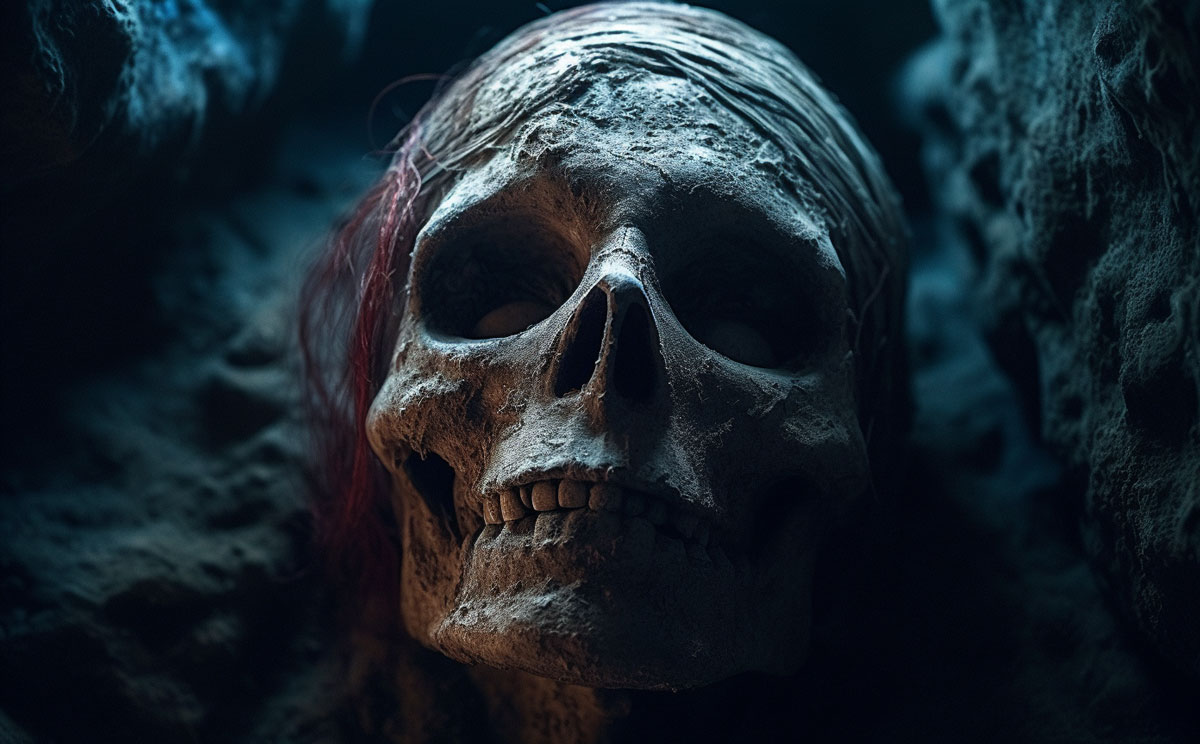
Lightning flashes as we scrape the final shovelfuls of dirt away from the top of the coffin, pry open the lid, and in the lantern light we see a perfectly preserved human body! It's as if she died only a few hours ago, but this body we're exhuming is centuries old. How can this be? How can this body have proven incorruptible by decay and the ravages of time? According to the Catholic faith, such incorruptibility is a miracle. A person who dies and proves incorruptible can thus qualify as a saint.

There are quite a few alleged examples of this, and we'll take a look at some of the best known. But first, let's examine exactly what the church's criteria are for incorruptibility. In essence it means that the body does not decompose after death, in a miraculous manner not explainable by natural processes. The body has to remain flexible and is supposed to be indistinguishable from sleep; it can't dry out like an Egyptian mummy and be all stiff. The body also must not have been embalmed or otherwise preserved.

The most famous of the Catholic incorruptibles is Saint Bernadette, currently on display at the Chapel of St. Bernadette in France. She died in 1879 and was exhumed thirty years later, so the story goes, and was discovered to be incorrupt and free of odor! However, two doctors swore a statement of their examination of the body, clearly describing a partially mummified corpse, describing the whole body as "shriveled", saying the lower parts of the body had turned black, the nose was "dilated and shrunken", and that the whole body was rigid and "sounded like cardboard when struck." The body was prepared and reburied in a sealed casket. When it was dug up again in 1919, another doctor filed the following report:

The body is practically mummified, covered with patches of mildew and quite a notable layer of salts, which appear to be calcium salts... The skin has disappeared in some places, but it is still present on most parts of the body.

Grauballe Man
A bog body (Grauballe Man)
(Photo credit: Wikimedia)

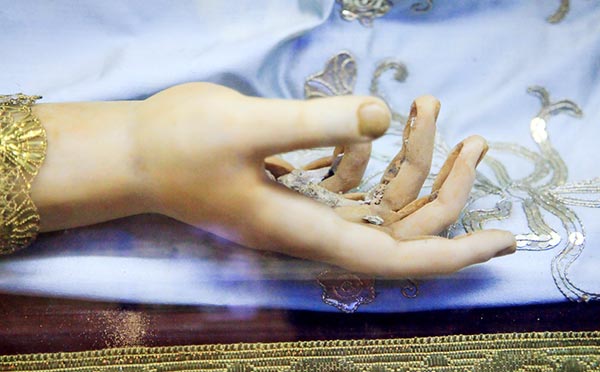
At her third and final exhumation in 1925, it was noted that the "blackish tinge to the face and the sunken eyes and nose would make an unpleasant impression on the public," and so the decision was made to display the corpse with a wax mask. That's right, the photos you see on the Internet of St. Bernadette's beautiful, incorrupt corpse are of a wax mask placed on an obviously mummified body. The descriptions of her condition openly violate all the requirements of incorruptibility, and yet St. Bernadette is the most often cited example of miraculous incorruptibility. When you think about it, if a saint dies and God decides that this body should be incorruptible, you'd think it should remain absolutely perfect, like Sleeping Beauty. It shouldn't be only slightly less decomposed than the average body, and certainly shouldn't be a common mummy.

St. Catherine of Bologna is another nun whose supposedly incorrupt body is still on display. She died in 1463, and although I couldn't find any documentation at all pertaining to the circumstances of her burial and exhumation, the story goes that she was buried without a coffin and was exhumed only 18 days later due to a strong sweet scent coming from her grave — more about that in a moment. Her body is displayed at the chapel of Poor Clares in Bologna, Italy, in a seated position inside a glass case. As you can see from the many photos on the Internet, the body is completely mummified, black and shriveled, and can by no definition be called incorrupt. And yet she is called just that anyway, in utter defiance of the blatantly obvious.

Saint Silvan was a young man said to have been killed for a his faith in the year 350, and his body is on display in Dubrovnik, Croatia, replete with a fresh-looking gash on his throat said to have been the cause of death. The body appears to be perfect. It is a sculpted effigy — St. Silvan's actual remains are said to be contained within the box below the effigy. But there is no display signage to explain this to the faithful, and many come away with photographs of what they think is the actual body. If he is incorrupt as the church claims, why display the effigy instead of the body?

Padre Pio, the 20th century priest famous for his stigmata, is also on the church's list of incorruptibles. However, according to the church's own records, his body was embalmed with formaldehyde upon death. Even so, at his exhumation 40 years later, the remains were described as "partially skeletal" and morticians were unable to restore the face to a viewable condition, so Padre Pio is displayed today with a lifelike silicone mask.

Incorruptible bodies, when exhumed, are often said to be accompanied by a sweet odor which Catholics called the Odor of Sanctity. This odor is also said to come from stigmata on living saints. Some saints are said to have exuded this odor after death. Of course the obvious explanation for such a smell would be embalming fluid. However, modern embalming fluids, basically formaldehyde mixtures, are said to have a strong, unpleasant smell like gasoline. Therefore most manufacturers mask the smell with perfume additives. Historically, sweet-smelling ointments were used on corpses to counter the smell of decomposition, and many such ointments are now known to have contained guaiacol, an effective preservative made from beechwood tar, similar to creosote. So, dig up a body and find it in any state of preservation, and you're likely to smell a strong sweet odor. Evidence of embalming or odor-masking is a better explanation for this smell than some supernatural "Odor of Sanctity".

The best examples of natural incorruptibility come from the peat bogs of northern Europe. About a thousand individuals have been exhumed from the bogs, where a unique combination of cold conditions and chemical processes preserves the soft tissues. Most of these come from the Celtic iron age, but some are far older; the oldest being Koelbjerg Woman who is 5,500 years old. In bog bodies, peat acid actually dissolves the bones but leaves the soft tissues pliable, like rubber, though stained brown and actually tanned into leather. Technically, these bodies meet the Catholic criteria of incorruptibility far better than any of the dried mummified corpses that the church claims. Why are the bog people not considered saints? At least their bodies actually do remain flexible. The church probably says that the natural chemical process counts as embalming, which of course it does; but at least this is a natural process and not a deliberate human embalming as has happened with so many of the so-called miraculous Catholic incorruptibles.

Most recent is the case of Hambo Lama Itigelov, a Buddhist monk who died in the Russian Mongol territory of Buryatia in 1927 and was exhumed in 2002, by his own last request. His condition was described by the monks and a pathologist in attendance as that of someone who had died only 36 hours before. Video shows what looks to be a well-preserved mummy, but hardly that of someone who died only 36 hours before. His body is on display in the open air and is claimed to remain pliable, a claim which is untested. Despite a Russian documentary movie finding no explanation, and the monks' claims to the contrary, the pathologist's own report found the body to have been preserved with bromide salts. Itigelov had also instructed that his body be packed in salt, another way to help prevent decomposition by absorbing moisture away from the body. It's interesting that in life, Itigelov actually had a degree in medicine, and had written a Buddhist encyclopedia on pharmacology.

Buddhist monks have long practiced self-mummification. Some Japanese monks used to prepare themselves for self-mummification through a technique called sokushinbutsu. They ate a subsistence diet of nuts and seeds for 1000 days to get rid of all their fat, and then spent the next 1000 days eating only bark, roots, and drinking the tea of a poisonous tree called the urushi, in an effort to make their body both dehydrated and toxic to parasites. Finally they would place themselves inside a stone tomb, ringing a bell once each day. When the bell failed to ring, the other monks would seal the tomb, wait another 1000 days, and then open it up to find out whether the monk had mummified. Only about 20 such monks were successfully mummified in this manner; the rest decomposed normally. Even this number is impressive given that the internal organs remained, which are a prime source of bacteria that contribute to decomposition. Tests of the mummies have revealed toxic levels of arsenic, which is another embalming agent. Together with the lack of body fat and pre-existing dehydration, monks practicing sokushinbutsu actually had a reasonable chance of mummification if their tomb was well sealed and conditions were dry. Hambo Lama Itigelov's own technique of using bromide salts and salt packing appears to be a scientifically updated form of sokushinbutsu.

But you couldn't call these monks incorruptible any more than you can use the term to describe the Catholic saints who are obviously mummified. Mummification is the natural, expected process that happens to a body under the right conditions. There's nothing miraculous about a natural, expected process. I suppose some people claim that in some of these cases, decomposition should have taken place instead of mummification, and thus the miracle. So, what; leaving a few strands of beef jerky stretched over the bones is the best that the miracle-creating superbeing was able to muster? I'm not convinced, and a skeptical Catholic shouldn't be either. Incorruptible should mean incorruptible. The corpse needs to be flexible and lifelike, as if asleep. We've never seen anything remotely like that. There are no verifiable, viewable examples of supernatural incorruptibility anywhere on the planet, and no reason to think there ever have been.

You should follow me on twitter here.

Brian Dunning
Brian Dunning

© 2008 Skeptoid Media, Inc. Copyright information

References & Further Reading

Aufderheide Arthur C. The Scientific Study of Mummies. Cambridge: Cambridge University Press, 2003. 273-276.

Edwards, Harry. "Incorruptibility: Miracle or Myth?" Incorruptibility: Miracle or Myth? Investigator Magazine, 1 Nov. 1995. Web. 10 Jan. 2010. <http://users.adam.com.au/bstett/PaIncorruptibility.htm>

Faure, Bernard. The Rhetoric of Immediacy. Princeton, New Jersey: Princeton University Press, 1991. 148-178.

Nickell, Joe. Looking for a Miracle: Weeping Icons, Relics, Stigmata, Visions & Healing Cures. Amherst, New York: Prometheus Books, 1993. 85-92.

Spindler, K., Wilfing, H., Rastbichler-Zissernig, E., Nothdurfter, H. Human Mummies. New York: Springer-Verlag Wien, 1996. 161-171.

Reference this article:
Dunning, Brian. "The Incorruptibles." Skeptoid Podcast. Skeptoid Media, Inc., 4 Nov 2008. Web. 2 Sep 2010. <http://skeptoid.com/episodes/4126>

Discuss!

Remember, you should always read with skepticism the comments of anyone too lame to put their real name & city.

I was hoping to see something election-themed this week. At first, I was disappointed, but then I realized we've got a real, "live" incorruptible running on the Republican ticket.

Thanks for keeping us informed!

Andy Homer, Long Island, NY
November 04, 2008 1:06pm

The belief in this alleged state of incorruptibility by Catholics, seems to me to be an example of how little people of faith tend to question the claims made by the clergy, and others of religious authority. In my opinion, people are reluctant to do this, as it could be perceived as a deficit of faith. Which is obviously discouraged, as, for some odd reason, faith is supposedly a laudable trait to possess, at least to those that have it. Also, most people don't want to question their faith and often life-long held beliefs, as by refusing to accepting what is contradictory in life, a person need not face and try and consolidate such things with what they want to believe, lessening any internal conflict. This is something that can be equally difficult for non-believers when confronted with the counter-intuitive concepts of science that are so often true.

Wesley Harding, South Wales
November 04, 2008 1:56pm

What about Lennin? Is he one?

Or was that scientific intervention :-)

Peter, London, UK
November 05, 2008 4:43am

Lenin is more a propaganda myth than a saint

Roel Scheijde, The Netherlands
November 05, 2008 4:55am

Very interesting, even illuminating episode. I'm an atheist, yet coming from a catholic country I've used to think about modern catholic miracles as misinterpretations of natural phenomenas or exaggerations - I wasn't really interested, after all it's not my faith any more.

This episode showed me, that many of them are just blatant lies. I can tolerate if my friends and family believe in silly legends. I cannot when they are told lies. I thought religion is harmless folklore - now I see it's a gangrene that must be cauterized with red hot iron.

You have opened my eyes, thank you.

Tomasz Mazurek, Warsaw / Poland
November 05, 2008 8:39am

Many saints were actually pagan gods that the Catholic church converted. Their 'powers' (talking to animals or healing disease) were the powers of the old pagan god now in saint form.

It doesn't make Christianity wrong, but it certainly shows us that we should let go of Medieval myths and think about things. Thanks for the episode.

deepforestgreen.blogspot.com

Adam Jones, Dallas, TX
November 05, 2008 9:29am

Not very impressed this time. This is kind of a "so what?" revelation. Will you also be pointing out that Communion host is really just crackers, not Jesus's flesh? At what point does debunking fraud turn into outright religion-bashing? (I am, by the way, an atheist myself.)

There's plenty enough quackery and nonsense in the world to leave genuine religious doctrines at the bottom of the list.

Cambias, Amherst
November 06, 2008 6:25am

I hardly think this counts as "outright religion-bashing" the church is asserting claims of incorruptability which are obviously false. It seems more like outright lies.

mike kozlowskyj, sudbury, ontaro
November 06, 2008 8:29am

Tomasz Mazurek you are walking a dangerous line with your intolerance. You might want to take a deep breath and step back a few paces.

Interesting episode by the way.

Jake Stone, Ft Worth TX
November 06, 2008 11:00am

It's been a few years since I deeply delved into Catholic theology, but in my recollection, there are rankings of how important miracles are.

First there's the "YOU MUST BELEIVE" ranking. Christ's ressurection and things like that.

Then there's a "YOU PROBABLY SHOULD BELEIVE" and a "IT'S OKAY TO BELEIVE BUT NO SWEAT IF YOU DON'T" ranking for miracles, and I think saint's bodies fall into one of those. Also probably the Fatima Sun miracle.

Then there's a "YOU'RE NOT SUPPOSED TO BELEIVE" ranking, for alledged miralcles the church has discoutned.

Morgan, Tracy, CA
November 06, 2008 11:30am

There are far more criteria to the canonization of a saint than the 'miracle' of an incorruptible body. In fact, given the great number of saints officially acknowledged, and the fact that the Christian 'communion of saints' involves the consideration of not only those now dead as being saints, but also those who may be living saintly lives today, and includes those who may not even be or have been Christian. Leaves this particular article severely lacking in real research into just what it is that the Church requires for one to be see as a saint.

This article leaves the impression that an incorruptible body is all that is required when, the actual (and easily accessible) facts are quite different from the reality as the author has deemed to portray it.

It is also true that, in most (if not all) of the cases mentioned, the recognition (and traditional devotions) which have grown around these very few examples has not been a 'top-down' process of the Church saying "THIS IS A SAINT! YOU MUST NOW BELIEVE!" but a grassroots movement of the faithful seeking to uphold one of it's own members as an example of the Christian life lived well. Which again, is much more than just because they seem to have been preserved in some way. It is only later, and then sometimes reluctantly, that the official 'Church' will investigate and allow that something in this person's life (not death) is worth holding as an example.

Eric, Saskatchewan
November 06, 2008 1:33pm

wouldn't it be cool it there realy was an incoruptible.

or even better smeone who was so incarutible that noone beleved it was a mirical because they thought he had just died. but he had been dead for like 100 000 000 years. actualy were humans even around back then?

celestial-salamander, Australia
November 07, 2008 11:02pm

I must say, as a non-believer who had 12 years of Roman Catholic education, this is the sort of stuff that ultimately led me out of the church. Why they can't see the damage this sort of thing does among reasoning people is beyond me.

Chris Foreman, Yerevan, Armenia
November 09, 2008 6:27am

A brief search turned up this [and I mean brief]...

The general attitude to "learning" by the Faithers is this: If we Faithers teach it then it's right, if not it's nonsense...

Isaiah 44:21-28

24 "This is what the Lord says-- your Redeemer, who formed you in the womb: 25 who foils the signs of false prophets and makes fools of diviners, who overthrows the learning of the wise and turns it into nonsense."

Being a Faither means you've thrown Reason out through the door, with the Companion.

neil griffiths, Cardiff uk
November 10, 2008 4:55am

You could have mentioned the charred heart of the "burning monk"... that's an interesting story - hoax or miracle? :)

carlos, sao paulo
November 12, 2008 5:26am

Perhaps it is only my own personal opinion, but I always thought that for something to be declared scientific fact more actual test had to be conducted rather than a few outward observations by two doctors.
I would also like to know what relevance the rather unattractive picture of the 'bog body' holds to this article, since none of the Incorruptibles revered by the Catholic Church were found to be buried in a bog.
Finally, I would certainly love to see the references and/or proof of personal research that the author has conducted to support the blatant denials he makes of beliefs held by millions around the world. According to his own statement, he does a "crapload" of research for each article.... so where are the references?
Maybe next time place a disclaimer at the beginning of the article stating it as opinion rather than fact.

Tara, Wisconsin
November 12, 2008 7:31pm

Tara:

Brian mentioned bog bodies because they are evidence that human bodies can be preserved by natural means and meet the RCC's standards of "incorruptible" far better than their so-called "saints" do.

Brian links to the quotes from the doctors who exhumed Bernadette's corpse is from a Catholic website. It even mentions that it is wearing a wax mask and hands.

The fact that Padre Pio's body is wearing silicone mask can be found on this Catholic WWW site: http://www.catholic.org/international/international_story.php?id=27722

Whether or not a belief is held by "millions of others" doesn't make it true. "Faith" does not determine reality. In fact, faith is far too often the blatant and willful denial of reality.

Mark, Wisconsin
November 12, 2008 8:36pm

Tara,

Exactly what battery of tests would need to be conducted?

"Look at this perfectly preserved body!"
"Uh...that body is mummified."

What exactly would this army of scientists do? What number of scientists running what number of tests would have to agree that the body is not unnaturally well preserved before it would convince people?

This is like me holding up an orange and declaring it an apple then having people defend me by saying "It takes more than a few observations to prove him wrong."

Besides, who said anything has to be "fact?" Which is more likely: A few bodies were miraculously "well preserved" because God liked these people. Or the bodies were better preserved because we see examples of that all over the place?

Let's concede that God exists and pretend that these bodies even are preserved "better than the should have been", whatever that would mean. Where does God declare he's going to preserve these bodies? If God is behind this, why do we find better examples in non/pre Christian regions? If this is an example of God's will, why are these bodies not in gem-mint-ten condition?

This is clearly just an example of people looking for signs anywhere they can, which really should be considered the biggest blasphemy of anything. God is all powerful, I can't think of anything more insulting than believing he does a crappy job preserving these random stooges and that he reveals his holy presence to the world via oil stains and cheese sandwiches.

Jeremy Lindgren (vita10gy), Eau Claire, WI
November 14, 2008 9:34am

Excelllent work. I was reading the same catholic website which quotes the observations on exhumation of the cadaver. I immediately pondered as to why St Bernadettes body was covered in salt. Shes obviously been embalmed. Lourdes is a massive revenue stream through tourism for the church. Its down right dis respectful to use someones corpse as a means to make money. Thats all they are doing. I also compared the old image of Bernadette and the new image. When I looked at it I immediately thought it looked like it was a wax work model. The old and new likenesses are entirely different. It seems they have given her a more pleasant visage. I get so angry to think that millions of people are fooled by this non sense.

Thanks for the Article

Graham, Dublin
November 17, 2008 3:44pm

Maybe Nature itself is miraculous.

MisD, Sin City
November 18, 2008 12:17pm

I found this article to be very refreshing. I'm an atheist living in a Catholic country and It's very frustrating the lenghts some people go to promote these so called "miracles". (Think about a hundred chain emails a day). It's very hard to keep a straight face sometimes. Sometimes you think them very naive, but this kind of "incorruptibles" are not a mistake.

These are a full fledged hoax.

By the way, Cambias, another listener, made me think about the people that says that the host is indeed made of flesh. Literally. I love to hear you tackle the "Lanciano Miracle" and similar catholic stories. I know they must be a hoax similar to these "incorruptible" saints, but, as I said, I'd love to hear dismantle it.

Kudos, Mr. Dunning.

Another great episode.

Roberto Garcia., Mexico
November 20, 2008 11:41am

I'll make this brief as I suspect my first comment didn't take.

The best incorruptibles I can think of are Xin Zhui, the Lady of Dai, in China and Rosalina Lambardo in the Capuchin catacombs

F. Drake, College Station, Texas
November 29, 2008 10:33pm

And yet the same religions also use incorruptness as a sign of the corpse being a vampire if the person wasn't a religious figure when alive.

Robert Jase, New Britain, CT
November 30, 2008 7:47am

The 'Incorruptibles' are frequently described as being so unchanged or so beautiful that one might expect them to open their eyes and take up where they left off.

But when you see a picture of the mummy in question, they are distorted, dessicated and very obviously long deceased. To me, the 'Beauty of Loulan' looks like a dried apple doll or a piece of beef jerky.

Not corrupt perhaps, but certainly not miraculous or even surprising, considering the conditions in which her body and those of the other Tarim Mummies were interred. A Twinkie would look better, given the same circumstances.

Lois Carneiro, Yorktown, NY
November 30, 2008 11:06am

...

Ew.

Eshto, Madison
December 08, 2008 11:34am

If Mr. Dunning is going to challenge a claim of one who is an incorruptible, I would much prefer the truth. He starts his disclaimer with science and then selectively ignores all of the documents and scientific evidence surrounding the body. The Catholic Church discards embalming as an incorruptible. Bernadette was dug up, not once, but three times which led to damage to the original body. That is when wax was used to try and keep what was there as close as possible to the earliest state. A complete documentation is provided by doctors and observers each time. I would just suggest that Mr. Dunning provide references in order that people can view the entire scientific/profound experience and documentation, not just his selected remarks of disbelief. Controversy is good. Truth is better. Thank you.

Annabell Ross, Temple, TX
December 08, 2008 4:48pm

Perhaps Annabell, you could enlighten us as to where we might see your references and evidence, bearing in mind that the burden of proof lies with the claimants of incorruptibility.
I do tend to agree that the truth is the best policy.

Marius vanderLubbe, Nullabour plain, Australia
December 08, 2008 5:44pm

Hi Marius,

An attorney would disagree with your statement of where the burden of proof lies.

After Brian states his references, for which he has a disclaimer saying that he will not do; I will be glad to supply references of the conditions needed for incorruptibility (embalming and steps to preserve the body upon death, etc., are not included); those the Church will not factually claim are so, and may or may not be considered saints (which is another tedious process) and anything else I have commented. Brian did take some selected comments out of sound texts and left out the parts with the scientific evidence.

Point: If my body was dug up 3 times like Bernadette, was washed, handled by many, and not meticulously cared for (climate, humidity, etc.) I would need far more than a wax-like impression. I do agree that the wax enhanced her features when she was alive when she had heavier eyebrows...

Anyway, this has been entertaining.

Annabell Ross, Temple, TX
December 10, 2008 1:37pm

Annabelle, an attorney will disagree with *anything*. That is why they drive flash cars and live in big houses....

Marius' point is a common one in science - that the burden of proof lies with the person making an extraordinary claim, not with the rest of the world who "only" have centuries of scientific observation and theory to guide them.

Brenton, New Zealand
December 10, 2008 2:10pm

We are still waiting, Annabell.

Marius vanderLubbe, Nullabour plain, Australia
December 10, 2008 5:49pm

Hey, I'm glad I'm getting so popular.

If you look at Brian's statements, he is the one making the extraordinary claims. Since he is the one who put it out there, did not research his claim thoroughly, refuses to give references; I would think he (or y'all) would give the documented reasons why he believes as he does, not just make up a lot of nonsense and then say anyone who disagrees, has to provide the scientific background.

Based on the way it is presented, I could make the original claim that all men are idiots, give no references; and it is up to you all to prove they are not idiots (if in fact, you believe that) and be the ones to provide references.

I would prefer that if someone is going to offer opinions, that he/she do so on facts backed by references.

I don't even know how I stumbled on this site but it seems twisted in how it is relayed. But if it is for controversy only, it met that goal.

Annabell Ross, Temple, TX
December 11, 2008 1:31am

Uh... no. An extraordinary claim is one where something extraordinary happens, like "some people don't rot, due to the influence of God".

A non-extraodrinary claim is one along the lines of "All people rot, unless there is some physical factor that prevents them, that can be explained by natural processes, without appealing to God or the supernatural for help"

The first statement is extraordinary - it involves input from the supernatural or the divine. The second statement is not extraordinary - all events can be explained in a completely scientific manner.

Do you understand the difference now?

A claim of incorruptability is an extraordinary claim. It involves an act from beyond the realm of normal science.

A claim that incorruptability doesn't exist, or that cases where it occurs can be explained by natural phenomena, or intervention by people, or just plain deception is not extraordinary.

Lets say I saw a unicorn, and you say I did not.

Lets go further and say that I have a skeleton of one buried in my back yard, and you do not believe me.

Is it up to me to dig up my unicorn and show you the bones, or is it up to you to prove scientifically that unicorns don't exist? Which of us is making the extraordinary claim?

Sorry to labour the point - but it seems that it is neccessary for clarity...

Brenton, New Zealand
December 11, 2008 12:19pm

Incorruptibles do exist. People like Brian are so focused on "no" that they would never be open enough to understand "yes." In some instances his comments are valid, but this is the type of person who will never believe anything unless he can touch, taste, smell, hear or see it. And who among us really believes the universe is limited to our 5 physical senses?

Ed Nygma, Key West, Fl.
December 11, 2008 12:31pm

Excellent. The assertion has been made that they exist.

Now... prove it.

Brenton, New Zealand
December 11, 2008 1:40pm

I am looking at so many illogical and non-referenced comments, that I think I will move on to other sites. Ed and Eric's comments appear to be ignored, as well as many items I mentioned.

Extraordinary issues? I don't agree. It's like going back to a square earth.

Do ghosts or spirits exist? Blab about how they don't exist without scientific background or referenced facts, and then say "Prove they exist."

Guys, it's been fun for this short time. I was looking for something a little more rational, logical, fair to both sides of an issue and intellectual, not emotional. I'm going the cremation route, so you'll never know if I remain intact after I'm dead, can move around, open my eyes, be flexible and maybe even walk over to shake your hand. Sorry to disappoint.

Annabell Ross, Temple, TX
December 11, 2008 2:47pm

There are not two sides to a scientific debate. There is only the truth and nothing.

What you are confusing this with is a political thing. In politics, there can be two view points that are equally valid to two different people. It does not work that way in scientific inquiry: Either it is or it isn't.

It would seem that you only came to this website only once just to post this. It is not our fault that you do not understand what true science is.

Goodbye.

jakob ambrose, holtville ca
December 11, 2008 3:30pm

So... God causing some people to not rot is self evident, needs no proof and is to just be believed - despite any evidence and all science to the contrary...

Right...

You haven't actually addressed the items I brought up Annabell. You simply dismissed them out of hand.

Let's break this down into nice digestable chunks.

1. Are you (and other Catholics) claiming that incorruptability exists?

2. Are you claiming that it is an act of God?

3. Would you agree that such a phenomenom falls outside of the realm of the normal, that it is an extraordinary event?

4. Would you agree that incorruptability, if it exists, should be demonstrable - ie, the "incorruptible" appear simply asleep - not withered corpses - without the intervention of human efforts?

5. Where, if the answer to all of the above questions is "yes", would one go to view such a corpse in such a pristine state, and what assurances would one have that such a corpse had not been ... "enhanced" to make it appear more lifelike than it might otherwise be?

Brenton, New Zealand
December 11, 2008 3:33pm

If Annabell Ross is simply looking for confirmation of her beliefs, perhaps she might be best advised to join a catholic forum, or such like, where the scientific method is not employed as rigourously as it is here.

Marius vanderLubbe, Nullabour plain, Australia
December 11, 2008 5:44pm

In 2001 Heather Pringle published THE MUMMY CONGRESS. To say the least, the book is a fasinating read. Its focus is on natural and man made mummification through the millenia, and it has a chapter titled The Incorruptibles.

In part, this chapter summarizes the work of a British business called The Necropolis Company. This company has moved thousands of graves in the last 150 years. Occasionally, they find bodies that are remarkably well preserved. The company owner credited this preservation to the formation of a "vacuum" that formed when a tightly sealed coffin was placed in clay soil. I don't believe a vacuum can actually form, but a tight seal with some embalming probably kept insects and bacteria away from the body.

The book is a ripping good read, and I recommend it for anyone who has a marginal interest in this subject. I think Amazon has the paperback edition.

Darryl Bennett, Lexington, Kentucky
December 20, 2008 7:19am

Some people seem to have the view that there is science, wich is a matter of truth and is versus isn't, and nonsense.
I talked to a professor the other day. She said two important things: 1 science is not about truth but about how we explain something at this moment. It is changing all the time. People that think science is about truth, miss the point. 2 many scientists have themselves a believer's attitude.
Example she gave (out of 1000 she could give, she said): a talk was given by a doctor who had studied near death experiences. His approach was totally rational and scientific. During the break a collegue, known to be proud of his rationality, asked 'do you seriously believe this stuff ?'

There is no doubt that the church puts itself in a difficult position and will compromise the truth to hide it. Also there is no doubt that for many things that the church or anybody else claims are of a supernatural order, there is a natural explanation.
However. Take it from a skeptical and I believe intelligent person that if you state there is nothing special or, if you like, holy or beyond the usual about any of these corpses, you are dead wrong. And missing the oil in the olive.

Peter, Rotterdam
January 12, 2009 1:12pm

I'm skeptical of your extremely stringent definition of incorruptibility for the purposes of Catholic veneration. You give no source for your assertion that the Catholic Church defines incorruptibility as "the body has to remain flexible and is supposed to be indistinguishable from sleep". This is because such a definition is outlandish (NONE of the incorruptibles verified by the Catholic Church would fit this description). The doctors' reports that you cite with regard to St. Bernadette's body were actually used AS EVIDENCE that the body was in fact incorruptible according to the Catholic understanding.

It is unreasonable for you to set the bar unrealistically high and then mock Catholics for not meeting your excessively high standard. It is deceptive for you to pass this standard off as your own.

peace

Daniel, Atascadero, California
February 03, 2009 1:11pm

Well, there is no arguing with the Catholic Church on stuff like this. They will argue that it is all about "faith". I have none of that.

However there seems to be some anecdotal evidence that corpses are occasionally dug up and found to be "non-corrupted". I've run into a few sites mentioning Abraham Lincoln's dis-interment in the early 20th century. According to photos at the time and witness statements, it is apparent (with the odd exception of his eyebrows being missing) that he was that he is in perfect shape.

Whether this is from some advanced enbalming technique, how he was buried, or what, I don't know.

I've seen some photos of other dis-interred corpses online (that had nothing to do with any religion) that were also (at least in the face) non corrupted.

I belive these saints (and others) are genuinely discovered in this state; however once the corpses are removed from whatever their "perfect embalming environment", they begin to decay. Thus neccessitating the wax face masks and other nonsense.

Oscar, Sarasota, Florida
February 16, 2009 4:31am

I understand the skeptism, but research some more okay?

Here is a site for you to look at and understand better the differences between incorrupt and perserved....

http://www.overcomeproblems.com/incorruptables.htm

Science cannot conclude this to be natural - leaving open the possibility of a higher power. if you believe in the paranormal then why not this?

Christine, Anaheim, CA
February 25, 2009 3:08pm

Christine, I have a number of issues with your response.

Firstly, the site you link to provides no information (other than bald assurances of incorruptibility for a number of people) - there are no references or independant correlation of the claims made.

Secondly, it is a Catholic site designed to support the faithful - it is hardly objective.

Thirdly, a quick surf through google (and a reading of Brian's original transcript, above) demonstrates that rather a lot of the people incorruptibility is claimed for are not so incorruptable after all - Bernadette for example is described in some detail above, and Pope Pius X has his face covered by a silver mask - because of damage to his corpse post death!

Finally... your final arguement is a bit of a strawman.

Who was claiming to believe in paranormal activity??

Brenton, New Zealand
February 25, 2009 4:20pm

Genesis 3:19 (King James Version):

"In the sweat of thy face shalt thou eat bread, till thou return unto the ground; for out of it wast thou taken: for dust thou art, and unto dust shalt thou return."

Anyone who believes in the incorruptibility for any one person, would have to arguee with God, since He is the author of life and death and the bible.

Ron, Hazleton <pa
April 12, 2009 4:52pm

This is definitely an opinion piece, especially if you look at the way it is written. It doesn't present scientific facts, just like the articles about Incorruptibles don't present scientific facts. So the jury is still out in my opinion. Several qualified forensic pathologists or forencis anthropology should examine these cases.

Jorge, Chicago
April 19, 2009 8:31am

u kind of have a point about waxing bernadette's body and all..but eventhough,with waxing should A NORMAL DEAD BODY look like this?

stephanie, lebanon
May 20, 2009 4:54am

Stephanie, without knowing how much wax is on the body, what other processes it was subjected to, and how much rework was required to get the final appearance, it is impossible to state what a "normal dead body" would look like.

I think you are asking "would an untreated body" look like this - and the simple answer is no.

However, this isn't an untreated body - it is one at least partially encased in wax, and what you are looking at isn't the body - it IS the wax.

Brenton, New Zealand
May 21, 2009 8:03pm

You are not helping the Skeptics cause at all by this subjective, opinion-based evaluation of the phenomena of incorruptible bodies. Presuming a sweet smell to be due to preserving fluids without actually testing the conclusion with forensic evidence would be like the Church requiring the faithful to believe in incorrupt bodies as proof of Sainthood without reasonable substantiation. But from my experience, the majority of Catholics are not aware of this phenomenon, and the Church doesn't require them to believe in it an essential part of their faith. For my part I prefer to keep an open mind until more rigorous evidence for or against the case for incorruptibility is available. And how thick is the wax mask? Is it a thin coating to protect the skin from dust and mildew or a thick mask aimed at recreating the person's features? And why isn't this supposed deception used on all the other incorruptible saints they 'claim' to be miraculous.

John, Sydney, Australia
June 05, 2009 3:32pm

There is no need to link incorruptibility with belief. The accidental preservation of dead bodies is a natural phenomenon that does happen occasionally. (This is not the dessicating mummification of bog bodies.) It is called saponification, and the resultant bodies are often called 'soap mummies'. It happens when the fat in the body is slowly transformed into adipocere. It may affect a whole body or just part of it, and is most common when the body is in a warm, moist environment and protected from damage and carrion-eaters (eg by being in a coffin). Famous cases include the painter Dante Rossetti's wife and some of the saints listed here.

After they have been exhumed saponified bodies are likely to deteriorate, so some of those 'incorruptible' saints will have decayed after they were discovered. Or they may be preserved deliberately afterwards, which can make them look like fakes to an unscientific examination.

Bodies such as Lenin and Mao have been deliberately mummified and are not examples of incorruptibles.

So there is nothing mysterious or miraculous involved - just a chance random event which was unfamiliar to our forebears and so interpreted as a miracle.

Anne Rooney, Cambridge, UK
June 22, 2009 10:59pm

I recently visited St. Peter's Cathedral in Italy and came across the bodies of the saints - they are adorned with masks but these masks are not intended to fool anyone. It is obvious to anyone who passes by the the very fake looking mask is only there to hide the disfigurement caused by time. No one who visits these bodies could believe in their incorruptability.

Adam D. Jones, Dallas, TX
July 09, 2009 9:12am

Do you know anything about the "incorruptible" body of Saint Germaine Cousin? It look pretty good too.

Silvia, Campinas, Brazil
July 26, 2009 4:59pm

From "The Incorruptibles" by Joan Carroll Cruz:

Preserved bodies found in countries around the world can be divided into three classifications: the deliberately preserved, the accidentally preserved, and the incorruptibles. Specimens of the accidentally or naturally preserved were found even before Egyptian Pharoah times, when the art of embalming originated, producing for the first time the deliberately treated mummies which have survived for as many as three thousand years. The incorruptibles, however, have existed only since early Christian days. Their preservations since that time have challenged the opinions of skeptics and contradicted and defied the laws of nature, all to the dismay of many examining physicians and the admiration of succeeding generations

The more carefully we consider the preservation of the incorruptibles, the more baffling does the subject become, for their conservation seems to be neither dependent on the manner of burial nor on the temperature or place of interment. Nor were they adversely affected by extended delays between the time of death and their burials, by moisture in the tombs, by rough handling, by frequent transferences, by covering with quicklime, or by their proximity to decaying corpses. The greater majority were never embalmed or treated in any manner, yet most were found lifelike, flexible, and sweetly scented many years after death, in sharp contrast to the specimens of the other two classifications above, who . . ."

Real Name, Real City
August 03, 2009 8:03pm

i believe and classify miracles as supernatural and natural. God works on nature and other things. There are cases of supernatural miracles, for example, the turning of bread and wine into physical flesh and blood. For me, miracles does not necessarily mean that it has to supernatural.

christian emmanuel, Olongapo City, Philippines
August 30, 2009 10:02am

HI Brian, I read on www.FinerMinds.com story of Hambo Lama Itigelov preservation. I thought of urban legend and from your site, I got an answer. I'm a skeptic before fooling other.

Roger

Roger, Ottawa Canada
September 15, 2009 6:57pm

"Is it a thin coating to protect the skin from dust and mildew or a thick mask aimed at recreating the person's features?"
John, Sydney

But, if they're incorruptible, why would they need protection from dust or mildew? For that matter, if they're incorruptible, why should their features need recreating?

Lewayne, Near Des Moines
October 31, 2009 6:40am

Hi from Russia! Dear Brian, you say that Itigelov looks like a "well-preserved mummy". I'm nearly sure that you have NEVER seen a well preserved mummy. The body of Itigelov was NOT dehydrated (in spite of being buried in salt at least since 1973!) and is not dehydrated now (he even can absorb and evaporate water). The salt even hasn't mutilated his skin, only drained it a little in some places. Pliability of his joints and skin tonus were confirmed by local pathoanatomists just after the exhumation. Do not say it is untested, it's wrong. His body was exhumated several times before 2002 by local lamas and they easily changed his clothes (show me a mummy with so pliable limbs). The spectrophotometric analysis showed that Itigelov's tissues are absolutely resembling tissues of a living man. In fact his tissues are not really dead... You can believe it or not but but note that there are much more serious sources about Itigelov in Russian than in English. I also advise you not to be too sceptical, as scepticism can become a diagnosis :)
Best regards!

MITIL, Moscow
November 10, 2009 2:40am

I have to say, I do like your website and I enjoy reading about these things. But based on the bible I have to say that it would be totally against what God says to have a body that doesn't decompose. He says "From dust you became and to dust you will return" so in my opinion bodies being in this condition couldn't be the work of God.

Rachel, Tennessee
January 18, 2010 4:26pm

@MTIL from Moscow

Please show us some citation for your claims. Also, no offense to your country, but considering your Soviet history of ignoring or rewriting history, I wouldn't fully trust any sources that are ONLY available in Russian. If this corpse is in as great condition as claimed, it should have been confirmed by as many people as possible. Otherwise, why hide it, unless it's blatantly false?

And yet your claim that a long-dead man's tissue resembles a living man's tissue sounds to me to be the height of falsehood to this claim. It just sounds too ridiculous to be real, the same sort of lie that should have died with the Soviet Union.

But like I said, while I am biased, I am yet open to any real proof you can provide. Pictures would be a marvelous help as well. It was 2002---you can't tell me NO ONE took ANY pictures at all.

Andariel Halo, Miami, Florida
January 27, 2010 6:15am

I don't think that you have done this subject justice at all. St Sylvan's statue isn't an example at all of this phenomena, merely an attempt to prove bad faith in all other cases. The Church takes no line on this matter so has no official definition of incorruptibility. No-one claims that the bodies do not and have not decomposed. What is claimed is that they decompose at an astonishingly and inexplicably slow rate. The Soviet state spent a vast amount of money and effort preserving the bodies of Lenin & Stalin and the results were appalling. If you look at the case of Imelda Lambertini who died in the 1300's - the preservation is better than the Soviets managed over 700 years later with unlimited expenditure. This whole subject is worthy of proper investigation not a cursory dismissal.

Steve, UK
January 27, 2010 3:12pm

I will pray for all the skeptics. I will not judge you for your beliefs, that is up to God. Those who choose to argue are giving into the temptation of the ignorant. Martyrs did not argue, they never denied and continued to pray for those who victimized them. The skeptics are victimizing our Church and as good Catholics our stance should be to pray for them, not give them the argument they desire. Us Catholics live on God's love, they live on the Devil's forked toung. May they see the true light and may God forgive them. He loves you even if you don't love or believe in Him. As a child of God, I too love you, because that is our way. Bless you and may God watch over you.

Amber, Denver, US
January 28, 2010 1:03am

@Amber

I have no idea what you're trying to say. Since you said "Us Catholics live on God's love, they live on the Devil's forked toung [sic]" and badly mispelled "tongue", I can only assume you're threatening us non-Catholics with a very hostile message of "with us or against us".

You seem to be of the opinion that being a skeptic somehow makes someone an inherently wicked atheistic person. I believe in God and I am a skeptic. Sometimes I'm even skeptical of God's existance, but I still have faith.

You say you won't judge us for our beliefs, yet in the exact same paragraph, you proceed to do exactly that

You wonder why thinking people criticize Christians so much? Go back and read your own post. You have much of your answers right there. And in case you'd rather not look back and learn from history, let me summarize it:

1) You were hypocritical, claiming not to judge us, and yet you went ahead and did just that

2) You assume all skeptics argue for the sake of argument and are atheists

3) You assume Catholicism is the only true way to God

4) You act as though the Catholic Church is infallible and above criticism. HINT: ONLY GOD IS.

Andariel Halo, Miami, Florida
January 29, 2010 6:34am

I'm sure it is hard for anyone who has not been raised Catholic to not be skeptical of Incorruptible Saints as with the Stigmata and Shroud of Turin. I do have to point out that there are many saints who are not incorruptibles and led just as Godly lives. The point is that incorruption is a mystery. To those who believe it is the work of God. To those who are skeptics it is a pretty wax mask or effigy. I say, let the skeptics be skeptical, but I believe.

Beth, Springfield, MO
February 17, 2010 3:50pm

I checked once again and Brenton and the other non-believers continue to be very selective in what they will argue and agree with. I had a Friend, an Archeologist, from Mesa Verde National Park, send some basic comments. Do you know that everything he said was ommitted? In the disclaimer below this, it should also read that posts from professionals and experts will also be deleted. It's been fun.

Annabelle Ross, Temple/TX
March 15, 2010 7:52pm

Since last posting on this subject, I have discovered that the Vatican set up a group in 1985 to examine the bodies of some of the claimed incorruptibles in Italy. The group of scientists had impeccable and relevant specialist credentials.
They discovered that some of the most acclaimed 'incorruptibles' were subject to extensive work shortly after their deaths. Among these were some very famous names - Saint Catherine of Siena being one. Of 9 bodies examined, 5 had been preserved by intervention. They noted that all those had been preserved by the same method (which was startlingly effective)and all died within the same period of around 150 years (from 1300 to 1450) years and all in two adjoining Italian provinces. The group could not explain the reasons for the preservation of the other 4 bodies examined. It was noted that documents were found in the local parish archives relating to one Saint showing that the townspeople had openly petitioned the Church to preserve the body of the saint so that it could be venerated. (Cart before the horse).

Steve, UK
March 19, 2010 6:00pm

That's true. Preserved dead bodies by artificial technique, waxes, embalmed is just nothing but fooling public.

The GOD is not helpless to protect his beloved people in skeleton condition and let people use waxes etc. There should be 100% true reality of GOD is doing it.

100% Naturally Protected Bodies
===============================
There are thousands of protected dead bodies under the Earth since centuries in 100% fresh like sleeping condition without any chemical used on their dead bodies.

Some records are exists with proofs here:
http://rightfulreligion.com/events.php

If Media of World, Scientists, Researchers OR someone else want to research on this and TEST these dead bodies, we can show all bodies to them.

NOTE: All bodies are under the Earth and there is no machine or technique.

All Research is Online:
http://www.peaceinworld.com
http://www.rightfulreligion.com

Zeeshan Arshad, Pakistan
March 22, 2010 4:38pm

@Zeeshan

Proof or GTFO, in the form of pictures, video, actual archaeological digs, anything that can be falsifiable or tested. Those websites don't explain anything about this subject.

Andariel Halo, Miami, Florida
March 24, 2010 5:50am

I believe that this happens because it is the will of God. Yes let us say that the body of Saint Bernadette was covered or masked by wax but do you think she will remain in a natural state for more than a hundred years? I do not agree that she was mummified. The odor of sanctity that you are saying is just a perfume is not really convincing because perfume is made of volatile oils meaning it will never lasts for several years especially for centuries because volatile oils easily evaporates or volatilize, so it is really the odor of saintliness and holiness and how can you explain the miracles happened from them, those miracles have been reported and noted. The main reason why they still remains and just look like they have just died yesterday even they were died for centuries is that God doesn't want those holy people to decompose or decay! No science can explain the works of God!!!

Mark Anthony Haber, Laguna, Philippines
April 24, 2010 12:25pm

You mention the "church's list of incorruptibles". The church doesn't have a list of such cases and appears to be officially indifferent to the phenomena. Go to the Vatican website and search 'incorruptibles' and see what happens. A true skeptic would try and stick to the facts, when it comes to Catholicism there is not much effort to do so.

Steve, UK
April 29, 2010 6:55am

@Andariel Halo

Many people have asked me about proof in video format or the graves where dead bodies are preserved.

We have started video recording and interviews of eye witnesses of preserved dead bodies.

Also, complete address of city, area is given with bio data on each interview.

http://rightfulreligion.com/proofs.php

This list will increase in future as we move forward to the world cemeteries and come to media.

But there is NO single preserved dead body from any other religion than Islam without any chemical or artificial technique.

Zeeshan Arshad, Pakistan
June 24, 2010 1:07am

Make a comment about this episode of Skeptoid (please try to keep it brief & to the point). Anyone can post:

Your Name:
City/Location:
Comment:
characters left. Discuss the issues - personal attacks, posts containing advertisements or links to commercial services, nonsense, and other useless posts will be deleted.
Answer 7 + 1 =

You can also discuss this episode in the Skeptoid Forum, hosted by the James Randi Educational Foundation.

Join the Skeptalk email discussion list.

What's the most important thing about Skeptoid?

Support Skeptoid
Support Skeptoid
 
Skeptoid host, Brian Dunning
Skeptoid is hosted and produced
by Brian Dunning


Newest
The Myers-Briggs Personality Test
Skeptoid #221, Aug 31 2010
Read | Listen (13:10)
 
Yonaguni Monument: The Japanese Atlantis
Skeptoid #220, Aug 24 2010
Read | Listen (11:53)
 
Stalin's Human-Ape Hybrids
Skeptoid #219, Aug 17 2010
Read | Listen (13:14)
 
The Astronauts and the Aliens
Skeptoid #218, Aug 10 2010
Read | Listen (12:53)
 
Some New Logical Fallacies
Skeptoid #217, Aug 3 2010
Read | Listen (12:08)
 
Newest
#1 -
How to Debate a Young Earth Creationist
Read | Listen
#2 -
The Real Philadelphia Experiment
Read | Listen
#3 -
Medical Myths in Movies and Culture
Read | Listen
#4 -
MonaVie and Other "Superfruit" Juices
Read | Listen
#5 -
Religion as a Moral Center
Read | Listen
#6 -
HAARP Myths
Read | Listen
#7 -
Apocalypse 2012
Read | Listen
#8 -
The Detoxification Myth
Read | Listen

Recent Comments...

[Valid RSS]

ZIP Code Database

Skeptoid Podcast Skeptoid on Facebook   Skeptoid on Twitter


"Wheatgrass Juice"
inFact with Brian Dunning

Skeptoid is not responsible for the content of the ads below. Often they are great illustrations of what this episode is examining critically, so feel free to take a look.