




Rethinking Nuclear Power
Are modern nuclear reactors as bad for us as the environmentalists have painted them?
Filed under Environment
| Skeptoid #92 March 18, 2008 Podcast transcript | Listen | Subscribe |
|
Let's have a seat at Homer Simpson's control panel, chow down on some donuts, and nap away into oblivion while blinking lights and buzzers warn of impending doom and that glowing green bar of uranium that fell into our trousers. Today we're going to examine the popular notions about nuclear power. Specifically, if xenophobia had not killed nuclear power in the United States in the late 1970's, there's a good chance that we'd have all been driving electric cars for the past 20 years; and uncounted billions of tons of carbon dioxide would never been sucked out of the ground, burned in power plants, and exhausted into our atmosphere.
So let's state the obvious. The immediate reaction to that statement is "OK, that may be true, but look at all the new problems we'd have created with Chernobyl-type disasters and lethal nuclear waste." Fair enough, and important questions, to be sure. Let's start with a quick primer on the various types of nuclear reactors.
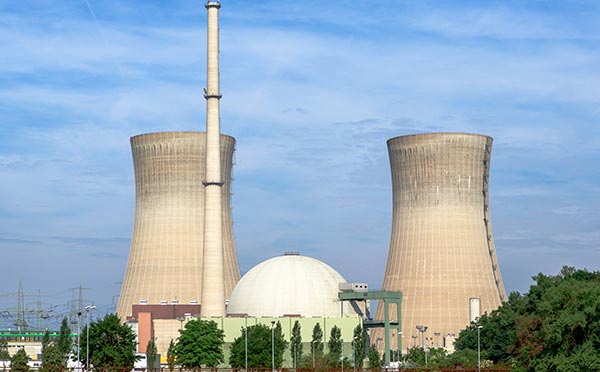
So-called Generation I reactors were the early prototypes developed by many nations, and actually placed into production in a few cases. Generation I reactors were characterized by fundamentally unsafe designs, and kludged layers of afterthought safety systems. When most nuclear nations began deploying commercial reactors, they were usually of Generation II design. Generation II reactors were significantly improved, but these changes were primarily evolutionary. Most of the commercial plants in operation in the United States are Generation II designs. A little over ten years ago, Generation III designs began appearing in some of the world's most advanced nuclear nations. Generation III reactors incorporate not only evolutionary improvements, but also revolutionary changes such as fuel cycles that result in much less nuclear waste; reduced capacity for the creation of weapons-grade plutonium; and passive safety designs wherein the reaction cannot be sustained in the event of a problem and the system effectively shuts itself down, by virtue of its basic design. The newest plants being designed for commercial use are called Generation III+, which incorporate all the newest knowledge from operating Generation III designs. If a new reactor was approved and built in the United States today, it would be a Generation III+ design. Even if every plant employee keeled over with a heart attack, neither a Chernobyl nor a Three Mile Island type accident would be possible; the systems are fundamentally redesigned so that the reaction cannot be sustained if things go outside the parameters.
The Idaho National Laboratory is the United States' primary advanced reactor research facility, and they've outlined six new reactor types to be developed for Generation IV. The designs take everything to a new level: Lower cost, safer designs, near-total elimination of nuclear waste, and reduced risk of nuclear weapons proliferation. There are also Generation V reactors in the ether, but these are primarily the domain of late-night rumination sessions at the lab, fueled by tequila and pot.
Then there's fusion power, which is everyone's ultimate goal. Fusion reactors have the profound advantages of using simple tritium or deuterium for fuel, producing no significant waste, and absolute safety since if anything goes even slightly off-kilter, the plasma disappears and you have no reaction. It's the ultimate in cheap, clean, safe, renewable energy, despite gross misunderstandings of the technology expressed by Greenpeace and other factions. The first operational tokamak fusion reactor for research is being built by the international ITER consortium in France and is expected to come online in 2016.
So you can probably guess that Three Mile Island was probably not the newest and safest design, and you'd be right. It was a Generation II design. It was the first and only significant nuclear accident in American history. A broken valve caused coolant to leak into a containment facility designed for that purpose, raising the temperature of the core and causing a partial meltdown. Despite significant confusion on the part of the operators (this being their first experience with an accident), and a somewhat lengthy chain of errors and misunderstandings, everything eventually worked out just as it should. There were no deaths or injuries, and despite 25,000 people living within five miles of the plant, nobody was exposed to any radiation worse than a single chest x-ray. All the studies predict zero cases of future cancer, despite ongoing lawsuits that the courts continue to find to be without merit. With proper perspective, Three Mile Island can (and should) be characterized as a shining example of how well the safety systems work, even in the face of human error and old-fashioned reactor design.
But that's not the way it was perceived. By an unfortunate coincidence, Jane Fonda's movie The China Syndrome about a nuclear accident came out only twelve days before Three Mile Island. The Cold War with Brezhnev was in full force and the words "nuclear accident" were simply too much for a scientifically uninformed public. Three Mile Island became the first nail in the coffin of American nuclear power.
Seven years later in 1986, things got much worse. Chernobyl was suffering from inadequate funding. Much basic maintenance had never been performed. It had only a skeleton crew, nearly all of whom were untrained workers from the local coal mine. The only manager with nuclear plant experience had been a worker installing small reactors on board Soviet submarines. Some genius decided to run a risky test of a type that no experienced nuclear engineer would ever gamble on. The test was to shut down the water pumps, which must run constantly in that type of reactor; and then find out whether the turbines, spinning on their momentum alone, had enough energy to restart and run the pumps during the forty-second delay before the backup diesel generators would kick in. The test was so risky that one faction within the plant deliberately disconnected some backup systems, trying to make the test too dangerous to attempt. The test was run anyway. It didn't work, the pumps couldn't keep up, the graphite core caught fire, the coal miners couldn't find any shovels so they didn't know what to do, and the reactor exploded. If you think I'm exaggerating this, there are extensive resources both online and in print, if you really want the hairy truth. In this short space I'm probably not even giving you ten percent of what a travesty this was — I'm tempted to call it a joke but it's so not funny. For example, they scheduled this right in the middle of a shift change, and the new workers coming in didn't even know what was going on.
Two people died that day, and some 30 to 60 people were dead within three months. Predictions of eventual cancer deaths caused by the radiation run from 1,000 to 4,000. And, of course, the damage to the local environment is extensive and difficult to estimate. The terror of a radiation cloud blowing across Europe was the second nail in the coffin of American nuclear power.
Not only was Chernobyl a monumental failure of the human element, the plant was a Generation I design, specifically an RBMK reactor, which is generally regarded as the least safe reactor type ever built. One design flaw is that the core used combustible graphite, and this distinction is the main reason that Chernobyl-type disasters are not possible in most reactors around the world. Only a very few Generation I designs are still in use, all in the former Soviet Union, and all have been retrofitted with improvements intended to prevent this type of accident. Other nations have long been lobbying for the closure of these reactors, and rightfully so.
How do the dangers of nuclear energy compare to the dangers of fossil fuel energy? A report in the Journal of the American Medical Association found that some 50,000-100,000 Americans die each year from lung cancer caused by particulate air pollution, the biggest cause of which is coal-burning power plants in the midwest and east. Even taking the maximum predicted death toll from Chernobyl, we would need a Chernobyl-sized accident every three weeks to make nuclear power as deadly as coal and oil already is. Shall I repeat that? If the world was filled with Generation I reactors run by feuding coal miners, we would need a worst-case scenario every three weeks just to match the US death toll we've imposed upon ourselves by clinging to our current fossil fuel system. Next time you see a hippie cheering the defeat of nuclear power in the US, realize that a healthy environment and saving lives are clearly not their priorities.
Well, maybe to them it's more about the future of the planet than about saving lives today. Maybe they just don't want to see high-level nuclear waste created that's going to poison the planet for tens of thousands of years. I can see that. But here's the problem with that logic: The plants we're designing now produce less waste than ever. Some on the drawing board produce none at all. We've already created most of the waste that we ever will. It already exists. It's out there. Lobbying against future cleaner plants won't make the existing waste go away. It's out there now in temporary facilities in neighborhoods all across the country, way more vulnerable than it would be in proper permanent storage in Yucca Mountain.
Opponents say that Yucca Mountain is geologically unstable or otherwise too hazardous, so the waste might leak out. Well, trust me: The location of the Yucca Mountain site was one of the most lengthy and expensive decisions the government ever made. What do you think they were doing with all that time and money, picking their noses? Well, it was a government program, so a large part of the time and budget probably was spent on nose mining. Nevertheless, this was one of the most scrutinized decisions ever made. Environmentally speaking it's as good a site as we could hope for. If you're concerned about it, go to a neutral and reliable source and research it personally. From every scrap of reason I can muster, environmentalists should be Yucca Mountain's #1 fans. I can't imagine why they prefer to leave the waste out where it is now, unless they are driven more by ideology than by science. Who would have thought that?
There is a safe and clean solution to our energy crisis, gasoline prices, and global warming. It's the latest generation nuclear reactor.
You should follow me on twitter here.
© 2008 Skeptoid Media, Inc. Copyright information
References & Further Reading
ACS News Center. "Air Pollution Linked to Deaths From Lung Cancer." American Cancer Society. American Cancer Society, Inc., 6 Mar. 2002. Web. 21 Dec. 2009. <http://www.cancer.org/docroot/NWS/content/NWS_1_1x_Air_Pollution_Linked_to_Deaths_From_Lung_Cancer.asp>
Bernarde, Melvin A. PhD. Our Precarious Habitat... Its In Your Hands. Hoboken: John Wiley & Sons Inc., 2007. 243-287, 417-425.
Cohen, Bernard L. The Nuclear Energy Option: An Alternative for the 90s. New York: Plenum Publishing Corporation, 1990.
Domenici, Pete, Lyons, Blythe, and Steyn, Julian. A Brighter Tomorrow: Fulfilling the Promise of Nuclear Energy. Lanham: Rowman & Littlefield Publishers, Inc., 2004. 181-211.
Economist. "Nuclear's next generation." The Economist. The Economist Newspaper Limited, 10 Dec. 2009. Web. 19 Dec. 2009. <http://www.economist.com/sciencetechnology/tq/displayStory.cfm?story_id=15048703>
Ehresman, Teri. "Next Generation of Reactors." Idaho Nation Labortatory: Nuclear Advances. Idaho National Laboratory, 24 Oct. 2005. Web. 21 Dec. 2009. <http://nuclear.inl.gov/gen4/>
International Atomic Energy Agency. "INSAG-7, The Chernobyl Accident: Updating of INSAG-1." Safety Series. 1 Jan. 1992, No. 75-INSAG-7.
ITER. "The ITER homepage." ITER - The Way To New Energy. ITER Organization, 1 Jan. 2009. Web. 21 Dec. 2009. <http://www.iter.org/>
Manaugh, Geoff and Twilley, Nicola. "One Million Years of Isolation: An Interview with Abraham Van Luik." BLDGBLOG. Future Plural, 2 Nov. 2009. Web. 19 Dec. 2009. <http://bldgblog.blogspot.com/2009/11/million-years-of-isolation-interview.html>
Moss, Zachary. "Chernobyl accident still haunts UK." Bellona. The Bellona Foundation, 1 May 2003. Web. 21 Dec. 2009. <http://www.bellona.no/bellona.org/english_import_area/energy/nuclear/28808>
Pope, C. Arden III; Burnett, Richard T.; Thun, Michael J. "Lung Cancer, Cardiopulmonary Mortality, and Long-term Exposure to Fine Particulate Air Pollution." JAMA. 6 Mar. 2002, Volume 287, Numer 9: 1132-1141.
Spencer, Jack and Loris, Nicolas D. "Three Mile Island and Chernobyl: What Went Wrong and Why Today’s Reactors Are Safe." Web Memo: The Heritage Foundation. 27 Mar. 2009, No. 2367.
USA Today. "Study: Air pollution, lung cancer are linked." USA Today. Gannet Co. Inc., 5 Mar. 2002. Web. 21 Dec. 2009. <http://www.usatoday.com/news/health/2002-03-05-pollution.htm>
Reference this article:
Dunning, Brian.
"Rethinking Nuclear Power." Skeptoid Podcast. Skeptoid Media, Inc.,
18 Mar 2008. Web.
6 Sep 2010. <http://skeptoid.com/episodes/4092>
Discuss!
Remember, you should always read with skepticism the comments of anyone too lame to put their real name & city.
Small adition to existing nuclear waste:
Cleaner, more efficient nuclear plants can actually DECREASE the ammount of waste.
With new plants, you can take what is currently considered high level waste, and use it as fuel. That makes Yucca mountain the cheapest source of nuclear fuel in the world. Send in a robot to fetch the barrels, and pour it in the reactor.
The resultant waste is stable enough to simply bury, even without a protective encasing.
And even if we did somehow get tonnes of radioactive waste, it's still much, much better then pumping more and more CO2 into the air, using our severly limited oil reserves. As for depleting uranium reserves, with Reduced Moderation Water reactors, the breeding ratio is greater then 1, so all the uranium gets used up. This makes the current stockpile of nuclear "waste" adequate for providing elektricity for the whole world for 60 years. After that, the known reserves are enough for hundreds of years.
Again, this problem is caused by the fact that people are idiots. Which is (IMHO) why dumb people shouldn't be allowed to vote.
Alcari, Reykjavik, Iceland
March 18, 2008 1:18pm
"there's a good chance that we'd have all been driving electric cars for the past 20 years"
Was this a tongue-in-cheek comment or a serious assertion? This would imply that the source or cost of electricity is the reason were aren't all driving electric cars now. Do countries using lots of nuclear power now have large fleets of electric cars?
Even if electricity had been free, I doubt many people would have been happy with electric cars built using 1988 battery technology.
Brian, Modjeska Canyon, CA
March 18, 2008 1:41pm
The lucky few who got GM Impacts LOVED them. GM practically had to wrestle them away in some cases.
Eric Schulman, Corona, CA
March 18, 2008 2:25pm
Irrationality kills...in more ways than one.
SR, Brussels
March 18, 2008 4:40pm
I have long been a fan of nuclear power for many of the reasons in this episode. With the new innovations being made in nuclear power, it is becoming monumentally cleaner and safer than fossil fuel derived power.
I guess this is why I have never understood my environmental nut friends, other than the fact that they are a bit crazy. They go on for hours about how pollution and CO2 are killing the earth, but one mention of nuclear power and they look at you like you are Satan. If they were really dedicated to the wellbeing of the planet, they would be on board with nuclear power like Brian said. In the case of my friends, I'm pretty sure it is the fact that they are more anti-corporation than pro-environment. Either way, another great episode!
Steve Loeffelholz, Iowa City, IA
March 18, 2008 8:41pm
I made the decision about ten years ago that any self-described "environmentalist" who is not advocating large-scale expansion of nuclear power is a fool and a poltroon, and not worth my time.
Cambias, Amherst, MA
March 19, 2008 6:15am
Great episode, and not one I anticipated. Energy will continue to be one of the most important debates for a long time to come. Some countries are already boxing themselves in because they want to reduce coal power, but are too afriad of nuclear power to embrace it. The result will be radical increases in energy prices and possibly radical changes in the way we live.
I thought you would never get to the real reason for the Chernobyl accident--human stupidity, not reactor technology or safety mechanisms.
Mark, Huntsville, AL
March 19, 2008 6:23am
One more comment. The US is one of the few countries that does not recycle their nuclear waste. France does, Japan does, we don't.
If we did we would reduce the waste to just 2% of what it is currently, and the half life would be 30 years.
Why don't we? Thank a Jimmy Carter executive order 3 decades ago for that.
One more thing -- there are now 30 new nuclear plants in the permit process and many more rumored to be coming in behind those. The times they are a-changing!
Neil Myers, Santa Barbara, CA
March 19, 2008 9:35am
Wow, Brian I was "anti-nuclear" but you have educated me to a more moderate position. Could you speak in a bit more detail about the amount of waste left behind by the latest generation reactors? You didn't really quantify those numbers. For example, how much waste will a Generation IV plant produce and how long is that waste a hazard to biological health?
Thanks.
Paul McHone, Dayton, OH
March 19, 2008 12:20pm
Self-described "environmentalist" here, who does not (yet) advocate nuclear power. Btw, proud to be a Fool, and though I don't know what a "poltroon" is, it's probably got a silver lining.
Anyway, my objection to nukes has always been the waste - a problem that haunts the planet way too far into the future to be simply swept under the mountain.
When you talk about a pollution that is so deadly so far into the future, you have to start wondering who will be in charge over all that time, and is it likely that they'll always be smart. It was those bumbling Ruskie coal miners who were responsible for Chernobyl, after all... but what kind of Ruskies will be living in Nevada in 1000 years? 6-String Samurai anyone?
And about that mountain -- it may be the best solution we have, but that doesn't mean the problem's gone.
That said, I admit that I don't know much about contemporary reactor design, and this podcast has given me something to think about.
My skeptical spidey-senses are tingling though when I hear you saying things like, "near-total elimination of nuclear waste." Not sure what that means, or if I agree that the problem becomes negligible. Like fusion, it sounds a little too good to be true.
I believe you (though I'd check sources before voting) when you say that yesterday's pile of yuck is worse than tomorrow's. But I'm not ready to pile it even higher just yet.
You've given me something to look into. Maybe even be hopeful about. Hope you're right. Thanks for that!
Rick, Alexandria, VA
March 19, 2008 2:05pm
I too would like to hear more detail about reactor waste. At the Australian Skeptic Conference last year we heard a talk in which the case was put forward for Australia to be the worlds depository of nuclear waste. Given our stable social, political, and geological environment (with nice solid leak-proof granites); dry climate; surrounded by water; first class mining technology and experienced workers, the zero-populated granitic area of desert outback of Western Australia would be the perfect spot to bury all the worlds nuclear waste, thus releasing the burden on all the other countries where it is currently held in less than ideal conditions. A perfect example of acting locally but thinking globally. Even transporting it is very safe nowadays. Unfortunately the "not in my backyard" syndrome (even if that backyard is thousands of miles back..) and misinformation from Green political will mean we will never see this. A shame.
Andrew Walsh, Hobart, Tasmania, Australia
March 19, 2008 2:20pm
Another quick point with regard to Global Warming...
If we decided today to go all out on nukes, we'd be swimming in Manhattan by time they made a difference.
How long would it take to get a significant number of Gen-IV reactors online? Is that a reasonable amount of time to address the Global Climate?
Seems that at best, nukes are part of a long-term strategy, and should not come at the expense of more immediate alt-energy/conservation solutions.
Solar, wind, efficiency standards... these things can (and should) happen now. The nuke debate is secondary.
Another downer... a quick link to ITER reveals that fusions is still a net-loss energy technology. If all goes perfectly, and the public accepts them, there <i>might</i> be a reactor or two on the grid by 2040. But at what efficiency rate? And how long until they scale to the point of making a difference?
Sounds about as promising as the fuel cell car... always on the horizon.
I'm still open to the "perfect solution" when I see it. Even if it's *atomic*. Still looking...
Rick, Alexandria, VA
March 19, 2008 2:41pm
Wow! Really good episode this time. Of course that's always the case with Skeptoid.
The Swedish situation is just like any other western country I guess. We are going to phase out nuclear power in favour of more environmentally-friendly alternatives. The anti-nuke people directly point to the Chernobyl incident as a perfect example of why nuclear power is bad. Who knew their claims rested on so thin ice? My personal view is that nuclear power shouldn't be phased out, instead it should be increased and when I then hear about the newer generations of reactors; so eloquently put my Mr. Dunning my opinion on the subject received some strong arguing points when facing the opponents. Too bad the people making the descisions in my country aren't as well informed as they rightfully should and, thanks to Skeptoid, could be.
I find it fun to debate the subject in private situations and this podcast have really given me some strong arguments. Thanks Brian, you really make a difference for people who choose not to remain ignorant of important matters!
Anyway, I go on and can't shut up. I guess what I want to say is that I'm really happy for Skeptoid.
Henrik, Sweden
March 19, 2008 4:07pm
Since you asked, who ever it was, can't rememebr me nome I tink tha nuky stuf ed mi bnrone....
No seriously the waste isn't that much here's a link...
http://www.environment-agency.gov.uk/commondata/103196/s5-2a?referrer=/yourenv/eff/1190084/business_industry/213963/513813/
2000 cubic metres may sound a lot until you get your calculator out...
10x10x10 = 1000, plus another pile like that one...
It's a bit like 2 terraced houses full.
Compare that to the (quite literally) mountains of coal waste!
More people have died in coal/oil plants than due to nuclear plants.
Read that someplace when in college.
neil griffiths, Cardiff uk
March 19, 2008 5:22pm
To Rick:
Yes, it takes a long time to build a nuclear reactor, but it's quite a lot faster per kilowatthour then building windmills or solarheat plants.
Solar and wind power aren't all that effective as an primary energy source. The problem is that there isn't always sun or wind.
The second problem is that you should consider the Net gain in power. Photovoltaic (solar) panels take a huge ammount of energy to fabricate. So much that they need at least three years (= 365*24 hours) of constant sahara-style sun to break even. Photovoltaic panels last, on average, 10-15 years.
Solar heat plants are very complex, and very low yield. They also need constant, uninterupted solar heat to work properly, so you can only really build them in the desert.
Windmills require lots of aluminum and copper, which needs refining, and have a short lifespan (under 30 years)
Nuclear powerplants are relatively simple to build, and generate huge ammounts of power for every joulle used in construction, even including enrichment. A well designed nuclear plant will easily last a hundred years, with far less maintenance then a solar/wind farm.
Similarly, how much time will it take to switch to solar and wind power? We've been at it for decades now, and the share of these two is still extremely low.
Alcari, Reykjavik, Iceland
March 19, 2008 5:48pm
Hey, Brian--
Thanks for writing about this!
I've always been very skeptical about nuclear power--just for that whole, creating-deadly-waste-that-can't-be-gotten-rid-of thing--but you've caused me to give it a second glance, for sure. I absolutely love Skeptoid.
One thing though: your line, regarding Three Mile Island: "It was the first and only significant nuclear accident in American history."
I don't think that's entirely right. There were fairly major meltdowns in California, that you can read about it, in brief, here--
http://www.straightdope.com/columns/070119.html
--on the website of another favorite skeptic of mine, the pseudonymous and sarcastic Cecil Adams. Though Three Mile was undoubtedly America's worst and most infamous.
Again, great job!
Mike Smith, Albuquerque, NM
March 19, 2008 8:13pm
The meltdowns weren't in actual nuclear powerplants though, but in research labs.
Most mistakes don't create any casualties, and those that do were operator error. Besides, if you compare the list of nuclear accidents to the number of death due to cole mining (collapses, accidents at the plant) it's a non-issue.
For a longer list on nuclear mishaps, see:
http://en.wikipedia.org/wiki/List_of_civilian_nuclear_accidents
Alcari, Reykjavik, Iceland
March 19, 2008 8:32pm
Put solar panels ON THE SUN. Is anyone listening?
... And then, like, 93 million miles of power lines across space or something. How about it, science?
Stephen, El Paso, Texas
March 20, 2008 1:05pm
I have frequently heard the argument that Nuclear waste is dangerous because it sticks around for "millions of years". So what? Many harmful emissions from fossil plants stick around forever. For instance, according to the US EPA, 48 tons of mercury are released from coal fired power plants every year.
Spent Nuclear Fuel that lasts for millions of years seems scary because we can apply a large number to it, but the fact that it sticks around a long time (instead of forever...) doesn't make it any more dangerous than other byproducts of power production.
Eva, Portland, Oregon
March 20, 2008 4:55pm
Nuclear waste is also created by any mining and concentration operations. The waste form coal fired plants has a radiation level higher than background. It is of a lower level than that from a nuclear plant but the shear tonnage adds to the radiation load in the environment.
Waste from a nuclear plant is contained and shielded. Waste from a coal plant is piled up. Where am I at greater risk?
David Tyler, Union, ME
March 21, 2008 4:43am
Thanks for the education on the topic. Had always been on the fence regarding the issue, and like most of america, too lazy or apathetic to do my own research.
Here in Minnesota I'm within 100 miles of 2 nuclear power plants, and with any luck one day more american's will be too.
On a related note, check out Discover magazine's article this month regarding geo thermal power. I realize it's not as efficient as nuclear power, but for the western half of the united states there doesn't seem to be any reason we're not using more of it, although I would not be surprised to discover the cause to be another supposed environmental issue. Couple years ago in Iowa there was an uproar over putting up some wind turbines because they were going to disrupt some sub species of ground squirrel. No I don't have a reference, just my anectodtal evidence there.
Seems that more environmentalists, I do see myself as one, need to create a priority list. In reality you can't have everything you want, but with the nuclear energy technology reported by Brian, we're getting closer.
-matt
Matthew Love, Hastings, MN, USA
March 21, 2008 9:18pm
When I first heard that Patrick Moore, co-founder of Greenpeace, had reversed his position on nuclear power, that's when I decided to take a closer look at the issue. I'm now pro-nukes.
J. D.
J. D. Mack, Silver Spring, MD
March 22, 2008 11:57am
Brian,
I wish that you would do deeper research before writing an article that some might take seriously.
To simplistically compare nuclear against coal and not mention any of the other choices shows bias. You can do better.
Here, for those who prefer a more scientific approach...
Rocky Mountain Institute cofounder and Chief Scientist Amory Lovins told a hearing of the U.S. Select Committee on Energy Independence and Global Warming in Washington DC.
"Far from undergoing a renaissance, nuclear power is conspicuously failing in the marketplace, for the same forgotten reason it failed previously: it costs too much and it bears too much financial risk to attract private risk capital."
http://www.rmi.org/
truth4u, Obvious, USA
March 22, 2008 7:27pm
First time I comment on your website after listening to your podcasts for about 2 months. I love your podcasts and the topics that you discuss and I do not get turned off whenever you break away from some beliefs that I have held on to. What I enjoy most is that it forces me to do research behind your issues because after all we should be skeptical of everything.
Bye.
Cesar, FSU
March 23, 2008 12:22am
While I wholeheartedly agree on your stance on the dangers ofcoal and other fossil fuels, I think that it is also unfortunate that you did not mention the pros/cons of other alternative resources, and the advancements being made in those fields. For example, solar power, while potential inexpensive and efficient, is being hindered by the oil relient government that is unwilling to fund research for cheaper, cleaner energy. Also, you fail to mention in detail the cons associated with nuclear power, and even though I agree that it is better than coal, I feel that you do not give an unbiased view of the subject. Well written, in terms of writing skills, but lacking in true substance and a poor example of reporting the FACTS.
Kati O, Hartford, CT
March 23, 2008 4:10pm
Brian
Just some quick feedback on this most recent nuclear power one. There were some good thought provoking points in it but by in large it didn’t meet your usual standard.
Stating that that generation 2 reactors are safer than generation 1 reactors and generation 3 are safer than generation 2, sounds funny for four reasons.
1. It isn’t an argument, its an assertion. It sounded like you were reading straight from the nuclear industry brochure.
2. It smells of contradiction. If Generation 3 reactors are so wonderfully safe, why are they dreaming up generation 4 and 5? Yeah there might be reasons to do with fuel efficiency and minimizing waste etc but without dealing with those reasons explicitly it sounds funny..
3. It flies in the face of our own experience. Just because there is a new generation of a product, it doesn’t mean that the problems are solved. I don’t know how many generations of Microsoft operating systems there have been but I’m sure that Vista still crashes. (Not a perfect analogy I know).
4. It’s incomplete in terms of a safety story, design is only part of the safety picture. You just touch on this briefly by saying that operator error is taken out of the equation in later generation design but don’t say exactly how. The only other clue you mention is that non flammable graphite is used in new generations.
You can imagine if the same argument had been used to promote Mona Vie. “Oh sure Generation 1 Mona Vie might not work - but now we have Gen 2!"
Kevin Biggar, Auckland, NZ
March 24, 2008 1:09pm
<i>Yes, it takes a long time to build a nuclear reactor, but it's quite a lot faster per kilowatthour then building windmills or solarheat plants.</i>
Thanks for the response, Alcari.
Just to clarify, I'm not supposing that solar and wind alone will solve the energy/climate crisis.
All of the credible science that I've seen suggests that there is no silver bullet, and that the problem must be solved by a collection of cures.
Renewable energy sources, including solar, wind, geothermal, tidal, etc. are one piece. Efficiency and conservation, involving both innovation and lifestyle changes, are another.
The relevant discussion here (in the context of the climate crisis) is whether nuclear energy is included in the cure, or whether it is too risky/expensive to play a role.
I remain unconvinced, to the extent that I am still learning the details. I'm certainly not prepared to abandon my position based on a 10-minute podcast.
Brian is entertaining and thought-provoking, but I hope his skeptical audience doesn't assume he's always right. That would be tragically ironic!
And so, with thoughts provoked, I'm a bit more hesitant in my anti-nuke position, and studying details as time allows.
Thanks for the sparks and ongoing discussion.
Rick, Alexandria, VA
March 26, 2008 8:42am
I enjoyed this podcast very much.
There are two issues that I didn't hear addressed in the podcast nor discussed on this page:
1. the finite supplies of uranium (and thorium): were the world to switch to nuclear power I understand that the world's known deposits of easily accessible, high-grade uranium would be exhausted after several decades.
2. nuclear weapons "readiness": the technology required to enrich uranium for nuclear fuel is the same as that required to enrich uranium for nuclear weapons - the latter require greater time and scale. This appears to be the Iranian situation. The IAEA claim they've detected no evidence that Iran is developing nuclear weapons. That may be so but they could do so by ramping up their existing enrichment infrastructure.
Looking forward to your comments.
Chris Pudney, Perth, WA
March 26, 2008 4:33pm
hmm, my thoughts on some of the response points that have been bruaght up:
"1. It isn’t an argument, its an assertion. It sounded like you were reading straight from the nuclear
industry brochure."
-and this isnt an argument either, its an asertion, and it smacks of a bias in ideoligy
"2. It smells of contradiction. If Generation 3 reactors are so wonderfully safe, why are they dreaming up generation 4 and 5? Yeah there might be reasons to do with fuel efficiency and minimizing waste etc but without dealing with those reasons explicitly it sounds funny"
-this has clearly been stated in the podcast, the designers of power stations are trying to reduce the amount of waist and increase output, as well as make things safer.
this is how technology works. it gets redesigned to incorperate new and better ideas, i mean look at how much better our current computers, ipods and such are compared to a few years ago.
"3. It flies in the face of our own experience. Just because there is a new generation of a product, it doesn’t mean that the problems are solved. I don’t know how many generations of Microsoft operating systems there have been but I’m sure that Vista still crashes. (Not a
perfect analogy I know)."
-does it fly in the face of our experience? the early versions of vista were terrible, but the more recent updated versions they have released now have next to none of the problems the early released one have. true computers still crash, but thats computers for you
craig stevenson, london
March 27, 2008 4:51am
"-does it fly in the face of our experience? the early versions of vista were terrible, but the more recent updated versions they have released now have next to none of the problems the early released one have. true computers still crash, but thats computers for you"
If a windmill breaks, we can fix it. If a nuclear reactor breaks, people won't be living in that region for hundreds and even thousands of years.
James, nashua,NH
March 30, 2008 2:47pm
actually if a nuclear reactor breaks, it shuts down. the proof that nuclear reactors arent as unsafe as they are told to be is that there have only been 2 significant disasters in history.
im not saying we should all embrace nuclear power as our savior, im just making a point. the upcoming threat of global warming caused primarily by coal and oil power plants is quite a bit more pressing than the threat of a nuclear meltdown. sure i would much rather have wind or solar power than either nuclear or coal power, considering the obvious dominance of the oil and coal power companies, any quick attempt to turn our country into a large wind or solar farm would probably be ended rather quickly.
good luck to you all
stan, butteville, OR
March 30, 2008 3:23pm
<i>"If a windmill breaks, we can fix it. If a nuclear reactor breaks, people won't be living in that region for hundreds and even thousands of years."
-James, nashua,NH
March 30, 2008 2:47pm</i>
Are people currently living in Hiroshima or Nagasaki?
Eric, Decatur, Illinois
March 30, 2008 5:10pm
"Are people currently living in Hiroshima or Nagasaki?"
That, my ignorant friend, was a nuclear bomb, not a reactor. There is no possible way that could happen with the current reactors, mostly because there is no compression needed for an explosion and critical mass for an out of control atomic chain-reaction is never reached.
Look into the new breeder reactors in Europe. They are the ones that create little to no nuclear waste, they re-use the plutonium they produce from the first stage of uranium reaction as more fuel.
Also, look into the fungi that is growing in and around Chernobyl that has modified mitochondria which takes in gamma radiation an metabolizes it so the fungi can use it as energy. Could be used in the future to "eat" our old nuclear waste.
Plans for nuclear plants are already available and could be deployed on a large scale for IMMEDIATE energy, the only reason cost is so high is the delluge of law suits America will lay on the plants. The cost issue is a non-issue in Europe where, dpeending on the country, energy from nuclear sources can make up as much as 30% of all energy.
Also, regarding gen II not being worthwile or safe, and it just being a rationality to "trick" people into thinking its safer than gen I: Did you use a computer in 1950? No? Lets call those (Eniac etc) gen 1. How about PCs in 1980s (gen 2) to expensive still? How about 1990s (gen 3) Still no real use? How about now, with widespread internet use. Were 1950s cpu's useless th
Patrick Swailes, Madison Wisconsin
March 31, 2008 9:23am
There is one major problem with nuclear energy that is often overlooked - people - humans, and greed plus complacently. America should have the best schools in the world, but we do not. America should have the best cars in the world, but we do not. There should be a concern with filling America with nuclear reactors and managing them with indiviuals who place a greater value on money than on lives.
Tom, Tenino WA
April 01, 2008 9:07am
Interesting podcast, but the real question is not why not nuclear over coal. The question is why nuclear over a combination of wind/solar/tidal/etc.? The billions of dollars sunk into researching an inherently dangerous enegy solution could probably have yielded equally impressive results in other alternative methods. In the few short years since alternative energy has become vogue, just look at the advancements that have come along in wind, solar, and other generation techniques.
The real reason that Nuclear is still an option is because it is a marketable solution that still allows for centralized energy distribution. The GEs and Exxons of the world can still invest their billions and control the market for consumers. Wind and solar are the beginning of decentralized power, and Wall St. doesn't like that.
Mark, New York NY
April 01, 2008 12:24pm
http://en.wikipedia.org/wiki/Tokamak
I don't see how ITER is the first? Even JET was operational in a sense that it produced power. Could you clarify?
Oli, London, UK
April 02, 2008 3:01am
The difference between ITER an JET is, that JET was only a reactor built for experimental purposes, and that ITER is going be on line.
Michael, Stuttgart, Germany
April 02, 2008 10:16am
i AM horrified by the fiscal impacts on taxpayers to subsidize this potential boondoggle yet again. i guess it's time once again to throw billions of dollars at a technology that's already been established; then shield it from liability if heaven forbid something were to go wrong; and finally to continue to ignore promising technologies that don't leave wastes measured in the half life.
sparky, la, ca
April 02, 2008 8:21pm
well written article, can't wait to move to france!
david, dublin
April 03, 2008 3:14am
look up peak oil on Wiki in case you haven't done so already - the evidence is pointing to us already having peaked; if so, we need something fast or 2 out of 3 of us may not be here in around 20 years and that's a good estimate....
chris, UK
April 05, 2008 12:59am
Great article Brian. I hadn't heard about the fact that Chernobyl was because of human stupidity and error!
Here in NZ we've been strongly anti-nuclear since the mid 80s but based mainly on an anti-nuclear weapons stance. Unfortunately, in the minds of most of the public that translates into anti-nuclear anything.
Today, an article was published about a survey showing that 20% of NZers would now consider nuclear power:
http://www.nzherald.co.nz/section/1/story.cfm?c_id=1&objectid=10502473
Being a nation of only about 4 million people though means that we're really not big enough to support this.
One thing you didn't mention in the article was the costs of setting up the plant and the end-of-life costs...
Keep up the great work!
Craig, Auckland, New Zealand
April 07, 2008 1:16am
Hey Brian, great podcast. I have recently been in some discussion with my discrete mathematics professor at my university. He is pretty much perpetuating the same fundamental ideas as you are.
I do deviate from both of you a little bit in that I think there is a sinister hording of power and money that greatly contributes to our lack of nuclear energy. I believe that a great force against the implementation of nuclear energy stems from powerful people having a deep seated interests in maintaining the status quo.
Great work! Keep it up!
Ryan, Dallas, TX
April 08, 2008 3:26pm
Nuclear power generation is only one of a raft of new technologies required to replace fossil fuels as they begin their inevitable decline. Proposals such as Yucca Mountain do worry me in one regard though; it seems there is a dearth of research into further processing radioactive waste, reducing activity levels (efectively shortening the half life) and so making safe these products.
It is heartening to hear that modern reactor designs are low waste producers (I wasn't aware of that) and this gives some hope for the future. If we can keep the tree huggers out of the way and get them to let us get on with savingthe planet.
Phil, Scotland
April 14, 2008 11:35am
Great cast Brian, I found a Chernobyl/Green Peace site talking about how nuclear power kills and there should be laws against it in the US.
I tried to send an email to start some kind of discussion with them but alas it came back undeliverable, kinda tells you something huh?
Nicki, Calgary Canada
April 19, 2008 9:14am
Nuclear power in the United States was killed by economics and its limited flexibility as a source of heat. The electricity it generated was the most expensive generated, the lead times, technical requirements, and capital costs all drove the price of central station nuclear through the roof, bankrupting some utilities along the way. At the same time, thanks to PURPA, the prime function of electric utilities -- efficient raising of massive amounts of capital -- was unleashed on energy investments with much higher rate of return and much lower lead time than any central station electric. Result -- rebates for insulation, more efficient appliances, etc. and more than two decades of simple improved energy efficiency freeing us from the need to build additional plants. Plus a lot of natural gas for peak needs. And no investment in clean coal, by the way, as well as postponement of coal clean-up regulations and technologies. Expert predictions of the rate of accidents, the inability to insure this endeavor, and regulator failures to meet proponents' promises of regulatory infallibility didn't help the reputation. But at bottom, nuclear power was an immature technology, promoted with a naivety that is breathtaking -- remember "power too cheap to meter"? -- with arrogance, and a disdain for the marketplace, due process, and common law traditions of economic actors being responsible for bad impacts of their projects, and you have the reasons why nuclear power was marginalized.
Jeff, Oakland, CA
April 27, 2008 4:43pm
Please look at "Fossil Fuel Power Plants" in Wikipedia for the scientific reference for this amazing fact: coal plants produce far more radioactive waste than nuclear plants do!!!
All rock is mildly radioactive, including coal. Coal plants use zillions of tons of coal, so they get a lot of radioactive elements. Luckily most of them are heavy and end up in the ash so they don't go up the stack. No one complains about this radioactive waste which is just put back where the coal came from.
Harvey Brown, Spirit River, Alberta, Canada
May 10, 2008 10:59pm
Great information, making me think a lot harder about my opinions on Nuclear energy, and could potentially bolster my convictions to support a potential democratic candidate.
I would like to see a bit on the limited resources of uranium for fission reactors - I've this seen to be a counter argument by environmentalists.
I wonder if there is an environmental case for nuclear power over wind or solar if the latters' technology were increased to a an economically sound level and could meet demand, knowing these are huge hurdles.
Daniel McFarland, Brooklyn, NY
May 11, 2008 1:56pm
Other than natural (or unnatural) disaster, the safety of the reactors is only one step in the equation.
Fuel for nuclear reactors has to be mined and transported. I have yet to hear of an environmentally sound uranium or plutonium mine. The mines I hear about aren't even humane to their workers. Radioactive waste has to be stored, and there are many ingenious ways of doing this so that not we, but future generations, get to deal with our crap. If you're particularly ingenious you can convert the waste to ammunition and rain it down on foreign lands - check, done that.
Yes, fusion for all practical purposes is renewable, but the fission reactors proposed now are not. Nuclear fuel produces big energy, but it is also relatively rare. Just like peak oil, there will be a peak uranium, plutonium... Figuring out whether the environmental costs will outweigh the gains from the finite power produced is for informed minds, not me. Given the choice, I would err on the side of caution, pour money into fusion research and skip the fission.
Aren't we already in a joint fusion research program with China? Why Iran insists on enriching fuels for fission power is beyond me. With the future price of oil, Iran should have plenty of money to invest into fusion research.
I suggest reading Irrevy by John Gofman, or checking out information at the website http://www.ratical.org/radiation/CNR/.
aganunitsi, San Francisco, CA
July 24, 2008 1:04am
I would rather not wait until we can do fushion power sucessfully. I would rather see we using Nuclear power, bio-diesel, coal, wind and whatever other kind of power we can create here. We need energy now, and France has nuclear plants that have little envirmental impact.
I would rather not see some green party fears of potential consequences to nuclear power. Everything involves risks. There is something called acceptable risks. Nuclar power is acceptable to me.
Joseph Furguson, Brawley, Ca
October 29, 2008 9:08pm
No we wouldn't be driving the electric car.
The reason the electric car was killed was because the idiots who run the American government hprobably had high investments in oil shares. They made up a load of crap about how it was unreliable and would cost too much (accountant fiddling), and took from the people they had lent the test cars to.
The people who had tested them had actually loved them, America probably lost long-term trillions.
Next was George W Bush who brought in a new HUMMER!!! A huge gas-guzzling car that has no good purpose other than make money for oil companies (George bush had shares there).
Killing Nuclear power did not kill the electric car.
Elisabeth, London
November 19, 2008 9:03am
Hummer came out in 1992, but did not become really popular until 1998, when General Motors bought the marketing rights for it.
Why are you making a big deal out of Bush owning shares in a company? Bush owned the Texas Rangers, but baseball has not done well under in his administration.
That really has nothing to do with the death of the Electric Car because the car died in 1999, the last year of the CLINTON administration. If anything, it is Clinton's fault for the EV1 death.
Joseph Furguson, Brawley Ca
November 19, 2008 1:30pm
This was a very interesting podcast, thanks for this. However, I'd like to apply a little more critical thinking to this.
Had Three Mile Island and Chernobyl not occurred, the USA would not now be covered in Generation III+ reactors, because those designs are more recent than either of those accidents. A more likely scenario is that there would simply be more Generation II reactors, perhaps with some newer designs coming on line around now. In other words, you're only generating as little active waste as you are BECAUSE of the moratorium on building new reactors.
Uranium needs to be mined, transported and enriched. Mining is an inherently dirty process. Many recent mines use in-situ leaching, in particular, which has a poorly-understood environmental impact. Enrichment in particular uses a huge amount of energy: The US first transports the fuel to its one enrichment plant, then uses the output of two coal power stations to run the enrichment, then transports it back to the power stations.
This is not to say that it's any "cleaner" than coal. It's just not a complete "safe and clean solution to our energy crisis, gasoline prices, and global warming" by itself.
(Conclusion in next comment.)
Pseudonym, Melbourne, Australlia
December 13, 2008 4:13pm
just read thevthread on this and i consider it your best. is there any way you could step in and keep it going? another thread on reactor design for the layman would generate(intended)more posts.
david erardi, milford,ma
December 28, 2008 6:53am
Excellent podcast: short, concise and very interesting.
I work for a global nuclear company.
Only correction I would like to make is: even though the 2 named accidents were in fact a public relation blow to nuclear power it should not be forgotten that by the time the accidents occurred a number of nuclear investments were already scaled back in the West or terminated do to the effects of the oil crisis and no need for additional electric output. Later the liberalization of the electricity market had a similar effect. NOW that there IS need for new capacity (and a huge one) the option of nuclear energy surfaces again, since there are no serious environmentally and economically viable alternatives.
I hope all of the listeners and readers are happy - as much as I am - about the nuclear renaissance. Now is our time.
dr Akos cserhati, Germany
January 04, 2009 5:35am
I'm a former Navy nuclear power operator and am very happy to see this podcast episode. I spend a lot of time educating friends and family on "real" nuclear power versus the Simpsons version (because this is honestly where most people get their ideas about it), so thank you for doing the same thing. I get angry every time I see people protesting a new nuclear powered aircraft carrier while not even considering the environmental or public health impact of the fossil fuel-driven ships sitting right next to them at the pier.
One thing I think needs more emphasis is the idea of "radiation." People are often shocked when I tell them they get more radiation from a day at the beach or smoking a pack of cigarettes than I got during my entire time in the reactor plant of a carrier. Radiation has become some sort of boogie-man word that immediately invokes irrational fear, and it drives me crazy.
Hopefully the mainstream will become more educated on this subject (there will always be fringe opposition, I realize) and nuclear power will become more accepted in the future.
Beth, Virginia
January 12, 2009 1:08pm
Nuclear power is far from a panacea, and far more can go wrong than dramatic mushroom-cloud inducing disasters. Here in Ontario, we have a number of CANDU reactors, which are apparently generation III+ designs.
While it's true that our reactors can't meltdown or explode, that doesn't mean they are safe. Over time, radiation degrades various components of the reactor. These have to be replaced, at high cost. Failure to keep up with maintenance has lead to numerous accidents. On more than one occasion, we have dumped radioactive water into lake Ontario as the result of coolant system failures.
Also, these reactors are far from "waste free." They produce little enough waste that we can store it on the reactor sites themselves. This keeps it neatly out of the public eye, but it's there none-the-less and won't be going away any time soon. The idea that a reactor could be "waste free" is in fact patently absurd. Fission is an inherently dirty process.
The way forward is not to produce more of these stations. The way to attack our energy problem is to both develop truly clean generation methods (such as hydro and wind power) and on reduce demand through energy-efficient technologies.
Peter R, Toronto, Ontario, Canada
January 29, 2009 11:53am
The real problem with nulcear power is that it produces waste for which we have no acceptable solution. In this episode you talk mostly about the power plants themself, like everybody is afaid that they could explode into their faces.
It doesn´t matter what is on the drawingboard. The plants out there are running and produce waste that is not "almost zero".
Over here in Germany it was decided to quit on nuclear power plants and turn to renewable types of energy, but new party in power and all that changes again. The lobyists do their best to keep the "old" plants running and that despite there are serious problems in handling the waste. -> Asse II is a repository mine which was much in the news a short while ago. Google for it and also look at the pics. I find that rather scary.
The nuclear plants themselves can be as save as they want, as long as there are plants running that produce waste for which there is no acceptable solution, I´m all against nuclear power. I do agree with you that protesting against research on new and better plants is not making sence at all, but that is not the core of the nuclear power topic.
Perhaps make another podcast that addresses the nuclear waste issue and also other ways of producing energy (wind, tidal, solar... and so on) and as well talk about thier downsites too (which they have as well). That would be an interesting topic and add well to this episode. Maybe this would need two episodes, but do it. Its interesting enough.
Andre, Berlin
February 06, 2009 9:46pm
Andre & Peter,
While I agree with both of you that nuclear power plants do produce waste, which is not something we can ignore, they are probably our best hope for resolving the energy crisis in the short term before we can build the infrastructure for long-term sustainable energy strategies.
Of course nuclear power produces waste, I doubt anyone seriously thinks it's clean power in the sense of zero waste. Fossil fuel plants also produce waste, but the important point is the nature of that waste in either case.
Fossil fuel plants produce waste which escapes into the air, is dispersed globally and is difficult to collect or remove once it has escaped.
Nuclear plants produce waste which is concentrated and localised, and which can be (for now at least) effectively contained.
I much prefer the solution where the waste is contained, this makes it much easier to deal with and the impact of any mistakes/errors don't have a global impact.
I believe it will be more cost effective for us to find an efficient solution to the nuclear waste problem than to try to scrub CO2 out of the air.
In the long-term, we should try to use wind, hydro, solar, geothermal etc... for all our energy needs, but in the short term, the infrastructure to meet our immediate energy usage needs with sustainable sources is simply not there.
Nuclear power is a mature industry and can supply the energy we demand without causing global warming.
Joe
Joe Duncan, Kingston, ON, Canada
February 26, 2009 5:28am
Yes, nuclear is the main way to go. Generation 4 reactors (and future ones) will eliminate waste altogether. I live 40 minutes from one of Canada's largest nuclear facilities and I hear from residents that the biggest danger is not from the facility per se but from the tramsmission corridor itself (ie elecctromagnetic side-effects).
We should, in fact, be up in arms against fossil-fuel plants. Brian is right: more deaths and illnesses have been incurred by coal and oil than from any nuclear generating process. Keep in mind too that nuclear fusion will someday be a reality.
We humans suffer from the NIMBY (not in my back yard) complex. But wind generators, solar power, hydro projects and tidal energies all present ugly back yards too, even though I would accept them if the yard is wide enough. We also suffer from incompetence and negligence. That is why Three Mile Island happened; that is why Chernobyl happened. We have polluted our environment far more with regular wastes then we ever have with nuclear wastes. Besides, as Brian indicated, Yucca Mountain is far superior (even for nuclear wastes) than anything we have concocted for our other wastes, and there are numerous Yucca Mountains in the world. Never mind paranoid suspicions; let's go with the statistics before it's too late.
Joe Boudreault, Hanover, Ontario, Canada
April 28, 2009 12:27pm
Like some of the previous posters I work in nuclear power so I have experience if not expertise in the subject. One thing I would like to point out to those of you who would pin future hopes on fusion is that despite it's popular image fusion is not clean. The fusion reactions that I have seen produce a fair amount of neutrons and a neutron flux will activate whatever happens to be around it. In short fusion reactors will produce nuclear waste. Not the same stuff as fission reactors, but waste nonetheless.
Personally I think reprocessing the fuel and using a fuel cycle/mixture to minimize (not eliminate) waste is the key. There is still plenty of energy in a spent fuel rod and every effort should be made to extract as much as possible.
There are presently a lot of rumblings about the nuclear Renaissance, but I will be more inclined to believe in it when they actually break ground.
A little factoid in regards to Uranium: Uranium is 40 times more naturally abundant than silver. Uranium serving set anyone?
Don, Portland, Maine
June 03, 2009 11:49pm
I like the idea of reprocessing the wastes. Isn't that what Generation Four reactors are aiming at..?
Joe Boudreault, Hanover, On, Canada
June 10, 2009 6:23pm
Great website and terrific podcasts.
A question: Could you turn your attention to the latest health claim - that wind turbines cause "Wind Turbine Syndrome" a cluster of symptoms (headache, nausea, insomnia, etc). Is there any solid medical or scientific evidence for the claims?
Thanks,
Paul Benedetti
pbenedet@uwo.ca, Hamilton, Ontario
June 11, 2009 5:09am
Nuclear power is too risky, cancer rates have skyrocketed in and around nuclear plants. And how long before we get to experience a dirty bomb made from nuclear waste? If it is stored in little piles all over the country it probably won't be long before terrorists ( international or domestic) get their hands on this material, if they haven't already. Say no to all types of nuclear proliferation and nuclear power plants.
Chris Hooymans, Calgary
June 26, 2009 7:24pm
Nuclear waste creates permanent storage problems, when things do go wrong it's horrific. You're still talking about an energy source that brought Japan to it's knees at the end of the WWII. You have much faith in engineering, safety procedures and careful maintenance and governments. I do not.
R Smith, Adelaide
July 17, 2009 10:27pm
Did R. Smith of Adelaide even read or listen to this episode?
Tom Forest, Brisbane
July 19, 2009 4:44pm
Yes people, have you even tried to find out about the latest generations of power plant design where the waste is reused, reducing the actual waste to orders of magnitude lesser amounts and reduced radioactivity etc and where, even if every human in the place completely stuffs up the plant will only safely shut down because that's all it can do. If the environment is your primary concern, then do what the former head of Greenpeace did and embrace the new generation of nuclear power.
Adrian, Brisbane, Australia
July 20, 2009 12:01am
Just found the podcast and enjoy it. (Just got the bloody IPOD recently & hooked.) Listened to the nuclear power podcast today and as an ex-nuclear operator it was good to hear a rational voice. One item- (and I had to check it out on the net so I didn't violate my clearance). There have been 3 fatalities in the USA from a reactor- the SL-1 reactor accident in Dec 1960. (Technically it was a steam explosion in a badly built boiler, but it was a nuclear boiler.) I am pro-nuclear power (operated safely and responsibly) and don't see a need to advertise the accident, but thought I would bring it up in the interests of accuracy & honesty. Please keep up the good work. I have been skeptical all my life and did not entirely believe what I was taught about exposure, so I researched it myself & no longer worry about it. I get very sick of the alarmidst viewpoint, and it seems most of the people who feel duty-bound to read me the riot act about N-power have never studied at all- just saw it on TV or heard someone making unsubstantiated claims. I am not an expert but worked in the field for 22+ years and for this reason (and my own study) feel I am entitled to a (slightly, at least) informed position.
John W Cassell, Byford, West Australia
July 23, 2009 6:26am
"You have much faith in engineering, safety procedures and careful maintenance and governments. I do not."
Yes, damn that crazy science! Let's all sit around in huts praying to the nature gods to protect us.
KSgop, United States
July 25, 2009 11:53am
I think the Tokamak reactor is going to be like the LHC - people will freak out about it, it'll run for ten minutes, and a bolt will pop loose, it will shut itself down, and we have to wait another few years to actually get the damn thing running again. Also, I like how the Tokamak reactor is being designed by a country who was part of Ukraine at one time...I'm hinting at Chernobyl. I love that irony.
Joseph Bozeman, Norman
July 28, 2009 8:16pm
what you need to understand is that the greens are really reds who's only interest is the down fall of the republic to be replaced by obama commies.
bruce, bristol
July 30, 2009 7:40am
I'm not terribly afraid of nuclear, so if we need some plants, fine. But it is very expensive, and other methods may be cheaper. Also, we shouldn't have to choose between fossil fuels and nuclear power.
Basically, the solution to much of the energy and CO2 problem is quite simple, but politically almost impossible: Just use a hell of a lot less energy!
People can live in smaller houses, we can use electrified rail for passenger and cargo transport, which is extremely energy efficient. We just need to get rid of the massive waste our culture seems to revel in. Besides, if we were making a lot less junk, and buying less junk, we'd be wasting less energy manufacturing it and transporting it in the first place, which would also reduce pollution.
So, it's simple, scale everything down, get rid of cars and stop the ridiculous over-consumption.
Simple, but probably impossible. :(
Chris, Toronto
September 01, 2009 7:25pm
This is my favourite episode - completely altered my opinion of Nuclear Power, using a range of information that I had never considered. It is safer, cheaper, longer-term, and better for the environment. But I’m only going to discuss that latter of these advantages regarding environmental impact.
I now have a solid argument against anyone who wants to waste time complaining about the environment/CO2 emission trading schemes/earth health/global warming/etc., but doesn't support Nuclear Power. If they really care about the earth, they should support Nuclear Power – it is the easiest and most efficient way of fixing all of their perceived environmental issues. Otherwise get out of my face because you are being irrational, and I'm really bored of the complaining. If you are serious, support Nuclear.
Furthermore, even if ‘Global Warming’ is something to eventually worry about, there are surely other more important issues to spend time and resources on in the meantime... such as people who are CURRENTLY dying from starvation or pointless wars. It is ridiculous to waste resources on "possible" living condition issues that people “may” experience hundreds of years in the future due to Global Warming, when people RIGHT NOW on earth are dying needlessly. Worry about them first. You can guarantee it’s a problem - unlike Global Warming which science will likely solve anyway - or to that point, already has... Nuclear Power!
Matt, New Zealand
November 12, 2009 3:29pm
I would love to hear Mr dunnings take on the sellafield nuclear power plant and the damage supposedly done to the Irish sea personally I don't think the issue is has open and shut has he would have you believe. Maybe hes angling for a job at Haliburton.
Ron Halverson, Grand Rapids, MI
November 28, 2009 2:55pm
For those of you who have a favorite “clean energy” source – I have a challenge for you. Take your energy source, put it inside a hermetically-sealed steel tube, and drive around with it 400 feet below the surface of the ocean for three months.
How did that work out?
What? - you suffocated from too much CO2? (burning methane)
You ran out of energy and sank to the bottom of the ocean before you had a chance to die from the CO2? (burning “renewables”)
You sank to the bottom right away because there was no sun? (solar)
You sank to the bottom right away because there was no wind? (you guessed it)
Your submarine sank when they loaded enough fuel on board? (“clean” coal)
You did 25 knots for three solid months without ever having to surface until the crew ran out of food (I think you guessed right again)
Only atomic energy could provide 100% of the reliable, clean, powerful, emissions-free, on-demand requirements for an environment as sensitive as the inside of a submarine.
You want clean, this is the Gold Standard.
Harley Morgan, New York
January 08, 2010 8:28pm
I have only two things to say.
1) A very large airplain, 3 mad men, one nuclear power station.
2) A very large airplain, 3 mad men, and a fossil fuel power plant.
Its going to happen, and i know the power plant were i want to live close too.
domi, Finland
January 09, 2010 5:09am
I don't know what intelligence you possess that makes you know "it's going to happen", but I strongly suggest you share it with the authorities.
Safe-Keeper, Norway
January 18, 2010 11:56am
The World Trade Center wasn't built with the idea that two 747s were going to crash into them. Nuclear power plant engineers would build safe-guards against that type of terrorism, especially now that we know how likely it is.
Abby, Austin, TX
February 17, 2010 8:30pm
Domi from Finland should watch this video:
http://www.youtube.com/watch?v=4q35xHzjxB0
The idea that a reinforced concrete structure like a nuclear power plant could be threatened by a hijacked aircraft is ludicrous.
Ryan Meray, Ferndale, MI
February 22, 2010 6:48am
A friend of mine proposed a possible threat no mentioned in this podcast. That of a terrorist attack on a reactor. Would suck an attack give anyone more destructive potential than if they didn't have access to one?
Dylan, Braintree, MA
March 08, 2010 5:23am
Excellent article. (And sorry I missed this when you first posted it.) I agree with 99% of it, but have one nitpick:
> The location of the Yucca Mountain site was one of the most lengthy and
> expensive decisions the government ever made.
Not really. The decision to go with Yucca Mtn (and stop studying the alternative sites) was a purely political decision based on what states had political clout at the time. Most of the research since then has focused on justifying that decision, not questioning it.
Back in the early 80s, DOE drew up a list of requirements that would make a good repository site. We have since found that Yucca meets basically NONE of those original requirements. It’s a seismically and volcanically active site. The rock is shot through with fissures, so surface water can leach through the containment area and reach the water table within 100 years, rather than 10,000 years as originally believed. (Hence the need for drip shields and containers that can supposedly remain corrosion-free for 10,000 years; according to DOE’s own license application, the actual geography of the site itself contributes almost zero containment.) But because Yucca was the ONLY site being considered, DOE simply re-wrote the requirements to reflect the reality of the site they were stuck with.
Of course, it’s all a moot issue now, since the current administration has officially put the project out of our misery.
Scott Field, Denver, CO
March 16, 2010 10:31am
""A friend of mine proposed a possible threat no mentioned in this podcast. That of a terrorist attack on a reactor. Would suck an attack give anyone more destructive potential than if they didn't have access to one?""
As we saw on 9/11, just as good a way to kill a large number of people and contaminate a huge area is to tear down a skyscraper.
Or you could hit a gas power plant, which would probably have much of the same effect, body count-wise.
Safe-Keeper, Norway
March 19, 2010 8:04pm
The question of nuclear power plant vulnerability to terrorist attacks has been studied extensively, both before and after 9-11. Here’s a link to the NRC’s page on the subject, which specifically addresses plane crashes. Short version: reactor containment buildings aren’t made of glass:
http://www.nrc.gov/reading-rm/doc-collections/fact-sheets/security-spotlight/index.html
BTW, the latest Gallup poll shows support for nuclear power is up to a new high of 62%:
http://www.gallup.com/poll/126827/Support-Nuclear-Power-Climbs-New-High.aspx?utm_source=alert&utm_medium=email&utm_campaign=syndication&utm_content=morelink&utm_term=Politics
Scott Field, Denver, CO
March 23, 2010 12:16pm
Ok, this episode is two years old now, but I'm about to catch up episodes and I don't know if you still see this one the same way, but this is a rather optimistic and naive view, since it leaves out the most important aspects. Sorry to use multiple comments, but I'm covering also multiple aspects.
I don't argue that it is theoretically possible to build safe nuclear reactors. The major problem is, that in reality, it just isn't done. In reality you will only get a compromise between what is necessary and what will be paid for. Energy corps are in for the profit, and as such their interest in safety is always quite little. More safety means more costs to them and less profit. They rather invest money in lobbying and corruption to let politicians lower safety regulations. The reality of nuclear power (at least for germany I can tell) means it being highly subsidized by the state, making it no cheap energy at all. The corporations are very neglegent of safety procedures, hardly caring about necessary maintenace, rather putting the profits into their pockets instead into safety measures and taking their chances on not having an accident. You hardly can rule out, that accidents will still happen. Like Forsmark 2006 ("the most serious nuclear incident in the world since the Chernobyl disaster and it was pure luck that prevented a meltdown"
http://en.wikipedia.org/wiki/Forsmark_Nuclear_Power_Plant#July_2006_incident).
Wolfram Riedel, Berlin, Germany
April 11, 2010 7:39am
Sorry, when did you say will Type 4 reactors (producing very little nuclear waste) will be available? It's not before two decades. Being stuck with the old type reactors means that for at least the next 20 years we would continue to procuce highly dangrious waste and depleting uranium deposits. Corps won't just switch to a newer reactor type as soon it is available. They have also shown no interest in safely dealing with the waste. They rather try to burden waste handling on the public, either by letting the state pay for the storage or by dumping it somewhere into the environment. One case during recent years has become public where nuclear waste has been brought to russia just to stand there out in the open without any protection from rain, possibly corroding and leaking into the ground eventually. We still don't have a final storage facility here in germany because understandably nobody wants to have this crap in their yards. Do you? Well, don't have the "luxury" of wide deserts and mountains where no people are living.
Wolfram Riedel, Berlin, Germany
April 11, 2010 7:42am
It is disrespectful to play down the deaths and health issues from the Chernobyl meltdown. There have been 600000 to 800000 so called liquidators, the people who had to help cleaning up this mess. Only 200000 have been officially registered. About 50000 are dead today. Since the data about them is so incomplete it is impossible to say how many of the liquidators really died from radiation poisioning and how many still suffer from long term effects. To assume the smallest possible number is somewhat cynical.
You also claim that there has been no proof of radiation poisioning from nuclear power plants to their surrounding areas. Well there is a credible study (called KiKK) from Mainz about children who get twice as often cancer living close to nuclear reactors than elsewhere. Even if it were not from the radiation, this is no risk they should take "for the greater good" of nuclear power. (http://www.ehjournal.net/content/8/1/43 ,
http://tekknorg.wordpress.com/2007/12/17/german-kikk-study-higher-cancer-risc-next-to-atomic-power-plants-unofficial-belarussian-children-cancer-data/).
Wolfram Riedel, Berlin, Germany
April 11, 2010 7:44am
Last one, I promise.
I do support research (i.e. fusion reactors and nuclear waste processing), but what we need today the most, are not only carbon free (which nuclear power isn't) but also safe alternatives: energy from sun, wind, water, and geothermal power. These technologies are available today and they are safe. But for using these extensively we also need to invest in decentralized power grids and energy storage technology. Investments that energy corporations won't do on their own because they don't get not as much profit out of it than from centralized coal and nuclear power plants. Renewable energy is really our best option today. But every dime invested in nuclear and centralized power generation will hinder the rise of renewable energies and postpone this change we all need all around the globe.
So there are several very good reasons that we don't put our bets on the nuclear option, in short: the costs are too high to be profitable and safe at the same time, the waste doesn't go away, health is more important than energy, and renewable energy should be the now and the future.
Wolfram Riedel, Berlin, Germany
April 11, 2010 7:46am
Just a quick note to say thanks Brian! I have always been interested in Nuclear power but always assumed the waste produced was just too high a price to pay. This podcast has been very useful and has challanged to me give nuclear power a second consideration. Definatley worthy of some personal research time!
Keep up the awesome Podcast!
Cameron Robinson, Edinburgh
May 05, 2010 4:21am
i had been giving money to the wilderness society. recently i found out they oppose nuclear power. Because of this I am thinking of stoping sponsoring them.
Coal is bad, really bad. The wilderness society seems to think we should try to power the entire county with renewable.
some guy, why do i have to fill this in
May 12, 2010 3:25am
Meanwhile, the Oyster Creek Nuclear Generating Station is leaking radioactive water into a major New Jersey aquifer, and the Vermont Senate voted 26 to 4 to shut down the newer Vermont Yankee Nuclear Power Plant, which also leaked tritium this year, had a cooling tower collapse in 2007, and had security violations. Nuclear power may be better than fossil fuels when it's done right, but it's not exempt from Murphy's law.
Max, Boston, MA
May 12, 2010 3:21pm
I was anti-nuke back in the seventies and eighties. I changed my mind several years ago and here's one of the articles that convinced me:
http://www-formal.stanford.edu/jmc/progress/nuclear-faq.html
It's written by John McCarthy, one of the top computer scientists of the 20th century. He's retired now and devoting some of his free time to publicizing nuclear power.
In recent years Stewart Brand of "Whole Earth Catalog" fame has also changed his mind about nuclear energy as a necessary alternative to oil, gas and coal in the face of global warming.
Solar and wind energy can contribute but they can't provide the constant base-load support necessary for power stations. Perhaps that changes as technology improves, but for now nuclear looks to be the necessary bridge to the future for our civilization.
jack, San Francisco
July 06, 2010 11:34am
Pity about the tequila and pot, that was a tad unnecessary generalising drunks and dope smokers as those who would be thinking about new designs.
Or even, reigniting old designs into the gen 4 framework?
Most folk are incredibly apathetic about technology unless its immediately tangible. It does only take a song or movie to create a ridiculous anti-technology slant.
Its amasing tho, they all have computers and go to blog sites.
Chakras to you all!!
Henk van der Gaast, Sydney
August 31, 2010 7:39pm
Make a comment about this episode of Skeptoid (please try to keep it brief & to the point). Anyone can post:
You can also discuss this episode in the Skeptoid Forum, hosted by the James Randi Educational Foundation.
Join the Skeptalk email discussion list.
What's the most important thing about Skeptoid?


I made that above comment a week ago on the not working "Please help with" thread regarding the Skeptoid movie. This played fine.
I think one of the most ironic things about the ongoing protest against nuclear power is the issue you touched on a bit regarding the fact that all their protesting is doing is not allowing new innovations, while the old plants work at a more-than-should-be-needed capacity.
Our plants are perfectly safe, but they aren't as safe as they could be if we were "allowed" to build new plants.
I was unaware that newer models even eliminate some or all of the waste, but even if they didn't Yucca Mountain renders that issue completely obsolete.
This is just one of many many areas where people protest for the sake of it, while not bringing any ideas of their own to the table. Every other method of creating significant amounts of power is worse for everyone involved, (I guarantee you the accidents from coal mining harm way more then 3 Mile Island and Chernobyl ever will) or it's a complete pipe dream like wind/solar power being used to generate 100% of our power usage.
And just for the record, because I've seen these protesters referred to as "Al Gore Environmentalists" Al Gore is down with nuclear power in theory and any of his reservations I've seen aren't environmental.
vita10gy (Again), Eau Claire, WI
March 18, 2008 10:56am