 |
      
|
 |
Do Your Body Features Measure Up?An examination of phrenology, physiognomy, palmistry, and iridology. Skeptoid Podcast
#67 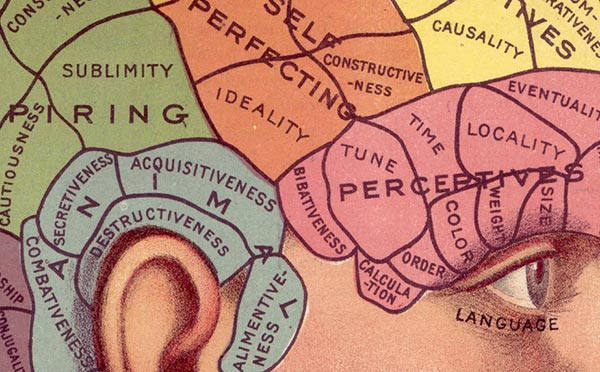 Come and stand over here: I'm going to put my calipers across your cranium to assess your IQ, look into your eyes to see if you have any health problems, run my fingers over your facial structure to see what kind of personality you have, and then check your hands to see what your future holds. In short, I'm going to learn everything there is to know about you by examining your body features. Most people are generally familiar with phrenology, the belief that studying the bumps on your head gives insight into which parts of the brain are more developed. Phrenology was developed around 1800 by a German doctor named Franz Joseph Gall, and it's interesting in that it was the legitimate cutting edge of neurological study at the time. Gall was one of the first innovators to believe that the brain, not the heart, was the center of the human mind. If he'd stopped there, everything would have been all right. But, working with the best knowledge that was available at the time, he had an oversimplified concept of how the brain might work. He reasoned that each part of the whole brain, which he believed was made of many separate organs, was responsible for a certain element of thought or behavior. Gall and other phrenologists, working with the best of intentions, made poorly-performed studies of subjects' craniums and dissected the brains of deceased patients who had known personality traits, and eventually came up with the charts that you see today: craniums with little areas marked all over them showing what elements of personality are governed by each little range of brain area. Now this was fine for the 1800's but later, as the brain's true nature became better understood, phrenology was replaced with modern neurology. However, like with all pseudosciences, some believers reject what modern science has taught us and prefer to cling to the ancient level of knowledge instead. Phrenology is very much alive in India, for example; perhaps because 19th-century British phrenologists determined that Indians had Aryan characteristics superior to other Asian races. Phrenology is central to Samudrika Lakchana, the body-feature based medical modality that is still widely practiced in India. They believe each part of the body is connected to a different part of the brain, and irregularities in the bumps on your head correspond directly to dysfunction in the connected body part. Closely related to phrenology is physiognomy, the belief that aspects of character and personality can be derived from facial anatomy. Physiognomy is interesting in that it has actually regressed as a pseudoscience, having a reasonable foundation in its early days but being refined further and further into nonsense as the centuries progressed. In their day, both Aristotle and Pythagoras noted what we would term non-verbal communication and ascribed it to a correlation of temperament and facial expression. No big deal in our times, but in their day this was groundbreaking stuff, nobody had really studied this before. Aristotle's original works are found in his volume Physiognomica. As the centuries wore on and we started learning more about anatomy, well-meaning researchers like Johann Lavater and Sir Thomas Browne began making these correlations not to facial expression, but to facial anatomy. Modern practitioners have refined this further, calling it scientific correlation physiognomy. They believe that the same gene that causes an angry temperament causes a large brow or powerful frowning muscles. They take it all the way to extreme details, to the point that widely spaced eyes mean that a person is honest or naïve; and the shape of your face indicates the type of job you have the aptitude for. One of their research tools is called the Facial Action Coding System, which you use to determine your facial metrics; and then you plug the results into the Affect Interpretation Dictionary to translate your facial scores into meaningful emotional categories. It's easy to see why people buy into physiognomy. A lot of times, you can see a person and at first glance, tell something about their personality, and even be right fairly often. That guy's bad news. That girl's flirtatious. He looks like a nice guy. I bet she's a lawyer. There's a lot of information you can learn by looking at someone: that's why psychics and fortune tellers have jobs. But this isn't physiognomy. None of the cues you picked up have to do with physiological facial structure. What you saw was the facial expression, indicating their attitude, their confidence level, their demeanor. You saw their hairstyle and clothing, from which you get a hint at their social background, their profession, the type of people they hang out with. You may have seen jewelry or tattoos. There was non-verbal communication and body language. You saw their hygiene and grooming. You saw their dress-up level and their behavior relative to the environment they're in. Congratulations, you just performed a cold reading. You just successfully derived a great deal of information about this person with one glance at their face, using well established principles of psychology. There is no need for the unfounded pseudoscience of physiognomy, but it's easy to understand how and why people lacking expertise in psychology or communication would assume that there must be something to physiognomy. The art of palm reading is familiar to every schoolchild, and has been around as long as recorded history. The first written book on palmistry came from a Hindu 5000 years ago. Formally called chiromancy, from the Greek for hand divination, palmistry is the art of reading the lines in your palm to supposedly derive information about your character, events in your future life, and even events from past lives. It should be noted that there are many conflicting schools of palmistry from different cultures, from China to gypsies to carnival readers to your local naturopath, and even modern practitioners who believe that their particular methodology is based on science. As you can surmise, there's never been any well-performed research that supports any of the classical claims of palmistry. So what do its modern supporters cling to? They tend to look for correlations between hand anatomy and known physical conditions, in the hope that such correlations will give the appearance of a scientific foundation for chiromancy. For example, one author, John Manning, attributes digit length ratios to in utero levels of sex hormones. A longer ring finger means more testosterone, and a longer index finger means more estrogen. Manning argues that digit ratios correlate to such characteristics as homosexuality, fertility, likelihood of suffering from a heart attack or breast cancer, and your aptitude for music or sports. When palm readers point to such research as scientific support for their practice, just remember that publishers will publish anything that they think will sell. In fact, digit length ratios are correlated much more strongly with geography and race — in other words, it's genetic. Iridology is fascinatingly bizarre. Iridologists believe that the iris (the colored part of your eye) is like a computer readout telling exactly what's wrong anywhere in your body. Iridology is mainly practiced by straight chiropractors in the United States. The late great chiropractor Bernard Jensen said of iridology that "Nature has provided us with a miniature television screen showing the most remote portions of the body," and added that iridology analyses "offer much more information about the state of the body than do the examinations of Western medicine." He then went on to perform in a well controlled clinical trial with two other iridologists where they were shown photographs of irises and asked to choose which ones were from patients with kidney disease. All three iridologists failed to improve on random chance, and all three disagreed with one another. To date, no rigorous controlled trial has shown that iridology has any ability to show accurate or useful information about your body's health. (I should be clear that although most iridologists are chiropractors, relatively few chiropractors are iridologists, and they're almost always straight or mixer chiropractors, not reforms.) Iridology is fairly unique among alternative therapies in that it was actually invented by an 11-year-old boy, Hungarian Ignatz von Peczely, in the mid 19th century. While playing with an owl, he accidentally broke its leg and later noted a black mark in part of its iris. Being just a boy, he assumed a causal relationship, and iridology was born. He grew up and practiced this as a profession. Modern medicine does note that there are a number of conditions which can cause changes in the appearance of the iris, notably abnormal clumping of melanin resulting in permanent markings. Compounds like lipofuscin, a "wear-and-tear" pigment, can leech into the eye under certain conditions and cause temporary or permanent discoloration of a type watched by iridologists. The anecdotal evidence supporting iridology can all be ascribed to such conditions happening to coincide with perceived onsets or healing of disease or injury, thus appearing to indicate a correlation when in fact none exists. However the vast majority of iridology analysis involves the reading of normal marks on healthy eyes by practitioners who then make diagnoses of non-existent conditions and proceed with chiropractic, holistic, or other alternative modalities to treat it. It sure would be handy if iridology was real, and if all answers in life were as simple as those promised by phrenology, palmistry, and physiognomy, we'd all be living large indeed. Easy answers and cheap promises. They're seductive, aren't they? Just remember the old saying "Good questions outrank easy answers." If you have a good question or an important question, involving, like, for example, your health, be very skeptical of cheap, easy answers.
Cite this article:
©2024 Skeptoid Media, Inc. All Rights Reserved. |