 |
      
|
 |
The Mystery of the Vitrified FortsSkeptoid Podcast
#326 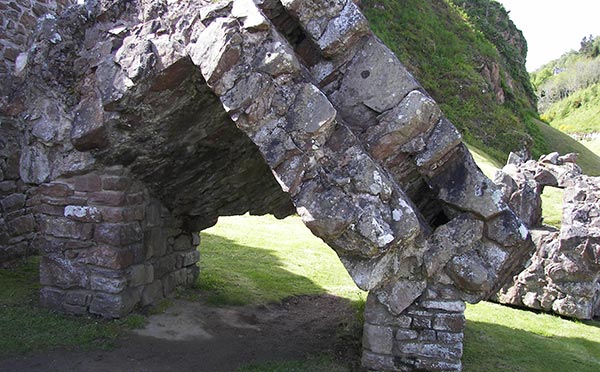 For over 250 years, archaeologists studying ancient Scottish ruins have reported a type of construction said to defy explanation. About sixty of these rough stone wall enclosures have been found throughout Scotland, and even a few scattered across mainland Europe. Most are prehistoric. Called vitrified forts, they're notable for a unique and surprising feature. The rocks that make up the walls were originally stacked dry, with no mortar; but have been fused together into a solid surface through a process called vitrification, the transformation into glass. How can rock be melted into glass using prehistoric technology? Some say that it can't because the temperatures required to do it are far too high, and that the only plausible explanation is an ancient atomic blast. Stories of primitives possessing advanced technologies are not new here on Skeptoid. We run into them pretty routinely; and from what I've seen, they're usually a sort of shortcut detour from doing the extra work required to actually solve a mystery: "Strange glass-walled forts in Scotland? Ancient atomic blast. The ancients possessed modern superweapons. End of mystery." Not only does that usually turn out to be factually wrong, it also deprives us of whatever the truly fascinating question is — and the answer, assuming we have one yet; and we don't always. But at least we learn what we don't know and why we don't yet know it. So here's the way we should explore the mystery of the vitrified forts. I like to break it down into a four step process:
So let's begin with our first and most important question. Do vitrified forts exist, ancient stone walls with their sides melted into glass? This one's pretty easy to answer, because there's plenty of archaeological literature about them. Yes, they do exist, and the popularly given number of about sixty known examples in Scotland is correct. Some are small grassy lumps, hardly recognizable; some are large and exposed enough that visitors can walk right up and examine them. They're great, sloping piles of stone, often built on hilltops, and enclosing an area that we usually presume was to be defended. Timbers were often used to reinforce the walls from within, and from these timbers we've been able to get radiocarbon dating telling us when the forts were built. Most were built or repaired in various centuries during the first millennium BCE, around 700 to 300 BCE. The vitrification is not easy to spot. It doesn't look like glass; it looks like the native white rocks embedded in a sort of darker asphalt. Sometimes there are lava-like bubbles in the darker vitrified stone, and sometimes there are solidified drips; but without knowing what you're looking at, it's unimpressive visually. If you do know what you're looking at, it's really something else. This brings us to our second step, finding out what's already known about the forts. When studying the vitrified forts, context is a crucial consideration. We must understand the technological context in which the forts were built. The first millennium BCE was smack dab in the middle of the British Iron Age, a historical era named after the smelting of ore into iron. Metalworking, forging, and vitrification were well known to the people of the age. It was not a mysterious technology. The melting of rocks to serve the purposes of mankind was the technological focus of the period. And even in this early date, it was not a new concept. The Iron Age was preceded by the Bronze Age. Mankind had been melting ore for perhaps 10,000 years, ever since (nobody really knows for certain) accidental discoveries were made in pottery kilns. So when the archaeologists study the vitrified forts and report that we don't know how they were made, all we're saying is that we don't know exactly what method was used. We're not saying that it is a surprising or inexplicable accomplishment. Any number of methods could have been used; we just don't know which. The vitrified rocks require about 1100°C to vitrify in the observed manner. So let's take a quick look at what various researchers have discovered. The most famous experiment, widely trumpeted in virtually all writings about the vitrified forts, was performed in 1934 and repeated in 1937 by Wallace Thorneycroft and Vere Gordon Childe who built a fire against an experimental stone wall, built to the observed specifications. As described in the 1966-67 edition of The Proceedings of the Society of Antiquaries of Scotland:
By that, they meant whether the vitrification was done deliberately by the builders, accidentally in a fire, or deliberately by attacking forces. Unfortunately this is an anthropological question, the certain answer to which is lost to history. Is it the result of an attack? Vitrification by attackers did not breach or destroy the walls, nor make them easier to scale. Builders may have done it on purpose; why, we don't know. It did not make the wall stronger or more difficult to breach. It was not always done; and even on most vitrified forts, it was usually done inconsistently in various patches. It could have been as simple as that the practice was traditional or ceremonial, or even merely aesthetic. We know it was done; we're just not sure why. All this suggests is that the reason is unknown, not that it was necessarily extraordinary. Some evidence suggests that on a few forts, the vitrification was done from within the wall, during construction. Such walls were usually built with solid stone facings on the inner and outer sides, with rubble filling in the center. During construction, fires could have been built in the center of the wall, covered with turf for insulation, and allowed to vitrify the stone faces. Rubble could then be filled in, and construction would move up to the next level where the process would repeat. Other vitrified walls show evidence that the fire was built against the outside of the wall, as Thorneycroft and Childe did in their test. Keep in mind also that Thorneycroft and Childe were archaeologists with minimal stone melting skills, while the men who vitrified the forts two and a half millennia before them were expert professionals whose knowledge was based on centuries of experience. It's important to keep in mind that wherever an Iron Age fortification was under construction, the supporting infrastructure of workers and local people would certainly have included blacksmiths, whose furnaces of the day reached some 1300°C. There was no lack for expertise in the arts of building smelting fires or keeping them hot. And so without a complete explanation for the forts from archaeology, we proceed to step three, evaluation of the fringe conjecture that ancient atomic blasts were used to produce the vitrification. This suggestion is unnecessary. The temperatures required were well within the capabilities of the technology of the day, and have been repeated experimentally. And, of course, the elephant in the room is that atomic weapons were not available 2500 years ago — or, to be precisely scientific, not known to have been available. At the earliest experimental atomic blast, the Trinity test in 1945, the temperature reached 5.5 million Kelvins, 4,000 times hotter than what was needed to vitrify stone forts, and left blatantly obvious chemical signatures that nobody has yet reported finding at a vitrified fort site. This is all to say nothing of the virtually insurmountable task of rearranging practically all known human history to accommodate such a twist. Some have also suggested that some variant of Greek fire may have caused the effect. Greek fire was an ancient weapon employed by the Byzantines about 1000 years later, but some sources have Athenians using something similar during the time of the vitrified forts. Although its exact composition is not known, Greek fire was probably simple petroleum collected from natural wells in the Middle East, useful in naval warfare for its ability to float on water while burning. Although vaguely plausible as an explanation, Greek fire would have been logistically difficult to transport such a great distance to serve a purpose that could have been served more easily by local wood, and likely would not have burned nearly hot enough nor long enough to vitrify the rock. This brings us to our final step, assessing what we've learned, and establishing a provisional conclusion. Like all science-based conclusions, it's provisional because it's always subject to new information that may arise. We've learned that the technology required to create the vitrified forts was not extraordinary. Nothing found at the sites requires any re-examination of the history of knowledge. The questions that do remain are sociological. Why were the forts vitrified, and who vitrified them? I'm happy to report that we don't know yet, and that this is one more item to add to our list of mysteries still to be solved.
Cite this article:
©2024 Skeptoid Media, Inc. All Rights Reserved. |