




The Mystery of the Mary Celeste
The facts, as we know them, about what really happened to maritime lore's most famous missing crew.
Filed under Ancient Mysteries, Urban Legends
| Skeptoid #289 December 20, 2011 Podcast transcript | Listen | Subscribe |
|
By Brian Dunning, Skeptoid Podcast
Episode 289, December 20, 2011
http://skeptoid.com/episodes/4289
![]() |
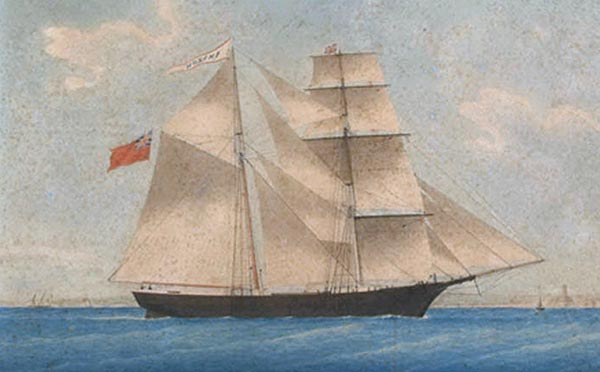
| The Mary Celeste, in her earlier days as the Amazon (Public domain image) |
In 1872, a ship was found adrift in the Atlantic Ocean, in near-perfect condition but for one problem: there was nobody aboard. In time, the story of the Mary Celeste became one of the most famous riddles of the sea. Over the years, many have offered solutions for what happened to the crew. But are any of them correct?
As is the case with so many of the mysteries we examine here on Skeptoid, the story of the Mary Celeste was an actual event that was largely forgotten until an imaginative author revived and exaggerated it for popular audiences. This time, the author was a young man who would later be knighted as Sir Arthur Conan Doyle for his Sherlock Holmes books. It was a short story written under the pseudonym W. Small for the January 1884 issue of Cornhill Magazine, entitled "J. Habakuk Jephson's Statement". Conan Doyle dramatized the Mary Celeste's story, adding such touches as meals laid out on the table, tea boiling on the stove, and the ship sailing boldly into the harbor at Gibraltar with nobody at the helm. Today, most people who have heard of the ship think these details are part of what actually happened. They aren't.
Conan Doyle's was only the first of many such treatments. A 1913 magazine article was the forged account of a man named Fosdyk who claimed to have been a stowaway on board the Mary Celeste, witnessed the entire crew fall overboard as they pressed against the rail to watch three of the men have a swimming race, then managed to be the only one not eaten by sharks and eventually washed ashore on Africa. In the 1920s, an author named Keating forged an article for Chamber's Journal telling the story of a man named Pemberton who survived. Keating soon expanded the fictitious Pemberton's tale into a book called The Great Mary Celeste Hoax. Unfortunately, the book's success became its downfall: Interviews with Pemberton were widely sought. Keating tried to weasel his way out with excuses, and even offered a picture of his own father as a photograph of Pemberton; but it was soon discovered that he made the whole thing up.
The Mary Celeste was a small merchant brigantine of 33 meters and 282 gross tons. She'd just been acquired by a small group of investors, among whom was the ship's one-third owner, Captain Benjamin Briggs. Joining him on board were his wife and baby daughter, plus seven sailors. They left port from Staten Island, New York in November of 1872, fully laden with cargo bound for Genoa, Italy. The cargo was 1,701 wooden barrels of pure grain alcohol, intended to fortify cheap Italian wines. America's vast corn fields made it the cheapest producer of grain alcohol at the time, and it made good economic sense for Italy to buy it and ship it all the way from the United States.
The voyage was relatively uneventful according to Captain Briggs' log entries, and the fine weather was confirmed by the captain of another ship sailing one week behind. Captain David Morehouse commanded the Dei Gratia, a similar brigantine laden with petroleum. Briggs and Morehouse had sailed together for many years and knew each other well, and it was a happy coincidence that the two friends found themselves on nearly identical voyages.
But almost halfway between the Azore Islands and Gibraltar, Morehouse made an unhappy discovery. The Dei Gratia unexpectedly caught up with the Mary Celeste, finding her adrift. Morehouse sent a party to investigate, and found the Mary Celeste unmanned. It was a bizarre find; there were no obvious signs of trouble and all appeared to be in order. But there were a few interesting clues.
The Mary Celeste had been equipped with a yawl, and though that term usually describes a type of sailboat, in this case it refers to a ship's rowboat capable of being rigged for sailing. The yawl was normally stored atop the main cargo hatch between the two masts, but was gone; and the railings on one side of the ship had been lowered indicating that the yawl had been launched normally. The other two cargo hatches — the forehatch on the foredeck and the lazarette hatch, above a small compartment aft — had both been removed and were stowed, exposing the cargo of alcohol.
When Morehouse found the ship, it was flying minimal sails, the fore lower topsail and two jibs. Modern analysis has confirmed that Morehouse found it just about where it would have been expected to be, driven primarily by currents, if it had been under no helm control since passing the Azores. Interestingly, the main peak halyard, the stoutest line on the ship, was missing; and it was very likely the same rope that was found cleated off and trailing in the water behind the ship. There was a significant amount of water in the bilge and cabins of the ship, but this was believed to be consistent with the open hatches and an opened skylight. The Mary Celeste had tossed about for at least ten days since its last log entries, in freshening weather that had compelled the crew to shorten sail; and so it was not surprising that it had taken on some water. As its stores were in good shape and it was perfectly seaworthy, Morehouse sent a skeleton crew aboard the Mary Celeste and brought it to Gibraltar, where the loss was reported and investigations took place for purposes of insurance and salvage. When the cargo was unloaded and examined, nine of the barrels of alcohol were empty: undamaged, yet empty.
Early theories quickly focused on the relationship between Briggs and Morehouse, and charges of conspiracy and insurance fraud were flung about; but these theories made no sense from a profit standpoint. For a while, some believed piracy had taken place, or that perhaps Briggs' crew had drunkenly mutinied against him; but all of these stories crumbled under scrutiny and lack of evidence that would have been expected.
Since then, even more suggestions have come from the fringe, pointing to exotic causes for the abandonment, like waterspouts and rogue waves. One in particular, David Williams, proposes that a "seaquake" struck the ocean floor. He states that the US and British navies know that such quakes can destroy surface vessels with powerful shockwaves, but that they cover it up so it's not generally known. Williams' theory is that this sudden shaking released embers from the ship's stove, so the crew fled the ship fearing the embers would ignite the store of alcohol. Williams states that there are numerous examples of ships sustaining heavy damage from such shockwaves, but as no damage was noted on the Mary Celeste, his seems an arbitrary explanation.
A few pieces of physical evidence strongly suggest what has emerged as the favorite theory, based on those nine empty barrels discovered in Gibraltar. The reason they were empty would have been clear to any cooper. All of those many barrels were of white oak, except for those nine, which were of red oak. Of the species of wood sold as white oak, the majority have occluded pores. This makes the wood watertight, which is why white oak is used for wine barrels and other barrels intended to hold liquid. The pores in the wood of the twenty or so species of red oak, on the other hand, are open; allowing liquids to seep through the wood. Consequently, red oak barrels should only be used for dry goods. But, for some reason, Meissner Ackermann & Co. (owner of the alcohol) used nine of the wrong type of barrel.
At some point in the voyage, or possibly even before, these barrels would have become soaked through. Alcohol evaporates quite quickly, so the smell would have permeated the ship's cargo hold. No record remains of where in that vast pile of 1,701 barrels the nine red oaks were found, but chances are that most of them were hidden from view. A visual inspection of the cargo hold probably would have found nothing, making it impossible to tell the extent of the leakage, but that smell would have been everywhere. This is also evidenced by the removed deck hatches; the crew were undoubtedly trying to vent the flammable fumes. But alcohol vapor is heavier than air, so it's unlikely that venting the deck hatches would have done much to dispel it.
The crew had to have feared that an explosion or fire was imminent. The yawl was launched and everyone on board removed to it. This was not done in a panic or haphazardly, but rather urgently and efficiently. The captain had the sense to collect his sextant and marine chronometer, necessary for navigating; but everything else on board that was not essential was left behind. No strong evidence suggests an answer to the question of whether they intended to completely abandon the ship, or to simply sit at a safe distance until they figured the danger was past. They took the precaution of using the strongest line they had to secure the yawl to the Mary Celeste, but in some unknown circumstance, the line was not secure or became severed. The few sails still set on the ship were enough that the yawl's rowers could not keep up. Once he saw they would not be able to catch the ship, the captain headed for Santa Maria Island in the Azores. And, as was all too often the end of such deep sea open boat voyages in those days, they never made it, and were ultimately swallowed by the Atlantic Ocean.
Over the next ten days, the Mary Celeste rocked in the breeze with its open hatches. The last of the alcohol evaporated away, and no one in Morehouse's party reported smelling anything. It's a certainty that all nine barrels, some 450 Imperial gallons, escaped as fumes while the Mary Celeste was at sea.
In 2006, Dr. Andrea Sella, a chemist at University College London, conducted an experiment to recreate conditions that he believes may have prompted Briggs to evacuate. Sella filled a compartment with cubes of paper and butane gas, then sparked it. The resulting combustion produced a sudden flash of flame that was visually dramatic, but was cool and quick enough that the paper was not scorched. Dr. Sella theorized that perhaps such a flash had happened in the Mary Celeste's cargo compartment, frightening the crew into fearing that a much larger explosion may well have been imminent. The ethanol vapors in the Mary Celeste's hold would burn even cooler and quicker than butane, though probably much less dramatically, with a blue or invisible flame, unlike like the butane's yellow flash. But it certainly would have been every bit as alarming to the crew, if it had happened.
Without any reasonable doubt, the cause of the disappearance of the Mary Celeste's crew was voluntary abandonment. We can't be certain what prompted the evacuation, but there seems little reason to speculate beyond what's best supported by the evidence: powerful and dangerous fumes from the alcohol-soaked red oak barrels. Briggs' action, though ultimately disastrous, was more than reasonable at the time.
© 2011 Skeptoid Media, Inc.
References & Further Reading
Begg, Paul. "The Classic Case of the Mary Celeste." The Unexplained Mysteries of Time and Space. 1 Jan. 1982, Volume 4, Issue 48.
Blumberg, J. "Abandoned Ship: the Mary Celeste." Smithsonian. 1 Nov. 2007, Volume 38, Number 8.
Corrado, J. "What Really Happened to the Mary Celeste?" The Straight Dope. Creative Loafing Media, Inc., 16 Oct. 2001. Web. 17 Dec. 2011. <http://www.straightdope.com/columns/read/1962/what-really-happened-to-the-em-mary-celeste-em>
Doyle, A. "J. Habakuk Jephson's Statement." Cornhill Magazine. 31 Dec. 1884, Volume 2, Number 7: 1-32.
Lee, A. "Solved: The Mystery of the Mary Celeste." UCL News. University College London, 20 May 2006. Web. 17 Dec. 2011. <http://www.ucl.ac.uk/news/news-articles/inthenews/itn060522>
Wengert, G. "Red Oak, White Oak, Black Oak, and More." WoodWeb. WOODWEB Inc., 20 Jun. 2005. Web. 17 Dec. 2011. <http://www.woodweb.com/knowledge_base/Red_Oak_White_Oak_Black_Oak_and_More.html>
Reference this article:
Dunning, B.
"The Mystery of the Mary Celeste." Skeptoid Podcast. Skeptoid Media, Inc.,
20 Dec 2011. Web.
19 May 2013. <http://skeptoid.com/episodes/4289>
Discuss!
I blame the reptoids. The alcohol, shipped by a rival Illuminati, was hiding a rare chemical which, when dabbed on reptoids, causes them to return to their natural shape.
See, makes much more sense than a crew was concerned, took some reasonable precautions regardinga hazard, misjudged their situation and ultimately were lost at sea, one of many thousands of people who have drowned in Atlantic crossings before the age of steam
BigSoph, Toronto, ON
December 20, 2011 11:52am
The "Jian Seng" is another mysterious ship, from more recent times, that would be worth looking into, also. Thanks.
Russell G., Broward County, FL, USA
December 20, 2011 1:45pm
This "mystery" was in fact solved on the Goon Show on BBC radio over 50 years ago ("The Mystery of the Marie Celeste - Solved"). The crew all abandoned ship on purpose and quietly slipped away, knowing that eventually it would become such a famous enigma that somebody would offer a huge reward for the solution, which they could then claim. Simple, really.
The Goon Show of course belonged to a strangely obsolete trend of yesteryear in which comedies featuring supernatural or otherwise paranormal events almost always revealed at the end that it was all a hoax, because outside of a straightforward horror context, the idea of people actually falling for this dreck was considered funny. Are we more credulous than our grandparents?
The Urban Spaceman, Edinburgh, Scotland
December 20, 2011 2:25pm
Another mystery the Kaz 11 lost
april 17 2007 of the Queensland coast.
graham mcneil, brisbane queensland
December 20, 2011 3:31pm
Where there is no smoke there is fire?? Why isnt there any trace of black marks on the ship from the smoke?
Guy, Regina, Canada
December 20, 2011 10:57pm
Guy - because the flash flame would not have produced smoke (or at least, not enough to leave sooty remains). Carbon, Hydrogen and Oxygen are present in alcohol - a clean burn would have allowed complete conversion of the Carbon to CO2 so no significant soot would remain. If the holds were open to the elements, any residual may well have been washed clean too.
Owen, Wales
December 21, 2011 4:14am
The creepiest "Mary Celeste" type incident has to be the WWII US Navy blimp L-8, which came back without its crew in August of 1942.
Cambias, Massachusetts
December 21, 2011 5:46am
I love a good logical explnation, and while this one is not simple, it is at least vagly plausable, good job Skeptoid!
MutantBuzzard, 90210
December 21, 2011 6:36am
Why was there no soot? Really?
When I was a kid I'd help my grandfather butcher chickens. He sometimes scorched the pinfeathers off by putting rubbing alcohol in a dish and lighting it on fire. Burned with a clear, relatively cool flame (not cold, but not enough to hurt too bad if your hand got in it). (The dish had a lid, if you're curious.) We never, in more than a decade of butchering, saw soot or smoke come from the dish. There's nothing to CREATE the soot--soot amounts to unburned, charred particles, and when you're dealing with vapor there's nothing to remain unburned.
Smoke is a really odd thing. Paleontologists sometimes burn magnesium ribbons and use the smoke to whiten fossils to be photographed (reduces glare, making the features easier to see). Wood smoke can have a blue tinge to it, and some more exotic (and toxic) chemicals can have other colors. A Japanese pyrotechnician recently used multicolored smoke for a daytime fireworks display. And then you have the stuff that burns without any smoke, converting the fuel completely into gas.
I've noted that Mr. Dunning is focusing on sailing myths recently. I like this trend. :D
Gregory, Alabama
December 21, 2011 3:03pm
One small correction; Arthur Conan Doyle was not knighted for his Sherlock Holmes stories. Instead, it was for his authorship of a "pamphlet" about the Boer War in which he served as a doctor for the British forces.
Otherwise, great episode. Keep up the good work!
Chris, Seattle
December 21, 2011 3:23pm
Mysterious flashes of fire that doesnt burn!?
Science is SO much cooler than nonsense.
Morgan Z., Tracy, CA
December 22, 2011 8:48am
As much as I love a mystery, a satisfactory hypothesis/explanation is just as good. This is the best unravelling and explanation of a famous vanishing that I've come across since I saw the BBC documentary on the BSAA Star Dust accident over the Andes ('Vanished: The Plane That Disappeared') in from 2000.
Patrick VS, London, UK
January 09, 2012 9:56am
Thanks so much for that explanation! I had long been intrigued by the mystery of the Mary Celeste, but had long suspected that there the stories I had heard about it were at least somewhat mythologized. The explanation you provided makes ever so much more sense than the standard myth about it!
Gunnar, Sacramento
January 10, 2012 6:18am
Patrick: You mean this one?
http://skeptoid.com/episodes/4231
wintermute, Cincinnati, OH
January 31, 2012 7:58am
thankx for all of this informations ...
a girl, egypt,cairo
February 24, 2012 7:39am
Thiswas awesome, science and a sherlock holmes keen eye for scientific detail really can make it all logical. as holmes said "once you eliminate the impossible, whats left must be truth"
Tom Hellert, OP NY
March 13, 2012 8:26pm
Other accounts state that the cargo hatches were fastened only the cabin hatch was open. If this was the case then the airing theory doesn't hold. Abandoning the ship to give the fumes time to evaporate you would need to remove the cargo hatches to speed up the process, the captain wouldn't want to sit in the yawl longer than necessary.
clive, yeovil
May 09, 2012 12:28am
A fascinating tale of intrigue on the high seas.
Even though the explanation of the nine barrels made of red oak leaking fumes into the hold seems at first the most plausible explanation for the ships abandonment, I still find some questions unanswered.
The boarding party from the Dei Gratia smelt no fumes, nor was there any such indication in Gibralter. Certainly alcohol fumes dissapate fairly rapidly but these barrels contained 450 gallons of alcohol, and the barrels although not suitable for liquid containment wouldn't exactly spill their contents all at once in a short time, surely.
If the barrels had leaked that badly there should have been some liquid leaking out into the hold as well, mixing with other timbers and bilge contents, taking some time to evaporate and cause further fumes.
Yet ten days after the last logbook entry the boarding party from the Dei Gratia smelt no fumes at all. From a state of near-panic over what ? .... to no trace of fumes in ten days.
I say near-panic because the order for all hands to abandon ship indicates a belief of imminent disaster. There was no time to even tie the helm in an attempt to keep the ship on a consistent heading along with the sails.
Perhaps the absence of fumes was the result of explosions using up the alcohol, and with the weather freshening, the slight movement of the barrels caused sparks which continued the illusion that the vessel was finished, prompting the captain to order the towing rope cut ?
Macky, Auckland
June 08, 2012 9:04pm
Your explanation ranks near the top in my opinion except for a few incorrect facts. The wheel not being lashed down, lines left un tended and a captains bed left unmade indicate an extremely hasty departure. A moderate seaquake seems the most plausible with a strong alcohol odor (cargo hatches were open), ships stove broken from its moorings, possibly spewing embers and wooden splinters along the hull planking all point to an unnatural incident that would provoke an experienced Captain to make a hastly departure in the life boat. What happened from there is open to even more speculation!
RL, Atlanta Ocean
July 09, 2012 2:11pm
Like RL, I have come to believe that the cause of the hasty departure was a small or moderate seaquake(s) that panicked an already worried Captain and crew into abandoning ship, believing that the upheavals were being caused by explosions in the hold.
The finding of the damaged compass and mounting, and the displaced stove by the boarding party supports that view.
The panic was so overwhelming that the helm was not even lashed, a standard procedure in those times.
Brian, you mention that alcohol fumes are heavier than air, so I would have thought that there would still have been some smell after 10 days, especially with 450 gallons of alcohol supposedly having leaked out of the barrels.
I venture an opinion that those nine barrels were empty from the start, having been loaded on board by watersiders both on the wharf and in the hold, who wouldn't care less whether the barrels were empty or not.
The hatches removed were a precaution by an already worried captain who had never carried a cargo like this before.
The Azores are known to be a site for seaquakes and the destructive force of a seaquake can cripple even a large ship.
Like rogue waves, it's possible for a mariner to spend his entire career at sea without ever encountering a seaquake, and in this case, the event(s) simply drove the Captain to abandon ship with a towline as a precaution.
Possible further seaquakes prompted him to order the towline cut, or may even have wrecked the much smaller yawl.
Macky, Auckland
July 09, 2012 9:40pm
Reptoids people... Reptoids...
Dan Hillman, Seattle
July 10, 2012 10:46am
would you have a Crew Record list from the second last voyage of the Mary Celeste please- My great Grandfather worked on it for a number of years, would love some information please
Sharon, Australia
July 26, 2012 7:08pm
I appreciate the stripping down of the myth and providing just the facts as available at the time.
Where I take issue with your well thought out theory is basing it on that scientist who used butane to "recreate conditions" on the ship.
Sorry but if you did not even start out using alcohol but butane (which even he admits later) is different and has different characteristics but then use it as an example of what could happen is not good science.
Its like trying to recreate a car cash, but using pickups instead of cars and saying "here is how it could have happened".
I don't know what happened, but if one wants to try to find out use the actual cargo for a start, the setup of the ship, similar sea conditions then experiment to the results.
I think the captain, crew and his family deserve that at least.
The results may be more facinating than the myths
Eric, Northern IL USA
August 26, 2012 11:53pm
I find this explanation incomplete. The exact kind of alcohol needs to be identified. This must be known, in delivery and salvage records or by deduction from similar ships and cargoes. Whether it's methanol or ethane or butane makes all the difference. Next, is the theory fumes or flames? The confusion here shows that no one has really researched how the alcohol in question would perform if it leakedin into sea water, or onto a dry hold and evaporated. Suggesting the metal staves caused a spark is a stretch that should only be considered after "fumes" have been investigated. 450 gallons isn't that much, and I question the kind of fumes that would be generated. A test could be done on this pretty easily.
SB, Massachusetts
October 19, 2012 11:33am
SB, I think you will find it was ethanol to be used to fortify wines.
I see no relevance to the type of combustible, we do not know the conditions and any flammable or combustible liquid can brought to flame or explosion with the right conditions. Same for any source of ignition. All we can say is that the cargo was volatile say compared to a cargo of water!!!
In the past I have known and seen people put out a cigarette in the gas tank of their motorcycle, the conditions obviously were not right for combustion.
Even when we have an explosive mixture we can't be sure of ignition, look at the Zeppelin Hindenburg, that was designed not to spark and ignite, yet it did.
All the article is doing is setting out a feasible series of events to explain the loss of the crew, it goes a long way to 'solving' it than others, imo.
Over the centuries thousands of ships have 'disappeared' in the oceans, what makes the Mary Celeste different is that the ship was still afloat, who knows how many other crews met a similar fate to the Mary Celeste - whatever that fate was - but had their ship founder and sink? Back in the day, keeping a ship afloat was pretty much a big part of the job of a sailor, leave alone get it pointing in the right direction!
Today, even with all the GPS and mayday technology, we still get crew go missing and leave behind an empty ship, usually small ones, but it hardly makes the news.
It's one of those tales that only a time machine will resolve..
Eriq, somewhere on Earth
November 04, 2012 9:23am
best story of a ship ever
grace, in
November 16, 2012 5:45am
OK Mr Dunning, now for the REAL answer provided by the Goon Show in 1954.
Just have a look at this for the real answer!
http://www.youtube.com/watch?v=f58tnD_4ZIg
Try disproving THAT Mr Dunning! :)
Stuart, Wellington Point
November 18, 2012 1:47pm
stuert i really need to tallkkkk to you at 10.am tomarrow morn. ill be getting on
chris, col.canon
November 18, 2012 9:10pm
I READ THE SYORY ABOUT MARY CELESTE. I ALSO READ ABOUT THE OCEAN GARBGE PATCH. THE OCEAN GARBGE PATCH SAID THAT ALL THE GARBGE GOES TO THAT SPOT. IN THE MARY CELESTE THEY HAD A SAIL BOAT. SENSE WOOD IS GARBGE WOULD THAT WOOD BE IN THE OCEAN GARBGE PATCH? BY THE WAY I AM 9 YEARS OLD. PLEASE RESPOND QUICKLY. P.S. WOOD DISINTEGRATES BY ITS SELF.
anna, box elder
December 08, 2012 8:00am
lol this is so funny good job at filling us with lies. the people on the shp were just pulling a prank and the people on ths ship are actually in las vegas having a wonderful life
boe buture, dallas texas
December 17, 2012 9:10am
good
g, africa
March 11, 2013 7:51am
Make a comment about this episode of Skeptoid (please try to keep it brief & to the point). Anyone can post:
You can also discuss this episode in the Skeptoid Forum, hosted by the James Randi Educational Foundation, or join the Skeptalk email discussion list.
What's the most important thing about Skeptoid?


Interesting episode. I remember a writing assignment in 6th grade (a really long time ago, in my case!) to create a fictional explanation for what happened to this ship. It's surprising what information one's mind hangs on to! So thanks for the trip down memory lane!
Sheri Kimbrough, Wyoming
December 20, 2011 8:19am