




The Hessdalen Lights
Scientists seek a high-tech explanation for these ghost lights in Norway. But is the true cause much simpler?
Filed under Aliens & UFOs, Paranormal
| Skeptoid #270 August 09, 2011 Podcast transcript | Listen | Subscribe |
|
By Brian Dunning, Skeptoid Podcast
Episode 270, August 09, 2011
http://skeptoid.com/episodes/4270
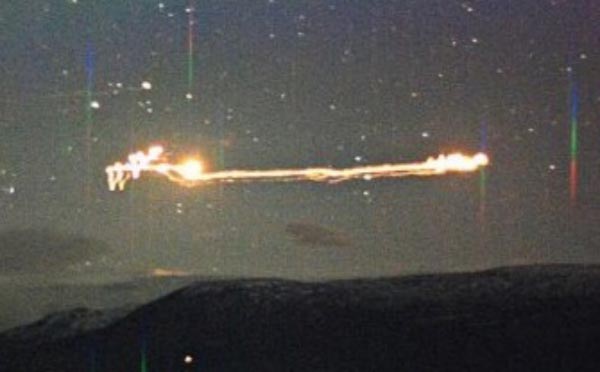
Let us travel back to 1981, when people in Norway's Hessdalen valley began seeing something strange in their night skies. Colored lights that hung silently sometimes appeared above the valley. Curious onlookers found they were best seen from a slope at the north end of the valley, looking south, and within a few years UFO seekers started converging on Hessdalen. And ever since, there has been one of the lengthiest and most technical of all UFO investigations.
Some call them UFOs, some call them ghost lights, some call them Earthlights. None of the researchers have a very good idea what they are, but Hessdalen's residents don't seem too concerned. Theirs is a small, quiet valley, well off the beaten path, and only a few hundred people live in its scattered village. In 1983, Dr. Erling Strand, a UFO researcher, initiated Project Hessdalen as a sort of central framework for all the information gathered by UFOlogists and other researchers. Strand was convinced that some unknown branch of physics was responsible for the strange lights, and he encouraged as many scientists as he could to join his project.
In 1998, Project Hessdalen constructed on automated measurement station on the popular slope, with a clear view of the sky looking south down the valley. It was filled with an astonishing array of technical gear. It included a number of optical cameras, but also magnetometers, weather gear, and equipment for measuring low frequency electromagnetic radiation. Curiously, the station also includes a random number generator, as a part of the Global Consciousness Project, which seeks to prove that collective human consciousness predicts significant events by altering the output of random number generators. Presumably, this is to test whether the appearance of the Hessdalen lights is some sort of psychic event.
What the automated station found is that the lights usually appear in the sky between 9pm and 1am, and more often in the winter. Many photographs have been sent to their web server, and can be seen at hessdalen.org. When they appear, the lights each maintain a constant color temperature, and its spectrum remains consistent.
The researchers dug in to try and track down this elusive new branch of physics. One of Dr. Strand's associates, astrophysicist and radioastronomer Dr. Massimo Teodorani, wrote of the many theories they explored:
Mainly the following possible causes have been considered: ionosphere activity, solar activity, cosmic rays, magnetic monopoles, mini-black holes, Rydberg matter, heated nanoparticles, piezoelectricity, [and] quantum fluctuation of the vacuum state. For none of these causes, except for some aspects of piezoelectricity, was it possible to find a successful proof.
Teodorani himself favored a rather colorful explanation. His theory is a bit lengthy, but I'll paraphrase it. He believes that water seeps into fissures in quartz in the valley, and when it freezes, it exerts pressure on the quartz, causing a piezoelectric effect that produces an electrical current. He then jumps to the assumed presence of a hovering ball of plasma, presumably ignited by the piezoelectric current, and the balance of his complex theory involves the characteristics of the plasma. It binds with water vapor, aerosols, and airborne mold spores. It keeps itself in equilibrium due to complex interactions, and keeps its shape due to a presumed "cool coat" of water and ions.
This is not a useful explanation; it is, at best, a pretty far-out hypothesis. It strings together a number of fringe suppositions, few of which are plausible or have ever been observed. For one thing, what the Earth's entire history has told us is that when water freezes inside rock fissures, it cracks the rock. Not once has it ever been observed to leave the rock intact and relieve the energy by producing electrical current that creates hovering plasma balls. For another thing, natural quartz does exhibit the piezoelectric effect, but there's very little quartz in Hessdalen. It's nearly all schist and sandstone. While schist does contain bits of quartz, the schist itself is easily fractured by ice and would relieve any pressure. Finally, the piezoelectric effect in some natural rock is real but barely detectable. To my knowledge, there's no example of such tiny microvoltages causing anything to ignite, either in the cold, wet natural conditions or in a controlled laboratory.
What Teodorani did was not to look for the source of the lights that were observed; it was, in contrast, an effort that started from the assumption that some unique geophysical process was producing balls of light that floated up out of the ground. He then came up with some hypotheses about how he thinks this might be accomplished. Starting with an explanation, and working backwards to try and match the observations, is the opposite of the way good science should be done.
Even if Teodorani's hypothesis turned out to be true in every detail, it would still not be an acceptable explanation for the Hessdalen observations. People live throughout the Hessdalen valley, and none of the observations have ever included lights coming up out of the ground, or even any lights overhead; indeed, nothing's even been reported to have been witnessed from inside the valley itself. To see the lights, you have to climb up on the hill at the north end of the valley, and look south, across the top of the valley's length. Teodorani's hypothesis presumes that his plasma balls are in the valley and floating upwards; in contrast to the observations that simply state the lights are visible to the south of the observation point. A better explanation for why nobody in the valley has ever seen balls hovering around them then rising overhead is that's not where the lights are, and that their sources are elsewhere.
One piece of advice that Teodorani and the other Hessdalen researchers appear to have failed to heed is that given by Marsha Adams of the International Earthlight Alliance in her 2006 paper titled Air Navigation Artifacts near the Hessdalen Valley, Norway. She states:
Earthlight researchers must be vigilant for artifact lights. In addition to vehicle headlights, house and ranch lights, stars, planets, Fata Morgana mirages, and natural aerial phenomenon, an important source of artifact lights are commercial and private aircraft operating near observation sites.
Using simple commercially available navigation software, she identified a number of air traffic corridors, VOR navigational stations, and local airports. These included one corridor that I found particularly intriguing: a corridor 18° North from the Tolga VOR, proceeding directly up the Hessdalen valley, straight toward the Automated Measuring Station, from exactly the direction it's facing.
As previously discussed on other Skeptoid episodes dealing with so-called ghost lights — the Marfa Lights in Texas, the Min Min Light in Australia, and the Brown Mountain Lights in North Carolina — there are known physical phenomena that can account for such reports. A better way to investigate the Hessdalen phenomenon would be to at least consider the causes found for these other lights. The Min Min light was proven to be a sort of thermal lensing effect, where warm air collected in ground topography underlaid cooler night air, and reflected lights from over the horizon; an effect we call a superior mirage. However the Marfa and Brown Mountain lights turned out to be misidentifications of conventional lights in a direct line of sight, probably distorted by similar lensing effects. Such thermal irregularities were found in both places. In the case of Marfa, they were car headlights along two prominent highways. At Brown Mountain, it was the headlight of a regularly scheduled locomotive on the plain far away, as well as some other lights. The majority of the images captured by the Hessdalen automated measurement station look exactly like the high-powered landing lights of aircraft following the corridor north from the Tolga VOR.
Trondheim Airport (TRD) is due north of Oslo, Norway. This route passes almost directly over Hessdalen. When the Hessdalen lights first started receiving attention in 1981, charter passenger service between Oslo and Trondheim was in its infancy, having begun with only a few flights in 1976. By 1982, Trondheim had opened its third terminal; and by the time Scandinavian Airlines acquired the local carriers in 2002, the Oslo-Trondheim route was the single busiest in all of Norway. Trondheim is about 40 nautical miles north of Hessdalen, and at that range the use of aircraft landing lights is discretionary. Some pilots will have them on, some won't; and weather often affects their choice. Note the automated station's finding that the lights usually appear between 9pm and 1am, when it's dark and the air traffic is active; and more often in the winter, when more pilots like to use the landing lights during flight amid clouds. Whether the Hessdalen Lights are mysterious balls of unexplained plasma or not, extremely bright lights matching the photographs would have been visible in the sky on many nights. If you've ever stood near the approach to a major airport and looked downrange at night, you've seen the sky dotted with strange, stationary glowing orbs.
At the very same time Project Hessdalen was building its automated measurement station, and UFO researchers were furiously weaving together complex hypotheses about plasma and nanoparticles and electromagnetism and mini-black holes, the skies above were filled with the largest number of these strange, stationary glowing orbs that Scandinavian Airlines had ever put up there.
By no means am I suggesting that aircraft landing lights are the cause of all the Hessdalen sightings, but I have found no mention by any of the project's lead scientists that any serious effort was made to match the lights to aircraft flyovers in an attempt to falsify this particular hypothesis. Indeed, a few of the photographs from the automated station show lights down at ground level. Highway 576 winds along the floor of Hessdalen valley, so it would also be necessary to attempt to correlate ground level sightings with automobile traffic, which is exactly how the Marfa Lights case was solved in Texas. The effects seen at Marfa and in Australia of distant light sources appearing to be nearby, as liquidy and hovering orbs, can be quite impressive and persuasive; and it would be presumptuous of the Hessdalen investigators not to exhaust that possibility. Since we have an excellent and proven explanation for identical light phenomena in other parts of the world, that explanation is perhaps more likely than the list of exotic science-fiction avenues of investigation listed by Dr. Teodorani.
Investigate with an open mind. It's tough, because it means you have to be open to the possibility that you have not, in fact, discovered whole new branches of physics.
© 2011 Skeptoid Media, Inc.
References & Further Reading
Adams, M. Air Navigation Artifacts near the Hessdalen Valley, Norway. Redwood City: International Earthlight Alliance, 2006.
National Geospatial Intelligence Agency. "Tolga VOR." World Aero Data. WorldAeroData.com, 1 Oct. 2007. Web. 5 Aug. 2011. <http://worldaerodata.com/wad.cgi?nav=TOLGA>
Radin, D., Nelson, R. "Meaningful Correlations in Random Data." Global Consciousness Project. Global Consciousness Project, 1 Jun. 2009. Web. 29 Jan. 2010. <http://noosphere.princeton.edu/>
Seckbach, J. Life as We Know It. New York: Springer-Verlag, 2006. 494-496.
Stolyarov, Alexander, Klenzing , Jeff, Roddy, Patrick, Heelis, R. A. "An Experimental Analysis of the Marfa Lights." Society of Physics Students. American Institute of Physics, 10 Dec. 2005. Web. 1 Mar. 2007. <http://www.spsnational.org/wormhole/utd_sps_report.pdf>
Strand, E. "Project Hessdalen." Project Hessdalen. Østfold University College, 18 Aug. 2000. Web. 2 Aug. 2011. <http://www.hessdalen.org/>
Strand, E., Teodorani, M. Experimental Methods for Studying the Hessdalen Phenomenon in the Light of the Proposed Theories: A Comparative Overview. Halden: Høgskolen i Østfold, 1998.
Reference this article:
Dunning, B.
"The Hessdalen Lights." Skeptoid Podcast. Skeptoid Media, Inc.,
9 Aug 2011. Web.
19 May 2013. <http://skeptoid.com/episodes/4270>
Discuss!
Just as a nitpicky point, sandstone normally has a very high quartz content. (Unless the sandstone at Hessdalen is one of those rare occurrences of a sandstone that's mostly feldspar or lithic fragments, which it could be... you just didn't say one way or the other.) Quartz is generally very resistant to chemical weathering, so tends to survive better than other minerals. So there's just normally a lot more of it around to make up detrital rocks like sandstone.
However, that said, sandstone isn't exactly known for its resistance to mechanical weathering via freeze/thaw action. It's pretty porous unless it's been completely cemented.
Rachael, Westminster
August 09, 2011 5:20pm
An intriguing article. It's very interesting that the increase in sightings is so well synchronized with the commercial flights between Oslo and Trondheim. What isn't clear to me from your explanation of the aircraft lights is why they would be described as "lights that hung silently". Aircraft lights may appear stationary for a while, but within a few minutes, they appear to come closer or change angles in a progressive way. Hasn't anyone noticed that?
Derek, Santa Fe, NM
August 09, 2011 9:00pm
I do not know weather or not your theory is a good one, though it sounds plausible.
But I am puzzled by your description of Værnes lufthavn and the traffic intensity.
The airport is almost 100 yrs old, and I imagine that there have been passenger flights to and from Oslo from well before 1980. Also, the airport was used more in the 80's and 90's than it is today. It used to be more like a hub between the north and south of Norway. But after the new airport opened in oslo, most of the traffic passes Trondheim and goes directly to Oslo wich work as a hub for all of Norway.
Also, the description of Værnes as the second busies airport in norway seems wrong, although I do not have any numbers, my guess is that BGO has that position, followed by SVG and then TRD.
Jau, Bergen/Norway
August 10, 2011 3:41am
Jau - The route between Oslo and Trondheim was the second busiest route in Norway for a time. I said nothing about Værnes being a busy airport. :-)
Brian Dunning, Laguna Niguel, CA
August 10, 2011 12:45pm
I'd be interested to know if the Eyjafjallajökull eruptions of 2010 disrupted air traffic over Hessdalen, and if so, did light sightings decrease during that period as well?
Stan Upshaw, Iowa
August 13, 2011 12:44am
I just looked up some of the youtube videos of this "phenomenon" and it looks very familiar to me. In fact, I see the exact same thing almost every night. Hint: I live right in one of the major corridors to the Newark Airport about 30 miles out from the airport...
Pontus, New Jersey, USA
August 13, 2011 8:44am
I live on one o fthe approach routes to Gatwick airport i nthe UK, again about 30 miles out, and the YouTube videos look as familiar to me as they do to "Pontus". Almost certainly aircraft lights seen "head on".
It's quite common for them to appear stationary for quite some time, and usually there's no accompanying engine sound.
Rob Naylor, Tunbridge Wells, Kent, UK
August 16, 2011 2:38am
Hey, it seems that a very cheap iPhone app could help with this mystery..
Most planes carry ADS-B equipment,
I use http://itunes.apple.com/au/app/plane-finder-ar/id390039844?mt=8# to find out models and flight paths of aircraft that fly by.
with surprising accuracy.
A few nights with a iPhone or iPad pointed at the sky may provide some help with this mystery.
Stuart Holloway, Perth, Australia
August 17, 2011 4:28am
on a crispy freezing cold winter night me and my friend walking from a pub, were astounded to see a large luminous white disc(in the sky) around which travelled red and yellow lights travellig inside a zone of brighter lights.
Briefly we thought of the saucer in Close Encounters.
Sadly this was not the case,rationality set in (despite effects of scrumpy)and we identified it was a reflection in presumably an icy,high altitude thin cloud of a busy roundabout a mile away from our position.
I have never seen anything like this since or before.
Has anyone else seen similar?
richard stone, south wales
August 17, 2011 6:44am
The statement in your article,
"...but I have found no mention by any of the project's lead scientists that any serious effort was made to match the lights to aircraft flyovers in an attempt to falsify this particular hypothesis."
may be technically true, but is ultimately a false statement. If you look at reports 981105001432 and 981105001432 from November 1998 and report 981204154816 from December 1998 from the Hessdalen site you link to in the article, you'll that the researchers make the statements, "There has been no air-traffic in that area at that time. No detection on the radars at the nearest airport..." and "This light is a snow-bike coming down from the hill. - It is an "identified" light."
I like your debunking of the earthlight theory, but you dropped the ball on some parts of this article.
http://www.hessdalen.org/station/1998/981204154816.shtml
http://www.hessdalen.org/station/1998/981207231653.shtml
http://www.hessdalen.org/station/1998/981105001432.shtml
Carl Sagan, Ann Arbor, MI
August 29, 2011 8:32pm
Had Carl Sagan been alive he would checked for himself if there were any aircraft in the area rather than take the word of somebody he suspected may have misidentified the source of the light.
I dont think airports would hand over their records to somebody who died in december 1996 though.
Tom H, Kent
September 16, 2011 11:38am
wonderful.. makes me cheaply posting as Brian Dunning elsewhere acceptable??
Only if he was dead...Right?
Cheap use there AnnArbour..Thank goodness your area has good beer to make up for its self promotion
Mud, (Oz) Sin City NSW,
October 01, 2011 2:09am
10km North of Hessdalen is a military shooting range. On the range, there are frequent sessions where both hand-held and shoulder fired incendiary illumination devices are used. Some of devices can reach altitudes of 1500 meters and more, and descend back to the ground suspended in small parachutes.
I think this can at least account for some of the observations.
Espen, Trondheim
October 08, 2011 3:17am
In my opinion Hessdalen represents the global UFO phenomenon in a miniature version. Hessdalen covers the entire spectrum - from lights in the sky, to close encounters. By studying what happens in Hessdalen, one can learn about the global UFO phenomenon as well. And that is exactly what happens: - I have written extensively about the research carried out in Hessdalen in my blog. The research results are amazing, and the conclusions are startling:
http://ufohessdalen.blogspot.com/
Hessdalen, Norway
March 17, 2012 10:14am
http://www.youtube.com/watch?v=sNObDdZPsY8
Please watch this, and tick of boxes on possible solutions of the phenomena in the article above.¨
I don`t think it is UFO`s/Aliens causing this. But perhaps a unexplained natural phenomena?
Christer, Kristiansund, Norway
July 10, 2012 6:15am
Has anyone at this station ever thought of triangulating on the lights with a couple of surveyor's scopes a few hundred yards apart? That would tell them exactly where they are above the ground and how high they are. Which would match the local flight paths perhaps?
And it sounds like the station has a spectrograph. It should be a simple matter to match the spectrum of the lights with that of standard aircraft lights (Halogen?) car lights, etc.
JBE, NY
August 07, 2012 4:10pm
Wonderful article,
I particularly liked:
"furiously weaving together complex hypotheses about plasma and nanoparticles and electromagnetism and mini-black holes, the skies above were filled with the largest number of these strange, stationary glowing orbs that Scandinavian Airlines had ever put up there."
lol Priceless!!
Just about sums up the UFO community to my thinking, coming up with all kinds of pseudo-science rather than actually look for the real solution. Personally, I think it cool when a mundane explanation explains something that seems so much more complex in observation. Sure some new phenomena or science would be cool too.
You would have thought that in a civilized modern country, with air-transport capabilities, that the first thing to do was rule out sir traffic!!
Pete Edwards, very Welsh Wales
November 11, 2012 9:24am
It seems that when they analysed pictures taken of these lights, the speed at which the they moved did not match any man made machines, and that the analysis from the spectrograph showed that part of it is solid matter.Can anyone explain this?
Joe, London, UK
November 21, 2012 5:08am
I like the "they" attribution.
Who is "they" and can we have some homework before the next request for us to explain something?
As to Pete's comments, wait till you read the excuses for "chemtrails" before picking on the feckless UFO announcers.
Its all priceless!
Mud, At (actually Pho\'s gulag) virtually missing point, NSW, OZ,
February 09, 2013 3:53am
Make a comment about this episode of Skeptoid (please try to keep it brief & to the point). Anyone can post:
You can also discuss this episode in the Skeptoid Forum, hosted by the James Randi Educational Foundation, or join the Skeptalk email discussion list.
What's the most important thing about Skeptoid?


Wow! Very happy to see this! I have been wondering about the Hessdalen lights for the long time, and this interested me greatly.
Keep up the good work.
Øyvind, Bergen, Norway
August 09, 2011 11:49am