




All About Astrology
Does astrology have any plausible foundations; and does it actually work?
Filed under Ancient Mysteries, Paranormal
| Skeptoid #173 September 29, 2009 Podcast transcript | Listen | Subscribe |
|
Today I'd like to talk about a subject that's very silly at face value, so silly that anyone with any functional part of a brain laughs it off as childish and ridiculous: Astrology, the notion that the time of year you were born assigns you a zodiac sign, and that sign determines your personality, forecasts your future, and provides decision guidance. The problem is that laughing something off is not really following a very skeptical process, especially when you remember that a lot of important people (such as the late President Reagan) depend on it. It's appropriate to look at the basis of astrology to see if it has any scientific validity, but it's also appropriate to look at the real-world results to see if there might be some real effect due to a mechanism that's not yet known.
The hardest part about examining the foundations of astrology is trying to determine what they are. It would be nice to be able to at least state that there are 12 signs of the zodiac, but that's only one system. Other astrology systems have 14 or 24 signs. Obviously, they can't all be right.
Even Western astrology with its reliable twelve signs of the zodiac has a serious flaw. Each sign of the zodiac is 30° wide (1/12 of our 360° view of the sky). The precession of the Earth's axis causes our view of the heavens to change over time, and the zodiac used by most astrologers is now wrong by 24°. This means that about 80% of people who have been raised with the understanding that they are of a given birth sign are actually of the preceding sign. My birth date pegs me as a Capricorn, but according to the constellations, I'm actually a Sagittarius. Some astrologers correct for this; others don't. Again, they can't all be right.
Most astrology systems rely on "houses", basically chunks of sky corresponding to each constellation. When a planet moves through a particular house, it's supposed to have a meaning different from when it's in another house. Unfortunately, there are all sorts of varying systems for defining where these houses are (Campaneus, Regiomontanus, and Placidean are the most popular methods in Western astrology), and every astrology system around the world has a completely different interpretation of what the houses mean.
But these only scratch the surface. Most astrological systems are extraordinarily complex, requiring years of study to master, and take many details into account that are far beyond the scope of this show. While it's possible for astrologers to precisely codify exactly how their system is to be used, there are so many different systems, and so many different schools of thought within each, that there are probably as many different ways of doing astrology than there are astrologers. Every single school of thought contradicts another, and every overall system often profoundly contradicts the others. The question "How is astrology done?" has only one right answer: It depends on who your astrologer is.
But differing interpretations don't disprove that there might be some cosmic influence. Whether it's the day, time, or month of your birth, there may indeed be some cosmic force acting upon you that affects your personality. Astrology is pre-scientific. It was developed millennia before we knew about the actual fundamental forces in nature, thus it makes no claims to having a basis in any real science. That's good, because appealing to any of the real forces in nature would be implausible; each breaks down easily:
- The strong and the weak atomic forces only have a range the size of an atomic nucleus.
- Gravity has an incredibly long range: You are, right now, being affected by the gravity of Neptune. But you're being affected by the gravity from your computer mouse much more. And from your chair even more. And from that person standing in the room even more. Gravity vectors are cumulative. You're not being pulled this way and that way; those vectors add up to a single direction. You cannot decode a gravity vector to determine there was x amount of pull from this direction, and x amount of pull from that direction. Rearranging the furniture in your room has a gravitational effect on you orders of magnitude higher than the positions of the planets. The moon is the only celestial body that has a significant gravitational effect on us, but most astrological systems give it little or no significance.
- Electromagnetism is the last of the four forces. None of the planets have magnetic fields strong enough to effect us here on Earth. Jupiter's field is the biggest and strongest, but even that is negligible. The sun is the overwhelming electromagnetic source in the solar system, blasting everything else away, but yet again, the sun is not much of a factor in most astrological systems.
- In astrology only the planets, which do not have any effect on us, are assigned all the responsibility for all cosmic influence upon us.
And so, given that there is no detectable effect, you might feel inclined to ask astrologers how they were able to detect its existence themselves, to the point of making it their careers. Generally they'll say they know it's real because it works. Now, I don't want to get into the whole cognitive bias thing here about how people can fool themselves into thinking a metaphysical reading is real; so let's just stick with what we can test and see if astrology really does work.
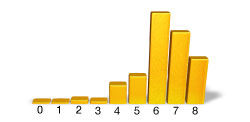
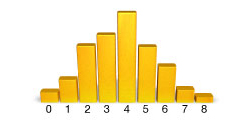
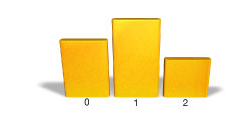
I wanted to find out if people generally do have the traits that their zodiac signs say they should, and so I conducted an informal survey over Twitter. (To be responsible, I should stress that there was nothing scientific about the way this survey was conducted, and so its results can at best be considered interesting, and not scientific proof of anything.) I went out on the web and found widely available personality descriptions of the various zodiac signs. For example, the words describing a Sagittarius were generally positive, things that I felt most people would probably identify with. So I took the four phrases (optimistic and freedom-loving, jovial and good-humored, honest and straightforward, intellectual and philosophical) and asked people to assign a 0 to each if they felt it did not describe them at all, a 1 if they felt it somewhat described them, and a 2 if it described them very well. I added each person's points up to get a score from 0 to 8. Since these were generally positive traits, I bet that most people would come up with pretty high scores. The average score turned out to be 6.3, with a clear distribution shoved up to the high end of the graph. The average respondent considers himself a 79% match with the traits of Sagittarius.
|
|
||||
|
|
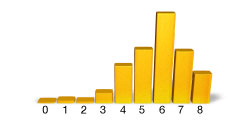
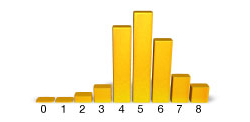
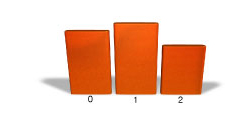
I also asked the same question using the traits of Leo, Taurus, and Scorpio, adjectives which were (in my estimation) progressively less complimentary, and the average scores did indeed turn out to be 5.7, 5.1, and 3.7. Each of these graphs has a nice, clear bell curve. It's clear that when you ask people, without any context, whether they feel they are better described by words which happen to be positive (like Sagittarius' "optimistic and freedom-loving"), they tend to identify with those terms; but when you ask the same question with less positive words (like Scorpio's "determined and forceful") there is less identification. Armed with knowledge of this fairly obvious axiom, any astrologer should have no problem writing fortunes for just about anyone that will hit the mark 9 times out of 10.
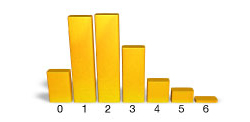
In my survey, I also wanted to see how the results of these same questions might differ between people who are of that zodiac sign, from those who are not. I took the negative qualities of a Libra (indecisive and changeable, gullible and easily influenced, flirtatious and self-indulgent) and asked Libras if they thought it represented them, and asked the same question of non-Libras. If there's anything to astrology, the Libras would have recognized their own weaknesses in those descriptions. But guess what; they didn't. Both groups reported an average of 2.0 out of 6 points, or about a 33% match.
|
|
This result was interesting, so I extended this line of investigation, and asked the same question again, but this time instead of using the zodiac sign's traits, I used randomly chosen readings from the Los Angeles Times horoscope. The first was for Capricorn, and it said:
The universe is sending out some muddled messages. Don't read too much into the signs. If you have to stretch to figure out what something means, it's just because you're not meant to know yet.
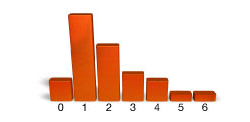
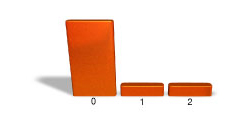
Neither Capricorns nor non-Capricorns felt that fortune applied to them much at all; the graphs look virtually identical with a big tall bar in the "Does not apply to me at all" column and only a smattering of results in the other two. Non-Capricorns reported a 12% match, and Capricorns reported a 17% match. While that five percentage point difference may seem significant, it's below the 7.8% margin of error that I calculated for this question.
|
|
||||
|
|
I tried it again with a fortune for Taurus that sounded more positive:
You can do more than instruct people. You can inspire them. You focus on a beautiful potential and describe it with the passion that gets others moving in the same direction.
As you can probably guess, more people felt this applied to them, and this time it made almost no difference at all whether they were Taurus (46% match) or anything else (45% match). Grant a positive sounding fortune, and more people convince themselves it applies to them.
But my little Twitter survey is hardly the first time anyone has tested astrology. Many, many studies have been done; and better the study, the less of an effect has been found. Dutch researcher Rob Nanninga wrote:
One of the best examples was conducted by the Australian researcher Dr. Geoffrey Dean... Dean selected 60 people with a very high introversion score and 60 people with a very high extraversion score. Next, he supplied 45 astrologers with the birth charts of these 120 subjects. By analyzing the charts the astrologers tried to identify the extroverts from the introverts. The results were very disappointing. It was as if the astrologers had tossed coins to determine their choices. Their average success rate was only 50.2 percent.
He devised his own test in which seven people from diverse backgrounds filled out detailed questionnaires about themselves, and separately provided a list of the dates of important events in their lives. 50 experienced astrologers agreed to match the questionnaires to the date charts, and were offered 5,000 guilders if they could correctly match all seven. As a control, Nanninga also had a group of skeptics try to perform the same matches, to rule out successes based on subtle clues in the data.
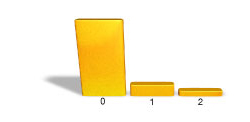
The astrologers were asked to indicate how many correct matches they would have expected... Half of them predicted that they had matched all subjects with the correct charts. Only six astrologers expected less than four hits. In fact, the most successful astrologer achieved only three correct matches, whereas half of the participants (22) did not score a single hit. The average number of hits was 0.75...
Moreover, there was no evidence that the most experienced astrologers did any better than beginners. It is interesting to compare the entries of the participants with each other. Because they all had received the same information, one would expect many similar responses. Actually, the lack of agreement was striking. Each of the seven charts could be paired with seven questionnaires. Of these 49 possible combinations, none was selected more than twelve times. It was as if each astrologer had used a random generator to determine the correct matches.
Of the control skeptics, the most successful also scored three hits, the same as the best astrologer.
In addition to his 1987 study referenced by Nanninga, Dr. Geoffrey Dean also performed a meta analysis of nearly 300 empirical studies of astrology. He found no real effect, and attributed the perceived effect to perceptual and cognitive biases that he called hidden persuaders. In his conclusion he wrote:
To critics, astrology's failure to deliver is unremarkable because its alleged efficacy is explained by the same hidden persuaders that underlie proven invalid approaches such as phrenology and bloodletting... Each hidden persuader creates the illusion that astrology works, all are used routinely in consulting rooms, all lead to client satisfaction — and none require that astrology be true... If you are looking for something where nothing is true and everything is permitted, then astrology seems to be an excellent choice.
People who are big believers in their horoscopes are probably going to continue to remain so, no matter how much evidence they're shown that any perceived effect is imaginary. But for those who are on the fence, this information is crucial, given that some leaders in government and business employ astrology in their decision making. If someone with authority over your life is making important decisions based on magical beliefs, you should trust the science, not the authority.
You should follow me on twitter here.
© 2009 Skeptoid Media, Inc. Copyright information
References & Further Reading
Culver, R., Ianna, P. The Gemini Syndrome: A Scientific Evaluation of Astrology. Buffalo: Prometheus Books, 1984.
Dean, G. "Meta-analyses of nearly 300 empirical studies: Putting astrology and astrologers to the test." astrology-and-science.com. Astrology & Science, 28 Sep. 2008. Web. 28 Sep. 2009. <http://www.rudolfhsmit.nl/d-meta2.htm>
Grim, Patrick, editor. Philosophy of Science and the Occult, Second Edition. Albany: State University of New York Press, 1990. 15-84, esp. 51-81.
Jenni. "Astrology is Bunk." Debate Unlimited by Martin Willett. Debate Unlimited, 14 Jan. 2008. Web. 28 Sep. 2009. <http://mwillett.org/mind/astrology-is-bunk.htm>
Nanninga, Rob. "The Astrotest: A Tough Match for Astrologers." Correlation, Journal of Research into Astrology. 10 Feb. 1997, Volume 15, Number 2: 14-20.
Reference this article:
Dunning, Brian.
"All About Astrology." Skeptoid Podcast. Skeptoid Media, Inc.,
29 Sep 2009. Web.
6 Sep 2010. <http://skeptoid.com/episodes/4173>
Discuss!
Remember, you should always read with skepticism the comments of anyone too lame to put their real name & city.
Beautifully done. Too bad there will always be some reason why YOUR research is flawed, in the eyes of believers. But we're not out to re-convince them (if we do it's a bonus) but instead to inform those who may get sucked into this flim-flam. Good work!
Mangraa, Los Angeles
September 29, 2009 9:18am
Robert, the comment you were quoting is followed by statements that show that these different schools of astrology are different systems with different meanings for exactly the same inputs. So the correct analogy would be closer to is chemistry the same as alchemy.
Robert Mcbride, Columbia, MD
September 29, 2009 10:18am
Isn't astrology supposed to be about how people actually *are*, rather than how they self-identify? I don't imagine there are any practical alternatives to using self-identification for this experiment, but it does make the results nearly meaningless. I'm sure if people looked at a list of real and fake descriptions given by friends, or examinations done by psychiatrists, they'd choose the positive ones over the negative ones as well. People don't have accurate views of themselves.
Simon, Seattle
September 29, 2009 11:04am
Robert Hirsch said:
"However it is possible that astrology with 24 signs is simply a more precise version of the 12 sign astrology. Therefore they can in fact both be right."
Let me fix that for you
"However it is possible that astrology with 24 signs is simply a more precise version of the 12 sign astrology. Therefore they can in fact both be WRONG."
There, much better
GW Crawford, Toronto/Canada
September 29, 2009 11:52am
Simon says:
"Isn't astrology supposed to be about how people actually *are*, rather than how they self-identify?"
Perhaps. But people who believe in astrology judge its accuracy by comparing their readings to how they perceive themselves. I think it's legitimate to point out to them that most people will self identify with any positive set of attributes.
Astrology itself is so implausible as to make studying it boring. Studying why people fool themselves into believing it is accurate is much more interesting. And for studying the latter, how people self identify is probably more important than how they really are.
Brian Davis, Modjeska Canyon
September 29, 2009 1:05pm
Awesome episode, but really 173 episodes and you're only *just* getting to astrology.
You should do an epidsode on the Myers-Briggs scale. I always got the feeling that you could mix those stupid things up and apply them to anyone.
Phil, Sydney, Australia
September 29, 2009 5:37pm
Phil;
The Myers-Briggs scale is slightly more accurate than the Zodiac in that it has 14 possible pigeon hole to put you in, rather than 12.
Otherwise, it makes as much sense, and is on a similar intellectual level to astrology.
Marius vanderLubbe, nullabour Plain, Australia.
September 29, 2009 8:00pm
Hmmm... being born Under he sign of "old codger" I know astrology to be absolutely correct...
Here in Aus, we only have three signs; the old codger, the old chook and the bullartist.
Given that 98% of the sky is covered by "the bull artist", the old codger and the old chook folk dont get much of a say..
But boy is our life enriched by the bullartists... we have the archibald prize, CAMS and organic standards..
Beat that guys!
"Oh Look, we are in the G20!"..."Daytime TV is so Informative!"... "This car was driven by an old lady..."
Its no wonder Aus has a permanent ring of confidence... saturn never sets for us
Henk van der Gaast, Sydney, Australia
September 29, 2009 10:47pm
I always viewed Astrology the same way as I viewed Norse Runes, the I-Ching or pointing to a random definition in the Dictionary: an interesting way to mentally approach upcoming events in the day with a different perspective.
All nonsense, of course, but it is interesting and sometimes fun.
Joel, Ottawa, Canada
September 30, 2009 6:36am
The Meters-Briggs inventory begins with a test unlike astrology, which ends with one. The "introvert/extrovert" section of the MB inventory is hardly akin to astrology - it's the result of ascertaining a person's social nature through questions.
The Kiersey interpretations of the Meyers-Briggs scores are more subjective - that may be what seems problematic.
Adam Jones, Dallas, TX
September 30, 2009 10:06am
Fascinating. While I always knew astrology was sheer shash, I figured there was at least some kind of internal logic to it, akin to the rules of Dungeons & Dragons or something. That these 'astologers' didn't even remotely agree with eachother is interesting.
Morgan, Tracy, CA
September 30, 2009 10:48am
I have a natal chart (radix horoscope?) done by a professional astrologer for whom I used to write programs in Nuremberg. Of course he made it after he got to knew me, after several days – cold reading? He did some strange things with the data my programs provided. It made me even more of a skeptic than I was before. I'm also a hobbyist astronomer (that's how the astrologer could trick me into writing »atrononomical utilities«), so I'd put it with Dawkins:
»Aquarius is a miscellaneous set of stars all at different distances from us, which have no connection with each other except that they constitute a (meaningless) pattern when seen from a certain (not particularly special) place in the galaxy (here).«
Marko, Nuremberg, Germany
September 30, 2009 12:06pm
I wonder if there have been studies linking time of year of birth with any characteristics, though. While the notion of stars and planets affecting us is silly, couldn't it be reasonable that the time of year you are born could have effects due to seasonal changes?
I think about here in Canada being under snow for 4 months of the year; if you're born in November the first 6 months of your life you'd be kept indoors, but born in April and you could be taken outside in the warm summer weather. I would think this <i>could</i> have an effect, and would be surprised if it (or something similar) hasn't come up as a confounding variable in any studies of astrology.
Malcolm Gladwell's First-quarter-baby NHL players is another example where the month of birth could have a real effect on someone's life.
http://www.behindthenet.ca/blog/2008/12/malcolm-gladwells-outliers-and-making.html
Shane, Montreal, Canada
September 30, 2009 8:27pm
The only benefit of Astrology to mankind is the existence of the Horoscopes at The Onion.
Erik, Miami
October 01, 2009 10:32am
Like Shane above, I too would be curious if the time of year has any effect on our personalities, and if astrology actually builds off of that.
I am a Libra and in general the traits astrology tends to ascribe to Libras (even the negative ones) fit me to a tee. That's not really significant, of course, and it doesn't make me a believer, but it's interesting.
Robert, Detroit, Michigan
October 04, 2009 12:19am
Great episode and I agree that so far astrology (in so far as being able to predict the future) lacks any plausibility. It reminds me of that line said by Hector (Eric Bana) in the movie Troy,
"Bird signs? You want to plan out strategy based on bird signs?"
But at that time, the Greeks (much like other civilisations) turned not to the skies, but saw the future through other signs they considered to be prophetic.
Well your guess is as good as mine!
Anthony, Adelaide
October 05, 2009 3:28am
Hi there, Richard Wiseman covers this in his book 'Quirkology" ... scientific evidence that astrology is a load of hokum, but that there are correlations of season/month you are born ( as mentioned by Shane & robert)...a good read!
louise, uk
October 05, 2009 5:35am
Hi there, Richard Wiseman covers this in his book 'Quirkology" ... scientific evidence that astrology is a load of hokum, but that there are interesting correlations of season/month you are born ( as mentioned by Shane & robert)...a good read!
louise, uk
October 05, 2009 5:42am
Whenever astrology comes up in a discussion there are people suggesting that some study be tried in a hope to salvage something from astrology. This view gets it backwards. If someone wants to fund research on a methodology the onus is on them to do it rather than suggest that scientists should. Remember that exceptional claims require exceptional evidence.
Robert Mcbride, Columbia, MD
October 05, 2009 10:16am
Some time ago I was thinking that it would be interesting to found "reverse astrology": The classical astrology assumes that the movement of celestial bodies somehow influences the life of people. The direct influence of these bodies is however impossible because they are simply too far away (and so any physical effect is negligible.) That means that if the astrological predictions work, it is not a causality (A → B) but a correlation (A ↔ B), and so these predictions should work other way around as well: From the biographies of people it should be possible to predict the movement of planets and stars :-))).
Adam J Sporka, Trento
October 05, 2009 11:55am
You silly people with your skeptical horse blinds.
There's no surprise in that various astrological systems do not agree, because there is a genetic element in play. That's why different cultures of different races and ethnic groups need different methodologies.
Shahar lubin, Ha-Noi, Vietnam
October 07, 2009 11:20pm
I think that the way to tackle Astrology is not to go the way of trying to work through interpretations as these can always be challenged. As you said in your podcast there are countless versions of Astrology so the best way is to attack it from first principles. I don't agree that it's hard to define this at all. All Astrological systems state that there is a correlation between what is in the heavens at the time of birth and your future life/personality down here. Showing that there is no physical effect that can have any influence also is a bit irrelevant as Astrologers don't use physical effect to justify their position. It's more of the "we are all connected" line of reasoning. The way to really test Astrology from first principles is to sidestep interpretation. What is needed is to make a study in a major maternity hospital of a number of people who were born very close together, say 20 years ago, and then follow these people up and see if there is any correlation at all personality wise or with regard to lifestyle. If there isn't then all Astrology in bunkum irrespective of the method of interpretation. I'm not saying it would be easy as there are probable countless privacy laws that would get in the way but it's an interesting experiment if it would be done
Andrew Stein, Melbourne, Australia
October 10, 2009 7:33pm
Nice podcast. I'd be careful about propagating the myth that Ronald Reagan used astrology. It was his wife, Nancy. He did apparently know about it and warned her that it might "seem odd" if it were known. So it looks more like a quirk he tolerated in his wife than something he depended on.
http://tinyurl.com/68gafc
On another subject, my usual conversation stopper with astrology buffs is "we saggittareans don't believe in astrology."
Craig, Emeryville, CA
October 15, 2009 9:46am
Andrew, you're right. A simple study of people who were born close together and looking at their lives downstream is proof positive against all the claims of astrology.
I wonder why nobody has mentioned twins. They are the best proof against the nonsense of astrological predictions. Remember Jacob and Essau, or Jim and Charlie Thorpe, or Joyce and Judith Scott. Even opposite-sex twins are rarely similar: Marty and Mamie Robbins, Alanis and Wade Morrisette, or Keifer and Rachel Sutherland.
I can assure you that astrology is bunk because I'm an identical twin and we are different in many ways. It is a con game that preys on peoples' suspicions.
Joe Boudreault, Hanover, Ontario
October 17, 2009 8:01pm
I think astrology is bunk, however the time of year one is born may affect future traits, because as you develop from an infant you go through stages, and whether it is winter or summer during particular stages may affect your future personality.
Matt, Orlando
October 21, 2009 9:14pm
The worst part about the surveys is that they're selection biased. As you noted, people are generally loathe to identify the negative portions of their personalities while over-stating their positives. In something like this, it might be more beneficial to ask a subject's peers what they think of the subject as generally, your friends and co-workers know your personality better than you do, or at least are less willing to candy-coat it.
However, I still think it's all crap. Fun, amusing crap (unless you make, I dunno, world-changing decisions based on 1-800-MISS-CLEO), but still crap.
Shane, Los Angeles, CA
October 29, 2009 10:37am
Interesting..
I dont care much for astrology but I was always under the idea that planetary torsion fields and their natural yearly alignments with earth did give off frequencies that satelites here on earth can record, hence the torsion field theory....
They have recorded these frequencies coming off from the planet Saturn in the months of December. This maybe be the reason why the ancients may have been referring through astrology that planetary alignments effect us here on Earth?
CasperJack, Newbury, Massachusetts
January 24, 2010 5:24pm
CasperJack:
In reality, the idea of a "torsion field" was created by hoaxsters fleecing the Russian government in the 1980s.
The planets "align" more or less then once per year, because the other planets are also moving. Thus, these "alignments" would fall into different months of the year. There is no planetary activity on any other planet that coincides with an earthly calendar in any meaningful way.
John, Canada
January 25, 2010 12:22am
I had great fun mocking Astrology on Yahoo Answers in their Horroscope section.
Someone once asked if Geminis and Cancers can get along. In response to my answer, they took the time out to address me personally, saying they were only asking those who believed what she believed, and called me "close-minded"
I have no idea how my answer could be construed as close-minded!:
"No. We wage a holocaust against gemini because they worship a different constellation from us. We can never get along because the mighty crab in the sky demands we slaughter any who are not cancer.
Seriously; stop believing in fiction like horoscopes and maybe try realizing that PEOPLE are different as they come---judging people based on their horoscope is just the same as judging them based on their skin color."
Someone else asked: What are Cancer men like in love? Are they good at showing their feelings?
I responded:
Chemotherapy and/or radiation therapy is very hard on men with cancer. Women, too. Usually they shave their heads before undergoing it, because the process of hair falling out can make a mess.
If you're a fisher woman, I don't see what that has to do with meeting men with cancer.
I wonder why they don't like me.
Andariel Halo, Miami, Florida
February 01, 2010 9:55am
I am wondering if anyone here has read Cosmos and Psyche? I am someone who rejects astrology in general, but the book was very persuasive in demonstrating an affect on popular collective psyche.
Chris, Kansas
February 04, 2010 5:31pm
I appreciate how this podcast stated that an outright laughing off of astrology is not a proper skeptical response & that you attempted a more in-depth investigation. However, I felt that your methods of investigation were lacking. General sign qualities that you listed don't really encompass all the subtleties and insights astrology has to offer. I have no doubt almost all daily horoscopes are complete bunk. However, natal charts and other parts of astrology do hold interest for me, because they make up a highly complex symbolic language. I'm glad you described it as pre-scientific; I agree with the notion that it is an ancient art that may not yet be able to be truly tested by science. But I think it can be enlightening and it is, as a language & system, personally fascinating. It has come to correspond with current psychological notions & has a lot of interesting overlap with Jungian concepts. And it has a lot to do with the notion of parallels between the microcosm and the macrocosm. I'd recommend looking into Liz Greene, Steven Forrest, and Stephen Arroyo for some thought-provoking reading. I'm interested in understanding science and I don't think that an interest in astrology & other methods outside of proven science inherently contradict scientific truths. They are just other, additional tools used to arrive at truths (largely personal truths & by tapping into the unconscious). Not something that works for or appeals to everyone, for sure, and I think that's okay.
Miriam, Chicago
February 22, 2010 10:58am
"I agree with the notion that it is an ancient art that may not yet be able to be truly tested by science."
That's not the issue. The issue is that astrology CAN be test, and HAS been tested scientifically, and failed.
As for the rest, I'm a hard scientist. I don't like psychology and sociology, personally or professionally. So I won't comment further on the subject--I don't know enough. I will say that merely because something is thought-provoking doesn't mean it's true, though. Many fantasy books are thought provoking, but that hardly means I need to accept all or even any of the concepts presented therein as valid.
Until a mechanism is presented by which astrology can function, we may safely reject any astrological systems, even those which are thought-provoking.
Unless you were talking about psychology getting their ideas from astrology?
Gregory, Alabama
February 22, 2010 11:50am
"The issue is that astrology CAN be test, and HAS been tested scientifically, and failed."
I'm not convinced astrology has failed all possible testing. Most are made from a point of view either trying to prove or debunk astrology. I've heard of tests by astrologers with strong results for it, & I'm not sure those trying to debunk conduct tests with proper knowledge of astrology to truly test it. Both tend to be faulty and biased.
I'm interested in any tool that can be used to obtain insights, especially in terms of self-knowledge. I don't have a problem with those of different opinions, but I also don't see how studying systems that can't be categorized as 'hard science' is an inherently harmful practice. Is studying poetry or music harmful and wrong because they delve into areas that are not scientific? Maybe the problem is in categorizing astrology as a science. What if, instead, we categorized it as an art or something akin to psychology (as you mentioned, also not a hard science)? I don't like seeing people making tons of money off of pseudo-astrology shams that distort the system and over-simplify, but I think there are a lot of people out there using it as a personal tool or helping others through counseling and genuinely trying to understand their client as a full person, as well as their client's chart. I admire the ability of astrology to help some people who are so inclined to self-reflect, and I think that ability, in itself, indicates some amount validity.
Miriam, Chicago
February 22, 2010 12:12pm
I always thought that the personality thing might have some basis in truth. Predicting the future is silly if 1/12 people all have the same future as you, but things like personalities could be tied to say, weather patterns couldn't they? People get depressed when there's no sunlight (look at suicide rates in Scandinavian countries) so what's to say someone born during a season with no sunlight, at a very developmental age, isn't affected somehow?
Of course this would only work in the northern hemisphere in certain climates, but the southern hemisphere has different constellations anyway :)
FA, KW
February 28, 2010 7:23am
But astrology does not divide all people into twelve categories. It is actually a highly complex system. Unless you are born at the exact same minute, in the same time zone as someone else, you do not have the same chart as another person. There are many factors that make up the chart besides the Sun sign (which is what everyone knows and what so-called astrology columns in news papers are based upon). You have your Sun, Moon, Mercury, Venus, Mars, Jupiter, Saturn, Uranus, Neptune, Pluto (still an astronomical body), Ascendant, etc. in different signs AND houses, making aspects to different planets. (For example, I have my Mercury [thinking/communicating]/Sun [ego drive/source of individuality/basic energy flow]/Ascendant [outer 'mask'/personality/filter between self and the world] in three adjacent signs.) And you can bring in asteroids, fixed stars, and other astronomical bodies and mathematically-calculated points. Additionally, the astrological make-up of a person does not point to one specific fate or future - it only indicates certain in-born potentials, needs, and energies that can actualize in many different ways, depending on environment, development, free will, chance, and so on.
I just want to dispel some of the false knowledge about astrology. The complexity doesn't, in itself, mean it's valid (though I'd argue it is for various reasons, as I did above), but it does make it less silly than if it really was about grouping all people into twelve simple categories.
Miriam, Chicago
March 01, 2010 10:08am
This is real simple. In order to be science it has to follow the scientific method. There is no consensus or reproducibility in astrology. It is, therefore, not a science. And, according to the followers of astrology and several of the comments here, true believers will not concede the falsifiability of astrology. When you show the numerous studies that show it to be false.. there's always an excuse. It's superstition pure and simple and the statistics will bear that conclusion.
Cletus, acworth
April 26, 2010 12:55pm
I'll stop jumpin' onto this thread after this comment, because I don't want to seem argumentative. I'm very interested in what everyone's been saying here (hence my checking for new posts). Smart lot!
I think what this really boils down to is the question of whether one believes that only areas of life/conceptual areas that are provable by science are in any way valid or worth studying.This topic is fascinating, because it encompasses so much, particularly in regards to science vs. religion debates.
I happen to find different kinds of validity and truth and meaning in some areas that exist outside of science. At the same time, I, personally, would not want to say that these things disprove science.
I'd love for those interested in the scientific and those interested in the outside-of-science to be able to respectfully get along and have conversations where they are really open to thinking over one another's ideas. I think there are a lot of folks out there who do this.
And I think it IS an interesting idea to analyze astrology and other pseudo-sciences by scientific methods and see how/if they fall short- I can absolutely see the appeal in this (and I'll happily use the term 'pseudo-science' for astrology, because I don't think it can or should fit snugly into the realm of science). I appreciate that scientists do studies, but what I'd REALLY dig would be a study executed in collaboration by scientists (non-believers) and knowledgeable astrologers. Now THAT would be cool.
Miriam, Chicago, IL
April 27, 2010 12:17am
Dave Gorman did an Astrology experiment a few years back that is worth looking up as further reading to this episode. If only because it is great fun.
Tom H, Kent, UK
August 23, 2010 8:01am
Make a comment about this episode of Skeptoid (please try to keep it brief & to the point). Anyone can post:
You can also discuss this episode in the Skeptoid Forum, hosted by the James Randi Educational Foundation.
Join the Skeptalk email discussion list.
What's the most important thing about Skeptoid?


<b>It would be nice to be able to at least state that there are 12 signs of the zodiac, but that's only one system. Other astrology systems have 14 or 24 signs. Obviously, they can't all be right</b>
I am not an astrology nut. I just want to point something out. Your statement above is similar to saying, that both Newton and Einstein can't both be right.
They both are, its just that Newtons discoveries are a subset of Einstiens.
I think astology is bunk. However it is possible that astrology with 24 signs is simply a more precise version of the 12 sign astrology. Therefore they can in fact both be right.
Robert Hirsch, Troy, NY
September 29, 2009 9:17am