




Should Tibet Be Free?
Misinformation and fantasy surrounds the popular Tibet notions.
Filed under Fads
| Skeptoid #111 July 29, 2008 Podcast transcript | Listen | Subscribe |
|
Perhaps an equally important question is "Should a science podcast take on a political topic?" For a long time, listeners have been sending me requests to do an episode about Tibet, and for a long time I've been putting the requests into a folder and keeping it stored away. This is Skeptoid, not Politicaloid, and my purpose is not to advocate one side or the other in political questions where you have two sides that are perfectly valid to different groups of people. But the more requests I've received, the more I've realized that there is a lot of misinformation, if not true pseudoscience, surrounding Tibet. There is, undoubtedly, a set of popular pop-culture beliefs out there, based entirely upon made-up crap that bears little resemblance to reality.
Mind you, I'm not saying "Hey, you've heard one side, let me give you the other side," because that's the job of a political commentator. What I'm saying today is "Here is the reality of Tibet, go forth and form whatever opinion you like," but base it on reality, not on made-up metaphysical nonsense. I'm encouraging you to apply skepticism to the reasons you may have heard for freeing Tibet.
|
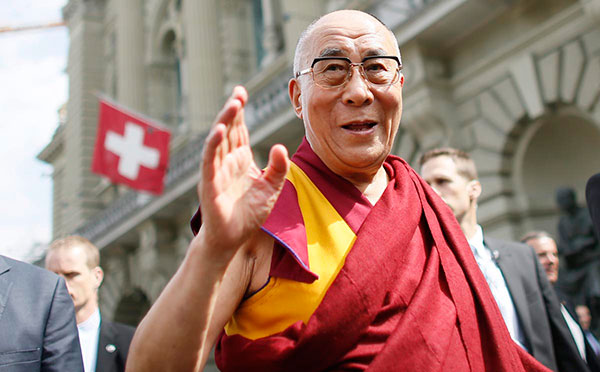
Like most Americans, I grew up watching video of the Chinese army taking howitzers and destroying the massive centuries-old Tibetan monasteries in 1959, and that's an indisputable crime against history, religious freedom, and the dignity of Tibetans. And then I watched video of the Dalai Lama, the exiled spiritual and political leader of the Tibetan people, in his red and yellow robes, speaking words of wisdom and brotherhood and freedom and peace. And I'll freely admit: For nearly all of my life, this was the extent of my knowledge of the Tibet situation: Violence and cruelty from the Chinese; innocence and beauty from the Tibetans. I believe that many Westerners, including many who fervently wave Free Tibet placards, have little knowledge of the situation any deeper than that. But isn't it likely that there's more to it than that? Isn't it equally disrespectful of the Tibetans as it is of the Chinese to attempt to encompass who and what they are with those tiny little pictures?
A complete history lesson is impossible, but here's a quick overview of the points relevant to today's discussion. China and Tibet have a long and complicated history. In 1950, China invaded to assert its claim, and ruled by trying to win hearts and minds, building roads and public utilities, and allowing the Tibetan system of feudal serfdoms to remain largely intact. In 1959 the Tibetan ruling class revolted, prompting a Chinese crackdown that sent the Dalai Lama and most other Tibetan aristocrats into exile in India, where they remain to this day. The former serfs became ordinary Chinese citizens, and Tibet is now an "autonomous region" in China, a status that many describe as actually less autonomous than an ordinary Chinese province. From his palace in India, the Dalai Lama now travels the world in a private jet, hobnobbing with the wealthy and powerful, fundraising, and writing highly successful books on metaphysics.
Recently there were some anti-China, pro-Tibet protests in Nepal, a neighboring independent nation. This is illegal in Nepal, and the authorities have been cracking down on it. Why does Nepal side with China on this issue? Because they depend heavily on Chinese aid to survive, and this is a requirement that China imposes, though they call it a "request". At first glance you might be shocked that an independent nation would give up its freedom of speech to make a deal with the devil, but that's an easy opinion to form when you're not hungry. It makes sense for Nepal to agree to these terms, because their back is against the wall: They need China's aid. As for China imposing this condition? Well, that's one for you to chalk up in your column of "Things China Needs to Reconsider".
So, why doesn't China simply give Tibet the same treatment they give Nepal — let them be an independent nation, give them aid, and just require them to say only nice things about them? Well, Nepal has long been an independent nation; Tibet hasn't. The history of China's rule over Tibet is exceptionally complicated and goes back many centuries. Anyone who tells you that either Tibet is historically part of China, or that Tibet is historically free, is making a disingenuous oversimplification. Personally, I choose to discount this subject completely, and not because it's too intricate to make a clear decision. I discount it because practically every square inch of land on the planet has been taken over militarily or annexed or stolen in one way or another from one people by another people. We don't give California back to the Spanish, and we don't give Italy back to Norway. Ancient history is not the way to settle current border disputes. To find a meaningful settlement that makes sense for people today, you have to consider Tibet to be a current border dispute. So while we're chalking up China's claim of ancient possession in the column of "Things China Needs to Reconsider", let's also chalk up Tibet's claim of ancient autonomy in the column of "Things Tibet Needs to Shut Up About".
And once we open up that column, we find it's a Pandora's Box. Advocates of a free Tibet make a long list of charges against Chinese oppression, largely centered upon a loss of rights and freedom. This claim makes anyone familiar with Tibetan history cough up their coffee. The only people who lost any rights under Chinese rule are Tibet's former ruling class, themselves guilty of cruelty and oppression of a magnitude that not even China can conceive. The vast majority of Tibetans, some 90% of whom were serfs, have enjoyed a relative level of freedom unheard of in their culture. Until 1950 when the Chinese put a stop to it, 90% of Tibetans had no rights at all. They were freely traded and sold. They were subject to the worst type of punishments from their lords, including gouging out of eyes; cutting off hands, feet, tongues, noses, or lips; and a dozen horrible forms of execution. There was no such concept as legal recourse; the landowning monk class was the law. There was no such thing as education, medical care, sanitation, or public utilities. Young boys were frequently and freely taken from families to endure lifelong servitude, including rape, in the monasteries. Amid all the pop-culture cries about Chinese oppression, why is there never any mention of the institutionalized daily oppression levied by the Dalai Lama's class prior to 1959?
Free Tibet advocates also point to the destruction of Tibetan culture. This charge is particularly bizarre. The only art produced in Tibet prior to 1950 was limited to the output of a few monks in each monastery, principally drawings of monasteries. New literature had not been produced in Tibet for centuries. Since the 1959 uprising, art and literature in Tibet have both flourished, now that the entire population is at liberty to produce. Tibet even has its share of well known poets, authors, and internationally known artists now.
Make no mistake about China's history of human rights failings: China's "Great Leap Forward" and "Cultural Revolution" programs from 1958 through 1976 were as disastrous for Tibet as they were for the rest of China. There can never be any excuse for the deliberate widescale destruction of life, liberty, and property during those years. Hundreds of thousands of Tibetans, and tens of millions of Chinese, lost their lives during this misguided pretense at "reform". This was a phase that China went through, and it's arguable that Tibet would have been spared this torment if they had been independent at the time. But for your average Tibetan in the field, a serf with no rights, living and working and dying at the whim of his lord, were those decades really worse than they would have been without China? There's no way to know, but to a skeptical mind, it's not a slam-dunk that China's Cultural Revolution was harder on Tibet than Tibet's ruling class had always been in the past.
If we think back to our list of red flags to identify misinformation, cultural campaigns and celebrity endorsements should always trigger your skeptical radar. Few campaigns are as near and dear to the hearts of Hollywood activists as "Freeing Tibet". Notable Tibet advocates include Sharon Stone, Richard Gere, Paris Hilton, and the great political science scholar Lindsay Lohan. Jounalist Christopher Hitchens notes that "when on his trips to Hollywood fundraisers, [the Dalai Lama] anoints major donors like Steven Segal and Richard Gere as holy." Being anointed as holy probably does great things for your social standing within Hollywood, but it should not be considered evidence of expertise. I'll bet that if you asked either Steven Segal or Paris Hilton to lecture on the events of the Lhasa Uprising of 1959, you'd find that neither knows even the most basic information about the cause they so passionately advocate. Just because Hollywood celebrities promote a viewpoint doesn't mean they're qualified to do so, something that (unbelieveably) still seems to escape most people.
Furthermore, the people shouting loudest about freeing Tibet don't seem to be aware that that's not even what the Dalai Lama wants from China. He's not seeking full independence, Nepal style; rather he would like to achieve the same status as Hong Kong, which is a "special administrative region". This would give them full economic benefits without having to become a regular province, something along the lines of a US territory. So here's a note to all the Hollywood celebrities: If you really want to support the Dalai Lama, ditch your "Free Tibet" signs and paint some up that say "Change Tibet from an Autonomous Region to a Special Administrative Region". It's not as good of a sound bite, and it's a change that would have little practical impact on Tibetans; but it would allow the Dalai Lama to return to his aristrocratic lifestyle and his 1000 room palace at Potala.
So to all those who so heatedly call for the freeing of Tibet, first consider whether you have the expertise to know whether Tibet is best served as an autonomous region or as a special administrative region. Understand exactly what implications such a change may have upon the economics and the daily lives of its citizens, or maybe even entertain the possibility that it's a decision best left to Tibetans.
You should follow me on twitter here.
© 2008 Skeptoid Media, Inc. Copyright information
References & Further Reading
Beckwith, C. The Tibetan Empire in Central Asia. Princeton: Princeton University Press, 1987.
Goldstein, M. The Snow Lion and the Dragon: China, Tibet and the Dalai Lama. Los Angeles: University of California Press, 1995.
Grunfeld, A. The Making of Modern Tibet, revised edition. Armonk: M. E. Sharpe, Inc., 1996.
Parenti, M. "Friendly Feudalism: The Tibet Myth." Political Archive. Michael Parenti, 1 Jan. 2007. Web. 14 Dec. 2009. <http://www.michaelparenti.org/Tibet.html>
Sperling, E. The Tibet-China Conflict: History and Polemics. Washington: East-West Center, 2004.
Reference this article:
Dunning, Brian.
"Should Tibet Be Free?" Skeptoid Podcast. Skeptoid Media, Inc.,
29 Jul 2008. Web.
2 Sep 2010. <http://skeptoid.com/episodes/4111>
Discuss!
Remember, you should always read with skepticism the comments of anyone too lame to put their real name & city.
I remember changing my msn sign in name to "Free Tibet with purchase of tibet of lesser or equal value". I lost friends.
Cambias, by your own logic then the conditions that the Tibetans have faced under Chinese rule are also irrelevent. If so then I'd stick with the current Chinese government which is undertaking slow but sure democratic reform. I sure trust them alot more than a guy who tells me it's a sin to have sex during the day.
Paul, Osaka
July 29, 2008 6:30am
Back when I was in high school I attended the Tibetan Freedom Concert in Alpine Valley, WI. Not because I believed in any cause, but because I liked a lot of the bands that were going to be there. I got a kick out of the fact that there were numerous petitions being passed around, but no one could even tell you what they were for. No one even seemed to know for sure who got the list of know-nothing-teenagers, like myself. Was it meant for our government? For China? Did the average person signing the petition even know they were trying to free Tibet from China?
Jeremy Lindgren (vita10gy), Eau Claire, WI
July 29, 2008 7:33am
China isn't undertaking "slow but sure" democratic reform. Its doing its best to introduce rule by party official to Hong Kong, and has done basically nothing elsewhere.
People continue to be arrested for political speech, and the press is state controlled. Somewhat better than the cultural revolution is not exactly a high point.
In mainland China, in a handful of places they can choose between different communist party officials- but mostly not, and even where they can it is structured to prevent this changing who is at any but the lowest level.
Internal immigration controls leave peasants stuck in the countyside in poverty no better than before the economic boom, while they have no right to own land- causing tens of thousands of protests a year.
In Tibet, the state is not as heavy handed as it used to be, but still slams down on any political speech, and is doing everything it can to encourage Han Chinese to move their through favourable treatment. Giving them huge economic incentives to move has an obvious motive.
The situation before any now isn't a deciding issue. Tibet should, like any other region, have self-determination. California doesn't want to be Mexican or Italy Danish, these are not valid analogies. The people (not the dalai lama, whos compromise is trying to get something achiveable, how much he wants to advance himself I leave to the reader) should be able to decide their destiny- which they can't even openly discuss under Chinas oppressive regime.
Sean, Leeds, UK
July 29, 2008 7:39am
China is no picnic but to be prioritising criticism of China over North Korea, the Sudan, Zimbabwe and a dozen others worse than China smacks of a knee-jerk fear based reaction to a newly powerful state.
Sure the Chinese were bad before, but now they're turning capitalist they're allowing more protests, tolerating more free speech and most importantly selling me cheaper computers, which is importnant because they listen to their clients.
It may be worth noting that at least as far as I remember the last time the west backed a local resistance movement guided by religious figures against a world power we got the Taleban. Straw man? You bet, but so is your perception of China.
Paul, Osaka
July 29, 2008 8:23am
Thank you, Brian, for another great episode.
I was wondering if you could give me the names of two books which depict the facts you mentioned in this article (books in English, of course). I'm talking specifically about Tibetan history books, and books that depict the Tibetan government before 1950 and between 1950 to 1959. I need two in order to compare facts.
I only ask that because I'm intrigued by this subject. So far I heard only positive opinions about the Dalai Lama, and was surprised to hear the facts you mentioned. I'm maybe only 18, but I think I can digest whatever book you'd give me. One last request, I prefer to buy from Amazon.co.uk, so if you could mention books that are available there, it'd be helpful. I didn't want to look for books myself, because I was afraid I'd buy a book by some biased source.
Thanks for a great podcast,
Ido
PS
I'm a programmer of sorts, and I know a guy who wrote a nice code that solves that "are you human math question" you got here. You might want to switch to a strong CAPTCHA, though that's hackable too, I'm afraid.
Ido Hadi, Israel
July 29, 2008 10:21am
I haven't delved deeply, but after an initial glance at wikipedia, it seems that the "serfdom" issue Dunning relates as fact is in itself pretty controversial. The main wiki entry on Tibet reads, "Supporters of the PRC have characterised the socio-economy of Tibet prior to Communism as 'feudal serfdom'. However, supporters of an independent Tibet objected to this assessment." The entry on "serfdom in Tibet controversy" reads, "The Chinese sources use only Chinese and English sources; the Tibetan sources use only Tibetan and English sources." Seems this issue is highly politicized at every level.
Brian, I've seen your note re: references, but could you make an exception and put up one or two sources for the aspects of tibetan socioeconomic history that you discussed in the show?
I listen every week and love the show!
Thanks,
Aleksei
Aleksei, Brooklyn
July 29, 2008 11:32am
While it's a good episode, there is one aspect I feel you are totally overlooking.
The question is not "Is Tibet better off compared to 60 years ago", it's "Is Tibet doing well compared to [insert western country]", to which the answer would of course be NO WAY.
There's no doubt that Tibet could, potentially, self-administrate better then what China is doing right now, but going back to the middle ages isn't the way to do that.
But will 'freeing' Tibet do anything to improve the situation? I have no idea, there's potential for improvement, but it might go disasterously wrong as well. Maybe someone with more knowledge on the subject answer that question.
Alcari, the Netherlands
July 29, 2008 12:12pm
Paul, I don't recall calling for an invasion of China. Criticism isn't always a pretext for external intervention.
I also did not back the Dalai Lama, I just said that Tibet (and indeed all of China) should enjoy political freedoms and self-determination, which I would call for anywhere.
Also, I posted a response here on China as I listen to this podcast. In terms of international campaigning I do, its not a priotity, I don't know why you would come up with that strawman.
So, nice set of stawmen to provide the bulk of your argument! In terms of the recent wave of protests, the Olympics just provided an opportunity to protests where normally it would have no impact, and people took it. Doesn't indicate a priority for all those who took part.
They aren't allowing more protests, the thousands of protests in the rural areas I mentioned have been suppresed and the leaders arrested. 30% of the population is benefiting from increasing moves towards capitalism- especially the % who are corrupt party officals.
The other 70% live in rural areas, are not permitted into those areas where wealth is growing, and are not even allowed to own the land they farm. Millions have had it taken from their farms and been either relocated or just kicked out, against their wishes and with out compensation. Capitalism in action? Oh, and which group do you think most Tibetans fall into?
Economic success and cheap exports doesn't mean the regime is serving its populace well at all.
Sean, Leeds, UK
July 29, 2008 1:27pm
Good episode. Makes one wonder about "freedom fighters" in Kosovo, Chechnya, South Africa, Northern Ireland, etc.
Max, Boston, MA
July 29, 2008 11:23pm
Thanks for making this episode. I was quite surprised, and made me think for the first time 'yeah, but can all this Tibetan paradise thing be true?'.
I'd never thought of that detail... so I went to search on Google and found some article by a Dr. Michael Parenti which explains in greater detail many of the things you touched. Very fascinating.
Maybe Tibet would be better off being free now a days, or maybe not. But now I'm not so terribly sorry that the old Tibet is gone.
Andres, Bangkok, Thailand
July 30, 2008 2:36am
Good point about celebrity activism. They should take a good look at the choices they make and ponder whether getting behind a cause is going to hurt or help it.
Mike, Chatham, Ontario, Canada
July 30, 2008 8:15am
I think you mischaracterize and oversimplify the Dalai Lama's position -- its not that he's adverse to a return to true independence; its that his realpolitik obliges him to recognize the facts as they exist, not as he might wish them to be -- namely, that China will never volunarily relinquish control of Tibet. As to destruction of artworks and forced repopulations by inviting/demanding ethnic Chinese to relocate to Tibet, I suggest you do a little more factfinding before making such bold pronouncements.
Finally, while not personally a believer in Buddhism or the Dalai Lama, I believe his claimed authority to govern is not aristocratic but religious -- its an unecessary potshot at him, regardless of whether you think Tibet should be dominated by China.
Jerry, the big apple
July 30, 2008 9:33am
"This is something China needs to reconsider."
"This is something Tibet needs to shut up about."
No judgments there...
Regarding Tibet's feudal past; "This is something Brian Dunning needs to shut up about." How about let's just have a referendum on Tibetan autonomy or independence for their future, not their past?
Marc Naimark, Paris
July 30, 2008 1:28pm
While I genuinely appreciate your no-nonsense approach to subjects, I was honestly distracted by your remark, "This is something Tibet needs to shut up about." Poor word choice, no one should have to "shut up" about anything. Regardless, the article brings up a lot of important modern geopolitical points. If you look back on Chinese history, their definition of a unified state is pretty damn young. And really, the idea of international boundaries is fairly recent in human history. So I am glad that you bring up the point that: it is not where you are ruled, but who you are ruled by. I for one am under the impression that the current the political climate in China (and Russia) is very aristocratic. So, perhaps the Tibetans involuntarily relented one kingship for another. Either way, it is far more complex than can be related on a bumper sticker.
Chris Stickler, Philadelphia
July 30, 2008 2:24pm
I had heard a snippet about this on a TV show but hadn't gotten around to researching it myself. After reading, what I wonder is just what socio-political system the current Dalai Lama wants to put in place if Tibet were to be "free." If he is all for the old feudal system, then all the people who want to "free Tibet" *really* need to get their heads on straight. But some cursory research suggests that Marxism is his government of choice. One can argue whether that's a good system or not, but still... how different would that be from Chinese rule anyway? A very gray area, if true.
Matt Gluesenkamp, Schenectady
July 30, 2008 3:30pm
Why is there the assumption that everyone who supports the line Free Tibet means by this "put in place the Dalai Lamas favoured system for Tibet, whatever that may be"?
I'm sure some celebrities may take that line, but by painting these as the main providers of political commentary on a Free Tibet, Brian is hardly taking a skeptical line himself. Indeed, much of the article just seems to be the guilt by association fallacy and the spotlight fallacy.
I've enjoyed this podcast for a long time, I hope this move into politics is one-off. I'm fine with politics, and I rather suspect Brians politics, but the rather absolute presentation method is very ill suited to it. Doesn't work as well with just one person, either.
Sean, Leeds, UK
July 30, 2008 4:38pm
Is it just me, or did Brian say that Tibet had no culture before 1950? Did they have no food or religion either? Ever heard of Tibetan rugs?
http://en.wikipedia.org/wiki/Tibetan_culture
Complaints about destruction of Tibetan culture resemble complaints over the loss of an urban slum's culture due to gentrification.
Max, Boston, MA
July 30, 2008 5:26pm
About time someone put that smirking be-robed git in his place.
Someone should ask the Llaaammma about his stance on issues such as homosexuality.
All Buddhist monks are parasites on the communities they inflict themselves upon.
Marius vanderLubbe, Nullabour Plain, Australia.
July 30, 2008 6:42pm
Why does Tibet need to 'shut up about' its independence? Let's make a comparison: why do the Palestinians 'deserve' (?) an independent state whereas the Tibetans do not? True, Tibet was not exactly a Shangri-La before the Chinese took over, but this does not justify China's invasion of Tibet. What are your motives to support Beijing - economics, perhaps?
Edith, The Netherlands
July 31, 2008 12:26am
Edith,
Brian said that Tibet needs to shut up about its "claim of ancient autonomy", not about its independence. He also said that China needs to reconsider its claim of ancient possession, and I'm sure he'd give the same advice to Arabs and Jews and Romans for that matter. "Ancient history is not the way to settle current border disputes."
You really think Brian is motivated by Chinese economics? Maybe he's a Chinese agent! I would've guessed Chinese girlfriend before any other ulterior motives.
Max, Boston, MA
July 31, 2008 2:59am
I have nejoyed Skeptoid podcasts for a long time now but Brian I think you should have taken your own advice and not ventured into the political arena with this one.
You did raise some interesting points in your podcast but then you spoil it when you mention the Dalai Lama's palace in India. Believe me, he hardly lives in a palace. Perhaps it may be seen as a palace in reflation to other dwelling in Dharamsala but in comparison with nobles and the like from other countries it is a long way from being a palace.
I am also not so sure about the Dalai Lama having his own private jet. He may well fly first class when he travels but then why wouldn't he? Would you want him in coach class? Does the pope fly coach?
The Dalai Lama is the 14th in a long tradition of spiritual and temporal leaders. He has been identified as such from a young age. He didnt build the Potala, he was placed there as a young boy.
Come on Brian, it sounds like you are trying to paint His Holiness in a very bad light.
You dont get awarded the nobel peace prize and the congressional medal of honour for nothing. HH may have his faults like everybody including other spiritual leaders.
If Tibet is so much better off under Chinese rule why do the majority of Tibetans want the Dalai Lama back leading the country from his country and why do so many try to flee every day.
Simon
Simon, Manchester UK
July 31, 2008 5:20am
I can tell you right now Simon, that unless he's enlisted in the Marines without anyone knowing, there is no way he could have been awarded the Congressional Medal of Honour. ;)
Tom, Adelaide, Australia
July 31, 2008 5:35am
Max,
RE economics: no, I was referring to Western interests in China. There is so much at stake here. We need China, so we opt for appeasement instead of confronting Bejing with its dismal human rights record.
RE ancient border disputes: China's invasion of Tibet took place only 50 years ago.
Edith, The Netherlands
July 31, 2008 9:28am
Oh god... welcome to the madness.
When the Chinese websters find you, they are going to overload you with replies and shut you down. Even if you end up agreeing with them on the key issues, if you don't agree with them in the "right way," or if you characterize deals with China as deals with the devil, they will become enraged at you (lacking the English skills necessary to understand English metaphors), attack you for getting small details wrong, and argue with you in the most illogical, irrational ways possible until you're having nightmares about it.
(Let's hope not.)
Peter, Beijing
July 31, 2008 9:53am
I'm only 36, but I think Ido from Israel is right to ask you, Brian, to point us in the direction of your sources.
Paul, Switzerland
July 31, 2008 1:38pm
lol quite correct Tom, 'congressional gold medal'
I knew what I meant, in any case.............
Simon, Manchester UK
July 31, 2008 2:39pm
There never has, nor ever will be, a legitimate reason to use that appalling acronym "lol" anywhere, ever. Even on Facebook. Even if you are 15.
Marius vanderLubbe, Nullabour Plain, Australia
July 31, 2008 2:48pm
This show was filled with several ad hominem attacks on the Dalai Lama. He travels in a private jet and holds fund raisers? Okay. How is that different from every other world leader? Do you think President Bush or Prime Minister Brown fly coach? Or Obama is somehow a charlatan because he takes a check from Oprah or Steven Spielberg? Who cares why they're funding them? Their ignorance is irrelevant to the issue.
Personally, I'm no fan of the Dalai Lama because I find him to be a shallow dilettante and purveyor of woo, but he's hardly the ringleader of a gang of abusive plutocrats you portray him to be.
Also, your assertion that if he were put back in charge he'd immediately turn back the clock to a feudalistic theocracy is pure speculation, not skepticism. You seem conflicted about whether you think the Tibetan people should be masters of their own fate, or that they should be happy to be under the thumb of the Chinese since it is a marginal improvement at times to what was there before.
This why you should have followed your own advice and steered clear of this subject. It's not something which can be presented objectively and ruled based solely on the evidence. Which form of government is better? Who is best suited to run Tibet? These are not scientific questions.
Also, how did this become the 'first' political Skeptoid? Have we forgotten the so called 'New Bill of Rights' libertarian rant devoid of science or skepticism?
Will, USA
July 31, 2008 4:12pm
Thanks for posting this Brian, P&T did an episode called "Holier than Thou" and they talked about the Dali Lama and Tibet.
It's nice to see someone else who will take a skeptical angle on the "Tibet issue". And yes it is wrong for political leaders or people with "agendas" (not sure what other word to use here) to fly on private jets using taxpayer money to spread their message.
If the Dali Lama wants to spread peace, love and a return to power for himself, then let him live the life of the people, for that’s who he is "preaching" to.
(Just my opinion)
Thanks again Brian.
Nicki, Calgary,Canada
July 31, 2008 4:45pm
It's also completely irrelevant to the question of whether or not Tibet should be free. That's why it's an ad hominem. The fact that the Dalai Lama flies around in a jet and accepts donations from celebrities has nothing whatsoever to do with his arguments about what Tibet's political status should be. I can't even see any reason for Brian to bring it up except as a character attack on the Dalai Lama.
Will, USA
July 31, 2008 5:42pm
I recently found Skeptoid through a mac widget.
I love it!
In response to Will, I think the point was to strip away the metaphysical awe of the Dalai Lama. He's just a political fundraiser like all the rest.
In that sense, it's perfectly relevant.
Dana, Appleton, WI
July 31, 2008 7:08pm
Just posting to thank you, Will, you described my concerns about the episode nicely.
Sorry Brian, I can't think of a way to phrase this without sounding melodramatic, but this sort of episode does seem like a bit of an abuse of power. You've put a lot of work into this site, and earned yourself a lot of willing ears - but this isn't what they're here for.
It's certainly not going to stop me from visiting the site - but I have to admit it makes me less eager to refer other people here, at least while it's still near the top of the 'Latest' panel. It doesn't give a good impression.
I do believe that it's possible to cover the same ground in a genuinely skeptical manner, and I always allow for a certain amount of editorialising - but in this case, the balance just wasn't there.
Gwilym, Christchurch, New Zealand
July 31, 2008 10:08pm
When I saw the episode title I knew it was going to talk about how horrible pre-China Tibet was. And it certainly was a brutal dictatorship. But China is also a brutal dictatorship
The issue on whether Tibet should be free or not is not choosing between China and feudal Tibet, it's choosing between China and an independent Tibet (though this may not be what the Dalai Lama is working for) -- and it's a no brainer.
This was the first episode I've heard that I reckon simply got it wrong: criticism of simplistic cris of "Free Tibet" does not imply criticism of the idea of an independent Tibet and the episode seemed to mesh the 2.
Michael Fridman, Sydney Australia
August 01, 2008 2:02am
I have to agree with many of the posters above. I was quite disappointed with this weeks episode. Essentially, you used personal attacks to support your arguments.
When someone does this i become very skeptical!
Sorry Brian, you missed on this one.
djc, Berkeley, CA
August 01, 2008 10:42am
I really enjoyed this episode. I prefer a topic like this to the umpteenth debunking of crop circles or Yetis (not that Skeptoid is usually that banal).
I am not suprised that this topic has generated more feedback than usual.
Tim, Yokohama
August 01, 2008 3:22pm
It's always interesting to follow a post that doesn't shoot crop-circles in a barrel. There's certainly some editorializing going on here but your point is salient. Well done.
Geoffrey, Seattle
August 01, 2008 10:56pm
Circa 3 months ago, I encountered a woman with a "Free Tibet" sticker on her car at a local supermarket.
I asked her about it.
She said she got it from her professor and that she was dedicated to bringing freedom to Tibet.
"From whom?" I queried.
"Why, from Bush, of course," she answered.
My response was, of course, "What?!"
She insisted that Tibet was one of countries Bush invaded and that it was in between Afghanistan and Iraq.
I informed her that Iran was in between Afghanistan and Iraq. Tibet was in between China and Nepal. And that it was invaded by China in the 1950's.
She opined that I was misinformed and a closet Republican.
The United States does not need an additional, unwarranted stain in the history books, no matter who you try to blame.
The young lady in question will be graduating from the University of New Mexico in May with a degree in Political Science - may God have mercy.
Frank, Albuquerque, NM
August 03, 2008 11:16am
You know, for a region under foreign occupation, at least Tibet hasn't become a breeding ground for guerillas and terrorists, the way some other regions have. I think the big reason is the Dalai Lama's rejection of violence. Contrast this with Maoists and Jihadists, and you see that culture and leadership make a difference.
Max, Boston, MA
August 03, 2008 11:06pm
Here's a fun thing to do. Next time you see a "Free Tibet" bumper sticker or whatnot, avail yourself of a marker and prefix the smug sticker "I(heart)Lama".
Marius vanderLubbe, Nullabour Plain,Australia
August 04, 2008 2:24am
I enjoyed this episode more than I have some of the recent ones. Honestly political issues seem right up Brian's alley. Like the blood for oil episode. There is just too much misinformation out there. Between medical myths and fake hiccup cures to to obama be an islamic terrorist there is plenty political topics for debunking.
Garner, Texas
August 04, 2008 6:59am
Free Tibet!*
*With the purchase of another Tibet of equal or greater value.
Living in one of the strongest bastions of uninformed hippiedom, I find it remarkably refreshing to see someone acknowledge that the Tibet situation isn't a binary "good guys" and "bad guys" situation.
Ryan, Toronto
August 04, 2008 10:48am
Make that sticker and I will buy it! Hilarious. I'll put it next to my "Save the Wales" sticker.
p.s. The Bush asked Charlotte Church (the famous Welsh singer) where she was from. She replied "Wales", to which he responded, with a typical Bushism, "Oh. What state is that in?"
She wanted to reply with "Awful", but didn't want to offend him by pointing out his geographical ignorance.
Elaine Ellerton, Austin, TX
August 04, 2008 2:32pm
It was a little off pseudo science, and I found it a little boring compared to the rest of the topics, but, still it was interesting because it proves something, that skeptic thinkins is not isolated solely to a system of beliefs, but, when you are a Skctp, it affects all the aspects of your life, your way of thinking about politics, bussiness, way of thinking and use of data, if you are a student, etc. Thats why I think that, a person that teach science, or works for a investigation lab, etc. cannot be a pastor, or a priest, or support creationism.
Aaron Silva, Hermosillo, sonora, mex
August 06, 2008 10:32pm
Thank you. That was a great episode. I get so tired of Hollywood-types that make themselves out to be such smart, compassionate, intellectual beings. The fact is that so many of the Hollywood types are always living in a fantasy world. They need to stick to acting. It's alright to have your own opinion, and to express it. However, when you try to make everyone think that you're an expert--because you're an actor, and that your opinion is MORE valid, because of that fact, then you've stepped over the line.
Barry Urry, Salt Lake City, Utah
August 07, 2008 8:20am
I appreciate your addressing this topic. Skepticism should be applied to more than religion and science. We need to challenge everything we hear/read. I think the Dali Lama is a hypocrite who talks of peace for Tibet, yet would most likely impose a religious state on tibetans. No human can claim a right to any 'land'. Each person should be free, releasing Tibet from Chinese rule will not accomplish that. I think we need a new slogan "Secular democracy for Tibet!" I do not want Tibet returned to the dictatorial rule of the Lamas.
Mike, Trenton Ontario
August 07, 2008 11:29am
Brian, while checking for some other background info on Tibet, I discovered that someone on Facebook is apparently copy & pasting this article without attribution in a number of fora.
http://ru.facebook.com/topic.php?uid=2204672500&topic=8849&post=71850
Pieter B, Los Angeles
August 08, 2008 8:56am
Other parts of China are no different from Tibet, Free China.
Alan Yu, New York
August 09, 2008 2:41pm
Quoting: 'Should Tibet be free? Perhaps an equally important question is "Should a science podcast take on a political topic?"'
It is downright silly to equate the second question to the first! Based on commentary in the podcast, I don't think Brian would say: "Should Tibet be free? Perhaps an equally important question is "Should a Hollywood movie star take on a political topic?"'
Comparing the freedom of a nation to a podcaster's freedom to wander off the path his podcast typically addresses seems like a bit of an ego trip (and I don't think it was an attempt to make a statement about free speech). Skeptoid is my favorite podcast, but I have to agree with prior commentators that this episode missed the mark in topic and content. I'm sure there are podcasts that take on politcal analysis, and I'll search them out if that is what I want to hear about.
Daniel, St. Louis, USA
August 09, 2008 3:40pm
People who shout "Free Tibet!" don't have the slightest idea what they're talking about. Tibet has not "always" been part of China... but it is now, and should stay that way. Tibet and other regions of China do deserve more freedom, yes. But that will come with time.
Jesus, get off your nobility clouds, people. It wasn't that long ago that your own country was lynching blacks, denying women the right to vote, buying and trading slaves, etc. You can't force democracy, human rights, or Ameri-Euro-centric society on the Middle East, China, or anywhere.
Peter, Beijing
August 10, 2008 12:11pm
@Mike
"No human can claim a right to any 'land'."
Well, perhaps you'll give your address and a few of us can move in. I'll take the big bed.
Marc Naimark, Paris
August 11, 2008 2:55am
Peter,
What does China want with Tibet anyway? It's not a cash cow, a threat, or a strategic region. Why occupy and feed them, and ruin your public image over the occupation?
And comparing China's Cultural Revolution 40 years ago with America's disenfranchisement of women 88 years ago is too easy and off topic here.
Max, Boston, MA
August 11, 2008 9:46am
Hi Brian I second what many contributors have said already - stick to science and debunking pseudo science which you do so very well, but keep out of politics. By its very nature it encompasses passions and prejudices that aren't compatable with purely factual analysis. Many of your assertions are disputable and certainly the suggestion that Tibet would likely be better off under its present regime. That is all conjecture, as is the idea that any kind of autonomy would wind the clock back 50 years. That is highly unlikely. Many people consider that political freedom of expression is something that can't be measured in purely economical terms. It is relatively easy to make evalutaions in that manner if you don't have to live there. Additionally you risk implying that if the majority of people were financially better off in 1930's Nazi Germany, Czechoslovakia, Austria etc, why worry about the minority groups that weren't? Yes, that might be an extreme metaphor but it is purely to illustrate a point. I'm sure that Georgian Great Britain made similar arguments about their presence in colonial America... and so on... Otherwise, keep the skeptic stuff coming... Love it :-)
Tony M, Portsmouth UK
August 11, 2008 9:52am
I know that it's against your stated policy to provide references, but I'd really like to know where to start looking for authoritative references to pre-1950 Tibetan history, particularly with respect to human rights abuses. There's so much biased information out there these days that it's really hard to find good sources, and most of the earlier references I've found are histories written either by or about the ruling classes.
Kris N, Boulder, CO
August 12, 2008 10:12am
economics is the only objective standard to measure human happiness
LOL
LOL
LOL
shii, USA
August 12, 2008 12:48pm
Don't most of you see? Tibet has long been under the Chinese authority ruling whom gave Tibet people freedom and security, a lifestyle 90% of Tibetans could only dream of before 1950s. Yet the world emphasize on "FREEDOM", "FREE TIBET" free the people and send them back to what? Slavery? Disorder?
And why now? After more than 50 years of Chinese ruling, the Dalia Lama makes a noise when the China hosts the Olympic Games? Does it take the Dalia Lama 50 years to come up with Tibet wants freedom. Or has he changed career from writing books to profiteering from the "Free Tibet" commotion?
Evalord, AUS
August 18, 2008 4:44am
Hearing this podcast makes me quetion the veracity of the whole series I've enjoyed to date.
I'd like you to go to Dharamasala, have a look at the Dalai Lama's so-called palace, which is a very basic sparse monastery indeed, and re-write a lot of what you've written. This is not a man who lives the life of an aristocrat.
Your bias is so astonishingly uninformed. You can't make comments about sanitation and rights without putting it into context with the norms for the region.
You're right that the Dalai Lama does seek a compromise.. one that would enable religious practice again in Tibet. One that the Chinese could say yes to without losing faith, and one that would provide a solution for the millions of Han Chinese in the area.
Perhaps talk to some of the hundreds of thousands of tibetans who have traversed the himalayas in little more than flip flops to escape persecution (and I've heard so many personal stories of institutionalised torture in China now) for some more perspective.
I'm ranting, but I've been there and seen the ancient art you say doesn't exist, and I must stop ranting but I'm gob-smacked that you can say this kind of thing knowing that your vioce carries authority.
Rachel, London, UK
August 19, 2008 12:21am
Rachel, Dharamsala was not the traditional home of the Dalia Lama no doubt partly due to the fact that it is located in India and not Tibet.
He fled to Dharamsala after the failed uprising of 1959. Prior to that he resided for the most part in the palace at Potala which is indeed a magnificent 1000 room palace as described.
Eamonn, Dublin, Ireland
August 19, 2008 3:50pm
When did Italy belong to Norway? I very strongly doubt it. Was it just a figure of speech? Coming directly after "California to Spain" it sounded as if it had occurred, and once again, I really don't think it has. It sound very unlikely.
Hazzel, Lund, Sweden
August 19, 2008 5:06pm
The Vikings once sacked Rome, and California used to be a Spanish colony.
Eric Schulman, Corona, CA
August 19, 2008 5:14pm
"but I've been there and seen the ancient art you say doesn't exist"-Rachel
Rachel, Brian never says the ancient artwork doesn't exist. I'm not sure where you got that from.
If you read the actual article you are commenting on you will see the only thing he says about the artwork is: "The only art produced in Tibet prior to 1950 was limited to the output of a few monks in each monastery"
And then goes on to explain that since then art and culture have flourished (increased).
So get your facts right before you make BIG claims like "quetioning the veracity of the whole series".
Also learning how to spell (or at least use spell check) would be nice.
You never know someone might even question your veracity.
Jon, Canberra
August 20, 2008 12:08am
@Eric.
I may have been unclear in my post, I'm sorry. Your comment about CA belonging to Spain once seems a bit out of it's place to me after my post saying the same thing :)
About the vikings though - the vikings were not a people, and even less so Norwegians, it's an pro-constructed name for all people whom lived in scandinavia during ~ the years 500-1100. Sure, some 300 pirates/warriors ransacked Rome (after it's fall), but they did by no means conquer the land. They went from land to land collecting gold to bring back home.
Hazzel, Lund, Sweden
August 20, 2008 8:27pm
Where did "give California back to Spain" come from? Although California was part of the NEW SPAIN a long time ago, it was part of Mexico when it was handed to the US after the treaty of Guadalupe Hidalgo in 1848.
So, in any case, California would be handed back to Mexico and not to Spain.
Johnny Gutierrez, Mexico City, Mexico
August 21, 2008 2:59pm
tnxs for clearing it up Johnny, I didn't know that.
Hazzel, Lund, Sweden
August 22, 2008 8:48am
It should say "giving southern Italy and Sicily” back to the Normans”. The Normans are the descendents of Norse men (men from the north = Scandinavians) who managed to obtain a large fiefdom form the king of France. This fiefdom is called Normandy. Norman lords went looking for adventure and fortune and thus shaped the history of Italy, the United Kingdom, Ireland and the Middle East.
http://en.wikipedia.org/wiki/Normans
Guido, Brussels
August 25, 2008 4:22am
More ad hominen and straw man arguments from Brian.
"Free Tibet" is just a slogan. It has as much and as little meaning as any other slogan. It's not rendered meaningless because the dalai lama wants Tibet to be an autonomous region within China. Anyway "autonomous" is a synonym for "free". You made a straw man argument.
Celebrities are as free to hold opinions as non-celebrities. A cause does not become invalid because a celebrity endorses it. You made an ad hominem attack here.
The assertion that Tibetan culture was non-existent or worthless or invalid prior to 1950...well, let's just say that this is not for you to decide. This is for the Tibetan people to decide. I will say that this kind of argument is typical of conquerors and I can't help wondering where you got it.
If you're going to call yourself "skeptic", you should be more critical about information you find from Google searches.
Paul, Walnut Creek, CA
October 05, 2008 11:07am
Paul from CA: If "Free Tibet" is "just a slogan", why use it then?
Brian's comment about celebrities endorsing the "cause" is not an Ad-hominem attack, in that it precisely warns us to double-check any such endorsement made by someone famous, to denude that claim from any bias.
"This is for the Tibetan people to decide. I will say that this kind of argument is typical of conquerors and I can't help wondering where you got it." Well, you may change "Tibetan" for "Mexican", "Iraqi", heck, even "Guamanian"...and your point (as a Californian) comes tumbling down...
Cheers from Mexico Cit..erm..shall I say "Tenochtitlán"??
Raúl Macías, Mexico City
October 06, 2008 9:48am
I have no problem reading that Tibetan monks were power-hungry sodomiIng dictators, most theocracies create those condidtions. However, I would like to see a bibliography so that I can independently check the facts.
Scott Peterson, Pohang, South Korea
October 08, 2008 11:06pm
Dear Brian
Get a life man. It a total waste of time to try and explain you that your claims are ridiculous.
But I would honestly like to express that the oppotunists like you and your idol Journalist Christopher Hitchens are disgusting. I mean, research about Hitchens, all he did was throw dirt on nice people to become famous and earn some cash.
I know that some people can go to any length to gain attention but you know what; that's just an fake and bubble gum attention. So my advice to you is; be real.and get a life,
Thupten, New York
October 13, 2008 9:23pm
Scott, you can read the autobiography of Tashi Tsering. There's even a Tibetan word for such a sex slave to a monk -- drombo.
I pasted the link to the book at Amazon (hope it works).
http://www.amazon.com/Struggle-Modern-Tibet-Autobiography-Tsering/dp/0765605090/ref=pd_sim_b_3
Sam, Ottawa, Canada
October 15, 2008 11:52am
Wow... this is the most ill-informed, factually incorrect article I have seen about Tibet in a long time.
God bless the Internet. Now any moron with a cable modem can stand on their soapbox and preach to the masses as if their opinion is fact.
I would suggest a little more reading and a lot less writing.
Thanks in advance.
Bob Wilson, Seattle, WA
November 03, 2008 3:20pm
Commenting on the accuracy of this article and then failing to cite any references isn't any help. Giving 'advice' such as this is in no way more productive than the article you've just critisised. You see, any moron can critisise a another morons point of view as if their opinion is fact, cough.
Matt, Australia
November 04, 2008 5:24am
Great article! No references cited, but this isn't school eh?
Factually incorrect?? Get off your lazy (dumb) asses and do some reading, not of Free Tibet hippie propaganda, but of serious scholarly works.
here's a start: http://www.case.edu/affil/tibet/tibetanSociety/social.htm
Americans need to stop relying on "experts" like Paris Hilton and Richard Gere for political advice.
Jay, Canada
November 04, 2008 12:28pm
Well written article. I don't get why these people are criticizing you about your sources as if what you are telling is false. If you want sources, google it. This is not high school. What he has said is backed up by facts. After reading it and you STILL are one sided on Tibet, you have just fallen victim to American anti china, anti communist media. Of course the media will say Free Tibet, if China frees Tibet, it is weaker. Americans are known to butt in on peoples issues. By the way Tibet was NEVER a utopian society. That is impossible. It was a feudalistic government with very little rights to the people.
Chris Gardener, New York
November 11, 2008 7:44pm
Wow! All these celeb endorsements and not a single mention of Rage Against the Machine.
Matthew Schramel, Mosul, Iraq
November 12, 2008 5:38am
The facts about the Dalai Lama's "prior incarnations" are enough to make your skin crawl -- the 9th, 10th, 11th and 12th Dalai Lama's were all murdered before their twenty-first birthdays in order to maintain a "Potala Junta" in power.http://www.american-buddha.com/dalai.prisoner.htm#THE%20DALAI%20LAMAS,%20PRISONERS%20OF%20THE%20POTALA%20JUNTA
Charles Carreon, Tucson, AZ
November 17, 2008 9:43am
This was very eye-opening. I was thinking about the " Free Tibet " topic and decided I need to take a stance. Accordingly I have been searching for information on the subject. This article painted such a good picture of the real situation. My mind is not completely made up but I am feeling that my view of the issue has become much more well-rounded.
P.S: the people who are criticizing this article are in denial.
Trace Byrd, The Dalles, Or
December 11, 2008 2:58pm
At least the current DL was most likely chosen out of political convenience rather than based on correct identification of a reincarnation - and i doubt it was for the first time.
Tibet was a violent country, not shangri la, and the DLs and their cliques ruled; though perhaps it's fair to say that the true grief was doled out by the cliques rather than the DLs, considering that some of them died rather young (does anybody know why they were killed?).
Anyhow, the current DL certainly rules the exile community with a clique rather than elected representatives, and they do as they please. Most of that stuff doesn't make it out of the tibetan community in exile, the Tibetans stick together.
But i'm sure you all heard about the Dorje Shugden controversy, which from all i could find out about was instigated by the DL based on hokey spiritual reasons (turning a mainstream deity into a minority demon) but for good polical reasons (blending the 4 tibetan buddhist schools into one, with spiritual leadership conveniently embodied by him = leader of the people for good as you can't break loyalty with your spriritual guide = mixing religion with politcs), and the TGIE and affiliate organizations like the youth congress (or whatever they call themselves) execute on his very wish.
Anyway, thanks for the article, very educational!
Mary, New York
December 24, 2008 8:23am
If Tibetans' rights improved so much after China, why are there so many Tibetans in exile and agitating against Chinese rule? A movement with only 10% popular support would not be able to make such noise, no? And if the Dalai Lama is the leader of such a cruel regime, why is it necessary to outlaw the display of his image in the homes of ordinary people, those supposedly freed by the People's Army. Wouldn't desecration of his images be a bigger problem?
Not romanticizing Tibetan life, but it sounds like you're just repeating wholesale Chinese propaganda for why Chinese domination of Tibet is a good thing.
Peter, Ann Arbor
January 10, 2009 6:52am
Everytime I hear the Dalai Lama speak his wisdom, I say, "Duh!!!" My child can speak the same exact profound saying but no worships this mortal as a god.
The March 2008 riots was an eye-opener. The pro-Tibet activists were obviously lying about what happened. All those videos they said were Chinese police beating Tibetans were actually taken in Nepal not Tibet. All the accounts by Westerners in Tibet that witnessed what happened said the Tibetans were the ones attacking innocent civilians. One American who joined in the riots thinking it was a protest found out he was a part of a mob attacking people who couln't defend themselves. Then I know people who wanted to join Tibetan Buddhist organization in the US and they weren't allowed because they didn't have the minimum $10,000 fee to join. What happened that non-materialist Tibetan monk? Down the street from my house, we use to see this homeless man that used the front of this unused church as a place to sleep. Then some Tibetan monks moved in and used it for their own purposes. They kicked the homeless man out to the street. Then the homeless man used a small patch of dirt at the corner of this property to sleep. The Tibetans kicked him off and planted bushes and put up a small fence to block him from sleeping there. What ever happened to the compassionate Tibetan Buddhist I'm always hearing about? The Tibetan Buddhist are just exploiting the false romantic image Hollywood has given them.
Peter, Oakland, CA
January 21, 2009 3:09pm
So, Tibet is a better place because China invaded and we must love them for it? They have the right to do as they please because they came in and hung pretty curtains?
The Dalai Lama and Tibet weren't as nice as you originally thought so they must be wrong seems to be what you are saying, which is as bad as saying he's a priest so he must be right which seems to be your main objection.
tudza, Anywhere
March 15, 2009 2:35pm
Below is a comment copied from an article "Why you shouldn't care about Tibet" on examiner.com. Read the article if you are interested.
http://www.examiner.com/x-1000-DC-Independent-Conservative-Examiner~y2009m3d10-Why-you-shouldnt-care-about-Tibet
a Muslim in Tibet says:
Tibetans only make 20% the population of Qinghai. We, the non-Tibetans, make up 80% of the population here. We also form more than half of the population in this Greater Tibet area claimed by the Dalai Lama, and we are not immigrants. Qiang people dominated east part of Tibet plateau for thousands of years when Tibetans were still some tribes in the Yarlung Zangbo villages. Mongolians have lived in Qinghai ever since Genghis Khan conquered here (700 years ago), many other ethnic groups moved here earlier than that, some followed and we all have been living here for hundreds of years.
If the exiled Tibet government becomes our government, with their 100% Tibetan background, every single government official being an ethnic Tibetan, and with a constitution that does not allow anybody to challenge the Dalai Lama's position both as a religious leader and political leader (the head of the government). It is also for sure what you are worried about Tibetans would be a practical problem for us. Are we then, going to be "happy watching our language and culture disappear?"
luyi99, Oklahoma City
April 03, 2009 12:10pm
Brian,
I am rather amazed at what you will do to live up to your reputation as a skeptic. There are too many inaccuracies to address. But that is for you to do the research to maintain your 'credibility'. DO THE RESEARCH!
Statements like 'Dalai Lama's palace' and travelling by private jet from Dharamsala is absolutely ridiculous. He flies commercial -- not even first class! Ask any event organisers/sponsors about the budget ... these are public documents. The Dalai Lama does not even accept honorarium or fees for his appearances.
I really hope that you actually believe in the crass statements about the suffering of the Tibetan people today. To suggest that 90% of the Tibetans in pre-China Tibet were serfs is like saying 99% of the American (taxpayers) are serfs too. Since cash was not used much in the economy, at times labour was exchanged instead of tax. Are you suggesting that we, Tibetans, are so stupid that we desire suffering and that we deserve suffering? If pre China Tibet was indeed that cruel, why would we be fighting the Chinese? And the most outrageous argument from you seem to suggest that Tibetans suffered greatly under Tibetan feudal system and THAT justifies the current suffering of the Tibetan people.
Are you serious?
Since your words will be forever on record, may the future generation of your family not hang their head in shame for your chose the wrong side. History of Nazis and others should have taught us the lessons. Lest we forget.
Gyame Kyaktsar, Canada
May 04, 2009 6:25pm
to Gyame Kyakstsar.
Before you compare with somebody with Nazis and others easily, you should be careful. Before you said sby is in the wrong side and think you are not, you should be careful. Actually after reading you long attack to the author, I think it is you but not the author who didn't do research.
Wen, Gainesville,US
June 03, 2009 12:33am
to Wen.
Ah another Chinese attacking a Tibetan with no facts, no proof, simple conjecture. If you believe that Gyame has done no research prove it! The onus is on you to prove him wrong. You can't just tell him he didn't do his research and say "nanny nanny boo boo".
Personally I think Brian hasn't done any of his research at all and after having been around many Tibetans I know the torturous things that have been done to the monks and nuns. He's just trying to stir up some shit. He's done it alright, he will have to live in it like a pig. I've heard pigs like their own shit so everything should be fine.
Todd, Atlanta, Georgia
June 04, 2009 7:45pm
Hi Brian, Can you give some example to support your statement "There is undoubtedly, a set of popular pop-culture beliefs out there....made-up crap....."
On your statement "Here is the reality of Tibet, go forth and form whatever opinion you like"; can you honestly say that your "reality" addresses all aspects of this issue? Why don't you talk about the exploitation by Han chinese of the Tibetan people and their lands since the occupation.
I agree that history is irrelevant in resolving this issue; then why even bother to mention it. But since you did, I wonder why you forget the period from 1912 to 1950 during which Tibet was in fact an independent nation?
Its not about what the Dalai Lama wants. Its about what the Tibetan people want. Dalai Lama didn't chose to be the leader, he just found himself in that position. But he has shouldered this responsiblity very well sofar. As a practical Buddhist he is aiming for the most practical solution. But like all human beings, freedom is what Tibetans want. So, what's wrong in shouting "Free Tibet".
I agree with most of what you say about celebrities. But you can't dismiss them as entirely wrong.
You know, you don't sound like a skeptic to me. You sound more like those televangelists and the bible-thumping anti-abortionists.
I wonder how much "People's Currency" you got for producing this podcast.
Kaphun, Toronto
June 25, 2009 1:34pm
I just returned from a trip to Tibet and I couldn't agree more! I don't know what the Dalai Lama lives like today, but when he lived at the Potala he was surrounded by opulence. All one has to do is tour the Potala to see that. When you start delving into the history of Tibet you find out that Hollywood is NOT a good source of "facts", that's for sure!
People who have never been to Tibet need to..well..SHUT UP.
For example, they don't mention the 37 tons of gold that go into making the Dalai Lama's tombs when he dies (not to mention the tons of jewels). Over and over, to be reincarnated again and then die again and have another 37 tons of gold extracted by serfs to make a new tomb..etc etc ad nauseum!
The people were slaves. They are not today.
Lisa, Paris
August 10, 2009 1:15pm
The reason why so much went into these tombs is because of the Tibetans' religion.
Think about all the palaces and ceremonies in western democracies and then we all seem like serfs
George Wright, UK
August 19, 2009 4:22am
Eduation
1.Chinese government claims that it has established more than 3,000 schools in the TAR.Contrary to official statements, the majority of schools in Tibet are constructed and funded by local Tibetans.
Tibet has higher than 60%illiteracy rate however China's illiteracy rate is only under 7%. As for higher studies for 40 years fewer than 10 Tibetans have graduated or are graduating from Beijing University . Chinese says Tibetans are incompetent and not smart but exile Tibetan of only 5% of total population had 10 exiled Tibetan graduated from Harvard for last 10 years.
Economics.
Yes, ninety percent of the TAR Government budget is subsidized by the central government in Beijing but 1952 to 1984, the cost of Bureaucracy was more than 15 percent of the total subsidies expended where as The agriculture and animal husbandry sector, which constitutes 90% of the Tibetan population, receives a meager 15% of the total subsidies.In 1994 at "Third Work Forum" on Tibet, Chinese leaders announced 62 development projects targeting industrial growth in the TAR.36 Certainly this level of investment seems impressive, and in fact, the accounting can be confusing. but Chinese government doesn't tell how Tibetan natural resources are exploited as part of this infusion of money. 126 different minerals that are found only in Tibet.
Approximately 95 percent of official Chinese immigrants are employed in the state- owned enterprises
For Citation of data
contact dhasarising@yahoo.com
Thanx
ling, usa
September 09, 2009 10:33pm
Beijing's policies in Tibet isn't necessarily a sinister ploy to marginalize the Tibetans.
"Traditional" Tibetans live mostly as nomads, subsistence farmers, or monks or nuns. I would venture to say these "jobs" aren't going to look very productive, quantitatively speaking, versus other more "modern" economic activities. If Beijing is trying to steer the traditional society towards more productive activities it must do so in subtle ways lest they be accused to cultural genocide.
This is true especially of the monks and nuns. One in 35 Tibetan is a monk or nun. That's a very high ratio. The global average is one clergy in a thousand or more non-clergy.
In general a clergyman isn't going to be anywhere as economically productive as a small businessman, for example. So now Beijing is faced with the dilemma of choosing between preserving the traditional lifestyle -- whatever that may actually mean -- and modernizing a portion of Tibetan society as a policy.
Obviously, it's easy to find fault and deliver the dual attack of cultural genocide (changing/modernizing of traditional lifestyles) AND a sinister plot to marginalize the Tibetans with economic policies that discriminate against the Tibetans (preserving the Tibetan lifestyles).
In short, this is unfair towards Beijing. What would the Dalai Lama, himself, do?
Dave, San Francisco
September 24, 2009 6:34pm
The Pope lives in opulence in a theocratic state, surrounded by servants and a cadre of elites and most of the world's 1 billion catholics don't see too upset about it, so I have no idea why those accoutrements should disqualify the statehood of Tibet.
No one expects Tibet to return to the caste society it was, but a constitutional theocracy with human rights protections the Dalai Lama has already endorsed would probably win out in a popular referendum amongst actual Tibetans.
Travis, Alpine
September 28, 2009 5:30pm
Brian, I enjoy your skeptoid podcasts, but of all episodes I've listened to so far (#1-#110), this one is one I have the most problems with.
You discussed the Tibet issue as a 2-sided battle of rule under a theocratic state versus rule under the Chinese, who seem to have mixed communism with free-market economics these days. But what about the excluded middle of proper democracy? Are you guilty of arguing using the excluded middle fallacy you described in Skeptoid #74? Maybe you'll argue that democracy for Tibet isn't on the political agenda, which is fair enough, but in an ideal world, shouldn't it be?
Simon, Doncaster UK
November 03, 2009 5:15pm
I'm not sure what you're suggesting, Simon. A magic wand to create some ideal utopia in Tibet is not one of the options being offered by anyone. Skeptoid is not about advocating political viewpoints.
The only question this episode attempts to address is whether the pop-culture "Free Tibet" campaign deserves the unconditional support accorded by Hollywood et. al.
Brian Dunning, Laguna Niguel, CA
November 04, 2009 5:53am
Thank you very much for taking the time to reply Brian. On first listening to the podcast, I initially took your criticism of the "Free Tibet" campaign, where you used words like:-
'I'm encouraging you to apply skepticism to the reasons you may have heard for freeing Tibet.'
as implying that you don't think Tibetans deserve freedom in the western sense (free speech, freedom to elect their leaders etc.). After carefully reading the full transcript from the podcast, I realise that I shouldn't have drawn that implication as I don't think that is your position. I realise now you were only criticising the "Free Tibet" campaign itself and not the idea of freedom for Tibetans.
I do agree with you that the "Free Tibet" campaign is something of a misnomer, supported by celebs who don't understand the complexity of the situation, and who naively just see the Dalai Lama as a wise, genteel and spiritual guy and the Chinese government as the enemy of Tibetans.
Simon, Doncaster UK
November 06, 2009 4:00am
Evidence that once again, there are ALWAYS two sides to the story. Not excusing the Chinese at all for their transgressions (which are myriad), I had always wondered what the other side of the story was with Tibet. I happen to like the idea of "the innocent utopias existing in harmony before the evil invaders attack" idea and so forth, but the realist in me always knows theres a real side to that story, and in the case of Tibet people may have in fact been worse off then better. Brian, any chance you could link some of the literature you reviewed for this discussion? It happened to make a minor firestorm in the office during coffee break. :D
Cameron, Thunder Bay, ON.
November 06, 2009 8:13am
Hello Brian
Can you apply your sceptical analysis to the Israel - Palestine situation.
The current mess is something that exists in myth and obfuscation from all sides.
I know cutting through the layers of accumulated misinformation that surrounds this topic won’t win you any friends but if you can do it for Tibet you should do it for a issue that effects the wider world.
Brad, Sydney
December 08, 2009 6:24pm
Hi Brian,
I would like to second the suggestion for an "Israel-Palestine" episode.
Clemens, Montreal
January 10, 2010 5:03pm
Special thanks for this episode - I had indeed never heard of serfdom in Tibet. The main Wikipedia page about Tibet only mentions the term among the footnotes. Worth reading:
Wikipedia: Serfdom in Tibet controversy,
http://en.wikipedia.org/wiki/Serfdom_in_Tibet_controversy
A.L., Augsburg, Germany
January 15, 2010 11:59am
i really don't understand what you guys mean.
marsh claodffd, unite state
April 09, 2010 8:45am
no Tibet Free!!
i'm writing an essay about No Tibet Independence now. your article helps me a lot. thanks, Brian
Yun, unite state
April 12, 2010 9:35am
It seems like you are advocating Chinese oppression in this article. I am not saying that Tibet was some type of utopia that was destroyed by the Chinese. But to say that Tibet does not have a right to demand Autonomy is wrong. Everyone should have that right. The Spanish give it to the Catalians and the Canadians give it to Quebec.
Kyle, Midwest
April 26, 2010 1:59pm
All the interesting information which you chose to share with people who are curious to understand why many people are carrying a tibetan flag or slogan "Free Tibet",might be right or have a legitimate source to proof it, but what you forgot to carry with you in your little backpack is your heart...if you ever want to further your research on Tibet, learn to use your heart(awareness) with your brain..believe me you'll see things more clearly...and maybe you will also believe in "FREE TIBET"
Peta, Madison/WI
May 05, 2010 7:12am
The presence or absence of his 'heart' doesn't change the equation. Facts remain facts regardless of how anyone feels about them.
Frankly, I figure what the Tibetans want is probably more important than any westerner's uninformed abtract idea of an unclear 'freedom.' And what Tibetans choose to do about it is probably more effective and meaningful than a 'Free Tibet' sticker.
C. MacLeod, Lots of different places
May 18, 2010 8:48am
Most people shouting "FREE TIBET!" just do it for the social prestige it gives them.
Just saying.
Anonymous, the internet
May 28, 2010 5:56pm
@Kyle
No it doesn't seem like he is advocating Chinese oppression. The entirety of paragraph 9 addresses this directly, but you probably didn't even bother reading that far did you?
Paragraph 9:
"Make no mistake about China's history of human rights failings: China's "Great Leap Forward" and "Cultural Revolution" programs from 1958 through 1976 were as disastrous for Tibet as they were for the rest of China. There can never be any excuse for the deliberate widescale destruction of life, liberty, and property during those years. Hundreds of thousands of Tibetans, and tens of millions of Chinese, lost their lives during this misguided pretense at "reform". This was a phase that China went through, and it's arguable that Tibet would have been spared this torment if they had been independent at the time. But for your average Tibetan in the field, a serf with no rights, living and working and dying at the whim of his lord, were those decades really worse than they would have been without China? There's no way to know, but to a skeptical mind, it's not a slam-dunk that China's Cultural Revolution was harder on Tibet than Tibet's ruling class had always been in the past."
Nick, Murfreesboro, TN
July 23, 2010 9:40am
@Kyle, just be aware that there are two issues here:
1) should Tibet be free now?
2) was Tibet free before?
Brians evidence on number 2 should have no influence on your belief in a possitive answer to 1. It can be argued that Tibet should be freed now, but is possibly wrong to glorify its past. The two twains need never meet.
Tom H, Kent, UK
August 09, 2010 8:14am
These articles don't meet any fair criteria for skeptical evaluation, having no sources or citations for the reader to themselves be a good skeptic and check their information.
Seamus, Vancouver
August 29, 2010 11:38pm
Seamus, did I miss anything, or did you not read the very bottom of the article, just above the comments section?
Were you referring to these?:
Beckwith, C. The Tibetan Empire in Central Asia. Princeton: Princeton University Press, 1987.
Goldstein, M. The Snow Lion and the Dragon: China, Tibet and the Dalai Lama. Los Angeles: University of California Press, 1995.
Grunfeld, A. The Making of Modern Tibet, revised edition. Armonk: M. E. Sharpe, Inc., 1996.
Parenti, M. "Friendly Feudalism: The Tibet Myth." Political Archive. Michael Parenti, 1 Jan. 2007. Web. 14 Dec. 2009. <http://www.michaelparenti.org/Tibet.html>
Sperling, E. The Tibet-China Conflict: History and Polemics. Washington: East-West Center, 2004.
He lists refrences at the bottom of every article.
Cam, Thunder Bay
August 30, 2010 7:26am
Make a comment about this episode of Skeptoid (please try to keep it brief & to the point). Anyone can post:
You can also discuss this episode in the Skeptoid Forum, hosted by the James Randi Educational Foundation.
Join the Skeptalk email discussion list.
What's the most important thing about Skeptoid?


Brian:
Your statements about conditions in Tibet before the Chinese invaded are true -- and utterly irrelevant.
One might just as easily point out that China itself was badly-governed before the Japanese invaded, yet somehow few of the Chinese considered foreign rule an improvement.
Tibetans should be free to screw up their own country, instead of having the Chinese politburo do it for them.
Cambias, Amherst, MA
July 29, 2008 6:06am