What You Didn't Know about the Stanford Prison Experiment

Did the infamous Stanford Prison Experiment prove that evil environments produce evil behavior, or were there serious flaws in the experiment?

Filed under General Science

Skeptoid #102
May 27, 2008
Podcast transcript | Listen | Subscribe
Bookmark and Share

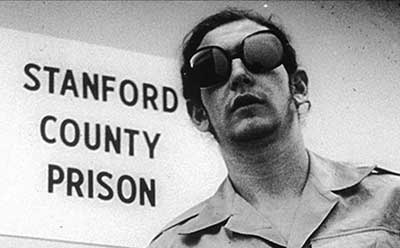
It was 1971 when the prisoner, emotionally drained, sleep deprived, chained, and dehumanized in his rough muslin smock was thrown into a tiny dark closet by the cruel guard nicknamed John Wayne, to endure solitary confinement without food or bathroom privileges. You might think this scene was from Hanoi in Vietnam, or at best a military prison in the United States. You'd be close. This brutal activity was funded by the United States Navy, which was interested in learning more about the psychological mechanisms in a prison environment. It took place at Stanford University in California, and the prisoner had done nothing wrong other than to volunteer for a research project. This was the infamous Stanford Prison Experiment, conducted by professor of psychology Dr. Philip Zimbardo.

Philip Zimbardo grew up in what he describes as a "South Bronx ghetto", and as a boy watched his close friends engage in acts of violence, abuse drugs, and wind up in jail. He grew fascinated by the question of why good people do bad things, and became convinced from a very young age that bad environments tend to poison the people placed into them. Put a good person into an evil situation, and that person will become evil. He later wrote:

To investigate this I created an experiment. We took women students at New York University and made them anonymous. We put them in hoods, put them in the dark, took away their names, gave them numbers, and put them in small groups. And sure enough, within half an hour those sweet women were giving painful electric shocks to other women within an experimental setting... Any situation that makes you anonymous and gives permission for aggression will bring out the beast in most people. That was the start of my interest in showing how easy it is to get good people to do things they say they would never do.

From his body of work, it is easy to conclude that he was actively interested in justifying a preconceived notion: That good people will become evil if you put them into an evil environment. About a decade after getting his Ph.D. in psychology from Yale, Zimbardo went to Stanford University, where he got tenure and then set about planning the experiment that was to define his career.

24 students were recruited for a two-week experiment for which they would each receive $15 per day. They were randomly assigned to be either prison guards or inmates. The prisoners were surprised to be picked up unexpectedly at their homes by real Palo Alto police officers. They were roughly hustled to their new home, stripped, deloused, and put into rough muslin smocks with no underwear. Zimbardo described it:

The question there was, what happens when you put good people in an evil place? We put good, ordinary college students in a very realistic, prison-like setting in the basement of the psychology department at Stanford. We dehumanized the prisoners, gave them numbers, and took away their identity. We also deindividuated the guards, calling them Mr. Correctional Officer, putting them in khaki uniforms, and giving them silver reflecting sunglasses like in the movie Cool Hand Luke. Essentially, we translated the anonymity of Lord of the Flies into a setting where we could observe exactly what happened from moment to moment.

The results have become legendary. Some of the guards seemed to relish their newfound authority a little too much, becoming sadistic, and working extra hours just for fun. The torment they put on the prisoners was real. Some began showing physical manifestations of stress and psychological trauma, to the point that one third of them had to be removed from the experiment early. In fact, it got so bad that Zimbardo decided to end the experiment after only six days, less than half the planned duration.

Zimbardo's conclusion was clear. Good, ordinary college students willingly became sadistic tormentors, simply because they were given the permission, the means, and the expectation of doing so. The Stanford Prison Experiment, and this well-publicized result, became a permanent fixture in the popular conception of psychology.

The problem is that a lot of the psychology community disagrees with his findings. Some found that any results were rendered meaningless by insufficient controls. Some have problems with his analysis of the results, reaching a different conclusion based on the same data. Some found the sample population invalidated by selection biases, or the size of the sample inadequate for statistically useful results. Some found methodological flaws that tainted the participants' behavior. Let's look at some of these criticisms in closer detail.

Dr. Zimbardo and the Stanford Experiment came into the news again in 2004, following the Abu Ghraib prison scandal in Iraq. American prison guards were accused of cruelty to Iraqi prisoners — the great Naked Human Pyramidgate scandal. A number of soldiers and senior officers were court martialed and imprisoned or demoted. The prosecutors claimed that "a few bad apples" were responsible. The defense disagreed, and called in Dr. Zimbardo as an expert witness to testify that it was the environment that was responsible, not the individuals. "You can't be a sweet cucumber in a vinegar barrel," he famously said. The court disagreed, finding (rightly, as many would say) that individuals must be held accountable for their own actions, and the few bad apples went to jail. Dr. Zimbardo then wrote the book The Lucifer Effect, drawing further parallels between his prison experiment and the Abu Ghraib scandal.

Psychology is complicated, and there will probably never be a perfect theory explaining all human behavior; so people should never assign too much significance to the results of any given experiment like the Stanford Prison Experiment. And, when an experiment receives a large amount of scholarly criticism from mainstream science, as this one did, you have very good reason to look past its portrayal in the popular media and, instead, be skeptical.

You should follow me on twitter here.

Brian Dunning
Brian Dunning

© 2008 Skeptoid Media, Inc. Copyright information

References & Further Reading

Brannigan, A. The Rise and Fall of Social Psychology: The Use and Misuse of the Experimental Method. New York: Aldine de Gruyter, 2004. 37-39.

Brockman, John. "You can't be a sweet cucumber in a vinegar barrel: A talk with Philip Zimbardo." Edge: The Third Culture. Edge Foundation, Inc., 19 Jan. 2005. Web. 24 Apr. 2008. <http://www.edge.org/3rd_culture/zimbardo05/zimbardo05_index.html>

Carnahan T., McFarland S. "Revisiting the Stanford prison experiment: Could participant self-selection have led to the cruelty?" Personality and social psychology bulletin. 1 May 2007, Volume 33, Number 5: 603-614.

Haney, C., Banks, C., Zimbardo, P. "Interpersonal dynamics in a simulated prison." International Journal of Criminology & Penology. 1 Feb. 1973, Volume 1, Number 1: 69-97.

Reicher, S., Haslam, S. A. "Rethinking the psychology of tyranny: The BBC prison study." British Journal of Social Psychology. 1 Mar. 2006, Volume 45, Number 1: 1-40.

Reference this article:
Dunning, Brian. "What You Didn't Know about the Stanford Prison Experiment." Skeptoid Podcast. Skeptoid Media, Inc., 27 May 2008. Web. 6 Sep 2010. <http://skeptoid.com/episodes/4102>

Discuss!

Remember, you should always read with skepticism the comments of anyone too lame to put their real name & city.

Wow, this is really fascinating. I learned about this experiment in a social psychology class in college, and the textbook and the professor presented it uncritically, with no reference to its results being controversial. Along with the bystander effect (as illustrated by the Kitty Genovese murder story, which, as I found out later, was also presented to us by this teacher without any of the criticism attached to it) and the Milgram experiment, the Stanford Prison Experiment was one of my favorite topics we discussed in class. I'm sad to know that it was misreported, but happy to see that the reality is likely not as scary as "anyone will turn into a complete depraved monster if you just give him some authority."

Sarah, Connecticut
May 27, 2008 1:23pm

I think it still stands as interesting. It's just not the definitive study some people make it out to be. Also, sometimes you just have limited time to cover things and can't get into every little detail of what the controversies are.

It's hard to say though, because like everything there's a fine line. I never heard any of the controversy either, but I'm not sure any of my intro to psych classes presented it in any way other than "here's what happened, isn't that interesting." rather than treating it like it was the end all study that proved that anyone given a badge and told, "treat these people like crap" will beat them within an inch of their lives without giving it a second thought.

There's probably some amount of controversy surrounding any study or idea and how much you have to get into those probably depends on how much past a "matter of fact" teaching you get.

If you're in an intro class and all you're teaching is that the prisoners were really "arrested," after a few days some prisoners couldn't handle it and had to be sent home, and the entire thing got scrapped after only half the planned time, and so on, I'm not so sure you need to get into all the controversy.

Now, if you are in a class designed to be more advanced that is actually getting into methodology of studies and whatnot than yes, this should probably not be a shining example of a flawless study. Even if it were, one study involving so few people wouldn't mean anything in any other studies.

Jeremy Lindgren (vita10gy), Eau Claire, WI
May 27, 2008 2:44pm

So, anonimity and the ability to be an asshole, makes people acts like assholes?

Well, with the invention of the internet, I'd say we can pretty much confirm that theory, for at least part of humanity.

Alcari, Reykjavik, Iceland
May 27, 2008 4:50pm

Has anyone ever tried to replicate this experiment with proper controls?

Cambias, Amherst, MA
May 28, 2008 5:07am

I too learned about this experiment in psych class back in the day. We did discuss the selection bias, but in a completely different way. These were not thugs from the hood with violent or criminal histories, they were soldily middle-class, even well-off students. If anything, the results should have skewed the other way, against the observed behavior. Also, the conclusions of this experiment are supported by other experiments that show in general that people are capable of greater cruelty than one would think. The character of the target matters a lot. At one point during the experiment, the prisoners rebelled, and things deteriorated after that. In the mentioned shock experiments, people would shock a person more if they were told the person had a criminal background.

Chris Moyer, Decatur, GA
May 28, 2008 5:13am

Interesting. I'd always thought that people considered it to be more of a verified anecdote.. as in, "This is a situation that can occur, even with people not known to be sadists", not an experiment demonstrating what will happen when people are put in a prison situation.

Patrick, San Diego, CA
May 28, 2008 6:36am

"Any situation that makes you anonymous and gives permission for aggression will bring out the beast in most people."

If this premise were true, the World Wide Web would never have made it out of 1993.

Alan B, Long Island, NY
May 28, 2008 3:37pm

Almost *all* psychology experiments, including the most famous (and infamous) are conducted at elite research universities on undergraduate subjects who are children of privilege, so I'm not so sure that the sample bias charge is particular to Prof. Zim's work.

Also, have a look at another infamous experiment, the Milgram experiment:
<http://en.wikipedia.org/wiki/Milgram_experiment>
Similar results.

Lastly, to Alan B.'s comment, uh, yeah, you’re really right on about the internet. I mean, it’s not like people who are anonymous on the internet feel free to behave like belligerent assholes now, is it?

Robert, Palo Alto
May 28, 2008 4:59pm

Sorry Brian but I thought this was a particularly poor episode. Was it your intention to argue that people are not a product of their environment? Or perhaps that poor African Americans are genetically programmed to commit crime on a larger scale than their rich white counterparts? At the end of the episode, you drew an implicit false dichotomy, where either people can be a product of their society, or they can be responsible for their own actions, as if there is no grey area.

Trying to argue that peoples' actions cannot be influenced by their environment in a very real and very shocking way is a tough line to tow - Nazi Germany taught us a lot about what people are capable of, if fed the right propaganda in the right circumstances.

Chris Doms, Tauranga, New Zealand
June 01, 2008 10:51pm

Of course people are not the product of their environment. Its easy to disprove that statement. Otherwise we would still be hunter gathers fighting in tribal groups. Some people let their environment eat away at them, for some even the worst environment is a motivator, and some let a privileged beginning take way their motivation. Its combination of their situation, personality, the culture in which they were raised, and ability.

Aaron Richoux, New Orleans
June 08, 2008 6:49pm

If I may interject a couple of related fiction works on role reversal and behavior, the novel ‘Lord of the Flies’ basically makes the statement that man is inherently evil, as a group of young innocent school boys transform into a tribe of deceit and murder. While only a classic work of fiction, many see this story as a true reflection of man’s instinctive darker side.

On a lighter note, the 1983 movie ‘Trading Places’ with Eddie Murphy takes light-hearted look at role reversal between rich man-poor man.

Whether were talking fiction, scientific studies, or real world examples, such as Nazi Germany, mob mentality, or simply peer pressure, it appears that some people do become a product of their surroundings, and I think this is what the Sanford experiment was trying to prove. However, psychology is not always a black and white subject, and any related experiments will always be open to interpretation, as Brian has done here.

Ken Stringer, Atlanta, GA
June 09, 2008 11:19pm

Its ironic that Michael Shermer made a reference to this experiment in his book "Mind of the Market" but does not hint at any skeptisism. I wonder if Brian and Michael had any back and forths on this while filming "SKEPTOLOGIST" if not it would be a good episode 2, at least to show that there's more to skeptisism than just doubt.

Juan R, Baltimore
June 11, 2008 9:35am

I think the issue of the quality of the sample is more important than many of Zimbardo is letting on. Nobody would say that the mean shoe size of 25 male college students is representative of the general population? Nor does anybody discuss the influence factors while the participants were outside of the experiment. Or, to point...why don't prison guards in the real world begin to act the way the participants did? Also, what about other situations that promote anonymous, controlling behavior...like frat house initiations?
And where was the control group? Which variable caused the students to act the way they did?
There are to many people who want this to be true for whatever reason.

Deucer, Biloxi
June 16, 2008 1:34pm

Zimbardo's book, The Lucifer Effect, draws on a wide range of controlled psychological experiments as well as examining historical precedents (Nazi Germany and the Rwandan genocides among others) to support his hypothesis.

Although your criticisms of the SPE are generally valid, I would raise two objections:

-Your contention that only one prison guard ('John Wayne') acted in a sadistic manner is inaccurate. Admittedly this guard's behaviour was most striking but several others readily abused their position of authority. I would therefore not accept your conclusion that the environment 'did not affect most participants'.

-The applicability of psychological research is limited when it attempts to investigate human behaviour in contrived simulated environments. However, even in 'natural' environments, the act of observation will invariably influence the outcome.

Zimbardo's body of work does not provide conclusive proof for his hypothesis (but then he doesn't argue this is the case). It does provide pause for thought and a scpetic should apply equal, if not greater, scepticism to the cosy assumption that 'evil' is an inate quality.

Fraser Gibb, Edinburgh, UK
June 17, 2008 2:14am

Seems right in line with the celebrated Milgram experiment, where numerous participants did something they could not have conceived of otherwise doing (though some stood up to authority). I guess the difference in the prison experiment is that he was testing the locale and HAVING authority, rather than obeying it.

I think it's an interesting experiment, and one that is possibly impossible to conduct with the sorts of controls that Brian might want to see. For example, how would you eliminate the selection bias? Kidnap random people off the street? That would do it. Having people sign up for a random trial would likely be unethical unless they were offered an 'out'- that would still cause selection bias based on who stays.

Anyway, it's still a good alternative take on a study that may be presented in a one-sided fashion regularly...

eric thorn, Seoul, ROK
June 23, 2008 1:13am

I am grateful to you for this article. Zimbardo, who has appeared in a psych series on TV, has always seemed to me to be an advocate rather than a scientist. His appearance at the Abu Ghraib trial is confirmation that he's still pushing his pet theories. That experiment was so very flawed and the similar Milgram experiments, too, would be anathema today and ought to have been, then, as well. To use people as puppets without regard to the impact on them is immoral.

Freddie Bendell, Oak Harbor WA
July 01, 2008 8:33am

We watched a Discovering Psychology video in my psychology class last year in which Zimbardo explained this experiment. He said it got so real that even he and his collegues began believing the situation, which is a reason it was stopped, but it's just amazing what the power of situation can do to anyone. Zimbardo's experiment is regarded still as highly controversial ethics-wise.

Megan, Fort Worth, Texas
July 02, 2008 9:54pm

so we don't know whether the results had validity, or if so, how much. but a causal link has not been disproved.
therefore, while the possibility exists that the behaviour might have resulted from the environmental conditions; while we are still not certain that they were NOT, we should at all costs avoid reproducing those conditions.
ie abolish this whole line of thought and practice. never again abu ghraib.

the fact of helplessness in a persecution victim is provocation to further violence. this is empirical. what needs to be established is why.

hz, melbourne
July 03, 2008 7:39am

Clearly from watching some of the footage of this experiment, Mr. "John Wayne," was not the only guard to abuse his powers, as mentioned by Mr. Gibb.

But it is also true that their were more severe conditions at the Abu Ghraib prison in Iraq. I'm sure these soldiers had taken a toll from the war itself, yet this was ignored due to the fact that our country needs to seem correct and just in all its actions.

Does this not almost compare also to the My Lai incident during the Vietnam War? A different setting of course, but in all three situations <i>nearly</i> every participant was, in the end, affected by the movement of the whole.

I believe it is merely a combination of ones own personality as well as the actions of the society that affect a single person and their actions.

Surely you would do some things you wouldn't normally do if you <i>knew</i> you could get away with it, especially given a taste of absolute power. Perhaps not though, the human mind, as mysterious as it is, remains so even to us today.

Zimbardo in his experiment with the "broken down cars" (forgive me I do not recall the correct title for the experiment) clearly shows the impact of certain societies on individuals.

Can you so readily shoot down the fact that bad environments help to push an individual towards bad behavior?

Still I agree with the part you mentioned about insufficient controls and the lack of information on participants outside of the experiment itself.

Thanks for the read,

Joe

Joe, Tampa, Florida
July 03, 2008 11:56am

This experiment was unethical by ANY time's standards, not just "today's".

greghousesgf, california
July 03, 2008 3:13pm

I've read Zimbardo's book, and seen tapes of the Prison experiment. I think you mean well to raise questions, but the article itself is a croc of shit. The situations to which they were assigned resulted in a high level of toxicity, it poisoned the individual and his behavior. They were allowed to keep order by any means except violence; This allowed for demeaning and embarrassing acts of punishment, and ever more sadistic ways of punishment.

He made clear in his book that this people were elected for the fact that they had no previous mental problems, and they themselves confessed that they wanted to experience what a jail felt like in case they were ever imprisoned. They chose middle class students because they lacked any "pathological" issues.

I applaud his advocacy for the reforming of poorly thought out systems. Such as Abu Ghraib or Gitmo. These places are a stain on American History and shouldn't exist. If I had evidence that 2+2 is 4 but everyone in society thought otherwise, wouldn't that make me an advocate? On your point of view, nobody should advocate their point of view, even if it withstands criticism.

Experiments such as the Milgram Experiment and the Stanford Prison Experiment, although highly unethical today, should not be thrown away. Their validity and evidence of conformity, situational pressure, and other factors, should be lessons for those who think themselves invincible morally or otherwise.

If you think by grammar sucks, big deal I'm foreign

Manuel, Cypress
July 03, 2008 3:49pm

" First, the issue of selection bias. ....all applicants to the Stanford Prison Experiment were preselected for comfort with the idea of "prison life"."

But not for their preference for being either a guard of a prisoner. This was random. Since it was the role that appeared to result in the behaviour the original "bias", if it existed, did not appear to be significant.

It would have been interesting to see how the subjects reacted in reversed roles.

Rosemary Lyndall Wemm, Danville, CA, USA
July 04, 2008 1:03am

Ironic that you are asking individuals to be skeptical about a book/professor/experiment that is skeptical. Indeed all scientists go in with a particular bias when developing an experiment but that is primary due to the extensive backgrounds we carry in others research. For example, if I were to conduct an experiment on the decision centers in the brain I would look at all of the prior work done on this topic and then develop a hypothesis. Because he was acting much like a Freud of his era, there was not a plethora research to go upon so we have to use our other methods of informing oneself on a topic. Observations. Where you see bias and lack of control I see correlative evidence. In social psychology you rarely get causality.

But back to the original point. The theme of the entire book is to consider your situation and the situation of others. To be skeptical of your situation and attempt to still maintain your humanity.

N Ring, South Bend
July 05, 2008 2:45pm

"Most of the Stanford guards did not exhibit any cruel or unusual behavior, often being friendly and doing favors for the prisoners."

Was this before or after spraying them with firehoses for starting a riot? Or when they had them stand and chant in unison, denouncing one of their fellow prisoners as he bordered on a mental breakdown?

"Was he generally a friendly guy, or might he already have been a royal jerk?"

The debriefing and interview shows that John Wayne wasn't an ass- his normal behavior, as documented in the above source, shows him pretty clearly as a calm and normal person.

You do have a point with statistics, but this was a one-time experiment on a small-scale. The APA would never clear something like this again, so what we have now must be used to its full extent.

Jon, USA
July 08, 2008 1:08am

Try your own experiment on it. Try to identify a personality that you don't like, then act out the personality. The personality would have to be something that is pretty different from the people around you so that they will dislike your nonconformity. See if you can act it out even though everyone dislikes you. Try to do something like let everyone around you think you are a pedophile. If you can even attempt at doing it, you will see how hard it can be to not conform.

I realize that there was only a small amount of people in the experiment, so the knowledge that people outside of the experiment would support your nonconformity in that situation would make it easier to rebel. The idea was to see if good people in a bad situation could stay good, or would conform. Since good and bad are relative, just switch it to see if you can stay bad in a good situation to give you more perspective on it.

Adam, Vancouver, WA
July 08, 2008 7:55am

Congratulations for highlighting the weaknesses and flaws in the most over-rated experiment of all time. The Stanford Prison Experiment provides no useful insights, scientific advances, or revelations about people at all.

By his own account, Zimbardo oversaw and even participated in brutalisation of the young volunteers in his experiment. He should have been drummed out of academia in disgrace, but instead he has been allowed to parade around like some kind of expert on evil and cruelty.

The statistics- you were too kind - there are no meaningful statistics to be derived from the experiment - it was qualitative research at best.

The experimenter was as you rightly point out, utterly biased, and to make matters worse, actively controlled the proceedings! Proceedings that were overtly sadistic!

Stanley Milgrim's experiments on cruelty were thought-provoking and useful. Zimbardo is not Stanley Milgram. Not by a long shot.

Congratulations again for questioning the common practice of of teaching this garbage as science.

David, Sydney
August 09, 2008 2:55am

Anyone who has ever worked behind a counter can assure all who are interested that, yes, you are all degenerate assholes.
There is not a single individual not related to me that I would give half a thought to screwing over, simply because the overwhelming evidence is very, very clear: you are an asshole, I am an asshole, and anyone who claims otherwise is trying to sell you something.
And I may reconsider regarding my family, if evidence comes to light.

Yes, the above is cynical, but realistic.
If you've never felt the same way, please tell me what part of fairyland you reside in.

David Horrell, Alachua/Florida
September 08, 2008 11:33pm

David Horrell, it's well known that cheaters think that everyone cheats and assholes think that everyone's an asshole. Think about that.

Max, Boston, MA
September 10, 2008 8:02pm

I saw a TV special called "The Human Experiment" in an ethics class over the summer, and was really bothered by Zimbardo's experiment. I couldn't quite put my finger on why, so I picked up "The Lucifer Effect" from the library and read part of it. What I realized was bothering me was the sensational level of the experiment. It seemed like it was created for the purposes of marketing, not research.

Zimbardo must be aware of the criticism that he was essentially "cherry picking," because he claimed in the special that he'd expected a different outcome. But from what I've seen and read thus far, it really does appear that he actively influenced the experiment.

I'd suggest that what was really going on is similar to what you see in exorcisms: role-playing. Some of the subjects in the experiment, clearly influenced by films like "Cool Hand Luke," allowed themselves to slip into roles that they believed were proper for the setting. Zimbardo seems to have encouraged this, and may have even planted the idea.

My experience is that anonymity can cause some people to behave badly, yes. But much of the time, I would argue that it causes people to behave more decently since they fear confrontation and avoid drawing attention to themselves. Being nice to strangers is a socially acceptable behavior; being unpleasant is generally punished by confrontation and unwanted attention.

SeanJJordan, St. Louis
December 02, 2008 11:19am

It's unfortunate there were no legal ramifications for that incident.

Zimbardo should have been fired, sued, had is license suspended, and Stanford Univ. should have been sued into bankruptcy.

S. M. Shultz, Lincoln, Nebraska
February 09, 2009 2:01pm

What is interesting about discussions on this topic, this experiment and others like it (Milgram Experiment) is the two extreme OPINIONS about them. Either people praise the experiment and point out that people are generally capable of poor behavior, OR the experiment is completly flawed. The discussions alone prove a lot about human behavior, the above comments either say: do your research on human behavior, look at commone factors that prove it to be correct. Such as events in military prisons. OR They should be sued, licenses taken away and the like.

I have seen the inside of state prisons and federal prisons, and noticed there are many who live beter than some outside those systems, I have also noticed very clear abuse that is covered up by the profiting prison system. As soon as you say something to the effect of "the government should..." "if he would have followed the cops orders he would not have been injured", you have proved that the experiment, while flawed, carries a lot of merit in human behavior. When men are given authority over other men, they need to take control, and to take control, you end up abusing those you want to control at many different levels... not just physical.

The next time you go to your local DMV to "register" your vehicle and get a tax tag (license plate) you will clearly see the point I am making. Man can be organized, and not controled by other men. Most have been trained to bee too afraid for that though... hence, proof again.

Mr. Smith, Salt Lake City, Utah
February 19, 2009 10:50am

Mr. Smith.

I hope that your comment is used in a future episode to define straw man. You argue that because people are against an experiment that had several ethical or incorrect procedures therefore those people hate all experiments. I'm sure that many people would be all for doing these same type of experiments in a more appropriate manner.

I really hate to bring up Nazi's since it usually leads to weak arguments but if I say that Josef Mengele was unethical or crazy and his research wasn't done properly does that mean I hate all modern medical research or research into new surgeries or genetics? I doubt it. If I were to support medical research that doesn't mean I have to believe all researchers are perfect either.

I also don't really see any proof in your claims, just what is perceived by one person.

I can't quite understand your last argument so I'm not going to comment on that one. Maybe you accidently pasted a fortune cookie or haiku into the middle of a sentence (I kid).

Turner Joy, MN
March 08, 2009 11:07pm

Mr Smith,

I think you are a little confused about how to interpret experiments. Yes the Zimbardo and Milgrim's (and Harry Harlow's and Watson's) experiments are ethically flawed - this does not logically entail that they are flawed experiments. What they neatly show is that people TEND to follow instructions from authority figures (Milgrim) or adopt certain social roles based on situational factors (Zimbardo).
The fact that participants experienced distress in these experiments does not invalidate the conclusions of the experiments.
I'm not defending the conclusions of the experiments per se. However evaluating the conclusions of any research should not be based on ethical grounds, but instead it should be based on whether the conclusions logically follow from the experiments' findings.

Bronson, Sydney, Australia
May 11, 2009 12:18am

A lot of these points are incorrect, to be honest.
1. The people chosen didn't know that they were going to be guards or prisoners: in fact, most of them wanted to be prisoners. This was during Vietnam student protesting, you see.

2. None of them exhibited good behavior, either. All of them did not treat the prisoners as peers, and the worst guards were pretty harsh while the best guards did not participate.

3. Zimbardo himself stated that he couldn't help but participate due to him taking the role of the prison warden.

4. The individual personalities did not give any indication of the tendency to sexually harass people. This wasn't ignored, you just didn't do the research.

5. The Prison Experiment has been repeated, and in similar environments similar results occur.

6. Again, other people have repeated the Prison Experiments and found similar results.

Not to mention that the problem with the Abu Ghraib trials was that the individuals took all the blame for the torture, while those in charge of the environment took none of the blame whatsoever. Everyone would have tortured the prisoners if they were in that situation.

Daniel Valle, San Jose, CA
May 20, 2009 10:51pm

I think the fact that the experiment was biased in that they were almost encouraged to be abusive is good.

Because there is normally condonement - explicit or implicit from authority when this happens in real life - holocaust/ slavery etc.

Not all guards participated or approved but none of the "guards" withdrew or protested against the worst guards actions - thats an interesting observation in itself. In terms of compliance with authority - the researcher himself

mike, london
May 28, 2009 9:01pm

I call hypocrisy of the author, because he also had preconceived notions for writing this skeptical analysis of the Standford prison experiment.

Charles, Tucson
June 10, 2009 10:07am

You have made many valid points but I do disagree with your claim, "the scientific method starts with a null hypothesis". I take issue with this statement because it implies that all natural science requires the use of a null hypothesis when in actuality, the opposite is true. 1) the methods of science are determined by the environment being studied and therefore there is no single scientific method but the methods of science are many. 2) science does not depend on the use of a null hypothesis because most natural scientist do not use statistical methods as an experimental design, instead, they may use statistics as a set of data analysis tools and it is never considered a "source" of knowledge.

lawofeffect, denton
June 10, 2009 7:46pm

On May 20, 2009 Daniel Valle of San Jose, CA wrote:

5. The Prison Experiment has been repeated, and in similar environments similar results occur.

6. Again, other people have repeated the Prison Experiments and found similar results.

Daniel, I would very much appreciate if you could provide when and where these similar experiments were conducted.

Thank you,
Arnell Dowret
New York, NY

Arnell Dowret, New York
June 30, 2009 3:19pm

Hi,

Just on a personal note.

I have seen first hand what people can do with 'unlimited' power. (The place and situation have no bearing here, only the fact that it happens under certain circumstances.)

It makes me think that we are all basally (basically?) reptilian by nature, and only our surroundings and external conditioning limit our actions.

Once we have no boundaries, or even worse, an authority figure who gives us permission to do sociably or ethically unacceptable acts, most of us will willingly go along.

I am an atheist, but this is one of the main reasons I believe religions developed. Control of the masses, although initially might seem "bad", was probably a great contributing factor to our cultural and social evolution.

I know it sounds ugly, but we are animals, and a lot of us will behave as very bad animals given the chance.

This is a great post, although I feel that this kind of human reaction happens in many many other day to day situations, but as the results aren't as direct and intense as this controlled experiment, they aren't as noticeable.

Thanks for the food for thought!

Trymaw, London
September 02, 2009 1:05pm

1971 is a long time ago in psychological science, or should I say, social psychology to become a science. Zimbardo's experiment was unique, with a lot of methodological flaws. I agree with most of the ones you mention. Setting up this experiment nowadays would be different. But I do think that both Zimbardo's and Milgram's experiments changed the way we understand the role of the context in submissive human behaviour. And yes, we do need a replication. And yes, contemporary ethical committees would disapprove.

Sure, Zimbardo still talks about his findings. But he is honored and will be remembered because of his diversity, and how he integrates different fields of psychology. You might want to read some of his other work.

Be skeptical might be the first rule in science. Do something original perhaps the second. Your criticism could use more of the second I guess. Science is not meant to be just science, but a means in understanding our world. Not everyone went all the way in Milgram's experiment, and not all the guards became mean in Zimbardo's fake prison. But we now understand that some will, partly because of the context. That's original. Putting rats in a controlled lab environment is science. And makes hardly any sense in understanding human beings.

Wessel van Beek
psychologist/scientist

Wessel, The Netherlands
October 14, 2009 12:07pm

This topic interests me because of a family history in law enforcement and corrections. Regardless of whether the study was scientifically valid, I believe its general conclusions are true and have been validated by other studies like the Milgram experiment. And I have seen first hand how generally nice people, once in law enforcement, begin acting in a much more authoritarian and aggressive way, fitting in with their new peer group, including becoming vastly more racist, actually looking forward to getting to try out their batons and tasers and such.

Marissa, New York
October 25, 2009 7:12pm

I read through this and while I agree that the Stanford experiment is not scientifically valid, when you apply the facts of what happened during this study to other similar studies such as Milgram's experiments on authority as well as such things as the bystander effect studies, there is definitely enough evidence to suggest that despite its flaws the Stanford experiment does hold some weight. Especially considering that the study became so stressful on the volunteers who were assigned to the prisoner group that one person had to leave, a riot broke out and the entire study had to be shut down before it was even half way through being done. The Stanford experiment is also an important lesson in ethics and controls being set up in experiments for those who are going into psychology so this sort of trauma cannot occur again.

Lauren, New York
November 20, 2009 8:34pm

What about the Milgram experiment? Also what about the normal day to day stories we hear about where people actually do awful things they wouldn't do under "normal" circumstances. What about the kids beaten on the school bus while the other kids cheer? The young employee at McDonald's whose manager strip searched her via suggestion from a phone call? I agree with Zimbardo, I think a majority of people can and will do things they would not normally do when subject to peer pressure and/or authority.

Kim Beaty, Manassas, VA
January 08, 2010 2:19pm

Allow me the opportunity to be a skeptoid myself:

From the article:

"the great Naked Human Pyramidgate scandal"

This purported 'summing up' of the scandal has been widely used to glibly trivialize the evil that was actually done, as if the naked pyramids were the worst that happened at Abu Ghraib.In fact, anyone can easily find on the web pictures depicting far more brutal examples of bloodshed and terror than any 'naked pyramid' in the photos taken by the prisoners themselves. Buying into the military's spin is not the act of a "skeptoid."

From the article:

"A number of soldiers and senior officers were court martialed and imprisoned or demoted."

Only true if you consider a sergeant a "senior officer."

From the article:

"The prosecutors claimed that 'a few bad apples' were responsible. The defense disagreed, and called in Dr. Zimbardo as an expert witness to testify that it was the environment that was responsible, not the individuals. 'You can't be a sweet cucumber in a vinegar barrel', he famously said. The court disagreed, finding (rightly, as many would say) that individuals must be held accountable for their own actions, and the few bad apples went to jail."

This is what is known in logic as "begging the question," as your conclusion simply assumes that the court was right, and those responsible were, indeed, "a few bad apples." Are you really satisfied that what happened at Abu Ghraib did not reflect American policy at the highest levels?

Tom, DC
January 13, 2010 11:41am

I have my doubts that the experiment was perfectly legal because a real Palo Alto Police Officer unexpectedly handcuffed the prisoners in front of where they lived. The prisoners only expected to get into the police car. No crime was committed so the handcuffing was completely outrageous. Is it perfectly legal for a real uniformed police officer to publicly handcuff innocent people in a realistic way? The handcuffing generates most of the interest because many people find it extremely entertaining. There are some shades of sadism here. The handcuffing is a likely breach of any consent for four reasons. First, the Palo Alto Police and the news media camera teams knew about the arrests and handcuffing but the prisoners didn’t. Second, it destroyed anonymity because the name and addresses of the prisoners became widely known. Third, it was public spectacle that had nothing to do with “no privacy” as was likely included in the consent. Fourth, the study into prison life was to take place on campus ensuring the anonymity of the participants. What do public arrests have to do with prison life? It’s obvious the neighbors and others could exactly figure out who was who in the Stanford film and photographs given that the prisoners were clearly identified. This badly hurt the future lives of the young prisoners. The public handcuffing was detrimental in the long term because the prisoners felt a need to continually explain it as part of an experiment. Every aspect of this experiment was brutal to the prisoners. In a study document a psychologist says that the guards were “to realize if the prisoners escaped the study would be terminated.” It was impossible for any of the prisoners to walk out because

Harold, Tampa, FL
February 11, 2010 4:08pm

I think Zimbardo has stated many many times that he was way off with the Stanford Prison Experiment. The ethics were bad and the whole experiment went wrong from the beginning with Zimbardo being both the supervisor and prison's superintendent.

I feel the remarkable finding is itself that the experiment got so far off hands. Zimbardo writes the following on his own website:

"...perhaps the most important was simply this: The simulation became so real, and the guards became so abusive, that the experiment had to be shut down after only 6 days rather than the two weeks planned."

On his book, The Lucifer Effect, he also states that the experiment was inhuman "the findings came at the expense of human suffering. I am sorry for that and to this day apologize for contributing to this inhumanity." (pp. 181, 235)"

There are many infamous experiments in the history of social psychology. Many of them are inaccurate or not up to the scientific standards of today.

I feel that there is definitely a group, role, deindividuation, environment, authority, circumstances -or what ever you want to call it - factor in human decision making and acting.

Again, in my personal view, I don't see Zimbardo denying the individual's responsibility in doing bad things. But he does state that the individual decision is widely affected by the circumstances (possibly more in the narrow experiments than in real life).

Otso, Helsinki, Finland
February 15, 2010 2:06pm

“From his body of work, it is easy to conclude that he was actively interested in justifying a preconceived notion: That good people will become evil if you put them into an evil environment.”

You make it sound like he set out to prove a point, maybe even unethically. That’s not fair. Like any good researcher, Zimbardo was simply interested in a specific topic area. The scientific method, used correctly, would prevent any bias from affecting his findings.

The fact that one of the worst guards, the so-called John Wayne, took his cue from a movie character says little about his willingness to use the behaviors of that character to mask, or even to justify, his bullying of the prisoners. It also says nothing about the other 1/3 of guards who took their cue from him and also abused the prisoners.

“Some researchers have also questioned why Zimbardo neglected the effect of individual personalities, instead generally attributing all behavior to the prison environment.”
I don’t know why they’d ask that. Obviously, it wasn’t the purpose of the study.

In science, we try to eliminate “individual personalities” (aka, extraneous variables) specifically so that they WON’T interfere in the study. As long as the subjects were randomly assigned to the role of prison guard, we can be relatively certain what caused their behavior. That’s Research Methods 101.

The static you're finding in the field of Psych boils down to an age-old debate between Situationalists and Dispositionalists.

Sheldon W. Helms, San Ramon, CA
April 17, 2010 9:23am

Before writing my own review of the Lucifer Effect as part of a blog entry I checked what others had to say about him and was surprised to find that it was almost all positive without much if any criticism. This surprised me since I found many problems with it and what looked like a clear conflict of interest. Zimbardo seems to be doing research for reasons other than what he initially claims and I suspect he almost certainly wasn’t a sincere opponent of the Viet Nam war as he claims. His focus seems to be studying ways to use authority and other methods to manipulate people and although he has partly admitted to this he is still doing more to manipulate people for the wrong reasons. Tour criticism was an exception. You seem to be the only person I’ve found that provided a better review of it so far. However even though I don’t agree with everything Zimabardo wrote I do believe that the situation is part of the explanation but not all of it and even though he had preconceived ideas to prove some of them were partially true. If any one is interested in the other comments I had about Zimbardo or a truth and education commission see the following blog entry (discussion about Zimbardo is on the second half):

http://zakherys.tripod.com/nonviolence/index.blog/2003131/truth-and-education-commission/

Zach Taylor, Boston Mass
April 19, 2010 9:15am

“Most of the guards did not exhibit any cruel behavior... the alleged poisonous atmosphere did not affect most participants.” This is factually incorrect and misleading. It is NOT true that most participants were not affected. Quoting from The Lucifer Effect (TLE): “Half of our student prisoners had to be released early because of severe emotional and cognitive disorders, transient but intense at the time. Most of those who remained for the duration generally became mindlessly obedient to the guards’ demands and seemed ‘zombie-like’ in their listless movements while yielding to the whims of the ever-escalating guard power.”
“As with the rare ‘good guards,’ so too, a few prisoners were able to stand up to the guards’ domination...Clay-416, who should have been supported for his heroic passive resistance, instead was harassed by his fellow prisoners for being a ‘troublemaker.’ They adopted the narrow dispositional perspective provided by the guards rather than generate their own metaperspective on Clay’s hunger strike as emblematic of a path for their communal resistance.” [p. 196) The video of the experiment bears out this observation.

As for the guards, about one-third did engage in cruel behavior, about a third were neutral and did nothing in the face of appallingly cruel behavior that, under other circumstances, no reasonable person would have tolerated (e.g., forcing the prisoners to make homosexual advances in crude and graphic language).
[From a longer response...]

Sharon Presley, Oakland CA
May 22, 2010 8:13pm

Make a comment about this episode of Skeptoid (please try to keep it brief & to the point). Anyone can post:

Your Name:
City/Location:
Comment:
characters left. Discuss the issues - personal attacks, posts containing advertisements or links to commercial services, nonsense, and other useless posts will be deleted.
Answer 2 + 8 =

You can also discuss this episode in the Skeptoid Forum, hosted by the James Randi Educational Foundation.

Join the Skeptalk email discussion list.

What's the most important thing about Skeptoid?

Support Skeptoid
Support Skeptoid
 
Skeptoid host, Brian Dunning
Skeptoid is hosted and produced
by Brian Dunning


Newest
The Myers-Briggs Personality Test
Skeptoid #221, Aug 31 2010
Read | Listen (13:10)
 
Yonaguni Monument: The Japanese Atlantis
Skeptoid #220, Aug 24 2010
Read | Listen (11:53)
 
Stalin's Human-Ape Hybrids
Skeptoid #219, Aug 17 2010
Read | Listen (13:14)
 
The Astronauts and the Aliens
Skeptoid #218, Aug 10 2010
Read | Listen (12:53)
 
Some New Logical Fallacies
Skeptoid #217, Aug 3 2010
Read | Listen (12:08)
 
Newest
#1 -
How to Debate a Young Earth Creationist
Read | Listen
#2 -
The Real Philadelphia Experiment
Read | Listen
#3 -
Medical Myths in Movies and Culture
Read | Listen
#4 -
MonaVie and Other "Superfruit" Juices
Read | Listen
#5 -
Religion as a Moral Center
Read | Listen
#6 -
HAARP Myths
Read | Listen
#7 -
Apocalypse 2012
Read | Listen
#8 -
The Detoxification Myth
Read | Listen

Recent Comments...

[Valid RSS]

ZIP Code Database

Skeptoid Podcast Skeptoid on Facebook   Skeptoid on Twitter


"The Pacific Garbage Patch"
inFact with Brian Dunning

Skeptoid is not responsible for the content of the ads below. Often they are great illustrations of what this episode is examining critically, so feel free to take a look.