




Is Peak Oil the End of Civilization?

Doomsayers claim that peak oil will produce worldwide panic and disaster, but the lessons of history make a very different prediction.

Filed under Environment

Skeptoid #100
May 13, 2008
Podcast transcript | Listen | Subscribe
Bookmark and Share

Think back to the days following 9/11, when all commercial and civilian air traffic was grounded. People were stranded everywhere. Only take it a step further: Take away the trains, the buses, and the rental cars. Imagine every gas station closed, and cars abandoned on the roadside as they too run out. People can't get to work and the nation's businesses can't even declare bankruptcy because there's no way to get to the courthouse to file the papers. The mail stops. Supermarkets are empty because there are no delivery trucks. And then, in a final shriek of terror, the power plants shut down, darkness falls everywhere, water pressure stops, and humanity devolves into a battlefield of hand-to-hand combat over who gets to eat the neighbor's dog.

This is the extremist scenario painted by peak oil advocates. Peak oil refers to the point at which world oil production must start to decline as reserves are emptied and pumps run dry. Oil is a finite resource, and so there's no doubt that at some point, peak oil will occur. The world's appetite for oil continues to grow exponentially, fueled by the explosive growth of most of the world's population in China and India. When the rift between increasing demand and decreasing supply gets to a breaking point, advocates say that the apocalyptic scenario described above must happen.

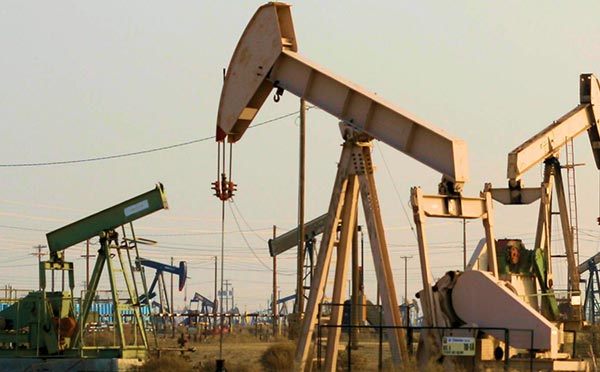
In some places, peak oil has already happened. In the United States, oil production peaked about 1970, when we produced about 3.4 billion barrels per year. Today we produce about 1.5 billion. The curve has followed the 1956 prediction by American geophysicist M. King Hubbert who described the oil production of any given region over time as a bell curve. This is called Hubbert's curve. Every region in the world has its own separate curve. Some, like the US, are already on the downside. Others, like Canada, which is just beginning to exploit its oil sands, are only just now hitting the steepest climb on the upside. In addition to Canada, the middle east and China are also still climbing their upsides. Russia has just barely tipped past its peak. The most pessimistic estimates for world peak oil say that it's already happened; the most optimistic give us another 30 years before we peak.

Oil production in any given region is not determined simply by physical factors such as the amount of reserves remaining and the technology required to develop it, but also by political and economic pressures. For example, Russia peaked way back in the Soviet days when their economy was falling apart, but their oil industry recovered throughout the 1990's and they've managed to find a second peak. The same could happen in the United States, if continental shelf and rocky mountain reserves were to be developed. They probably won't be, due to political pressures, but it's nice to know that they could be, if things came down to eating your neighbor's dog.

The biggest error made by the peak oil doomsayers is in failing to recognize the adaptive nature of the world economy. When demand goes up and supply goes down, prices go up, and consumers look to alternatives. As alternatives become more popular than the original, prices drop in reaction to the reduced demand, and eventually a marginalized industry disappears. Markets react and adapt. Currently, we have very high gasoline prices. Consumers are reacting by clamoring for alternative fuel vehicles. Many industrial products depend on oil, such as fertilizers, solvents, and plastics to name only a few; and as the price of producing these climbs, industry turns to alternatives. Alternatives become increasingly commoditized and prices come down. Oil becomes less relevant, and eventually nobody will care when reserves finally do run dry.

If consumers and industry failed to react to oil prices that climb astronomically for decades, then yes, it could be possible that we'd have an overnight shutdown of everything and the world would turn into a tumultuous battlefield of cannibalism. But neither consumers nor industry have ever acted this way, don't now, and aren't likely to in the future. Everyone wants to spend less money, and the most expensive options will always be least desirable.

Part of the reason that the doomsayers don't see this is that what's most visible right now is gasoline prices, and the total nonexistence of any viable alternative fuel vehicles. That's our worldview: Expensive gas, diminishing production, no alternatives. But outside of this worldview, some very interesting things are happening. Believe it or not, tremendous research is going on to develop alternative fuel vehicles: Supercapacitor technologies, fuel cells, hydrogen production. Silicon Valley is investing into alternative energy like a bat out of hell. And worldwide, industry is developing alternatives to petroleum based plastic like fructose. Agricultural fertilizers can be made from seawater or atmospheric nitrogen, but they're not in production because the market has not yet reacted that far. Eventually, when the price gap closes, these non-oil based sources may become the inexpensive standards.

What about other resources? Do they peak as well? Yes, they do, at least non-renewable ones do. It's generally believed that we're either just past or right about at the peak of gold production. Some 150,000 tons of gold have been mined throughout history, and the US Geological Survey estimates that there's another 90,000 tons still out there. Considering there's been a constant increase in gold mining efficiency, this all sounds about right. In many countries around the world, gold production has been dropping in recent years as reserves have been tapped out. But, do we need to expect a worldwide panic over gold? Probably not, since it's largely a luxury item and its industrial uses are relatively modest. We expect to see prices rise as supply diminishes, and probably a number of market adjustments until we settle into an eventual equilibrium of old gold being reused to meet demand.

There are other more serious resource peaks. Peak phosphorous, for one. Phosphorous is a crucial ingredient of both synthetic and organic crop fertilizers. And glyophosphate is a principal ingredient in herbicides used in super-high-yield genetically modified food crops. Both have seen dramatic price hikes in recent years as rock phosphate, the source of nearly all industrial phosphorus, is being mined out. If I stopped talking now, this would seem an alarming, terrifying prospect, and you might see doom & gloom web sites predicting global disaster the way you do with peak oil. Peak phosphorus is a painful situation for farmers, but it's one that's not insoluble. In the short term, farmers invest in the phosphorus companies, thus offsetting their production costs with dividend income. In the long term, the fertilizer producers continue their research into alternative supplies. High on their list is seawater, which is after all, the eventual depository of all agricultural runoff. This proposal is essentially an accelerated leveraging of nature's existing cycle.

Another peak that we're starting to hear about is peak silicon. In this case, it's not a physical shortage of silicon; it's the engineering limits of what you can do with silicon to make computer chips. Such a peak would mean that the capabilities of computers could no longer grow with our increasing demand on them. The doomsayer pundits could make an argument here too that overnight we'll start each eating other and burning down our cities and running around with babies on pitchforks. But in fact what happens is that the silicon industry fades and the graphene industry rises. Graphene is only one of numerous next-generation computer chip technologies that obsolesce silicon.

Generally, what tends to happen in any industry, is that by the time an existing resource runs out, inventive scientists have already come up with something better. When a production peak looms (be it oil, phosphorus, silicon, or anything), this provides a kick in the pants to accelerate development. Market economies work in such a way that investors are encouraged to fund such development, and the bigger the looming problem, the bigger the investment to meet it.

Mark Twain used to speak nostalgically of the sad disappearance of the riverboat industry. It was killed by steam trains. Steam trains were later killed in turn by diesel electrics. The glory days of rail travel were ended by the advent of airlines. Eventually airliners aren't going to be able to burn jet fuel anymore. What will happen then? Today, I have no idea; much like Mark Twain had no idea that airliners would one day replace his beloved steamboat. To assume that the current state of technology represents the last and final stage of development is a completely ignorant viewpoint. To listen to the doomsayers is to be completely uncritical and unskeptical. I don't know what's around tomorrow's corner, but all the evidence of history tells us that it's probably not a big scary dragon.


You should follow me on twitter here.

Brian Dunning
Brian Dunning

© 2008 Skeptoid Media, Inc. Copyright information

References & Further Reading

Cordell, Dana, Drangert, Jan-Olof, White, Stuart. "The story of phosphorus: Global food security and food for thought." Global Environmental Change. 1 May 2009, Volume 19, Issue 2: 292-305.

Deffeyes, Kenneth S. Hubbert's Peak, the Impending World Oil Shortage. Princeton: Princeton University Press, 2001.

Grubb, Adam, Anderson, Bart. "Peak Oil Primer." Energy Bulletin. Energybulletin.net, 11 Dec. 2009. Web. 16 Dec. 2009. <http://www.energybulletin.net/primer.php>

Swartz, Spencer. "World Need for OIl Expected to Ease, International Energy Agency Says Conservation Efforts Will Trump Any Global Economic Recovery." The Wall Street Journal. 4 Nov. 2009, Nov. 4: A13.

Tinker, Scott. "Of peaks and valleys: Doomsday energy scenarios burn away under scrutiny." News Releases and Features. Jackson School of Geosciences, University of Texas, 25 Jun. 2005. Web. 16 Dec. 2009. <http://www.jsg.utexas.edu/news/rels/062505a.html>

VanDerwater, Michael. "Oregon Builds a Solar Forest." Solar Today. 1 Jul. 2008, Volume 22, Number 4: 20-21.

Reference this article:
Dunning, Brian. "Is Peak Oil the End of Civilization?" Skeptoid Podcast. Skeptoid Media, Inc., 13 May 2008. Web. 6 Sep 2010. <http://skeptoid.com/episodes/4100>

Discuss!

Remember, you should always read with skepticism the comments of anyone too lame to put their real name & city.

Thank you! Everywhere I go, I hear people talking about how the world is going to end because we're going to run out of oil. Finally, reassurance for everyone who thinks that doomsday is approaching

Michelle, Michigan
May 13, 2008 8:55am

I've been waiting for Mr. Dunning to tackle this issue since I started listening to the podcast. Well done, sir. Well done.

Josh, Massachusetts
May 13, 2008 9:10am

You use a lot of numbers in this podcast without saying where they came from. Unless you went out and counted the barrels of oil yourself, I'd suggest adding "According to" to the beginning of a few sentences.

You're advocating critical thinking, but not giving your audience the tools to critically evaluate your own arguments.

Ryan, Illinois
May 13, 2008 10:00am

Ryan, a little googling will find you the same numbers, the rest is just common economics.

Which brings me to a little point that I didn't find, concerning oil depletion.

As oil prices rise, previously unprofitable oil fields suddenly become interesting to oil companies. As the price increases, the world oil reserves INcrease, even though more and more is consumed. With the higher price, companies are starting to take a look at wells that were previously considered "empty", which actually means "it costs more to get the rest out then we get for selling it".

We're not running out of oil for a while, but we are running out of cheap oil.

Alcari, Reykjavik, Iceland
May 13, 2008 2:09pm

Hi Brian

I agree with you that the potential of the market to respond to shortfalls in supply should not be underestimated.

However, I think it’s too easy to be complacent about this issue. As evident by some of the comments above, it is comforting to assume that demand for innovation will make up for shortfalls in supply.

This whole topic reminds me a little of evolution by natural selection, and the tendency for nature to ‘find a way’. As zoology undergraduate I came across the exam question “Evolutionary biologists need not worry about the underlying mechanisms for an adaptive trait. If something is adaptive, it will evolve. Discuss.” (or something along those lines).

Of course, just because there is a selective advantage for something, doesn’t mean it will always arise. Evolution is a great architect, but it has to work with certain foundations, and these limit what it can do.

My point is: Markets don’t always work. Societies exhaust their supplies and they vanish. Given time and options, they can survive, but both of these are finite, and lack of time and options constrain their ability to adapt. My expertise on this is not based on first-hand evaluation of the evidence (only going as far as reading Jared Diamond’s recent book ‘Collapse’), but I’m not at present convinced that all the evidence shows that market forces will always solve problems of energy shortage.

I'd like to hear if other posters think I'm wrong...

Ian, Sheffield, UK
May 13, 2008 2:29pm

"Ryan, a little googling will find you the same numbers, the rest is just common economics."

No. This is not about the numbers or the argument. This is about properly sourcing an argument for listeners. Brian is making claims without providing evidence. It's not the listener's job to hunt down where his numbers came from. If a creationist or a parapsychologist tossed around numbers like this without providing a reference, everyone posting here would rightly excoriate them. If they demanded we used Google to find the numbers ourselves, they would be ridiculed!

Whether we're listening to someone we agree or disagree with, we must hold them to the same standards. Otherwise, we're just hypocrites looking for validation of our own opinions.

Beyond the context of the argument, someone somewhere worked hard to come up with those numbers. They should be recognized for their work. Brian didn't do that research himself. Giving credit to the person who did is only fair.

Ryan, Illinois
May 13, 2008 5:10pm

Brian,
Very interesting commentary, I do agree that the claims of end of civilization have to be taken with a grain of salt and that the world would at least try to adapt to changes in the availability of cheap oil.

Nevertheless I think that the situation is more worrying that you seem to believe. The first mayor problem I see is that the complete infrastructure of life in the US currently depends in the availability of a cheap and convenient sources of energy. Oil happened to both be a great source and delivery system of energy. Your examples of new alternative fuel vehicles do solve the problem of delivery but the source of energy has to be found elsewhere.

As you mentioned the US peaked in oil production in the early seventies and since the oil crisis of the middle of that decade there has been enormous amount of money invested in alternatives source of energy. But after three decades the percentage of total energy obtained from these alternatives is minimal. This is also an enormous problem since the scale of the replacement has to be gigantic.

So while I am also skeptical that the world will end I think that the current technological civilization has its days numbered.

Cristian, San Diego, CA
May 13, 2008 5:13pm

Brian,

I appreciate what you are trying to do -- smash the ridiculous idea of world disaster from declining oil reserves; however, instead of actually addressing the concerns you seem to set up a straw man and then wave the magic "free market" flag.

More subdued versions of the peak oil disaster scenario you painted may happen, and those versions deserve more attention. Much of our infrastructure and economy runs on cheap oil, and investment in alternative resources (particularly in the US) is incredibly small.

The main worry regarding peak oils is that we are already crossing the "hump", so the time for preemptive alternative investment is over. Right in the article you admit we have no viable alternatives ready.

So quick innovation is out. Demand will be reduced only to an extent -- our energy demands are not all that elastic without drastic effects on our economy. I don't have numbers to back me up, but biking instead of riding to the store only goes so far: the store still needs goods created and shipped using oil.

Depending on how quickly oil output drops, some industries may snap (see the Hirsh report). Large scale depressions do happen. The free market is not infallible, and we should not deify it.

Peter, Los Angeles, CA
May 14, 2008 2:04am

Part of the issue is that some oil-producing nations lie about the reserves that they have, in order to protect sales. And while it's true that people will want to switch to alternatives for transport, there's the issue of replacing the existing infrastructure - it's generally assumed that a single technology will be needed if it is to successfully replace petrol, and it's not clear which one will win.

Lee, Nottingham, England
May 14, 2008 2:55am

Another thought provoking entry!
But like other commentors have said, I think the situation is more complex and delicate. Most Western civilization depends on cheap, plentiful fuel. While the world might not descend into a reducto ad absurdum horror scenario en mass, the cost and complexity of converting civilization over to an entirely new fuel structure could be massively detrimental to all but the most privileged.

Another problem to think about--what if we do at the 11th, or even 10th hour discover wondrous energy replacement...what if to develop that energy and implement that change requires the use of petrol fuel we have (near)exhausted? What would happen if perolium scarcity gets to the point we can't fuel the machines and infrastructure needed to create th machines and infrastructure that would replace petrol dependent machines and infrastructure?

Liam, Springfield, MO
May 14, 2008 12:10pm

Brian,

A very thought-provoking episode to be sure. Coincidentally, I came accross this article today from The Sierra Club:

http://www.sierraclub.org/wecandoit/home/electric_cars.asp

Change won't come quickly and there will be some pain. Though certainly not the ultimate solution to the world's energy and transportation needs, just look how quickly hybrids have caught on. And Honda, not satisfied with how their solution compared with systems of its rivals, is in the process of building an even better one.

Thanks for taking the time to give us Skeptoid.

Greg, Centennial, CO
May 14, 2008 1:25pm

I have to side with Brian. The pain is already here, though it may subside. If I get a car with three times the mileage for her (possible because she is driving a 4 WD truck -- she has a MS in Environmental Education -- her choice not mine) we can pay for it with the savings in gas.

The energy crisis is easily soluble. We have enough nuclear material and the technology to deal with it (See Integral Fast Reactor for details). With the "mining the oceans for fertilizers" example Brian gives there is the added possibility of "mining" for uranium.

The solutions are already there. We can create electric cars that go 150+ miles on a charge. We can grow our own oil (biodiesel). We can build Nuclear Reactors to power the entire country cleanly and have little left over but some waste we have to shield for a couple hundred years.

Even though Gas is expensive, life is still pretty damn good.

Have a great day.

brad.tittle, bremerton
May 14, 2008 3:36pm

Congrats on being a centurion, Brian.
The surface has a good scratch.

Marius vanderLubbe, Nullabor Plain,Australia
May 14, 2008 5:34pm

It was his chapter on this Peak Oil conspiracy which made me stop reading Micheal Moore...I can't remember which book it was from but it was his chapter on this which made me stop reading his books.

Scott Harrison, Durham, England
May 17, 2008 1:24pm

Thanks Brian for this uplifting and well argued comment on peak oil. I have to admit that I got so much dragged down by the doomsayers that i started to lose sleep over the whole peak oil issue ever since I first learned about it roughly a year ago. My private life and all my prospects for the future became overshadowed by this looming spell of gloom.

But you are right, there are good alternatives, they just need to become comercially viable and they are with a barrel of crude at 130 dollars. The only sad thing is that my countries government wants to phase out nuclear alltogether. I think this is a dangerous step to take. I hope you in the US realize that the nuclear option together with electrification of personal transport is the way to go.

Jens, Germany
May 19, 2008 6:14am

Thought your case was well put Basically your case is ..price signals stimulate investment in newer technology or brings on line formerly unprofitable energy sources etc etc the 'hidden hand of the market' (of which I am very very skeptical) . But lets not get deluded by silly market theories .. we should remember we are living off 'solar capital' (fossil fuels) instead of 'solar interest' ( wind ,solar,biogas etc). The capital is finite. The only sustainable solution is to move to a 'solar interest' based economy. Left to the wild forces of the market this won't happen .What would be the 'market solution' ??? well let me suggest .. "create a market in energy certificates so that the rich dirty fossil fuelers can buy up the certificates and pollute as before .. a 'business as usual' approach .. nonsense you say ? its happening ...rich countries are simply trying to 'buy their way out' ..the other 'market solution' is to invade oil bearing countries .. like say Iraq ,Iran or even 'Burma'.. more nonsense ? . By observation that is how the market really works .. the 20th century saw 2 world wars which was really 'the market' deciding who owned the resources ..mostly oil ..i.e in Europe and South East Asia .So I think economics should be tempered with a bit more history ,politics and science

Dan, Australia
May 22, 2008 5:20pm

About 55 years ago, when I was in Junior High School, I was told that there was an oil crisis. It was so severe that the world would be completely out of oil in 25 years. Today, we're still running out of oil and we're still taking the same action as we did then.

bigjohn756, East Texas
May 23, 2008 1:23pm

You do make a good case as to why it wont totally collapse......but unfortunately as others have pointed out, you are forgetting that it will still have serious economic consequences for the US if it isn't ready. It is a fact that most Americans live in the suburbs now, sprawling subdivisions of mcmansions 20 or 30+ miles away from your job with 2 large gas guzzling vehicles parked in the garage. The supermarket is often 10 or so miles away and that is supported with a trucking system (the 3000 mile ceaser salad). This was build with cheap oil and can became very dysfunctional without it.
Then there is a human factor. A very large number of families have invested $250,000+ in The American Way of Life (tm), ie. the suburban life style. With so much already invested and after several generations expecting it to last forever and believe it is their birthright, does anyone really believe they would give it up without a fight? Many will fight it as long as they can, which will only make the situation worse.

Jason, China
May 25, 2008 9:22am

This podcast is an intelligent example of how to completely miss the point.

The point is not oilfields "running out" but MAXING OUT.

The point is can we GROW the supply of fuels to meet growing population demands.

The point in not whether "alternatives" exist but whether they can be scaled up affordably and in time to grow liquid fuels supply.

As the cost of the very energy sources underlying the development of "alternatives" grows, the alternatives themselves become the victim of the "receding horizons" effect, otherwise known as the "Red Queen": having to run faster just to stand still.

Albert Bartlett, Professor of Physics, U of Colorado, puts it this way: "The human race's greatest shortcoming is our inability to understand the exponential function." Listen to him here:

http://globalpublicmedia.com/lectures/461

The podcast acts as if the peakists have never heard of such things as "alternatives" and "market adjustments." But the peakists have done the studies which show what would be necessary to prevent liquid fuels shortfalls.

The best one is what has come to be known as the Hirsch Report, sponsored by the US DOE: It would take a "crash program" of alternatives and adaptations TWENTY YEARS to mitigate a peak with a decline rate of a mere 2%.

http://www.energybulletin.net/4638.html

Such glib dismissals of peak oil, fostered by the inability to understand the implications of the exponential function, are what dishearten me, not the phenomenon of peak oil itself

Mike, Maine
May 31, 2008 5:47am

To suggest that peak oil advocates expect the world to run out of oil over night is disingenuous and completely misrepresents the views of any peakist I know. Peak oil, and it is being played out as I write this, is slowly changing the economics of the world and not in a good way.

To suggest that the magic of the market will somehow solve this is nothing but wishful thinking and who isn't skeptical of that?

Dean, Colorado
May 31, 2008 10:30am

OK, enough of this nonsense. As Mike says above. It is not the peaking of oil production itself that is so bad. It's our current economic-political systems failure to deal with it.

Interestingly enough, we seem to be at or very close to peak oil production now. So we will not have to wait long to see if some of the doomerish predictions pan out.

With the recent run up in fuel and food prices, food riots and string of BKs from the airline industries your primal instincts that warn you if something is wrong should be going off like gangbusters. Do not dismiss this, rather investigate and understand the problem and know what you can do to mitigate the issue personally.

Arraya, San Diego
May 31, 2008 3:35pm

So we're supposed to believe it when a dude on the internet who writes dialogue for TV shows says the following:

"Russia peaked way back in the Soviet days when their economy was falling apart, but their oil industry recovered throughout the 1990's and they've managed to find a second peak. The same could happen in the United States, if continental shelf and rocky mountain reserves were to be developed."

This is just a damned lie, not supported by any petroleum geologist.

I guess "skeptoids" are people who throw out "facts" with no links to data for support.

Ben, United States
May 31, 2008 3:38pm

This sort of post is exactly why we're going to have problems - people making a cursory investigation of the problem, learning just enough to dismiss it without really understanding.

Matthew Terhune, Glendora, CA
May 31, 2008 8:40pm

"The biggest error made by the peak oil doomsayers is in failing to recognize... Markets react and adapt."

The biggest error by the author is to fail to note they also crash. As do societies/empires. And they tend to do this when a key resources fail. Maya: Water. Angkor Wat: Water. Rome: food and silver. Germany: oil. Anaszasi: Water.

This period of growth has been exceptional, not normal. Look at graphs of population, GDP and oil.

Finally: If markets supply alternatives, why haven't they? Time's up.

"This is the extremist scenario painted by peak oil advocates."

Wrong. You should say "some" peak oil advocates. Painting people with a broad brush is essentially lying. If you follow the issue closely - and you seem to understand the problems better than most denialists - then you know the statement is false.

"In addition to Canada, the middle east and China are also still climbing their upsides."

China is likely very close to peak and the ME has yet to prove they can grow their oil significantly. Saudi Arabia is on record as never intending to go higher than 12.5 mb/d. There's likely less than one year of depletion rate covered by what OPEC can do in the future.

"Russia has just barely tipped past its peak." Given how steep the rise was on that curve, it's likely to be just as steep going down. The total change from Russia raising production by 550kb/d - 650kb/d to going backwards is going to hit close to a drop of 1,000,000b/d within just a few years.
Oil production

ccpo, Seoul
May 31, 2008 10:47pm

Buckminister Fuller found evidence that whenever mankind faced a critical shortage there was always an innovation that occured just in time. This wasn't an assertion or a philosophy. He found real evidence to prove it.

There are a number of companies and government funded organizations that are researching alternatives. I don't think the problem is being ignored.

It really only takes about a dozen people or so to come up with the key discovery. If you assume that many of them will fail it really only takes maybe a few thousand who are engaged and focused on solving this problem.

Regarding the pain of change, many of you are probably too young to remember the gas crisis of the 1970's and the shortages caused by WW II. History has shown that people will rally in a positive way in the face of a crisis.

Jon, Los Angeles
June 01, 2008 3:06pm

The shortest way to dispell the doomsday predictions of some groups that capitalize on sound peak-oil theory is to point out that western industrial nations had large populations long before the use of oil became widespread.

An alternative to most problems already exists. It is called the apartment building. The suburbs may have to go.
Globalization will stay, since shipping is energy efficient. Distribution to sprawling settlements is the problem.

It is not markets but human ingeniuity that produces progress. Prices are only one of many motivations for inventors and markets are usually latecomers. The Toyota Prius has been on sale in Japan since 1997, at a time where oil prices couldn't possibly justify such cars.
Sales of zero energy buildings are way up. But the technology was developed decades ago by idealists and people with foresight, not by profit seekers who responded to market prices.

Some doomsday predictions are based on the assertion that fertilizers depend on natural gas. But only a tiny percentage of world natural gas production is used for that purpose and ammonia can also be made from coal (lots still left) or hydrogen (requiring electricity).

So even current technology is sufficient to sustain comparable or even better living standards. (Suburbs ruin the countryside for the rest of us)

austrian, Vienna, Austria
June 02, 2008 7:01am

Peak oil is going to teach the ignorant a harsh lesson! I cannot believe that our modern society with all of our knowledge can think we can continue to consume and destroy our planet without repercussions? It is totally illogical! Even if Peak Oil didnt collapse modern society as I know it will, another finite resource will. Maybe if more polititions had a science background they would see that we live on an agar plate (earth) and we are behaving just like bacteria, consuming and multiplying with impunity. In 1800 we had 1 billion people on this planet, today we have 6.7 billion! If that is not bacteria on an agar plate I dont know what is!!! Wake up sheeple, then again dont worry keep sleeping, its too late in the game anyway!!

Mike, Brisbane Australia
June 06, 2008 7:37am

"Buckminister Fuller found evidence that whenever mankind faced a critical shortage there was always an innovation that occured just in time. This wasn't an assertion or a philosophy. He found real evidence to prove it."

Didn't Fuller get more pessimistic about this in later life though? I'm remembering Critical Path being pretty hopeless, but it's been awhile since I've read it.

Richard, Belleville, MI
June 07, 2008 5:38am

I've never heard any Peak Oil advocate state the dire, apocalyptic scenario that you state. Instead, they say that the transition is going to be happen, and it could be rough unless we start preparing for it by developing alternatives and/or decreasing use in order to postpone it. By equating Peak Oil with doomsday, your anti-regulation, pro-big business political bias is once again leaking out.

Guy Mac, Tucson, AZ
June 07, 2008 12:50pm

I'm one of the nutty wacko's that's looking forward to the upcoming peak oil event, and I hope it's arrival is hastened by possible, albeit unlikely, overestimation of oil reserves. When gas reached $4.00 a gallon I viewed it as a bittersweet event.

To be fair my heart bleeds for the underprivledged in oil dependent nations such as mine, and as I was once very poor, I can appreciate the financial hardship the lower and middle classes are enduring. However as Mr. Dunning pointed out our economy, industry, etc. is very market driven. The only way to get the big money people really interested in developing alternative energy sources/systems is to make those alternatives more economically viable.

Hopefully the alternative energy or energies that become the most predominant are more environmentally friendly.

Matthew Love, Hastings, Minnesota
June 11, 2008 6:57pm

Hmm... you seem to be endorsing critical path and hoping that rising oil prices will spawn more innovation that they have before, fast enough to overcome dwindling supplies. This first depends on a gradual reduction in production. There is a problem with this, however: increasing demand has spawned faster drilling of oil reserves and wells, making their eventual exhaustion more rapid.

Still, I'd agree- at least for the moment- that the world is not likely to be running on oil the moment it runs out (and then... lights off!). Much more likely, however, is major disruption to civilization as a result of different groups- here I'm mostly talking about countries- trying to maximize their use (and control) of lessening supplies. You didn't see this when countries turned to oil from coal for a couple reasons... one, pipelines to not exist for coal. Two, coal still exists in most places, it is just more expensive and dirty. Three, oil was a place to go from coal.

Where will nations go when the oil starts running out (but isn't gone yet)? Nuclear? Perhaps. The infrastructure for nuclear production is good in some areas. I would not be surprised if nations, typically procrastinators when it comes to energy policy, find themselves with drastically less energy resources and raising costs of buying them on the world market; this could lead to the sort of wars that peak-oil proponents fear.

eric thorn, Seoul, ROK
June 22, 2008 11:39pm

I don't know, I find your response to be just "faith based". The peak oil information I've seen ends with saying we have to DO something, not sit back and trust that someone else will build a better mousetrap.

Our economies thrive on cheap energy, and if you're saying that we haven't developed alternatives because they are more expensive than oil (at $150 a barrel right now), then we're not going to have cheap energy, either way.

More importantly, we, as a world, are not even talking about a world without oil. Shouldn't we have a plan B? If we don't, then the worst predictions will, at least partially, come true.

Being skeptical about this doesn't help the matter, people need to address this subject.

David, Connecticut
June 23, 2008 7:52am

I Europe we've seen highspeed trains starting to replace airtravel in many places. Trains traveling at 300-350 km/h are faster than flying in many cases, especielly if you count the time required to travel to and from the airport.

My guess is that highspeedtrains will become more popular as they are not effected by rising oil prices.

Jonas, Uppsala, Sweden
July 11, 2008 1:14am

I always used to think that "Peak Oil" would be our dooms day, probably because the media loves to shine on that idea and capitalize off it. Also probably because I am an Al Gore fan :).

But anyway, I had never ran the situation through in my mind of what would happen in the event of peak oil, while keeping alternatives in mind also.

Great concept!

Well, in my opinion, i think after we run out of Mother Nature's: oil, natural gasses and coal, and whatever else we end up depleting, i think that we are going to take a trip back the the "primitave" times (but with futuristic eyes) and end up using our good old friends, the sun and moon, for generating power, renewable sources. So energy prices may be extremely high, but those extreme prices make renewable energy sources a lot more attractable to use!

-Adam

Adam, CA
August 04, 2008 3:37pm

The thing that is entirely left out of the above article is that, of the various resources he lists as peaking, oil is the one which, by its very use, causes additional problems of reduced air quality, environmental damage and emission of harmful toxins. By the time our ingenuity solves the energy problem, addition resources (read: cash) will have to be allocated to solve the addition problems...and their collateral effects, such as increased asthma, etc. While our grandchildren will inevitably be smarter and more inventive, they will also be unfairly saddled with a multitude of additional woes, if we don't act now to prevent it.

Betsy, Dallas
August 10, 2008 12:55pm

Great podcast, however, I'm struggling with this episode.

A small percentage of the world's population has consumed approx 1/2 of the easily available oil in 100 years. At the current rate of oil consumption, where's the rest of the world going to get their share? This applies to more than just oil.

We don't have an oil problem, we have a population crisis; too many people and not enough planet. It takes oil to manufacture the renewable solutions like solar and if we don't get our heads right and focus on the long term problem, we'll be looking over our collective shoulders and asking "how did this happen" while we look for someone to blame. Politicians around the world are still talking about growth and positive GDP so we can't count on them for much help.

We don't have to wait for technology to resolve this problem. The solution exists now in the renewable technologies we have like solar. Give them a chance by charging the true price for a barrel of oil or a KW of nuclear power and then people will implement those solutions on their own.

It's not going to be pretty and I actually think we're screwed. The world is full of sheep and fools arranging the deck chairs on this sinking ship we call earth.

Other than that, things look good.

Rick, Ontario, Canada
August 15, 2008 7:11pm

If people start walking to work when oil prices double, what will people do when it goes a hundred times? It will never reach such levels because people will stop using it long before it gets anywhere near that expensive. Anyone who thinks the world will degenerate into anarchy is completely ignorant of even the most basic fundamentals of economics.

David Luland, Sydney, Australia
September 27, 2008 6:29am

Like someone mentioned earlier, it takes energy to make energy. If we don't really get moving on implementation of the aforementioned alternatives soon, the transition will become extremely difficult because the cheap oil and coal that allow us to cheaply manufacture solar cells, wind turbines, batteries, new vehicles etc... will be gone.

Now, by this point, I assume America and western Europe will still have the resources necessary to make the transition. But, what about the poor nations of the world? As has always been the case, I fear they will simply be left behind.

Patrick, Orlando, Fl
November 10, 2008 8:23pm

Well...

"Dr. Gold strongly believes that oil is a "renewable, primordial soup continually manufactured by the Earth under ultrahot conditions and tremendous pressures. As this substance migrates toward the surface, it is attached by bacteria, making it appear to have an organic origin dating back to the dinosaurs."

http://www.rense.com/general54/ssust.htm

marlo

Marlo, Holland
January 15, 2009 2:42am

"Believe it or not, tremendous research is going on to develop alternative fuel vehicles: Supercapacitor technologies, fuel cells, hydrogen production."

Wrong - these are all energy carriers, (EROEI<1), not energy sources. In other words - supercapacitors (sic) provide more efficient transfers, they do not produce ANY energy. Neither fuel cells nor it's media hydrogen. The alternative to oil does not exist, except for natural gas, which may exist in quantity. The transformation to that infrastructure involves a multi-decade scenario, however.

"Anyone who thinks the world will degenerate into anarchy is completely ignorant of even the most basic fundamentals of economics."
Sorry? Can people eat money? Economics is meaningless in the event of mass famine - study the Chinese famine of the 30's/40's for proof of anarchy under those conditions. And, yes, failure of oil supply = massive famine. Idiots think that money is paramount, but sensible people know that food is far more important.

Kelly Mitchell, Dallas
January 22, 2009 2:22pm

Given the development of adequate sustainable battery and/or fuel cell technology, most of the world's ground based systems could run on centrally generated and distributed electricity. Peak oil would then not be such a problem. However, a considerable portion of the world's electricity is generated by burning coal which also will experience a peak in the possibly not too distant future. Wind power and solar can supplement and augment coal, as can hydroelectric systems, but not nearly enough with current technology to replace coal. Currently the only viable option which could replace the use of fossil fuels is nuclear power. There the chief obstacles are the time it takes to construct the plants and bring them online, and the economic and most importantly political will to build them. If we wish to see our energy enriched lives stretch far into the future without an intervening depression of resources then we need to speak out in favor of nuclear energy. It is clean, safe and reliable, it works, and most importantly it is available right now.

Illya Leonov, Huntsville, Alabama
January 27, 2009 2:27pm

Worthwhile reading, no doubt. What is not discussed is more troubling. We have not yet engaged our species in leveling off population, nor does it appear we will. Climatologists are beginning to think in terms of best-case worst-case but no avoidance of climate change catastrophe. Politically, there appears no change that would reflect the species developing less violent and destructive tendencies, hence resource wars seem inevitable. Nanotechonology is the Pandora's Box of the very near future. In the wrong hands (and that is inevitable) we will see the darker side of molecular creativity. Despite alternative energy technologies in the wings, the other cast of 'characters' appears dismal, and I think what we will see is an amelioration, briefly, of some of the worst of the future, before other factors overwhelm. I hope I am wrong, but the sum total of the above is far larger than electric cars, wind power or faster computers.

Steve Missal, Scottsdale, AZ
April 20, 2009 4:37pm

The assumption that I question is that scientists will have come up with the solution by the time oil runs out, whenever that is. I cant answer that, but do not accept it as a given. I also question comparing peak phosporus and peak silcone with peak oil. Seems like comparing molee hills and mountains to me. We need to support any (sensible)alternative energy we can. And yes I include nuclear in this. This is the way we can smooth the transition whenever the pump runs out.

Ronald Hughston, Mason City IA
April 24, 2009 2:11pm

try free energy!

lots of it around!

Pindar, austria
May 08, 2009 8:13am

I've always been mildly concerned about this... It kind'a reminds me of this incident in the 2nd grade where we were taking a standarized test, and one of the little essays talked about how the world was basically going to run out of water in 50 or so years.

Since I'm not good at comments like these, I'll just link you to what you inspired: http://emerald-eyes-phoenix.deviantart.com/art/BABIES-ON-PITCHFORKS-123269235

Iris, Louisiana
May 21, 2009 4:44pm

To advocating a big switch to nuclear power, you're forgetting that nuclear reactors use uranium, which will eventually run out as well. We'll start hearing about peak uranium soon enough.

chris, Canada
June 13, 2009 6:58pm

Maybe they (whoever they are) already have a replacement for oil or a new efficient replacement technology and they're waiting until we pay our last cent for the last drop of oil and then they'll say, "Look what we just found".

Depending upon how you are classifying people you can find some groups that do things like that, I guess, anyway.

Raphael, Vero Beach / Florida
July 31, 2009 7:50pm

Keep government control away and someone will come up with a partial solution. Someone else will come up with an add on, and we will be looking at "peak something else".
In the interim, guns, ammo and canned goods are a good investment.

Carl Holm, Rochester NY
January 04, 2010 11:56pm

Perspective, people. Humanity can adapt to new situations. We will adapt and survive. We're good at that sort of thing.

Worried about our growing population and oil demand? Think about the squalid conditions of cities during the Industrial era. People needed more space and a better way of life, and those ways were found. We stumble along and we make mistakes, but overall, we're heading in a good direction.

Abby, Austin, TX
February 19, 2010 9:33pm

In both this podcast and the one on ethanol Mr Dunning refers to the 32% of oil the US imports from the Middle East as minimal. I think that 32% in rather a lot and if not imported would have a very significant impact. To brush it aside is not up to his usual rational standard. In referring to unfriendly Middle Eastern countries he has a point, but perhaps misses the long term strategic aim that US might have in ensuring that they remain friendly, or if not friendly, make sure that remain on side.
Mr Dunning also seems to believe, almost religiously and certainly unskeptically, in the "Market' and its ability to provide alternative energy sources once the oil runs out.

Yossi, London
February 26, 2010 3:52am

Im guessing you might have already got this about episode 100, but theres a very good book that I read thats called $20 a gallon that talks about what will happen when oil runs out, first of all, its not a doomsday book, and it actually talks of it happening fairly smoothly, and it gets into just about every aspect of whats going to change that you can think of, Im guessing you'd enjoy reading the "good" side of peak oil

Blair, Hagen
March 06, 2010 9:18am

Just because peak oil doesn't mean "the end of civilization" doesn't mean it isn't a horrific prospect.

You're right that while peak oil is a verifiable phenomenon the issue is what this MEANS. Some people think it's a non-issue, others see it as presaging horror.

There are two things your response doesn't address: over-population, and what "alternatives" means.

Professor Albert Bartlett of the University of Colorado has an absolutely terrific look at the arithmetic of population growth and energy use. It's all about the numbers, and it's terrifying:

http://www.globalpublicmedia.com/dr_albert_bartlett_arithmetic_population_and_energy

The word "alternatives" is a sort of escape hatch. It is an all-purpose term, and it's false: supposed alternatives--biodiesel, ethanol, solar, etc.--are not opposites of oil but in fact dependent on oil for their production.

It takes energy to "make" energy, and that energy comes mostly from petroleum. The output of energy compared to the inputs of energy to make these "alternatives" is a mere pittance when you look at it. See the work of Robert Rapier.

We COULD have used our increasing oil production to establish a new paradigm, which Hubbert himself heartily suggested back in the 70s. But we've waited too long. On the backside of peak oil, we'll be clamoring just to keep pace with simply providing for people rather than establishing new infrastructure.

It may not be the end of the world, but it will be then end of what we hold dear.

Mike, Maine
April 04, 2010 3:47am

Comparing evolving technologies to raw materials is wishful thinking. I never see what is in my mind the obvious conclusion, there will be a need for less people on the planet. This may come about by design or consequence.

Jim Anderson, Katy
May 27, 2010 8:47am

When viewing this topic skeptically, I think it's important to not expect anything from the future. Trusting that "science will provide an alternative with time and demand" is not skeptical thinking, even though it might be true. Science can bottleneck; we see it today in medicine, which, after decades of supplying new "miracle cures" to a plethora of previously deadly diseases, has now slowed down to a trickle of new treatments and pharmaceutical drugs per year (many of which treat diseases with existing medication).

And let's look at a specific example, mass air transport. You simply can't fly huge commercial airliners without consuming vast amounts of fuel, and that means burning oil. You can't use electricity alone to fly a Boeing 747, and you never will. It's an example of a device designed for a very specialised purpose, taking advantage of a very specialised resource, but not one that's going to last forever.

Running out of oil won't be the end of the world, but we're not even close to becoming totally independent of it. I think there will be a lot of unforeseen bumps (and some pleasant surprises) along the way - as is the case with every period of technological growth. Whatever happens, there's one thing I'm sure of - the future won't be anything like what I'm expecting!

Liam, Salisbury
September 01, 2010 3:51pm

Liam, while I agree that it isn't safe to 'assume' that 'science will fix it', however in this case it does appear that 'science will fix it'.

Even the specific example you use is solvable by current, proven technology. You can use an electric source (it would have to be an abundant one like nuclear or advanced solar) to capture CO2 from the air, do some chemical processes, and convert it to hydrocarbons like gasoline. Coal can also be made into jet fuel. Hydrogen can be used as a jet fuel (although that requires new aircraft).

As for never being able to fly a Boeing 747 on electricity alone, that may well be true. However, it doesn't matter because you might be able to fly a Boeing E-997 (or whatever) on hydrogen ram-jet, or electric-oxygen turbojet with nano-tub batteries. But even these solutions ignore the possibility that mass air transit ITSELF might be replaced by high speed rail, or Futurama tube tech, or whatnot. I don't know.

Isn't that just awesome?

Brandon, Falconer
September 01, 2010 6:25pm

Make a comment about this episode of Skeptoid (please try to keep it brief & to the point). Anyone can post:

Your Name:
City/Location:
Comment:
characters left. Discuss the issues - personal attacks, posts containing advertisements or links to commercial services, nonsense, and other useless posts will be deleted.
Answer 8 + 3 =

You can also discuss this episode in the Skeptoid Forum, hosted by the James Randi Educational Foundation.

Join the Skeptalk email discussion list.

What's the most important thing about Skeptoid?

Support Skeptoid
Support Skeptoid
 
Skeptoid host, Brian Dunning
Skeptoid is hosted and produced
by Brian Dunning


Newest
The Myers-Briggs Personality Test
Skeptoid #221, Aug 31 2010
Read | Listen (13:10)
 
Yonaguni Monument: The Japanese Atlantis
Skeptoid #220, Aug 24 2010
Read | Listen (11:53)
 
Stalin's Human-Ape Hybrids
Skeptoid #219, Aug 17 2010
Read | Listen (13:14)
 
The Astronauts and the Aliens
Skeptoid #218, Aug 10 2010
Read | Listen (12:53)
 
Some New Logical Fallacies
Skeptoid #217, Aug 3 2010
Read | Listen (12:08)
 
Newest
#1 -
How to Debate a Young Earth Creationist
Read | Listen
#2 -
The Real Philadelphia Experiment
Read | Listen
#3 -
Medical Myths in Movies and Culture
Read | Listen
#4 -
MonaVie and Other "Superfruit" Juices
Read | Listen
#5 -
Religion as a Moral Center
Read | Listen
#6 -
HAARP Myths
Read | Listen
#7 -
Apocalypse 2012
Read | Listen
#8 -
The Detoxification Myth
Read | Listen

Recent Comments...

[Valid RSS]

ZIP Code Database

Skeptoid Podcast Skeptoid on Facebook   Skeptoid on Twitter


"The Bloop"
inFact with Brian Dunning

Skeptoid is not responsible for the content of the ads below. Often they are great illustrations of what this episode is examining critically, so feel free to take a look.